Investing a large amount of money at one time can feel exciting. However, it can also feel overwhelming because one wrong decision may affect your wealth for years. Therefore, selecting the right mutual fund becomes one of the most important financial decisions you will make.
Many investors search for the best mutual funds every year. Unfortunately, most articles simply list a few schemes along with their returns. They rarely explain why a particular fund deserves your money, when you should invest, how much risk you should take, or whether a lump sum investment is even the right choice.
This guide has been created differently.
Instead of focusing only on past returns, every recommendation in this guide has been evaluated using multiple parameters such as long-term consistency, rolling returns, portfolio quality, downside protection, risk-adjusted performance, fund management quality, expense ratio, asset allocation, investment philosophy, and suitability for different financial goals.
Whether you have received a salary bonus, sold a property, inherited money, retired recently, accumulated savings over several years, or simply want to invest ₹1 lakh, ₹5 lakh, ₹10 lakh, or even ₹1 crore, this guide will help you make a well-informed investment decision.
Moreover, this guide explains how professional investors evaluate mutual funds. You will learn how to avoid common mistakes, understand market cycles, compare different fund categories, manage investment risk, and build a long-term wealth creation strategy.
By the end of this article, you will know:
- Which mutual funds deserve consideration for lump sum investment
- Which fund category suits your financial goals
- Whether you should invest today or wait
- How to reduce investment risk
- How taxation affects your returns
- How to select the right fund instead of blindly following recent performance
If your goal is long-term wealth creation rather than chasing short-term returns, this guide will provide the knowledge required to invest with confidence.
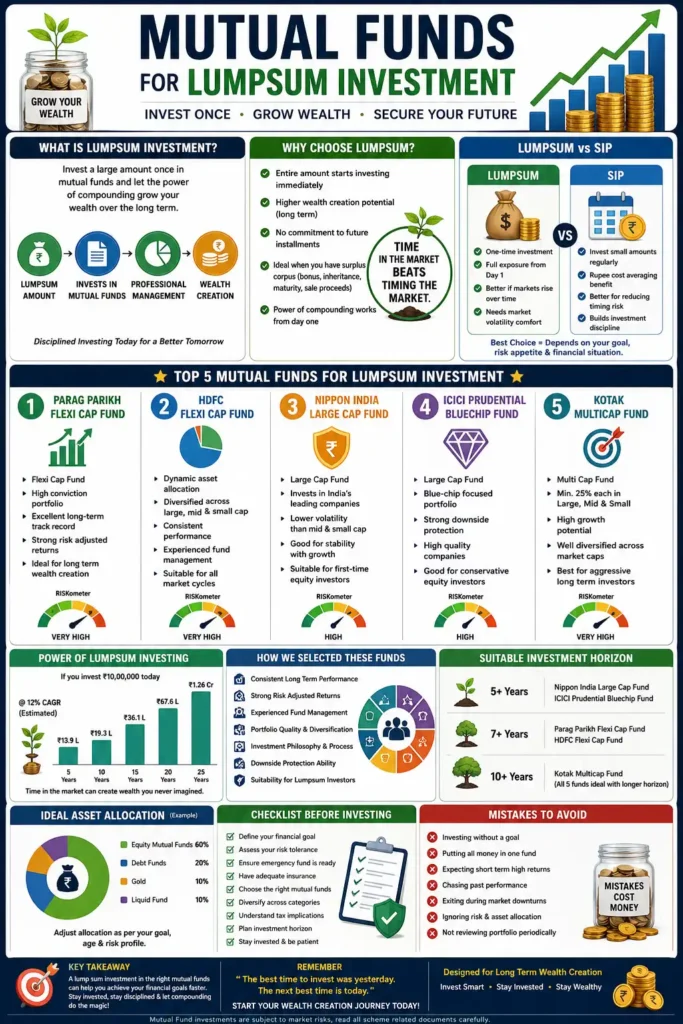
Quick Answer: Top 5 Mutual Funds for Lumpsum Investment in 2026
If you want a quick recommendation before reading the detailed guide, the following table summarizes five high-quality mutual funds that have historically demonstrated strong long-term performance, disciplined portfolio management, and broad investor appeal. Always remember that suitability depends on your risk tolerance, investment horizon, and financial goals.
| Category | Recommended Fund | Best For | Suggested Investment Horizon | Risk Level |
|---|---|---|---|---|
| Flexi Cap | Parag Parikh Flexi Cap Fund | Long-term wealth creation | 7–10+ years | Moderately High |
| Flexi Cap | HDFC Flexi Cap Fund | Balanced growth | 5–10+ years | Moderately High |
| Large & Mid Cap | Nippon India Large Cap Fund | Stable long-term growth | 5–10 years | Moderately High |
| Large Cap | ICICI Prudential Bluechip Fund | Conservative equity investors | 5–10 years | Moderate |
| Multi Cap | Kotak Multicap Fund | Diversified investing | 7–10+ years | Moderately High |
These funds have been selected based on multiple qualitative and quantitative factors rather than recent returns alone. A detailed analysis of each fund will be provided later in this guide.
Best Mutual Funds Based on Investor Type
| Investor Type | Suggested Category |
| Beginner | Large Cap Fund |
| Moderate Investor | Flexi Cap Fund |
| Aggressive Investor | Multi Cap Fund |
| Long-Term Wealth Builder | Flexi Cap Fund |
| Retirement Planning | Large Cap or Flexi Cap |
| Child Education | Flexi Cap |
| Financial Freedom | Multi Cap |
| ₹1 Lakh Investment | Large Cap |
| ₹5 Lakh Investment | Flexi Cap |
| ₹10 Lakh Investment | Diversified Portfolio of Multiple Funds |
Quick Investment Recommendation
| Investment Amount | Suggested Strategy |
| ₹50,000 | One diversified equity fund |
| ₹1,00,000 | One Flexi Cap or Large Cap Fund |
| ₹2,00,000 | Two diversified funds |
| ₹5,00,000 | Three-fund portfolio |
| ₹10,00,000 | Four to five diversified funds |
| ₹25,00,000+ | Asset allocation across equity, debt, and hybrid funds |
Remember that no mutual fund remains the best forever. Fund performance changes with market conditions, portfolio strategy, and fund management decisions. Therefore, a diversified approach often produces better long-term outcomes than investing all your money in a single scheme.
Why You Can Trust This Guide
Thousands of articles recommend mutual funds based only on the previous year’s returns. However, experienced investors know that yesterday’s winner does not always become tomorrow’s winner.
For this reason, this guide follows a professional evaluation framework similar to the one used by experienced wealth managers and financial planners.
Each mutual fund has been evaluated using several performance and risk parameters instead of relying on a single return figure.
The evaluation considers:
- Long-term CAGR
- Rolling returns
- Consistency across market cycles
- Downside protection
- Alpha generation
- Beta
- Sharpe Ratio
- Sortino Ratio
- Standard Deviation
- Portfolio diversification
- Fund manager experience
- Portfolio turnover ratio
- Expense ratio
- Exit load
- Asset allocation
- Sector diversification
- Market capitalization exposure
- Risk-adjusted returns
- Fund house reputation
- Investment philosophy
- Portfolio quality
Instead of asking, “Which fund delivered the highest return last year?” this guide answers a much more important question:
“Which mutual fund offers the highest probability of delivering consistent long-term wealth creation while managing investment risk effectively?”
That difference matters because investing is not about chasing the highest return. It is about achieving your financial goals with confidence.
What Is a Lumpsum Investment?
A lump sum investment means investing a large amount of money in a mutual fund through a single transaction instead of spreading it over several months.
For example:
- Investing ₹5 lakh today
- Investing ₹10 lakh after selling property
- Investing retirement benefits
- Investing an annual bonus
- Investing inherited wealth
All of these are examples of lump sum investing.
Unlike a Systematic Investment Plan (SIP), where you invest small amounts regularly, a lump sum investment puts your money to work immediately.
As a result, your entire investment starts participating in market growth from the first day.
Simple Example
Rahul receives a bonus of ₹10 lakh from his employer.
Instead of keeping the money in a savings account, he decides to invest the full amount in a diversified equity mutual fund.
His investment begins generating market-linked returns immediately.
This is a lump sum investment.
How Does a Lumpsum Investment Work?
The process is straightforward.
Money is invested.
↓
Units are allocated based on the current Net Asset Value (NAV).
↓
The mutual fund manager invests according to the fund’s objective.
↓
Portfolio value changes every day.
↓
Returns depend on market performance.
↓
Investor redeems units whenever required.
Although the process looks simple, selecting the right fund, entering at an appropriate time, and staying invested for the recommended period play a significant role in long-term performance.
Lumpsum vs SIP vs STP vs SWP
Many investors confuse these four investment methods. However, each serves a different purpose.
| Feature | Lumpsum | SIP | STP | SWP |
| Investment Style | One-time | Regular | Transfer | Withdrawal |
| Suitable For | Large savings | Monthly income | Gradual investing | Regular income |
| Market Timing Risk | High | Low | Moderate | Low |
| Ideal For | Bonus, inheritance | Salaried investors | Volatile markets | Retirees |
| Investment Frequency | Once | Monthly | Periodic | Monthly withdrawal |
| Wealth Creation | Excellent | Excellent | Good | Income generation |
Lumpsum Investment
A large amount is invested immediately.
Best suited for:
- Property sale proceeds
- Business profits
- Retirement corpus
- Bonus
- Inheritance
- Maturity proceeds
SIP
Small amounts are invested every month.
Ideal for:
- Salaried employees
- Beginners
- Long-term investors
- Monthly savings
STP
Systematic Transfer Plan gradually transfers money from one fund to another.
This strategy helps reduce market timing risk when you have a large amount to invest but want to avoid investing everything on a single day.
SWP
Systematic Withdrawal Plan allows investors to withdraw a fixed amount periodically while keeping the remaining corpus invested.
It is commonly used by retirees who need regular monthly income.
When Should You Choose a Lumpsum Investment?
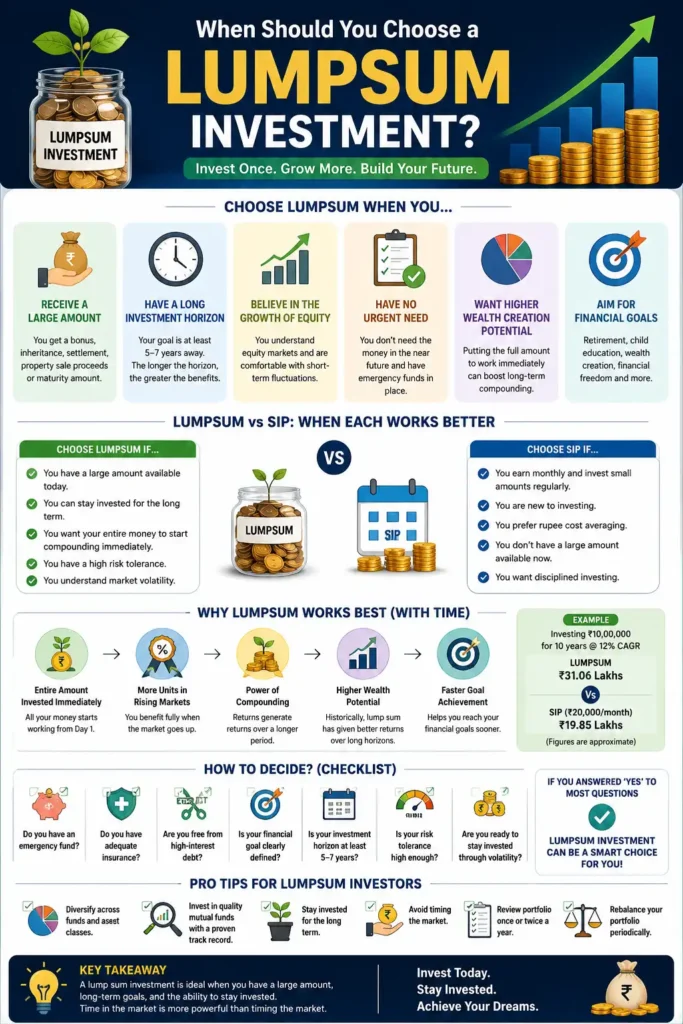
Many investors believe that they should wait for the “perfect” market level before investing. However, predicting the market consistently is almost impossible.
Instead, your investment decision should depend on your financial situation, investment horizon, and risk tolerance.
A lump sum investment may be suitable in several situations.
After Receiving a Bonus
Annual bonuses often remain idle in savings accounts.
Instead, investing them for long-term goals can improve wealth creation potential.
After Selling Property
Large capital received from property sales can remain unproductive if left in a bank account.
Therefore, many investors allocate a portion of such proceeds to diversified mutual funds.
After Retirement
Retirement benefits such as gratuity, provident fund withdrawals, leave encashment, or pension commutation may create a sizeable investment corpus.
However, asset allocation becomes extremely important at this stage.
After Receiving an Inheritance
Inherited wealth should not be invested impulsively.
Instead, financial goals, tax implications, and risk appetite should be evaluated before making investment decisions.
Insurance Maturity Proceeds
Many traditional insurance plans mature after 15 to 25 years.
Rather than spending the entire amount immediately, investors often allocate a portion toward long-term mutual fund investments.
Business Sale or Business Profits
Business owners frequently receive significant cash inflows.
Diversifying part of these profits into professionally managed mutual funds can reduce concentration risk.
Is Market Timing Important?
Yes—but not as much as most investors believe.
Many studies have shown that time in the market generally matters more than timing the market for long-term investors.
If your investment horizon extends beyond seven to ten years, entering the market slightly earlier or later often has a much smaller impact than remaining invested consistently.
However, if markets appear significantly overheated and you are investing a very large amount, you may consider using a Systematic Transfer Plan (STP) from a liquid fund into equity over several months. This approach can help reduce the emotional stress associated with investing all your money at once while still ensuring your funds begin earning returns.
In the next part, we will examine the professional methodology used to select the top five mutual funds and begin the in-depth analysis of the first recommended fund, including its portfolio, risk profile, historical performance, investment strategy, ideal investor, and expert verdict.
How We Selected the Top 5 Mutual Funds for Lumpsum Investment
Choosing the right mutual fund requires much more than looking at the highest returns. In fact, a fund that delivered exceptional returns in one year may underperform over the next five years. Therefore, a professional evaluation process should always be followed before investing.
For this guide, every shortlisted mutual fund was evaluated using both quantitative and qualitative parameters. The objective was to identify funds that have demonstrated long-term consistency, effective risk management, experienced fund management, and a disciplined investment strategy.
Instead of chasing short-term performance, this guide focuses on funds that have the potential to create sustainable long-term wealth.
Evaluation Criteria
| Evaluation Factor | Weightage |
|---|---|
| Long-Term Performance | 20% |
| Rolling Returns | 15% |
| Downside Protection | 10% |
| Risk-Adjusted Returns | 10% |
| Fund Manager Experience | 10% |
| Portfolio Quality | 10% |
| Diversification | 8% |
| Expense Ratio | 5% |
| Alpha Generation | 5% |
| Sharpe Ratio | 5% |
| Beta | 2% |
| Standard Deviation | 2% |
| AUM Stability | 3% |
| Fund House Reputation | 5% |
A fund was selected only after it performed well across most of these parameters.
Long-Term Performance
Past performance never guarantees future returns. However, long-term consistency often reflects the quality of a fund’s investment process.
Therefore, greater importance was given to:
- 5-Year CAGR
- 7-Year CAGR
- 10-Year CAGR
- Performance across different market cycles
Funds that consistently beat their benchmark received higher scores.
Rolling Returns
Most investors only compare CAGR.
However, professional investors prefer rolling returns because they eliminate the impact of choosing a specific start and end date.
Rolling returns help answer an important question.
“How consistently has this fund generated returns regardless of when an investor entered?”
Funds with more consistent rolling returns ranked higher.
Downside Protection
Every market experiences corrections.
The best mutual funds usually fall less than their peers during bear markets.
Therefore, every shortlisted fund was evaluated based on its ability to protect investor capital during periods of market stress.
Portfolio Quality
A quality portfolio usually contains companies with:
- Strong earnings growth
- Healthy balance sheets
- High return on equity
- Competitive advantages
- Experienced management
- Sustainable business models
Funds investing in fundamentally strong businesses received preference.
Fund Manager Experience
Even the best investment strategy depends on proper execution.
Therefore, the experience, investment philosophy, and long-term track record of the fund manager were carefully considered.
An experienced fund manager often demonstrates better discipline during volatile markets.
Expense Ratio
Lower costs leave more money invested.
Although expense ratio alone should never determine your investment decision, it still affects long-term returns.
Even a small difference can become significant over 15–20 years because of compounding.
Risk Metrics
Several risk measures were analysed.
These include:
- Alpha
- Beta
- Sharpe Ratio
- Sortino Ratio
- Standard Deviation
- Maximum Drawdown
Each metric provides a different perspective on portfolio risk.
Asset Allocation
A diversified portfolio generally performs better over long investment periods.
Therefore, preference was given to funds that invest across multiple sectors and market capitalizations while avoiding excessive concentration.
Consistency
Many funds perform exceptionally well for one or two years.
However, only a few maintain consistency for a decade.
Long-term consistency received one of the highest weightages in this analysis.
Should You Invest All Your Money at Once?
This question does not have one universal answer.
Instead, the right decision depends on market valuation, investment horizon, and your comfort with short-term volatility.
Invest Immediately If
You may consider investing the full amount immediately if:
- Your investment horizon exceeds ten years.
- Market valuations appear reasonable.
- You understand equity market volatility.
- You do not need the money in the near future.
- You have already built an emergency fund.
Historically, long investment horizons have reduced the importance of short-term market fluctuations.
Consider STP If
A Systematic Transfer Plan (STP) may be a better option when:
- Markets have rallied sharply.
- Valuations appear expensive.
- You have received a very large amount.
- You feel uncomfortable investing everything in one day.
- You want to reduce emotional decision-making.
Many experienced investors prefer this approach because it balances opportunity with risk management.
Common Characteristics of High-Quality Mutual Funds
The best mutual funds usually share several characteristics.
These include:
- Consistent long-term performance
- Disciplined investment process
- Stable fund management team
- Diversified portfolio
- High-quality businesses
- Reasonable portfolio turnover
- Transparent investment philosophy
- Strong risk management
- Competitive expense ratio
- Proven ability to outperform benchmarks
Instead of focusing on one characteristic, investors should evaluate the complete picture.
Top Mutual Fund #1 – Parag Parikh Flexi Cap Fund
Overview
Among all diversified equity mutual funds in India, Parag Parikh Flexi Cap Fund has built a strong reputation for disciplined investing and long-term wealth creation.
Unlike many actively managed funds, this scheme follows a value-oriented investment philosophy. The fund management team invests only when attractive opportunities become available. As a result, unnecessary portfolio churn is avoided.
Moreover, the portfolio typically contains businesses with durable competitive advantages and experienced management teams.
This disciplined approach has helped the fund navigate different market environments.
Quick Fund Snapshot
| Particular | Details |
| Category | Flexi Cap Fund |
| Fund Type | Open Ended Equity |
| Risk Level | Very High |
| Investment Style | Value + Growth |
| Suitable Horizon | 7–10+ Years |
| Suitable Investor | Long-Term Wealth Builder |
Investment Objective
The primary objective is to generate long-term capital appreciation by investing across companies of different market capitalizations.
Unlike many category peers, the fund manager has complete flexibility to allocate investments across:
- Large-cap companies
- Mid-cap companies
- Small-cap companies
This flexibility allows the portfolio to adapt to changing market conditions.
Why This Fund Made Our Top 5 List
Several reasons support its inclusion.
First, the investment philosophy has remained consistent for many years.
Second, the portfolio emphasizes business quality rather than market momentum.
Third, unnecessary buying and selling are generally avoided.
Fourth, the fund focuses on long-term wealth creation instead of chasing quarterly performance.
Finally, the portfolio often includes companies with strong cash flows, pricing power, and sustainable competitive advantages.
Investment Strategy
The strategy follows three important principles.
Buy Quality Businesses
Companies with sustainable competitive advantages receive preference.
Invest for the Long Term
The portfolio is built with patience.
Frequent trading is avoided.
Ignore Short-Term Market Noise
Temporary market corrections rarely change the investment philosophy.
Instead, attractive valuation opportunities are utilized.
Portfolio Diversification
The portfolio generally maintains exposure across multiple sectors.
This diversification helps reduce concentration risk.
Major sectors often include:
- Financial Services
- Information Technology
- Consumer Goods
- Healthcare
- Automobile
- Energy
- Manufacturing
- Communication Services
Because sector allocations change periodically, investors should always review the latest portfolio before investing.
Market Capitalization Allocation
The fund usually maintains exposure across:
- Large-cap companies
- Mid-cap companies
- Select small-cap companies
This balanced approach provides stability while preserving growth potential.
Investment Philosophy
Unlike momentum investing, this fund focuses on buying businesses at reasonable valuations.
The objective is not to own the fastest-growing stocks.
Instead, the goal is to own excellent businesses for long periods.
This philosophy has historically rewarded patient investors.
Advantages
The fund offers several strengths.
- Proven long-term investment process
- Diversified portfolio
- Experienced fund management
- High-quality businesses
- Flexible market-cap allocation
- Suitable for long investment horizons
- Strong wealth creation potential
- Disciplined portfolio management
Limitations
Every mutual fund also has limitations.
Investors should understand them before investing.
- Short-term returns may occasionally lag peers.
- Temporary underperformance is possible during momentum-driven markets.
- High equity exposure increases volatility.
- Investors should stay invested for several years.
Who Should Invest?
This fund may suit investors who:
- Want long-term capital appreciation.
- Can remain invested for at least seven years.
- Accept short-term market volatility.
- Prefer quality businesses.
- Want one core equity fund.
Who Should Avoid?
This fund may not suit investors who:
- Need money within three years.
- Expect guaranteed returns.
- Panic during market corrections.
- Prefer fixed-income investments.
Suggested Portfolio Allocation
| Investor Profile | Suggested Allocation |
| Conservative | 10–15% |
| Moderate | 20–25% |
| Aggressive | 25–35% |
Your overall allocation should always match your financial goals and existing portfolio.
Expert Verdict
Parag Parikh Flexi Cap Fund remains one of the strongest candidates for long-term lump sum investing because it combines disciplined stock selection, portfolio diversification, and a patient investment philosophy.
Investors should not expect the fund to lead performance every single year. Instead, they should focus on its ability to create wealth consistently over long investment periods.
For investors with a horizon of seven to ten years or more, this fund deserves serious consideration as a core equity holding.
Top Mutual Fund #2 – HDFC Flexi Cap Fund
Overview
HDFC Flexi Cap Fund has remained one of India’s most respected diversified equity mutual funds for many years. It follows a flexible investment approach that allows the fund manager to invest across large-cap, mid-cap, and small-cap companies based on market opportunities.
Unlike category-specific funds, a Flexi Cap Fund is not restricted to a fixed allocation across market capitalizations. Therefore, the fund manager can increase exposure to sectors and companies that offer better long-term growth potential while reducing exposure where valuations appear expensive.
Moreover, HDFC Mutual Fund follows a disciplined investment framework supported by extensive in-house research. As a result, portfolio decisions are generally based on business fundamentals rather than short-term market sentiment.
This flexibility has helped the fund remain relevant across different market cycles.
Quick Fund Snapshot
| Particular | Details |
|---|---|
| Category | Flexi Cap Fund |
| Fund Type | Open-Ended Equity Scheme |
| Investment Style | Growth at Reasonable Valuation (GARP) |
| Risk Level | Very High |
| Investment Horizon | 7–10+ Years |
| Suitable For | Long-Term Wealth Creation |
Investment Objective
The primary objective of HDFC Flexi Cap Fund is to generate long-term capital appreciation by investing in a diversified portfolio of equity and equity-related securities across different market capitalizations.
Instead of concentrating on a single segment, the fund manager has the flexibility to invest wherever attractive opportunities are available.
Therefore, the portfolio remains dynamic while maintaining diversification.
Why This Fund Made Our Top 5 List
Several factors contributed to its selection.
- Strong long-term investment philosophy
- Diversified equity portfolio
- Flexible asset allocation
- Experienced research team
- Focus on fundamentally strong businesses
- Proven ability to recover after market corrections
- Suitable for long-term investors
- Strong brand reputation
Furthermore, the fund has successfully navigated multiple bull and bear market cycles over the years.
Investment Philosophy
HDFC Flexi Cap Fund follows a disciplined investment approach based on business quality and reasonable valuations.
Instead of purchasing stocks simply because prices are rising, the fund manager looks for businesses with sustainable earnings growth and long-term competitive advantages.
Key characteristics generally include:
- Strong balance sheets
- Consistent profit growth
- Capable management teams
- Reasonable valuations
- Scalable business models
- Long-term growth opportunities
This approach helps reduce the probability of investing in overvalued businesses.
Portfolio Construction Strategy
Portfolio construction plays a critical role in long-term performance.
Instead of relying on only a few stocks, HDFC Flexi Cap Fund generally maintains a diversified portfolio spread across multiple industries.
The portfolio typically includes:
- Banking and Financial Services
- Information Technology
- Healthcare
- Automobile
- Consumer Goods
- Capital Goods
- Energy
- Infrastructure
- Chemicals
- Manufacturing
Diversification helps reduce company-specific risk while improving portfolio stability.
Market Capitalization Allocation
One of the biggest strengths of a Flexi Cap Fund is flexibility.
Depending on market conditions, the allocation may include:
- Large-cap companies for stability
- Mid-cap companies for growth
- Small-cap companies for higher return potential
This balanced approach allows the fund manager to capture opportunities across different segments of the market.
Portfolio Diversification
Diversification remains one of the strongest advantages of this fund.
Instead of concentrating investments in one sector, the portfolio usually spreads investments across numerous industries.
Benefits include:
- Lower concentration risk
- Better downside protection
- Reduced dependence on one industry
- More balanced long-term performance
Fund Management Approach
Successful investing depends on disciplined decision-making.
The investment team generally follows a structured research process before including any company in the portfolio.
Several factors are evaluated.
These include:
- Revenue growth
- Earnings consistency
- Debt levels
- Corporate governance
- Cash flow generation
- Competitive positioning
- Future growth opportunities
Only businesses meeting strict investment standards are typically considered.
Risk Management Strategy
Every equity investment carries risk.
However, proper risk management can reduce unnecessary volatility.
The fund attempts to manage risk through:
- Diversified portfolio
- Position size limits
- Continuous research
- Sector diversification
- Market-cap diversification
- Regular portfolio review
Although these measures cannot eliminate market risk, they help improve portfolio quality.
Historical Market Behaviour
High-quality mutual funds should not only perform well during bull markets.
They should also demonstrate resilience during corrections.
Historically, diversified Flexi Cap Funds have shown the ability to recover strongly after market downturns because quality businesses often regain momentum once economic conditions improve.
Therefore, investors should avoid making decisions based solely on temporary declines.
Key Strengths
Several strengths make HDFC Flexi Cap Fund attractive for long-term investors.
- Diversified portfolio
- Flexible investment strategy
- Long operating history
- Strong research support
- Exposure across market capitalizations
- High-quality companies
- Suitable for long-term wealth creation
- Good portfolio diversification
- Consistent investment philosophy
- Ability to adapt to changing market conditions
Potential Limitations
No mutual fund is perfect.
Investors should understand both strengths and weaknesses.
Potential limitations include:
- Returns may temporarily lag aggressive mid-cap funds during strong rallies.
- Equity market volatility can affect short-term performance.
- Investors with short investment horizons may experience temporary losses.
- Performance may vary depending on market cycles.
These limitations are common across most diversified equity funds.
Suitable Investment Horizon
A minimum investment horizon of seven years is recommended.
However, investors planning for ten years or longer generally benefit more from the power of compounding.
Long investment periods also reduce the impact of short-term market fluctuations.
Who Should Invest?
This fund may suit investors who:
- Want one diversified equity fund.
- Are building long-term wealth.
- Can tolerate market volatility.
- Prefer professional portfolio management.
- Are investing for retirement.
- Are planning for children’s higher education.
- Are creating long-term financial assets.
Who Should Avoid?
This fund may not be suitable if you:
- Need money within three years.
- Expect guaranteed returns.
- Cannot tolerate temporary market declines.
- Prefer fixed-income investments.
Suggested Portfolio Allocation
| Investor Profile | Suggested Allocation |
| Conservative | 10–15% |
| Moderate | 20–30% |
| Aggressive | 25–35% |
Investors should also maintain exposure to debt funds and emergency savings instead of investing all available money into equity.
Example Scenario
Suppose an investor receives ₹10 lakh after selling a property.
Instead of investing the entire amount in one scheme, a balanced allocation could be considered.
| Fund Category | Allocation |
| HDFC Flexi Cap Fund | 30% |
| Large Cap Fund | 25% |
| Multi Cap Fund | 20% |
| Hybrid Fund | 15% |
| Liquid Fund | 10% |
This approach improves diversification and reduces concentration risk.
Expert Tips Before Investing
Consider the following recommendations before selecting this fund.
- Review your financial goals first.
- Build an emergency fund before investing.
- Maintain adequate health and life insurance.
- Avoid investing borrowed money.
- Stay invested during market corrections.
- Review your portfolio annually instead of every week.
- Avoid comparing daily NAV movements.
- Focus on long-term wealth creation rather than short-term returns.
Expert Verdict
HDFC Flexi Cap Fund continues to remain one of the strongest choices for investors seeking long-term capital appreciation through a diversified equity portfolio.
Its flexible investment mandate, disciplined stock selection process, diversified holdings, and experienced research capabilities make it suitable as a core equity holding for many investors.
Although short-term volatility should always be expected, patient investors with a seven to ten-year investment horizon can benefit from its long-term wealth creation potential.
Top Mutual Fund #3 – Nippon India Large Cap Fund
Overview
Nippon India Large Cap Fund is one of the most established large-cap equity mutual funds in India. It primarily invests in financially strong companies with large market capitalizations. These companies usually have proven business models, experienced management teams, and consistent earnings.
Large-cap companies often become market leaders in their industries. Therefore, they generally offer greater stability than mid-cap or small-cap companies. Although their growth rate may sometimes be lower, they have historically demonstrated better resilience during market corrections.
For investors planning a lump sum investment, this fund can serve as a strong foundation for a long-term equity portfolio.
Quick Fund Snapshot
| Particular | Details |
|---|---|
| Category | Large Cap Fund |
| Fund Type | Open-Ended Equity Scheme |
| Investment Style | Growth with Stability |
| Risk Level | High |
| Investment Horizon | 5–10+ Years |
| Suitable For | Conservative to Moderate Equity Investors |
Investment Objective
The primary objective of Nippon India Large Cap Fund is to generate long-term capital appreciation by investing predominantly in large-cap companies across various sectors of the Indian economy.
Instead of taking excessive exposure to smaller companies, the fund focuses on established businesses that have demonstrated consistent financial performance over many years.
This strategy aims to balance growth potential with relatively lower volatility.
Why This Fund Made Our Top 5 List
This fund earned its place on the list because of several strengths.
- Focus on India’s leading companies
- Well-diversified portfolio
- Consistent investment process
- Lower volatility than mid-cap funds
- Suitable for first-time equity investors
- Strong long-term growth potential
- Professional portfolio management
- High liquidity
Moreover, the fund has historically performed well across different economic cycles by maintaining exposure to quality businesses.
Investment Philosophy
The fund follows a disciplined investment approach.
Instead of investing based on short-term market trends, the fund manager evaluates companies using several fundamental parameters.
These include:
- Revenue growth
- Earnings consistency
- Market leadership
- Corporate governance
- Cash flow generation
- Return on Equity (ROE)
- Return on Capital Employed (ROCE)
- Debt management
- Future expansion opportunities
Only companies with strong long-term growth potential generally become part of the portfolio.
Portfolio Strategy
Portfolio construction focuses on quality rather than quantity.
The fund generally maintains investments across multiple sectors to reduce concentration risk.
Major sectors often include:
- Banking and Financial Services
- Information Technology
- Oil & Gas
- Consumer Goods
- Healthcare
- Automobile
- Capital Goods
- Power
- Telecom
- Infrastructure
This diversified approach reduces dependence on any single industry.
Market Capitalization Strategy
Since this is a Large Cap Fund, most investments remain concentrated in India’s largest listed companies.
These businesses usually have:
- Higher liquidity
- Stable earnings
- Strong balance sheets
- Better corporate governance
- Established market positions
Although large-cap companies may not always deliver the highest annual returns, they often provide better downside protection during market volatility.
Benefits of Investing in Large-Cap Funds
Large-cap funds offer several advantages.
Better Stability
Large companies generally have diversified revenue streams.
Therefore, they often remain more resilient during economic slowdowns.
Lower Volatility
Price fluctuations are usually less extreme than those experienced by small-cap companies.
This makes large-cap funds suitable for investors who prefer relatively stable equity investments.
Strong Corporate Governance
Most large companies maintain high governance standards and transparent financial reporting.
Easier Recovery
Historically, market leaders have recovered faster after major corrections.
Therefore, long-term investors often benefit from staying invested.
Portfolio Diversification
Diversification remains one of the biggest strengths of this fund.
Instead of relying on only a few companies, investments are spread across numerous industries.
This helps reduce company-specific risk.
A diversified portfolio also improves long-term portfolio stability.
Risk Management Process
Risk cannot be eliminated completely.
However, it can be managed effectively.
The fund generally follows several risk management principles.
These include:
- Diversified stock selection
- Sector allocation limits
- Continuous portfolio review
- Fundamental research
- Regular earnings analysis
- Valuation monitoring
These practices help maintain portfolio quality over time.
Historical Behaviour During Market Corrections
Market corrections are a normal part of investing.
Large-cap funds have historically demonstrated lower drawdowns than many mid-cap and small-cap funds.
Although temporary declines should still be expected, investors often experience relatively lower volatility.
As a result, many first-time investors feel more comfortable beginning their equity journey with large-cap funds.
Key Strengths
Several factors make this fund attractive.
- Exposure to India’s largest companies
- Lower volatility
- Strong portfolio diversification
- Professional management
- Suitable for beginners
- Good liquidity
- Long operating history
- Consistent investment philosophy
- Better downside protection
- Core portfolio suitability
Potential Limitations
Every investment has certain limitations.
This fund is no exception.
Possible limitations include:
- May underperform mid-cap funds during strong bull markets.
- Growth potential may be lower than aggressive equity funds.
- Equity market risk remains.
- Returns are not guaranteed.
Investors should evaluate these factors before investing.
Suitable Investment Horizon
Investors should ideally remain invested for at least five years.
However, an investment horizon of seven to ten years generally offers better wealth creation opportunities.
Long-term investing also allows the power of compounding to work more effectively.
Who Should Invest?
This fund may suit investors who:
- Are investing in equity for the first time.
- Prefer relatively lower volatility.
- Want exposure to India’s largest companies.
- Are planning for retirement.
- Are building long-term wealth.
- Want a core equity holding.
Who Should Avoid?
This fund may not be suitable for investors who:
- Expect very high short-term returns.
- Have an investment horizon below three years.
- Cannot tolerate any market fluctuations.
- Prefer guaranteed income products.
Suggested Portfolio Allocation
| Investor Profile | Suggested Allocation |
| Conservative | 20–25% |
| Moderate | 25–35% |
| Aggressive | 15–20% |
The allocation should always complement your overall financial plan rather than replacing diversification.
Example Investment Strategy
Suppose you receive ₹5 lakh as a maturity amount from a fixed deposit.
Instead of investing the full amount in a single scheme, you could consider a diversified allocation.
| Investment | Allocation |
| Nippon India Large Cap Fund | 40% |
| Flexi Cap Fund | 35% |
| Hybrid Fund | 15% |
| Liquid Fund | 10% |
Such an allocation can balance growth opportunities with portfolio stability.
Expert Tips
Before investing, keep these practical tips in mind.
- Invest only after defining your financial goal.
- Avoid checking daily NAV movements.
- Stay invested through market corrections.
- Review your portfolio once a year.
- Rebalance your investments periodically.
- Avoid chasing last year’s best-performing fund.
- Focus on long-term consistency instead of short-term rankings.
Expert Verdict
Nippon India Large Cap Fund remains an excellent choice for investors seeking stability along with long-term capital appreciation.
Its focus on financially strong companies, disciplined portfolio management, and diversified sector exposure make it suitable as a core equity holding.
Although it may not generate the highest returns during every bull market, its ability to provide relatively lower volatility and consistent long-term performance makes it a valuable option for lump sum investors.
Top Mutual Fund #4 – ICICI Prudential Bluechip Fund
Overview
ICICI Prudential Bluechip Fund is one of India’s most trusted large-cap mutual funds. It invests predominantly in blue-chip companies that have established leadership positions in their respective industries.
Blue-chip companies usually possess strong financial strength, experienced management, healthy cash flows, and sustainable business models. Therefore, they often provide greater stability during uncertain market conditions.
This fund has built a reputation for maintaining a disciplined investment process while focusing on high-quality businesses with long-term growth potential.
For investors seeking a balance between capital appreciation and risk management, it deserves serious consideration.
Quick Fund Snapshot
| Particular | Details |
| Category | Large Cap Fund |
| Fund Type | Open-Ended Equity Scheme |
| Investment Style | Quality Growth |
| Risk Level | High |
| Investment Horizon | 5–10+ Years |
| Suitable For | Conservative and Moderate Equity Investors |
Investment Objective
The objective of the fund is to generate long-term capital appreciation by investing mainly in large-cap companies with strong fundamentals and sustainable growth prospects.
Instead of chasing speculative opportunities, the fund manager generally focuses on businesses that demonstrate consistent earnings and long-term competitive advantages.
Why This Fund Made Our Top 5 List
The fund stood out because of several important factors.
- Focus on blue-chip companies
- Strong research-driven investment process
- Diversified portfolio
- Lower volatility than aggressive equity funds
- Suitable for long-term investors
- Experienced fund management
- Strong liquidity
- Consistent investment philosophy
These qualities make it suitable for investors looking to build a stable long-term portfolio.
Investment Strategy
ICICI Prudential Bluechip Fund follows a research-driven investment strategy. Instead of investing based on market excitement, the fund manager focuses on companies that demonstrate sustainable earnings growth, healthy financials, and strong competitive advantages.
The investment team analyses every company using multiple parameters before adding it to the portfolio.
These include:
- Revenue growth
- Earnings consistency
- Profit margins
- Cash flow generation
- Corporate governance
- Return on Equity (ROE)
- Debt-to-equity ratio
- Future growth opportunities
- Industry leadership
- Valuation
This disciplined process helps maintain a portfolio of fundamentally strong companies.
Portfolio Diversification
Diversification plays a major role in reducing investment risk.
The portfolio is generally spread across several sectors of the Indian economy instead of concentrating investments in only one or two industries.
Major sector allocations usually include:
- Financial Services
- Information Technology
- FMCG
- Healthcare
- Automobile
- Capital Goods
- Oil & Gas
- Telecom
- Consumer Durables
- Infrastructure
Sector allocation changes periodically as market conditions evolve. Therefore, investors should review the latest portfolio before investing.
Market Capitalisation Allocation
Being a large-cap fund, at least 80% of the portfolio remains invested in India’s top 100 listed companies as required by regulations.
Large-cap companies generally provide:
- Better business stability
- Higher liquidity
- Strong corporate governance
- Predictable earnings
- Lower volatility compared to mid-cap and small-cap companies
This makes the fund suitable for investors who prefer relatively stable equity exposure.
Risk Management Process
The fund follows several measures to control portfolio risk.
These include:
- Diversification across sectors
- Continuous company research
- Position size limits
- Regular portfolio review
- Valuation monitoring
- Earnings analysis
Although equity investments remain subject to market risk, these measures help improve portfolio quality over time.
Performance Across Different Market Cycles
One of the strongest characteristics of this fund is its ability to remain relatively resilient during volatile market phases.
Large-cap companies usually recover faster after corrections because they possess:
- Strong balance sheets
- Diversified revenue streams
- Better access to capital
- Established customer base
Therefore, investors often experience relatively lower volatility than aggressive equity categories.
Advantages
Several strengths make this fund attractive for lump sum investors.
- Invests primarily in blue-chip companies.
- Strong research-driven investment process.
- Well-diversified portfolio.
- Suitable for first-time equity investors.
- Better downside protection than aggressive funds.
- Professional fund management.
- Good liquidity.
- Long operating history.
- Consistent investment philosophy.
- Suitable as a core portfolio holding.
Limitations
Investors should also understand the possible drawbacks.
- Returns may lag aggressive mid-cap funds during strong bull markets.
- Short-term underperformance can occur.
- Equity market volatility remains unavoidable.
- Wealth creation requires patience and discipline.
These limitations apply to most large-cap equity funds.
Suitable Investment Horizon
Investors should ideally remain invested for at least five years.
However, a seven to ten-year horizon provides better opportunities for long-term compounding.
Longer investment periods also reduce the impact of temporary market corrections.
Who Should Invest?
This fund may suit investors who:
- Are investing in equity for the first time.
- Prefer relatively lower volatility.
- Want exposure to India’s largest businesses.
- Are planning retirement.
- Are building wealth gradually.
- Need a core equity allocation.
Who Should Avoid?
This fund may not be suitable if you:
- Need money within three years.
- Expect guaranteed returns.
- Cannot tolerate temporary losses.
- Prefer debt-oriented investments.
Suggested Portfolio Allocation
| Investor Profile | Suggested Allocation |
|---|---|
| Conservative | 20–30% |
| Moderate | 20–25% |
| Aggressive | 10–15% |
The allocation should always match your overall asset allocation strategy.
Practical Example
Suppose you receive ₹15 lakh after selling an inherited asset.
Instead of investing everything in a single mutual fund, you may diversify as follows.
| Fund Category | Allocation |
| ICICI Prudential Bluechip Fund | 30% |
| Flexi Cap Fund | 30% |
| Multi Cap Fund | 20% |
| Hybrid Fund | 10% |
| Liquid Fund | 10% |
This strategy improves diversification while reducing concentration risk.
Expert Tips
Before investing, follow these best practices.
- Invest only for long-term financial goals.
- Do not panic during corrections.
- Review the portfolio once every year.
- Rebalance asset allocation whenever required.
- Avoid comparing daily NAV movements.
- Focus on long-term consistency instead of recent returns.
Expert Verdict
ICICI Prudential Bluechip Fund remains one of the strongest choices for conservative equity investors seeking long-term capital appreciation with relatively lower volatility.
Its disciplined investment philosophy, diversified portfolio, experienced fund management, and focus on India’s leading businesses make it an excellent core holding for lump sum investments.
Although short-term fluctuations should always be expected, patient investors with a long investment horizon may benefit significantly from the power of compounding. The fund continues to be a popular choice among investors seeking stable equity exposure.
Top Mutual Fund #5 – Kotak Multicap Fund
Overview
Kotak Multicap Fund is designed for investors who want exposure to companies of all sizes through a single mutual fund.
Unlike Flexi Cap Funds, Multi Cap Funds must maintain a minimum allocation of 25% each to large-cap, mid-cap, and small-cap companies. This regulatory requirement ensures balanced diversification across market segments.
As a result, investors receive exposure to stability, growth, and high-return potential within one portfolio.
For lump sum investors with a long investment horizon, this balanced structure offers an attractive combination of diversification and growth.
Quick Fund Snapshot
| Particular | Details |
| Category | Multi Cap Fund |
| Fund Type | Open-Ended Equity Scheme |
| Investment Style | Diversified Growth |
| Risk Level | Very High |
| Investment Horizon | 7–10+ Years |
| Suitable For | Aggressive Long-Term Investors |
Investment Objective
The objective of Kotak Multicap Fund is to generate long-term capital appreciation by investing across large-cap, mid-cap, and small-cap companies.
Instead of concentrating on one market segment, the portfolio maintains balanced exposure across all three categories, helping investors participate in different phases of the market cycle.
Why This Fund Made Our Top 5 List
Several factors support its inclusion.
- Mandatory diversification across market capitalisations.
- Exposure to high-growth companies.
- Balanced investment approach.
- Professional research team.
- Suitable for long-term wealth creation.
- Opportunity to benefit from different market cycles.
- Diversified sector allocation.
- Strong potential for compounding over long periods.
Investment Philosophy
The fund follows a structured investment process.
The investment team generally focuses on businesses that demonstrate:
- Sustainable earnings growth
- Competitive market position
- Healthy financial statements
- Strong management quality
- Reasonable valuations
- Long-term business potential
Rather than chasing momentum, the emphasis remains on identifying fundamentally strong companies with long-term growth prospects.
Market Capitalisation Strategy
This is one of the biggest strengths of the fund.
The portfolio must maintain exposure across all three segments.
Large-Cap Companies
Large companies provide stability and reduce overall portfolio volatility.
Mid-Cap Companies
Mid-cap businesses often offer faster earnings growth than mature companies.
Small-Cap Companies
Small-cap companies provide higher long-term growth potential, although they also increase portfolio volatility.
This combination creates a well-balanced investment approach for patient investors.
Sector Diversification
The portfolio usually includes companies from multiple sectors such as:
- Banking
- Financial Services
- Information Technology
- Healthcare
- Industrials
- Capital Goods
- Consumer Goods
- Automobile
- Chemicals
- Manufacturing
This diversified exposure helps reduce dependence on any single industry.
Key Advantages
Kotak Multicap Fund offers several benefits.
- Exposure across all market-cap segments.
- Better diversification than single-category funds.
- Higher long-term growth potential.
- Professional portfolio management.
- Suitable for investors seeking one diversified equity fund.
- Opportunity to benefit from different economic cycles.
- Balanced allocation mandated by regulation.
Potential Limitations
Investors should also understand the risks.
- Higher volatility than pure large-cap funds.
- Short-term returns can fluctuate significantly.
- Requires a longer investment horizon.
- Not suitable for conservative investors.
These risks should be considered before making a lump sum investment.
Suitable Investment Horizon
A minimum investment horizon of seven years is recommended.
However, ten years or longer is generally preferred because it allows sufficient time for the portfolio to benefit from long-term compounding while smoothing out market volatility.
Who Should Invest?
This fund may suit investors who:
- Have a high risk appetite.
- Are investing for long-term wealth creation.
- Want exposure to all market-cap segments.
- Can remain invested during market corrections.
- Prefer diversified equity investments.
Who Should Avoid?
This fund may not suit investors who:
- Need funds in the short term.
- Prefer low-risk investments.
- Cannot tolerate market volatility.
- Expect predictable annual returns.
Suggested Portfolio Allocation
| Investor Profile | Suggested Allocation |
| Conservative | 5–10% |
| Moderate | 15–20% |
| Aggressive | 25–35% |
Expert Verdict
Kotak Multicap Fund is well suited for investors who seek a single diversified equity fund with exposure to large-cap, mid-cap, and small-cap companies. Its balanced allocation framework and disciplined investment approach make it an attractive option for long-term lump sum investing, especially for investors who can tolerate higher volatility in pursuit of greater wealth creation potential.
Comparison of the Top 5 Mutual Funds for Lumpsum Investment
Selecting the right mutual fund becomes much easier when you compare them on the same parameters. Although every fund aims to create long-term wealth, each one follows a different investment strategy.
Some focus on stability. Others aim for aggressive growth. Therefore, your financial goals should always guide your final decision.
Quick Comparison Table
| Parameter | Parag Parikh Flexi Cap | HDFC Flexi Cap | Nippon India Large Cap | ICICI Prudential Bluechip | Kotak Multicap |
|---|---|---|---|---|---|
| Fund Category | Flexi Cap | Flexi Cap | Large Cap | Large Cap | Multi Cap |
| Risk Level | Very High | Very High | High | High | Very High |
| Investment Horizon | 7–10+ Years | 7–10+ Years | 5–10+ Years | 5–10+ Years | 7–10+ Years |
| Suitable for Beginners | Yes | Yes | Excellent | Excellent | Moderate |
| Downside Protection | Excellent | Very Good | Very Good | Excellent | Moderate |
| Diversification | Excellent | Excellent | Very Good | Very Good | Excellent |
| Growth Potential | Excellent | Very Good | Good | Good | Excellent |
| Volatility | Moderate | Moderate | Lower | Lower | Higher |
| Wealth Creation Potential | Excellent | Excellent | Very Good | Very Good | Excellent |
The above comparison highlights that no single fund is perfect for every investor.
Instead, each fund performs a different role within a diversified portfolio.
Which Mutual Fund Is Best Based on Your Financial Goal?
Every investment begins with a goal.
Instead of selecting a fund simply because someone recommended it, choose one that aligns with your financial objective.
For Retirement Planning
Retirement planning usually requires stability along with long-term growth.
Recommended Funds:
- Parag Parikh Flexi Cap Fund
- ICICI Prudential Bluechip Fund
These funds provide exposure to quality businesses while maintaining diversified portfolios.
For Child Education
Education expenses continue to increase every year.
Therefore, investors should focus on funds capable of beating inflation over long periods.
Recommended Funds:
- HDFC Flexi Cap Fund
- Parag Parikh Flexi Cap Fund
Suggested investment horizon:
10–15 years
For Wealth Creation
If your objective is maximizing long-term capital appreciation, diversified equity exposure becomes important.
Recommended Funds:
- Kotak Multicap Fund
- Parag Parikh Flexi Cap Fund
For Buying a House
If your goal lies seven to ten years away, equity mutual funds may help generate higher returns than many traditional investment options.
Recommended Funds:
- HDFC Flexi Cap Fund
- Nippon India Large Cap Fund
For Financial Freedom
Investors planning early retirement or financial independence should focus on long-term growth.
Recommended Funds:
- Parag Parikh Flexi Cap Fund
- Kotak Multicap Fund
Goal-Based Recommendation Table
| Financial Goal | Recommended Fund | Investment Horizon |
| Retirement | Parag Parikh Flexi Cap | 10+ Years |
| Child Education | HDFC Flexi Cap | 10–15 Years |
| House Purchase | Nippon India Large Cap | 7–10 Years |
| Wealth Creation | Kotak Multicap | 10+ Years |
| Financial Freedom | Parag Parikh Flexi Cap | 15+ Years |
| Long-Term Savings | ICICI Prudential Bluechip | 7–10 Years |
Best Mutual Fund Based on Investment Amount
The amount you invest also influences portfolio construction.
Investing ₹1 lakh requires a different strategy than investing ₹1 crore.
If You Want to Invest ₹50,000
One diversified equity fund is generally sufficient.
Suggested Fund:
- Nippon India Large Cap Fund
If You Want to Invest ₹1 Lakh
A single Flexi Cap Fund can provide sufficient diversification.
Suggested Fund:
- Parag Parikh Flexi Cap Fund
If You Want to Invest ₹2 Lakh
Consider splitting your investment.
Suggested Allocation
| Fund | Allocation |
| Parag Parikh Flexi Cap | 50% |
| Nippon India Large Cap | 50% |
This approach improves diversification.
If You Want to Invest ₹5 Lakh
Three-fund diversification may provide a better balance.
Example Allocation
| Fund | Allocation |
| Parag Parikh Flexi Cap | 40% |
| HDFC Flexi Cap | 30% |
| ICICI Prudential Bluechip | 30% |
If You Want to Invest ₹10 Lakh
A four-fund strategy may help reduce concentration risk.
Suggested Allocation
| Fund | Allocation |
| Parag Parikh Flexi Cap | 30% |
| HDFC Flexi Cap | 25% |
| ICICI Prudential Bluechip | 25% |
| Kotak Multicap | 20% |
If You Want to Invest ₹25 Lakh
Diversification should extend beyond equity.
Suggested Asset Allocation
| Asset Class | Allocation |
| Equity Mutual Funds | 65% |
| Debt Funds | 20% |
| Gold ETF | 10% |
| Liquid Fund | 5% |
If You Want to Invest ₹50 Lakh or More
High-value investors should avoid putting their entire corpus into one mutual fund.
Instead, diversification should be maintained across:
- Multiple fund houses
- Multiple categories
- Debt investments
- Gold
- Emergency liquidity
Professional financial planning also becomes increasingly valuable at this stage.
Which Mutual Fund Is Best for Different Types of Investors?
Every investor has a different risk tolerance.
Therefore, selecting the right fund should begin with understanding your investment personality.
Beginner Investors
Beginners usually prefer lower volatility.
Recommended Funds
- ICICI Prudential Bluechip Fund
- Nippon India Large Cap Fund
Moderate Investors
Moderate investors seek a balance between stability and growth.
Recommended Funds
- HDFC Flexi Cap Fund
- Parag Parikh Flexi Cap Fund
Aggressive Investors
Aggressive investors accept higher volatility in exchange for potentially higher long-term returns.
Recommended Funds
- Kotak Multicap Fund
- Parag Parikh Flexi Cap Fund
Senior Citizens
Senior citizens should prioritize capital preservation.
Instead of investing the entire retirement corpus in equity, they may allocate only a suitable portion based on their income needs and risk tolerance.
A combination of debt funds, hybrid funds, and selected equity funds may provide a more balanced approach.
Young Professionals
Young investors often have the advantage of time.
Therefore, they can usually tolerate temporary market fluctuations while benefiting from long-term compounding.
Recommended Funds
- Kotak Multicap Fund
- Parag Parikh Flexi Cap Fund
- HDFC Flexi Cap Fund
Expert Rating
After evaluating long-term consistency, portfolio quality, diversification, investment philosophy, and overall suitability for lump sum investing, the following ratings summarize our assessment.
| Mutual Fund | Overall Rating | Suitable For |
| Parag Parikh Flexi Cap Fund | ⭐⭐⭐⭐⭐ | Long-term wealth creation |
| HDFC Flexi Cap Fund | ⭐⭐⭐⭐⭐ | Balanced growth |
| Nippon India Large Cap Fund | ⭐⭐⭐⭐☆ | Stability |
| ICICI Prudential Bluechip Fund | ⭐⭐⭐⭐☆ | Conservative equity investors |
| Kotak Multicap Fund | ⭐⭐⭐⭐⭐ | Aggressive long-term investors |
These ratings are based on qualitative analysis and long-term investment characteristics rather than short-term returns alone.
Important Note Before Investing
Although these mutual funds have demonstrated strong long-term potential, future performance cannot be guaranteed.
Market conditions, economic policies, interest rates, corporate earnings, and global events can all influence returns.
Therefore:
- Invest according to your financial goals.
- Maintain realistic return expectations.
- Stay invested for the recommended horizon.
- Diversify across asset classes.
- Review your portfolio annually.
- Avoid making emotional decisions during market volatility.
A disciplined investment approach generally produces better long-term outcomes than frequently switching between funds based on recent performance.
How These Mutual Funds Performed During Major Market Crashes
Every investor enjoys a rising market. However, the true quality of a mutual fund becomes visible during market corrections.
A strong fund does not completely avoid losses because equity investments always carry market risk. Instead, it manages risk effectively, protects capital better than many peers, and recovers quickly when markets improve.
Therefore, you should always evaluate a mutual fund based on both its upside potential and its downside behaviour.
Many investors make the mistake of comparing only annual returns. Unfortunately, this approach provides only half the picture.
A fund that generated a 30% return in one year but lost 40% during a market crash may not be better than a fund that earned 24% but protected investor capital much more effectively.
That is why professional investors study market corrections before selecting a mutual fund.
Why Market Crash Performance Matters
Imagine two investors.
Investor A chooses a fund that falls by 48%.
Investor B chooses another fund that falls by only 30%.
Now suppose both funds recover.
Investor B reaches the previous investment value much earlier because recovering from a smaller decline requires a lower percentage gain.
For example:
| Market Fall | Return Required to Recover |
|---|---|
| 10% | 11.1% |
| 20% | 25% |
| 30% | 42.9% |
| 40% | 66.7% |
| 50% | 100% |
| 60% | 150% |
This table highlights why downside protection is extremely important for long-term investors.
Market Corrections Every Investor Should Understand
The Indian stock market has experienced several significant corrections over the past two decades.
Examples include:
- Global Financial Crisis (2008)
- European Debt Crisis
- COVID-19 Market Crash (2020)
- Inflation and Interest Rate Correction (2022)
- Periodic sector-specific corrections
Each correction tested the quality of mutual fund portfolios.
Funds holding financially strong companies generally recovered faster than those investing in speculative businesses.
Characteristics of Funds That Recover Faster
High-quality mutual funds usually share several common characteristics.
They often invest in:
- Market-leading companies
- Businesses with low debt
- Companies generating healthy cash flows
- Strong management teams
- Sustainable business models
- Businesses with pricing power
Because of these qualities, they usually recover more quickly after market declines.
Lessons from Previous Market Crashes
Every correction teaches investors valuable lessons.
Lesson 1: Do Not Panic
Many investors sell during market declines.
Unfortunately, this converts temporary losses into permanent losses.
Long-term investors who remained invested have historically benefited from market recoveries.
Lesson 2: Continue Reviewing Fundamentals
A falling market does not automatically mean your mutual fund has become poor.
Instead, review whether:
- The investment objective has changed.
- The fund manager has changed.
- Portfolio quality has deteriorated.
- Risk has increased significantly.
If fundamentals remain strong, patience often becomes the best strategy.
Lesson 3: Diversification Works
Diversified portfolios usually experience lower volatility than concentrated portfolios.
Therefore, funds investing across sectors and market capitalisations often recover more consistently.
Expert Tip
Instead of asking,
“How much return did this fund generate?”
Ask,
“How did this fund behave when markets declined sharply?”
This single question can significantly improve your investment decisions.
Understanding Rolling Returns
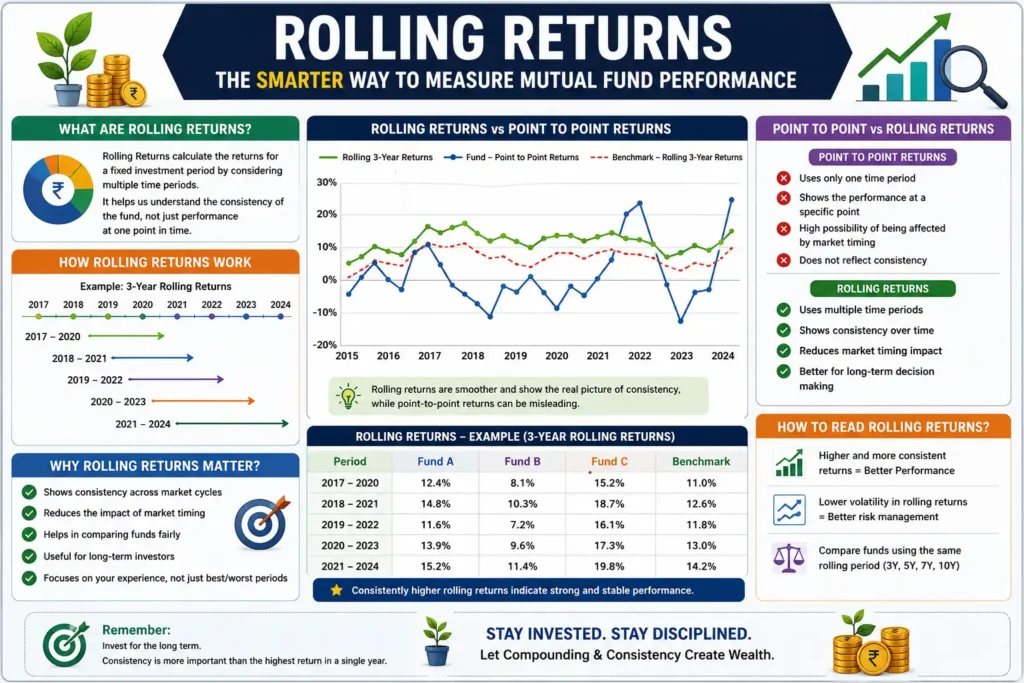
Most investors compare mutual funds using CAGR.
Although CAGR is useful, it does not tell the complete story.
Professional investors generally prefer rolling returns because they provide a better measure of consistency.
What Are Rolling Returns?
Rolling returns calculate returns over a fixed investment period by considering multiple starting dates instead of just one.
For example,
Suppose you want to evaluate five-year performance.
Instead of calculating returns only from January 2019 to January 2024, rolling returns calculate five-year returns starting from:
- January 2019
- February 2019
- March 2019
- April 2019
…and so on.
This approach produces hundreds of return observations.
As a result, investors receive a much clearer picture of consistency.
Why Rolling Returns Matter
Rolling returns answer important questions.
- How consistently has the fund performed?
- How often has it beaten its benchmark?
- How much variation exists?
- How reliable are long-term returns?
These insights cannot be obtained from CAGR alone.
CAGR vs Rolling Returns
| Parameter | CAGR | Rolling Returns |
| Uses One Time Period | Yes | No |
| Measures Consistency | No | Yes |
| Preferred by Professionals | Sometimes | Yes |
| Reduces Timing Bias | No | Yes |
| Better for Long-Term Analysis | Moderate | Excellent |
Why Long-Term Investors Should Focus on Rolling Returns
Suppose two funds generate similar 10-year CAGR.
However,
Fund A delivers consistent performance every year.
Fund B alternates between excellent years and poor years.
Although the CAGR appears similar, Fund A usually provides a smoother investment journey.
Therefore, professional investors often give greater importance to rolling returns.
Understanding Mutual Fund Risk Metrics
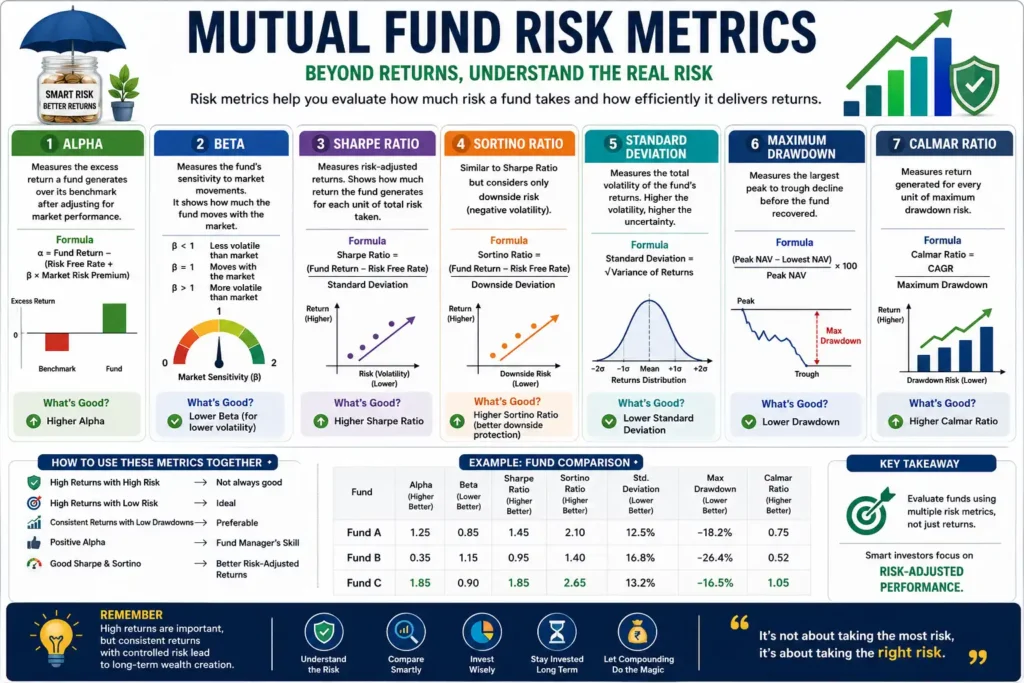
Returns alone never tell the complete story.
Risk-adjusted performance matters even more.
Professional investors evaluate several important metrics before investing.
You should understand these metrics as well.
Alpha
Alpha measures how much additional return a mutual fund generates compared with its benchmark after adjusting for market performance.
Higher alpha generally indicates better active fund management.
Example:
If the benchmark generated 14% while the mutual fund generated 17%, positive alpha may have been created.
Higher alpha is generally preferred.
Beta
Beta measures how sensitive a mutual fund is to overall market movements.
| Beta | Meaning |
| Below 1 | Lower volatility than market |
| Equal to 1 | Similar volatility |
| Above 1 | Higher volatility |
Lower beta generally suits conservative investors.
Higher beta may suit aggressive investors.
Sharpe Ratio
The Sharpe Ratio measures return earned for every unit of risk taken.
Higher Sharpe Ratio generally indicates better risk-adjusted performance.
Professional investors pay significant attention to this metric.
Sortino Ratio
Sortino Ratio works similarly to Sharpe Ratio.
However, it only considers downside volatility.
Many experts prefer Sortino Ratio because investors usually worry more about losses than gains.
Higher values generally indicate better downside risk management.
Standard Deviation
Standard deviation measures return volatility.
Higher standard deviation indicates larger fluctuations.
Lower standard deviation usually indicates greater stability.
However, lower volatility should always be evaluated together with expected returns.
Maximum Drawdown
Maximum drawdown measures the largest decline experienced by a mutual fund before recovering.
Lower drawdown generally indicates stronger downside protection.
Which Risk Metrics Matter Most?
Every metric provides different information.
Therefore, they should be analysed together rather than individually.
| Risk Metric | Why It Matters |
| Alpha | Measures fund manager skill |
| Beta | Measures market sensitivity |
| Sharpe Ratio | Measures return per unit of risk |
| Sortino Ratio | Measures downside efficiency |
| Standard Deviation | Measures volatility |
| Maximum Drawdown | Measures capital protection |
Professional investors rarely rely on a single metric before making investment decisions.
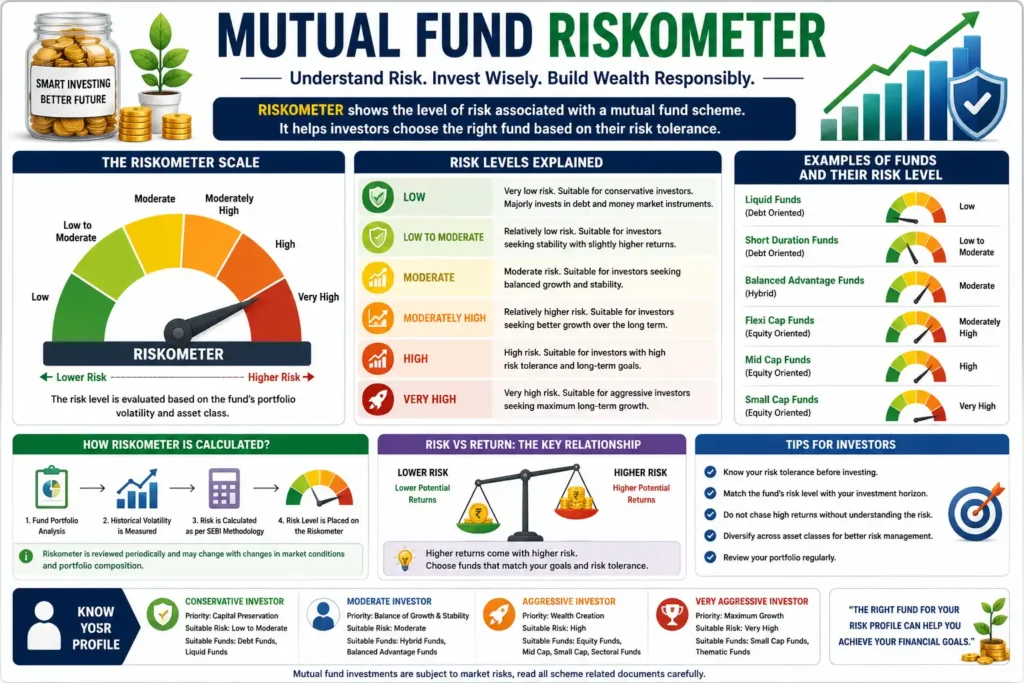
How to Read a Mutual Fund Riskometer
Every mutual fund in India displays a Riskometer.
This visual indicator helps investors understand the overall risk level of the scheme.
Risk categories generally include:
- Low
- Low to Moderate
- Moderate
- Moderately High
- High
- Very High
Most diversified equity mutual funds fall under the “Very High” risk category because they invest primarily in equity markets.
However, “Very High” does not necessarily mean a fund is unsuitable.
Instead, it indicates that investors should maintain an appropriate investment horizon.
For equity funds, seven years or longer is generally recommended.
Expert Advice
Never reject a mutual fund simply because its Riskometer shows “Very High.”
Instead, compare it with:
- Your financial goals
- Your investment horizon
- Your risk tolerance
- Your overall asset allocation
A well-planned investment strategy always considers all these factors together rather than focusing on a single label.
Understanding Sector Allocation Before Investing
Sector allocation is one of the most overlooked factors while selecting a mutual fund. Most investors only compare returns and ignore where their money is actually invested.
However, the sectors included in a portfolio play a major role in determining future returns and risk.
For example, a mutual fund with excessive exposure to a single sector may perform exceptionally well during a sector boom. On the other hand, it may also decline sharply if that sector underperforms.
Therefore, diversified sector allocation often provides a smoother investment journey.
What Is Sector Allocation?
Sector allocation refers to the percentage of a mutual fund’s portfolio invested in different industries.
Instead of investing in only one sector, equity mutual funds generally spread investments across multiple industries.
Examples include:
- Banking and Financial Services
- Information Technology
- Healthcare
- Automobile
- FMCG
- Oil & Gas
- Capital Goods
- Infrastructure
- Power
- Telecom
- Consumer Durables
- Chemicals
- Metals
- Cement
- Real Estate
Every sector reacts differently to economic conditions.
Therefore, proper diversification helps reduce overall portfolio risk.
Why Sector Allocation Matters
Different sectors perform differently during various phases of the economy.
For example:
- Banking often performs well during economic expansion.
- FMCG companies may remain relatively stable during slowdowns.
- Information Technology can benefit from global technology spending.
- Healthcare often remains resilient because medical demand continues regardless of market conditions.
- Infrastructure companies may benefit from government spending.
A diversified mutual fund benefits from multiple growth opportunities instead of depending on one industry.
Characteristics of a Well-Diversified Sector Portfolio
Although every fund follows its own investment strategy, a quality portfolio generally demonstrates the following characteristics.
- Exposure across several industries.
- No excessive concentration in one sector.
- Regular portfolio review.
- Allocation based on business fundamentals.
- Flexibility to adapt to changing market conditions.
These characteristics help improve long-term stability.
Example of Diversified Sector Allocation
The following table illustrates how a diversified equity portfolio may look.
| Sector | Approximate Portfolio Role |
|---|---|
| Financial Services | Core Growth |
| Information Technology | Innovation & Global Growth |
| Healthcare | Defensive Growth |
| Consumer Goods | Stable Earnings |
| Automobile | Economic Growth |
| Capital Goods | Infrastructure Development |
| Energy | Economic Activity |
| Telecom | Digital Economy |
| Manufacturing | Industrial Growth |
| Chemicals | Export Growth |
This example is only for educational purposes.
Actual sector allocation changes regularly based on market conditions and fund manager decisions.
Which Sector Carries the Highest Risk?
No sector remains the best forever.
Every industry experiences periods of growth and slowdown.
For example:
- Technology may outperform for several years.
- Banking may lead during another period.
- Healthcare may become attractive during uncertain economic conditions.
Therefore, investors should avoid selecting mutual funds solely because they have high exposure to one popular sector.
Diversification usually produces more consistent long-term results.
Understanding Market Capitalisation Allocation
Another important factor is market capitalisation allocation.
Many investors hear terms such as:
- Large Cap
- Mid Cap
- Small Cap
However, they do not understand how these categories influence risk and returns.
What Is Market Capitalisation?
Market capitalisation represents the total market value of a listed company.
Companies are generally classified into three categories.
Large-Cap Companies
These are India’s largest listed businesses.
Examples include companies with:
- Strong market leadership
- Stable earnings
- Better liquidity
- Lower volatility
Large-cap companies usually provide stability.
Mid-Cap Companies
Mid-cap companies are generally growing businesses.
They often offer higher growth potential than large-cap companies.
However, they also experience greater price fluctuations.
Small-Cap Companies
Small-cap companies usually have the highest long-term growth potential.
However, they also carry the highest risk.
Their share prices can move sharply during both bull and bear markets.
Comparison of Market Capitalisation Categories
| Parameter | Large Cap | Mid Cap | Small Cap |
| Stability | Excellent | Good | Moderate |
| Growth Potential | Moderate | High | Very High |
| Volatility | Lower | Moderate | High |
| Downside Risk | Lower | Moderate | High |
| Suitable for Beginners | Yes | Moderate | No |
| Suitable for Long-Term Investors | Yes | Yes | Yes |
Every category serves a different purpose within an investment portfolio.
Which Category Is Best for Lumpsum Investment?
The answer depends on your investment horizon and risk tolerance.
Conservative Investors
Large-cap funds usually remain the preferred choice.
Moderate Investors
Flexi Cap Funds provide a balanced approach.
Aggressive Investors
Multi Cap Funds and carefully selected mid-cap exposure may help improve long-term growth.
Instead of selecting only one category, many experienced investors combine different categories.
How Portfolio Overlap Affects Your Investments
Many investors unknowingly invest in multiple mutual funds holding almost identical stocks.
This is called portfolio overlap.
High overlap reduces diversification.
Example
Suppose you invest in three different mutual funds.
If all three funds own the same banking stocks, technology companies, and consumer businesses, your portfolio may not be as diversified as it appears.
Therefore, adding more mutual funds does not automatically improve diversification.
Quality diversification matters more than the number of schemes.
Why Portfolio Overlap Should Be Checked
Portfolio overlap can create several issues.
- Reduced diversification
- Higher concentration risk
- Similar performance across multiple funds
- Unnecessary duplication
- Difficult portfolio management
Before adding another mutual fund, investors should compare its holdings with existing investments.
Ideal Number of Equity Mutual Funds
Many investors believe owning ten or fifteen mutual funds improves diversification.
In reality, too many funds can make portfolio management difficult.
The following table provides a practical guideline.
| Investment Amount | Suggested Number of Equity Funds |
| Up to ₹2 lakh | 1–2 Funds |
| ₹2–5 lakh | 2–3 Funds |
| ₹5–15 lakh | 3–4 Funds |
| Above ₹15 lakh | 4–6 Funds |
Quality should always take priority over quantity.
Asset Allocation for Lumpsum Investors
Selecting the right mutual fund is only one part of successful investing.
The second part involves allocating your money across different asset classes.
This process is known as asset allocation.
Many financial experts believe that asset allocation contributes more to long-term portfolio performance than selecting individual mutual funds.
Why Asset Allocation Is Important
Every asset class performs differently.
For example:
- Equity generates long-term growth.
- Debt provides stability.
- Gold acts as a hedge during uncertainty.
- Liquid funds improve liquidity.
Combining these assets helps reduce portfolio volatility.
Example Asset Allocation
Conservative Investor
| Asset Class | Allocation |
| Equity Funds | 40% |
| Debt Funds | 40% |
| Gold | 10% |
| Liquid Fund | 10% |
Moderate Investor
| Asset Class | Allocation |
| Equity Funds | 60% |
| Debt Funds | 25% |
| Gold | 10% |
| Liquid Fund | 5% |
Aggressive Investor
| Asset Class | Allocation |
| Equity Funds | 80% |
| Debt Funds | 10% |
| Gold | 5% |
| Liquid Fund | 5% |
These allocations are only examples.
Your actual allocation should depend on your financial goals, investment horizon, age, and risk tolerance.
How Often Should You Review Your Mutual Funds?
Many investors check their portfolios every day.
Unfortunately, this often leads to emotional decisions.
Instead, review your investments periodically.
Recommended Review Frequency
| Investment Type | Review Frequency |
| Equity Mutual Funds | Once every 6–12 months |
| Debt Funds | Once a year |
| Overall Asset Allocation | Once a year |
| Financial Goals | Once a year |
Daily monitoring rarely improves investment performance.
Instead, focus on whether:
- The fund continues to follow its stated investment objective.
- Performance remains competitive over the long term.
- The fund manager has changed.
- Portfolio quality remains strong.
- Asset allocation still matches your goals.
Signs That You Should Replace a Mutual Fund
Do not replace a fund simply because it underperformed for a few months.
Instead, consider reviewing your investment if:
- The investment philosophy changes significantly.
- Long-term underperformance persists compared with peers and the benchmark.
- The portfolio quality deteriorates.
- Risk increases beyond your comfort level.
- Your financial goals change.
- Your asset allocation requires rebalancing.
Patience remains one of the most valuable qualities of successful investors.
Lumpsum vs SIP – Which Investment Method Is Better?
One of the most common questions investors ask is whether they should invest a lump sum amount or start a Systematic Investment Plan (SIP).
The answer depends on your financial situation rather than on which method is universally better.
Both investment methods have their own advantages.
Therefore, understanding the differences will help you make a better decision.
What Is a SIP?
A Systematic Investment Plan allows you to invest a fixed amount at regular intervals, usually every month.
For example:
- ₹2,000 every month
- ₹5,000 every month
- ₹10,000 every month
Instead of investing all your money at once, you gradually build your investment portfolio.
What Is a Lumpsum Investment?
A lump sum investment means investing the entire available amount in one transaction.
Examples include:
- Investing ₹1 lakh today
- Investing ₹5 lakh after receiving a bonus
- Investing ₹10 lakh after selling property
- Investing retirement benefits
The entire amount starts participating in the market immediately.
Key Differences Between Lumpsum and SIP
| Feature | Lumpsum | SIP |
|---|---|---|
| Investment Frequency | One-time | Monthly |
| Best For | Large available capital | Regular income |
| Market Timing Risk | Higher | Lower |
| Rupee Cost Averaging | No | Yes |
| Investment Discipline | Moderate | Excellent |
| Suitable for Salaried Investors | Moderate | Excellent |
| Suitable for Bonus or Inheritance | Excellent | Moderate |
Advantages of Lumpsum Investing
A lump sum investment offers several benefits.
Entire Money Starts Growing Immediately
Since the complete amount gets invested at once, every rupee begins compounding from the first day.
This can produce higher returns if markets continue to rise.
Simplicity
Only one investment decision is required.
No monthly monitoring becomes necessary.
Better for Long-Term Investors
Historically, investors with investment horizons exceeding ten years have often benefited from staying invested for longer periods.
Time in the market generally matters more than timing the market.
Advantages of SIP
SIP also offers significant advantages.
Rupee Cost Averaging
When markets decline, the same investment amount purchases more units.
When markets rise, fewer units are purchased.
Over time, this helps average the purchase cost.
Investment Discipline
Automatic monthly investing encourages long-term financial discipline.
Lower Emotional Stress
SIP reduces the pressure of finding the “perfect” market entry point.
When Should You Choose Lumpsum?
A lump sum investment may be suitable if:
- You receive a large bonus.
- You inherit money.
- You sell a property.
- You receive retirement benefits.
- Your investment horizon exceeds seven years.
- You understand market volatility.
When Should You Choose SIP?
SIP may be a better option if:
- You receive a monthly salary.
- You invest regularly.
- You are new to investing.
- You prefer gradual market participation.
- You feel uncomfortable investing a large amount at once.
Can You Combine Both?
Absolutely.
Many experienced investors combine both strategies.
For example:
- Invest ₹5 lakh as a lump sum.
- Continue investing ₹20,000 every month through SIP.
This approach combines immediate market participation with long-term disciplined investing.
Expert Verdict
Neither SIP nor lump sum investing is inherently superior.
Instead, choose the method that best matches your financial situation, available capital, investment horizon, and comfort with market volatility.
Lumpsum vs Fixed Deposit
Many investors compare mutual funds with fixed deposits before investing.
Although both options help grow money, they operate very differently.
Comparison Table
| Parameter | Mutual Fund | Fixed Deposit |
| Expected Return Potential | Higher (Market Linked) | Fixed |
| Capital Protection | No | Yes (Subject to Bank Terms) |
| Inflation Beating Potential | High (Long Term) | Lower |
| Liquidity | High | Moderate |
| Risk | Moderate to High | Low |
| Wealth Creation | Excellent | Limited |
| Suitable Horizon | 5–10+ Years | Short to Medium Term |
When Fixed Deposits May Be Better
Fixed deposits may suit investors who:
- Need guaranteed returns.
- Cannot tolerate market fluctuations.
- Need money within a few years.
- Prioritize capital protection.
When Mutual Funds May Be Better
Mutual funds may suit investors who:
- Want long-term wealth creation.
- Aim to beat inflation.
- Accept market volatility.
- Have long investment horizons.
Lumpsum vs Gold
Gold has always been a popular investment in India.
However, it serves a different purpose than equity mutual funds.
Comparison Table
| Parameter | Mutual Funds | Gold |
| Wealth Creation | Higher Potential | Moderate |
| Income Generation | Possible Through SWP | No |
| Inflation Protection | Good | Good |
| Volatility | Moderate | Moderate |
| Long-Term Growth | Excellent | Moderate |
| Diversification | Excellent | Excellent |
Gold can strengthen a diversified portfolio.
However, relying entirely on gold for long-term wealth creation may not always be appropriate.
Many financial planners recommend maintaining only a limited allocation to gold as part of a diversified investment strategy.
Lumpsum vs Real Estate
Real estate has traditionally been considered a preferred investment option.
However, it differs significantly from mutual funds.
Comparison Table
| Parameter | Mutual Funds | Real Estate |
| Initial Investment | Low | High |
| Liquidity | High | Low |
| Diversification | Excellent | Limited |
| Maintenance | None | Required |
| Professional Management | Yes | No |
| Entry Cost | Low | High |
| Exit Process | Simple | Time Consuming |
Real estate offers ownership of physical assets.
However, mutual funds provide greater liquidity and easier diversification.
Lumpsum vs Direct Stocks
Some investors prefer buying shares directly instead of investing through mutual funds.
Both approaches have advantages.
Mutual Funds
Advantages:
- Professional management
- Diversification
- Lower research requirement
- Suitable for beginners
- Automatic portfolio management
Direct Stocks
Advantages:
- Complete investment control
- Higher return potential
- No fund management fee
- Personalized portfolio
However, direct stock investing requires:
- Extensive research
- Continuous monitoring
- Strong understanding of financial statements
- Risk management skills
Therefore, many investors prefer mutual funds for long-term wealth creation.
Taxation of Mutual Funds
Understanding taxation is just as important as selecting the right mutual fund.
Tax rules directly influence your post-tax returns.
Therefore, investors should consider taxation before making a lump sum investment.
Capital Gains Tax
Capital gains arise when mutual fund units are sold for a profit.
The applicable tax depends on:
- Type of mutual fund
- Holding period
- Prevailing tax rules
Equity Mutual Funds
For equity-oriented mutual funds, taxation generally falls into two categories.
Short-Term Capital Gains (STCG)
If units are sold within the applicable short-term holding period, gains are taxed as short-term capital gains according to the prevailing tax rules.
Long-Term Capital Gains (LTCG)
If units are held beyond the prescribed long-term holding period, gains qualify as long-term capital gains and receive the tax treatment applicable under current regulations.
Because tax rules may change over time, investors should always verify the latest provisions before redeeming investments.
Debt Mutual Funds
Debt mutual funds follow different tax rules.
The applicable treatment depends on the prevailing regulations at the time of redemption.
Therefore, investors should review current tax laws before making investment decisions.
Tax Planning Tips
Investors can improve post-tax returns by following these practices.
- Invest for the long term.
- Avoid frequent buying and selling.
- Maintain proper investment records.
- Review tax implications before redemption.
- Consult a qualified tax professional for large investments.
Biggest Mistakes Investors Make While Investing a Lumpsum Amount
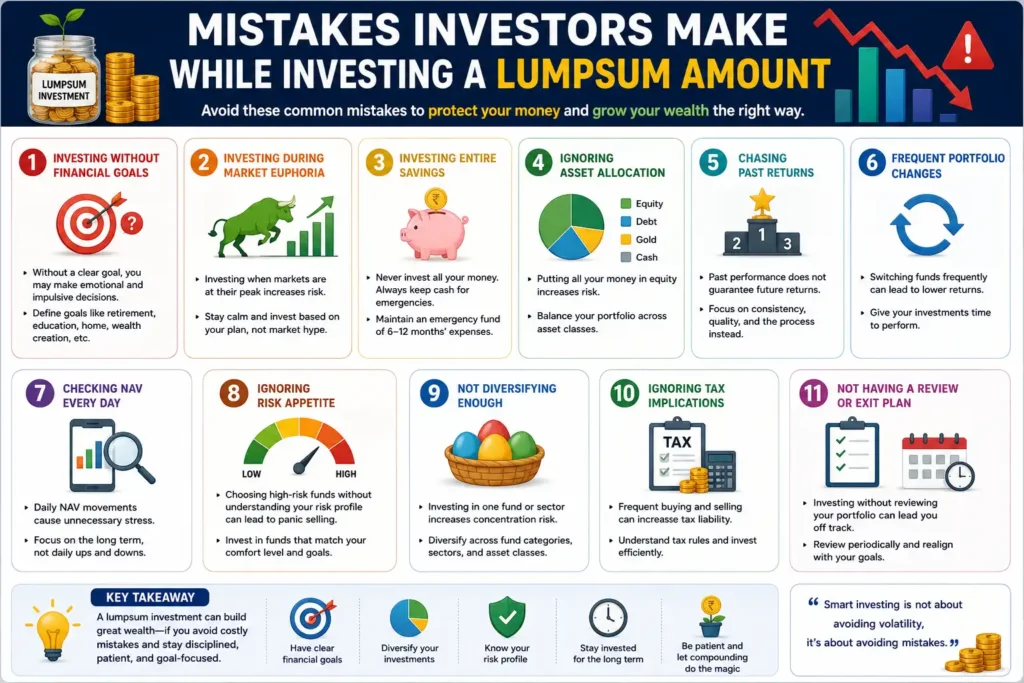
Avoiding mistakes often matters more than selecting the perfect mutual fund.
The following errors are commonly observed among investors.
Investing Without Financial Goals
Every investment should have a purpose.
Examples include:
- Retirement
- Child education
- House purchase
- Wealth creation
Without a goal, investors often make emotional decisions.
Investing During Market Euphoria
Many investors invest only after markets have already risen sharply.
Instead, investment decisions should depend on financial goals rather than market excitement.
Investing Entire Savings
Never invest your complete savings.
Always maintain:
- Emergency fund
- Health insurance
- Life insurance
- Short-term liquidity
Ignoring Asset Allocation
Putting all your money into equity increases portfolio risk.
A balanced asset allocation generally provides better long-term stability.
Chasing Past Returns
Yesterday’s best-performing fund may not become tomorrow’s winner.
Instead of focusing only on returns, evaluate:
- Portfolio quality
- Risk management
- Fund manager
- Consistency
- Investment philosophy
Frequent Portfolio Changes
Switching mutual funds every few months often reduces long-term wealth creation.
Patience remains one of the greatest advantages available to investors.
Checking NAV Every Day
Daily NAV fluctuations rarely matter for investors with long-term goals.
Instead, review performance periodically while focusing on long-term progress.
Ignoring Risk Appetite
Selecting an aggressive fund without understanding your ability to tolerate market volatility often leads to panic selling during corrections.
Choose investments that allow you to remain invested comfortably.
Complete Checklist Before Making a Lumpsum Investment
Before investing a large amount in mutual funds, spend a few minutes reviewing this checklist. A disciplined approach often produces better long-term results than making quick investment decisions.
Financial Readiness Checklist
✔ You have an emergency fund covering at least 6–12 months of expenses.
✔ You have adequate health insurance.
✔ You have sufficient life insurance if your family depends on your income.
✔ You have cleared high-interest debt such as credit card balances or personal loans.
✔ You have identified your financial goal.
✔ You know your investment horizon.
✔ You understand your risk tolerance.
✔ You have selected the right mutual fund category.
✔ You have diversified your investments.
✔ You have understood the taxation rules.
✔ You have read the Scheme Information Document (SID) and Key Information Memorandum (KIM).
✔ You have nominated a family member for your investments.
✔ You have decided how often you will review your portfolio.
If you can confidently answer “Yes” to most of these questions, you are better prepared to make a lump sum investment.
Expert Strategies to Maximize Lumpsum Investment Returns
Professional investors rarely depend on luck. Instead, they follow proven investment strategies.
Invest for the Long Term
Time is one of the biggest advantages in equity investing.
The longer you stay invested, the greater the opportunity for compounding.
For most equity mutual funds, a horizon of at least seven to ten years is recommended.
Diversify Across Fund Categories
Avoid investing your entire corpus in one mutual fund.
Instead, consider diversification across:
- Flexi Cap Funds
- Large Cap Funds
- Multi Cap Funds
- Hybrid Funds
- Debt Funds (based on your goals)
Diversification helps reduce concentration risk.
Rebalance Your Portfolio
Market movements change your asset allocation over time.
Review your portfolio once a year.
If one asset class grows significantly, rebalance the portfolio to restore your desired allocation.
Avoid Emotional Decisions
Fear and greed often become the biggest enemies of successful investing.
Avoid buying because everyone else is buying.
Similarly, avoid selling simply because markets have corrected.
Long-term investing rewards patience.
Continue Learning
The financial world keeps evolving.
Stay informed about:
- Economic trends
- Interest rates
- Inflation
- Corporate earnings
- Tax changes
- Mutual fund regulations
Better knowledge usually leads to better investment decisions.
Sample Lumpsum Investment Portfolios
The following examples are for educational purposes only. They illustrate how investors with different goals and risk profiles may structure their investments.
Portfolio Example 1 – Beginner Investor
Investment Amount: ₹1,00,000
| Fund | Allocation |
|---|---|
| Nippon India Large Cap Fund | 60% |
| ICICI Prudential Bluechip Fund | 40% |
This portfolio emphasizes stability and simplicity.
Portfolio Example 2 – Moderate Investor
Investment Amount: ₹5,00,000
| Fund | Allocation |
| Parag Parikh Flexi Cap Fund | 40% |
| HDFC Flexi Cap Fund | 30% |
| ICICI Prudential Bluechip Fund | 30% |
This allocation balances growth and risk.
Portfolio Example 3 – Aggressive Investor
Investment Amount: ₹10,00,000
| Fund | Allocation |
| Parag Parikh Flexi Cap Fund | 30% |
| Kotak Multicap Fund | 30% |
| HDFC Flexi Cap Fund | 20% |
| Nippon India Large Cap Fund | 20% |
This portfolio aims for higher long-term wealth creation while maintaining diversification.
Portfolio Example 4 – Retirement Corpus
Investment Amount: ₹50,00,000
| Asset Class | Allocation |
| Equity Mutual Funds | 50% |
| Hybrid Funds | 20% |
| Debt Funds | 20% |
| Liquid Fund | 10% |
This strategy balances growth with capital preservation and liquidity.
Real-Life Investment Case Studies
Case Study 1 – Young Professional
Age: 27 Years
Investment Amount: ₹2,00,000
Goal: Wealth Creation
Investment Horizon: 20 Years
Recommended Strategy:
- Invest through a Flexi Cap Fund.
- Continue monthly SIPs.
- Review annually.
- Avoid frequent portfolio changes.
Case Study 2 – Child Education
Age: 35 Years
Investment Amount: ₹8,00,000
Goal: Higher Education
Investment Horizon: 15 Years
Recommended Strategy:
- Diversify across Flexi Cap and Large Cap Funds.
- Gradually shift a portion to hybrid or debt funds as the goal approaches.
Case Study 3 – Retirement Planning
Age: 45 Years
Investment Amount: ₹15,00,000
Goal: Retirement at 60
Recommended Strategy:
- Build a diversified portfolio.
- Increase debt allocation gradually after age 55.
- Review the portfolio every year.
Case Study 4 – Recently Retired Investor
Age: 62 Years
Investment Amount: ₹1 Crore
Goal: Regular Income
Recommended Strategy:
- Allocate a suitable portion to equity for inflation-beating growth.
- Keep a significant allocation in debt and liquid funds.
- Consider a Systematic Withdrawal Plan (SWP) based on income needs.
Frequently Asked Questions
Which is the best mutual fund for lump sum investment?
There is no single best fund for every investor. The right choice depends on your financial goals, risk tolerance, and investment horizon.
Is a lump sum investment better than SIP?
A lump sum investment may work well when you already have a large amount and a long investment horizon. SIPs are generally better for investors who invest from their monthly income.
Can I invest ₹10 lakh in one mutual fund?
Yes. However, diversifying across multiple funds and asset classes may help reduce concentration risk.
Is it safe to invest a lump sum during a market correction?
Many long-term investors view market corrections as opportunities. However, if you are uncomfortable investing all at once, a Systematic Transfer Plan (STP) may be considered.
How long should I stay invested?
For equity mutual funds, a minimum investment horizon of five years is advisable. Seven to ten years or longer is generally preferred for wealth creation.
Should I review my portfolio every month?
No. Reviewing your portfolio once or twice a year is usually sufficient unless your financial goals or circumstances change.
Can senior citizens invest in equity mutual funds?
Yes. However, the allocation should reflect their income requirements, risk tolerance, and overall financial plan.
What happens if the market falls after I invest?
Market declines are a normal part of investing. If your financial goals remain unchanged and the fund continues to follow a sound investment strategy, staying invested is often the better approach.
Should I stop investing during a bear market?
No. Bear markets are temporary. Historically, disciplined long-term investing has rewarded patient investors.
How many mutual funds should I own?
Most investors can build a well-diversified portfolio with three to five carefully selected mutual funds.
Final Thoughts
A lump sum investment can become one of the most effective ways to build long-term wealth when made with careful planning and discipline.
Rather than chasing the latest top-performing scheme, focus on selecting mutual funds with a consistent investment philosophy, experienced fund managers, diversified portfolios, and a strong long-term track record.
Among the funds discussed in this guide:
- Parag Parikh Flexi Cap Fund stands out for long-term wealth creation.
- HDFC Flexi Cap Fund offers a balanced approach with flexibility across market capitalizations.
- Nippon India Large Cap Fund provides stability through established businesses.
- ICICI Prudential Bluechip Fund suits investors seeking relatively lower volatility within equity.
- Kotak Multicap Fund offers broad diversification across large-cap, mid-cap, and small-cap companies.
Remember that successful investing does not depend on finding the perfect mutual fund. Instead, it depends on choosing investments that match your financial goals, maintaining diversification, staying invested through market cycles, and allowing compounding to work over time.
Patience, consistency, and discipline remain the most valuable qualities of successful investors.
Key Takeaways
- Define your financial goal before investing.
- Match your mutual fund selection with your risk profile.
- Invest for at least 7–10 years when choosing equity funds.
- Diversify across fund categories and asset classes.
- Avoid chasing short-term returns.
- Review your portfolio annually.
- Stay invested during market volatility.
- Let compounding work in your favour.