Investing in mutual funds is one of the easiest ways to build wealth over the long term. However, selecting the right mutual fund category often becomes challenging because each category serves a different investment objective. While large-cap funds offer stability and small-cap funds provide aggressive growth opportunities, mid-cap mutual funds strike an excellent balance between growth potential and manageable risk.
Many of today’s biggest companies were once mid-cap businesses. As these companies expanded their market share, improved profitability, and increased their earnings, they eventually became large-cap stocks and rewarded long-term investors with exceptional returns. This growth potential makes mid-cap mutual funds an attractive choice for investors who want higher returns than large-cap funds while avoiding some of the extreme volatility associated with small-cap funds.
The year 2026 presents an interesting opportunity for investors. India’s economy continues to benefit from infrastructure development, manufacturing expansion, digital transformation, rising domestic consumption, and government reforms. Many mid-sized companies operate in sectors that stand to gain directly from these long-term trends.
This comprehensive guide explains everything you need to know about best mid cap mutual funds. You will learn how they work, who should invest, their advantages and risks, factors to consider before investing, and the best mid-cap mutual funds worth considering in 2026. Whether you are a beginner, an experienced investor, or planning your retirement, this guide will help you make informed investment decisions.
Quick Summary
| Feature | Details |
|---|---|
| Fund Category | Equity Mutual Fund |
| Investment Focus | Mid-cap companies |
| SEBI Definition | Companies ranked 101st–250th by market capitalization |
| Risk Level | Very High |
| Return Potential | High |
| Recommended Investment Horizon | 7–10 years or longer |
| Suitable Investment Mode | SIP and Lumpsum |
| Suitable Investors | Aggressive and long-term investors |
| Minimum SIP | Usually ₹100–₹500 |
| Taxation | Equity Mutual Fund Tax Rules |
| Liquidity | High |
| Wealth Creation Potential | Excellent |
What Are Mid Cap Mutual Funds?
Mid-cap mutual funds are equity mutual funds that primarily invest in medium-sized listed companies. According to the Securities and Exchange Board of India (SEBI), these funds must invest at least 65% of their total assets in mid-cap companies.
Mid-cap companies are businesses that have already established themselves in their industries but still have significant room for expansion. Unlike large corporations, they can grow their revenue and profits at a much faster pace.
These companies often operate in rapidly growing industries such as:
- Manufacturing
- Capital Goods
- Pharmaceuticals
- Information Technology
- Chemicals
- Auto Components
- Financial Services
- Consumer Goods
- Renewable Energy
- Infrastructure
Because these businesses continue to expand, investors often receive higher capital appreciation over long investment periods.
Why Are Mid Cap Companies Important?
Every successful large company was once a mid-sized business.
Companies grow in stages.
Small Company
↓
Mid Cap Company
↓
Large Cap Company
↓
Industry Leader
When investors identify strong businesses during the mid-cap stage, they often benefit from years of business growth.
This is why many experienced investors allocate a portion of their portfolio to mid-cap mutual funds.
Key Characteristics of Mid Cap Funds
- Invest mainly in medium-sized companies
- Offer higher growth potential than large-cap funds
- More volatile than large-cap funds
- Less risky than small-cap funds
- Suitable for long-term wealth creation
- Ideal for SIP investing
- Professionally managed by experienced fund managers
What Does SEBI Mean by Mid Cap Companies?
To ensure consistency across the mutual fund industry, SEBI classifies companies based on their full market capitalization.
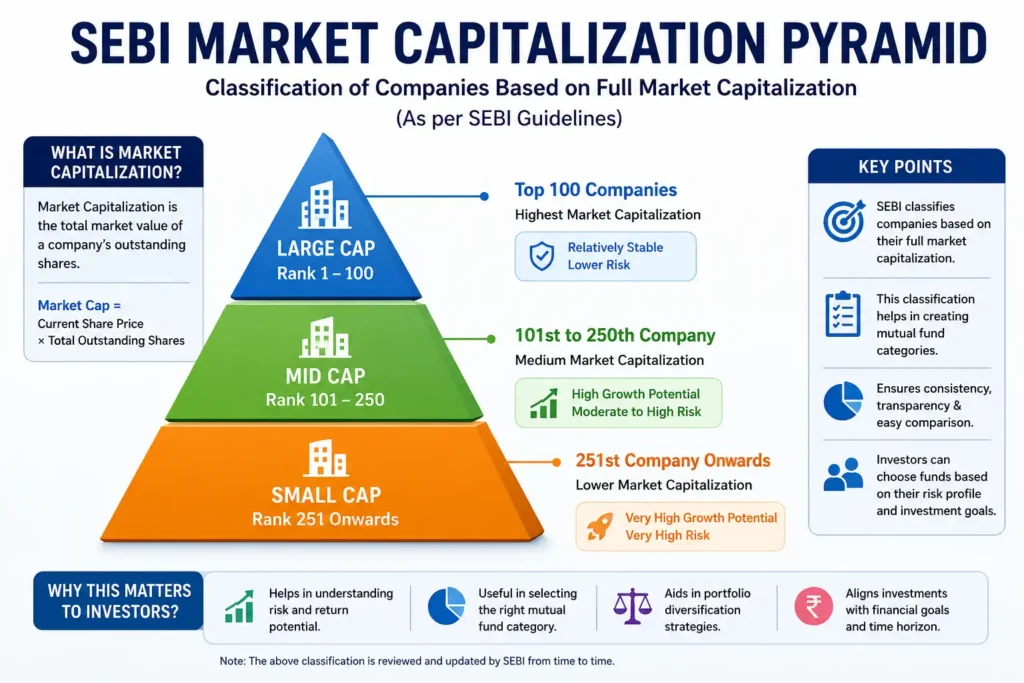
The categories are:
| Category | Market Capitalization Ranking |
| Large Cap | 1–100 |
| Mid Cap | 101–250 |
| Small Cap | 251 onwards |
This classification helps investors understand exactly where a fund invests.
For example, a mid-cap mutual fund cannot simply purchase large-cap stocks to improve short-term performance. It must maintain the minimum required allocation to genuine mid-cap companies.
This standardization increases transparency and allows investors to compare funds fairly.
Why Did SEBI Introduce This Classification?
Before SEBI introduced uniform categories, different fund houses followed different definitions for mid-cap companies.
As a result:
- Investors became confused.
- Risk levels varied significantly.
- Fund comparisons became difficult.
- Portfolio overlap increased.
The SEBI framework solved these problems by creating clear investment rules for every equity mutual fund category.
How Do Mid Cap Mutual Funds Work?
A mutual fund pools money from thousands of investors.
The Asset Management Company (AMC) appoints an experienced fund manager to manage this pooled money.
The fund manager researches hundreds of companies before selecting the best investment opportunities.
The process looks like this:
Investor Money
↓
Asset Management Company
↓
Fund Manager
↓
Research Team
↓
Selection of High-Quality Mid-Cap Companies
↓
Diversified Portfolio
↓
Net Asset Value (NAV)
↓
Long-Term Returns
Instead of buying one or two stocks yourself, you gain exposure to dozens of carefully selected businesses through a single investment.
How Does the Fund Manager Select Companies?
Fund managers evaluate companies using several factors, including:
Revenue Growth
Companies with steadily increasing sales often have strong future potential.
Profit Growth
Growing profits indicate improving business performance.
Competitive Advantage
Businesses with unique products or strong market positions usually perform better over time.
Debt Levels
Companies with manageable debt are generally more financially stable.
Cash Flow
Healthy cash flow helps companies expand without relying heavily on borrowing.
Corporate Governance
Experienced management teams and transparent business practices reduce investment risk.
Industry Outlook
Fund managers also analyze whether the company’s industry has long-term growth opportunities.
Why Should You Invest in Mid Cap Mutual Funds?
Many investors aim to achieve returns that comfortably beat inflation over long periods.
Mid-cap mutual funds have historically delivered strong long-term returns because they invest in companies during their growth phase.
Higher Growth Potential
Large companies often grow slowly because they already dominate their industries.
Mid-sized businesses still have room to:
- Expand operations
- Increase profits
- Enter new markets
- Launch new products
- Acquire competitors
This creates greater wealth creation opportunities.
Opportunity to Invest in Tomorrow’s Market Leaders
Today’s successful blue-chip companies were once mid-cap businesses.
Investing early allows investors to participate in this journey.
Professional Portfolio Management
Selecting individual mid-cap stocks requires significant research.
A mutual fund manager continuously monitors:
- Company earnings
- Industry changes
- Economic conditions
- Valuation levels
- Market risks
This professional management benefits investors who lack time or expertise.
Better Diversification
Instead of investing in one company, a mid-cap fund usually holds 50–80 stocks across multiple industries.
Diversification reduces company-specific risk.
Ideal for SIP Investors
Market volatility benefits SIP investors because they purchase more units during market declines and fewer units during rallies.
Over time, this reduces the average purchase cost.
Inflation-Beating Returns
Inflation reduces purchasing power every year.
Mid-cap funds have historically generated returns that exceeded inflation over long investment periods, helping investors build real wealth.
Suitable for Long-Term Goals
Mid-cap funds can support goals such as:
- Retirement planning
- Children’s higher education
- Buying a house
- Wealth creation
- Financial independence
Advantages of Mid Cap Mutual Funds
Mid-cap mutual funds offer several benefits when included as part of a diversified investment portfolio.
Strong Long-Term Return Potential
Mid-cap companies often grow faster than established industry leaders.
As their earnings increase, stock prices may also appreciate significantly over time.
Balanced Risk and Reward
Large-cap funds generally provide stability but moderate growth.
Small-cap funds offer higher growth but experience sharper market fluctuations.
Mid-cap funds sit comfortably between these two categories.
They provide attractive return potential while maintaining relatively better stability than small-cap funds.
Professional Stock Selection
Researching individual stocks requires expertise in finance, accounting, and industry analysis.
Mid-cap mutual funds remove this burden.
Professional fund managers make investment decisions on your behalf.
Portfolio Diversification
A single fund may invest across sectors such as:
- Banking
- Technology
- Healthcare
- Chemicals
- Consumer Goods
- Capital Goods
- Engineering
- Manufacturing
- Automobiles
This diversification lowers overall portfolio risk.
Lower Investment Amount
You do not need lakhs of rupees to begin investing.
Many AMCs allow SIPs starting from ₹100 or ₹500.
This makes mid-cap investing accessible to almost everyone.
Compounding Benefits
Long-term investing allows returns to generate additional returns.
For example:
An investment earning 15% annually can multiply several times over two decades because of compounding.
The earlier you start investing, the greater the impact of compounding.
Liquidity
Unlike fixed deposits or real estate, mutual fund units can generally be redeemed on any business day, subject to exit load and applicable regulations.
This provides flexibility during financial emergencies.
Transparency
Fund houses regularly disclose:
- Portfolio holdings
- NAV
- Performance reports
- Fund manager commentary
- Expense ratio
- Riskometer
Investors can monitor their investments easily.
Risks of Mid Cap Mutual Funds
Although mid-cap funds offer excellent growth opportunities, investors must understand the associated risks before investing.
Market Risk
Stock prices fluctuate because of:
- Economic slowdown
- Inflation
- Interest rate changes
- Global events
- Political uncertainty
Since mid-cap funds invest in equities, they are directly affected by market movements.
Higher Volatility
Mid-cap stocks often experience larger price swings than large-cap companies.
Short-term returns can therefore be unpredictable.
Investors should remain patient during periods of market correction.
Economic Slowdown
Mid-sized companies usually have fewer financial resources than large corporations.
During recessions, their profits may decline faster.
This can temporarily affect fund performance.
Liquidity Risk
Some mid-cap stocks trade with lower daily volumes.
During market stress, selling large quantities may become difficult.
Experienced fund managers manage this risk through diversification and careful stock selection.
Valuation Risk
Sometimes investors become overly optimistic.
Stock prices may rise much faster than company earnings.
Buying highly valued companies can reduce future returns.
Fund managers continuously monitor valuations before making investment decisions.
Fund Manager Risk
Performance also depends on the fund manager’s investment decisions.
A change in fund manager or investment strategy may influence future returns.
Sector Concentration Risk
Some mid-cap funds allocate larger portions to rapidly growing industries.
If those sectors underperform, the overall fund may also be affected.
Investor Behaviour Risk
Many investors make emotional decisions such as:
- Stopping SIPs during market crashes
- Selling after temporary losses
- Investing after markets reach new highs
- Chasing past performance
These mistakes often reduce long-term returns more than market volatility itself.
Long Recovery Periods
After major market corrections, mid-cap stocks may require time to recover.
Investors should therefore maintain an investment horizon of at least seven to ten years.
Should You Invest in Mid Cap Mutual Funds?
The answer depends on your financial goals, investment horizon, and risk tolerance.
You may consider investing if you:
- Want higher long-term returns.
- Can stay invested for at least seven years.
- Are comfortable with market volatility.
- Already have an emergency fund.
- Want to build long-term wealth through SIPs or lumpsum investments.
You should avoid or limit exposure if you:
- Need money within the next three years.
- Cannot tolerate temporary declines in portfolio value.
- Depend on your investments for regular monthly income.
- Prefer stable and predictable returns.
For most long-term investors, mid-cap mutual funds can play an important role in a diversified portfolio when combined with large-cap, flexi-cap, and debt investments.
Mid Cap vs Large Cap vs Small Cap Mutual Funds
Choosing the right mutual fund category is one of the most important investment decisions you will make. Every category offers a different combination of risk and return. Understanding these differences helps you build a balanced portfolio that matches your financial goals.
Large-cap funds focus on established companies with stable earnings. Mid-cap funds invest in growing businesses with strong expansion potential. Small-cap funds target emerging companies that may deliver exceptional returns but also carry higher risk.
Comparison at a Glance
| Feature | Large Cap Funds | Mid Cap Funds | Small Cap Funds |
|---|---|---|---|
| SEBI Classification | Top 100 Companies | 101–250 Companies | 251st Company Onwards |
| Risk Level | Moderate | High | Very High |
| Return Potential | Moderate | High | Very High |
| Volatility | Low | Moderate to High | Very High |
| Investment Horizon | 5+ Years | 7–10 Years | 10+ Years |
| Market Crash Impact | Lower | Moderate | Highest |
| Recovery Speed | Faster | Moderate | Slower |
| Suitable for Beginners | Yes | Yes (Long Term) | Limited |
| SIP Suitability | Excellent | Excellent | Good |
| Lumpsum Suitability | Good | Good During Corrections | Prefer Market Corrections |
| Wealth Creation Potential | Good | Excellent | Excellent |
| Stability | High | Moderate | Lower |
| Dividend Stability | Better | Moderate | Limited |
Large Cap Funds
Large-cap funds invest in India’s biggest companies. These businesses usually dominate their industries and generate consistent profits.
Examples include companies from sectors like banking, IT, automobiles, FMCG, and energy.
Advantages include:
- Stable earnings
- Lower volatility
- Better downside protection
- Suitable for conservative investors
- Ideal for first-time mutual fund investors
However, since these companies are already well established, their growth rate may be lower than that of mid-sized companies.
Mid Cap Funds
Mid-cap companies are often in their fastest growth phase.
Many are expanding into new markets, launching products, increasing manufacturing capacity, and improving profitability.
As a result, investors may benefit from higher long-term returns.
However, these businesses are also more sensitive to changes in economic conditions.
This creates short-term volatility.
Small Cap Funds
Small-cap companies are still developing their businesses.
Many eventually become successful mid-cap and large-cap companies.
Some may fail.
Because of this uncertainty, small-cap funds experience greater fluctuations.
They require patience and a long investment horizon.
Which Category Has Delivered Better Returns Historically?
Although historical returns never guarantee future performance, mid-cap and small-cap funds have often outperformed large-cap funds over long investment periods.
However, they also experience larger temporary declines during market corrections.
A diversified portfolio usually provides better risk-adjusted returns than investing in only one category.
Mid Cap Funds vs Flexi Cap Funds
Many investors confuse mid-cap funds with flexi-cap funds.
Although both invest in equities, their investment strategies differ significantly.
| Feature | Mid Cap Fund | Flexi Cap Fund |
| Investment Universe | Mid Cap Companies | Large, Mid and Small Caps |
| Diversification | Moderate | High |
| Risk | High | Moderate to High |
| Return Potential | High | High |
| Fund Manager Flexibility | Limited | Very High |
| Market Cycle Adaptability | Moderate | Excellent |
When Should You Choose a Mid Cap Fund?
A mid-cap fund may be suitable if:
- You already own large-cap funds.
- You have a long investment horizon.
- You can tolerate market volatility.
- You want higher growth potential.
When Should You Choose a Flexi Cap Fund?
A flexi-cap fund may be more suitable if:
- You want one diversified equity fund.
- You prefer lower portfolio volatility.
- You are investing for the first time.
- You want the fund manager to adjust allocations across market capitalizations.
Mid Cap Funds vs Multi Cap Funds
Although their names sound similar, these categories are different.
A multi-cap fund must maintain minimum investments in large-cap, mid-cap, and small-cap companies.
A mid-cap fund focuses primarily on medium-sized companies.
| Feature | Mid Cap Fund | Multi Cap Fund |
| Primary Investment | Mid Cap Stocks | Large, Mid and Small Caps |
| Diversification | Moderate | High |
| Volatility | Higher | Moderate |
| Return Potential | Higher | Balanced |
| Suitable for Beginners | Yes | Yes |
Mid Cap Funds vs Index Funds
Index funds simply replicate an index.
They do not attempt to outperform the market.
Mid-cap funds actively select stocks with the aim of generating higher returns.
| Feature | Mid Cap Fund | Index Fund |
| Fund Management | Active | Passive |
| Expense Ratio | Slightly Higher | Lower |
| Potential to Beat Benchmark | Yes | No |
| Research-Based Investing | Yes | No |
Mid Cap Funds vs Direct Stocks
Many investors wonder whether they should buy individual mid-cap stocks instead of investing through mutual funds.
The answer depends on your knowledge, experience, and available time.
| Feature | Mid Cap Mutual Fund | Direct Stocks |
| Diversification | High | Low |
| Research Required | Low | Very High |
| Risk | Diversified | Company Specific |
| Professional Management | Yes | No |
| Portfolio Monitoring | Managed by Experts | Investor Responsibility |
For most retail investors, professionally managed mutual funds remain the better option.
Who Should Invest in Mid Cap Mutual Funds?
Mid-cap mutual funds are not suitable for everyone.
Before investing, evaluate your financial goals, investment horizon, and ability to handle market fluctuations.
Young Professionals
Investors in their twenties and early thirties often have the longest investment horizon.
They also have enough time to recover from market corrections.
Mid-cap funds can therefore become a significant part of their equity allocation.
Suitable goals include:
- Retirement planning
- Wealth creation
- Financial independence
- Buying a home
- Children’s future education
Salaried Employees
Monthly SIP investing works particularly well for salaried individuals.
Regular investing helps reduce market timing risk.
It also encourages financial discipline.
Business Owners
Business owners often understand business cycles and long-term growth.
They may use mid-cap funds to diversify their wealth beyond their own business.
Long-Term Investors
If you plan to remain invested for seven years or longer, mid-cap funds may offer attractive wealth creation opportunities.
Longer holding periods help reduce the impact of short-term volatility.
Aggressive Investors
Investors seeking higher returns and willing to accept temporary declines may allocate a larger portion of their portfolio to mid-cap funds.
Parents Planning Children’s Education
Parents investing for goals that are more than ten years away may consider including mid-cap funds to improve long-term growth potential.
Retirement Investors
Individuals planning retirement twenty or thirty years in advance can benefit from systematic investing in mid-cap funds.
However, investors approaching retirement should gradually reduce equity exposure.
Who Should Avoid Mid Cap Mutual Funds?
Mid-cap funds may not be suitable for everyone.
Investors with Short-Term Goals
Avoid investing if you need money within:
- One year
- Three years
- Five years
Equity markets remain unpredictable over shorter periods.
Conservative Investors
If temporary declines make you uncomfortable, you may prefer:
- Large-cap funds
- Hybrid funds
- Debt mutual funds
Senior Citizens Seeking Regular Income
Although senior citizens can invest in mid-cap funds, they should avoid depending on them for monthly expenses.
Instead, they may allocate a smaller percentage for long-term growth while relying on safer investments for income.
Emergency Fund
Never invest your emergency savings in mid-cap funds.
Emergency money should remain in:
- Savings accounts
- Liquid funds
- Overnight funds
- Short-term debt funds
How Much Should You Invest in Mid Cap Mutual Funds?
There is no single allocation that suits every investor.
Your allocation depends on:
- Age
- Income
- Financial goals
- Existing investments
- Risk tolerance
Suggested Portfolio Allocation
| Investor Type | Suggested Mid Cap Allocation |
| Conservative | 10%–15% |
| Moderate | 15%–25% |
| Aggressive | 25%–40% |
Avoid investing your entire equity portfolio in mid-cap funds.
Diversification improves long-term stability.
Age-Wise Asset Allocation
Investors in Their 20s
Possible allocation:
- Large Cap: 30%
- Mid Cap: 35%
- Small Cap: 20%
- International Equity: 10%
- Debt: 5%
Young investors can afford greater equity exposure because they have a longer investment horizon.
Investors in Their 30s
Suggested allocation:
- Large Cap: 35%
- Mid Cap: 30%
- Small Cap: 15%
- Debt: 20%
This combination balances growth with increasing financial responsibilities.
Investors in Their 40s
Suggested allocation:
- Large Cap: 40%
- Mid Cap: 20%
- Hybrid Funds: 15%
- Debt Funds: 25%
As retirement approaches, reducing volatility becomes increasingly important.
Investors Above 50
Suggested allocation:
- Large Cap: 35%
- Mid Cap: 10%–15%
- Hybrid Funds: 20%
- Debt Funds: 35%–40%
Capital preservation becomes more important than maximizing returns.
Sample Portfolio Examples
₹5 Lakh Investment Portfolio
| Category | Allocation |
| Large Cap Funds | ₹2,00,000 |
| Mid Cap Funds | ₹1,25,000 |
| Flexi Cap Funds | ₹75,000 |
| Debt Funds | ₹1,00,000 |
₹10 Lakh Investment Portfolio
| Category | Allocation |
| Large Cap | ₹3,00,000 |
| Mid Cap | ₹2,50,000 |
| Small Cap | ₹1,00,000 |
| Flexi Cap | ₹2,00,000 |
| Debt Funds | ₹1,50,000 |
₹25 Lakh Portfolio
| Category | Allocation |
| Large Cap | ₹7,50,000 |
| Mid Cap | ₹6,25,000 |
| Flexi Cap | ₹4,00,000 |
| Small Cap | ₹2,50,000 |
| Debt Funds | ₹4,75,000 |
These examples are only illustrations. Your ideal allocation should depend on your personal financial plan.
How to Choose the Best Mid Cap Mutual Fund
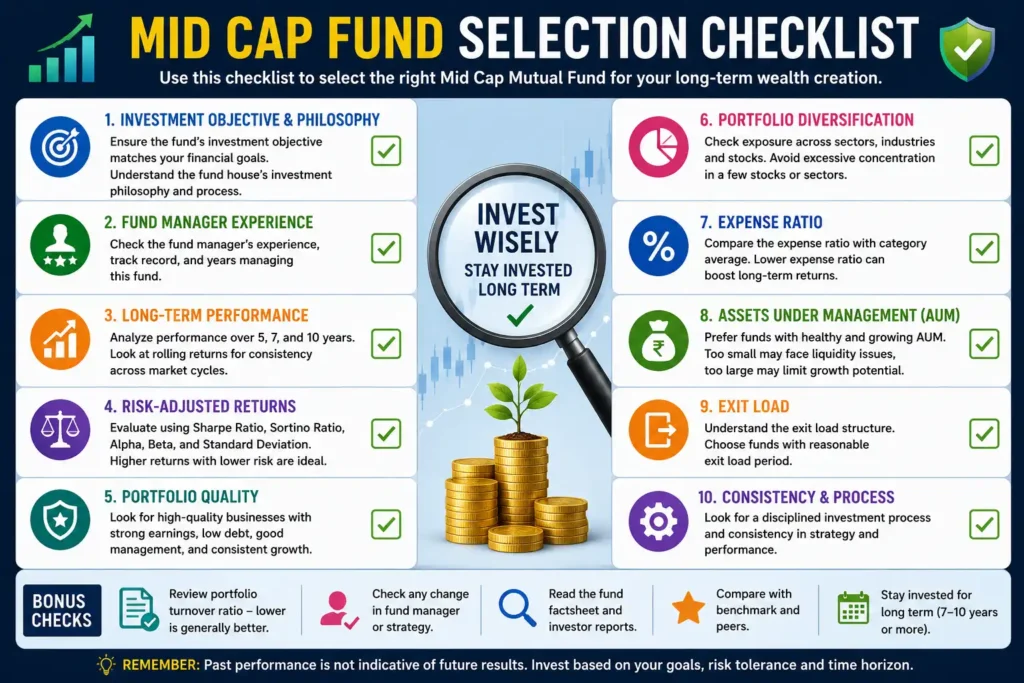
Thousands of investors select funds based only on recent returns.
This approach often leads to poor investment decisions.
Instead, evaluate every fund using multiple parameters.
Look Beyond Recent Returns
One-year returns can be misleading.
Markets move in cycles.
A fund that performs exceptionally well this year may underperform next year.
Instead, compare:
- Three-year returns
- Five-year returns
- Seven-year returns
- Rolling returns
- Downside protection
Consistency matters more than short-term performance.
Evaluate the Fund Manager
An experienced fund manager plays a critical role in long-term performance.
Review:
- Years of experience
- Investment philosophy
- Track record
- Previous funds managed
- Portfolio management style
Check Assets Under Management (AUM)
AUM represents the total money invested in the fund.
Very small funds may struggle with liquidity.
Extremely large funds may find it difficult to generate higher returns because deploying large amounts of capital becomes challenging.
Look for funds with healthy and steadily growing AUM rather than focusing only on size.
Compare Expense Ratio
The expense ratio directly affects your investment returns.
Lower costs leave more money invested for compounding.
Always compare direct plans when evaluating expense ratios.
Review Portfolio Quality
Study the fund’s holdings carefully.
Look for:
- High-quality businesses
- Diversified sectors
- Reasonable stock concentration
- Sustainable earnings growth
Avoid funds that take excessive concentration risk in only a few companies or sectors.
Examine Risk-Adjusted Returns
Higher returns alone do not make a fund superior.
Also evaluate:
- Standard Deviation
- Beta
- Alpha
- Sharpe Ratio
- Sortino Ratio
These metrics help you understand whether the fund has generated returns efficiently relative to the risk taken.
Check Portfolio Turnover
Frequent buying and selling may increase transaction costs.
A moderate turnover ratio often indicates a disciplined long-term investment approach.
Understand Exit Load
Before investing, know how long you should remain invested to avoid exit charges.
Long-term investors usually find this less important, but it is still worth reviewing.
Consider the Fund House
Choose Asset Management Companies with:
- Strong governance
- Consistent investment philosophy
- Experienced research teams
- Transparent communication
- Long performance history
A reputable fund house often provides greater confidence during changing market conditions.
Best Mid Cap Mutual Funds in 2026
Selecting the best mid-cap mutual fund requires more than looking at the highest one-year return. A fund may perform exceptionally well during a bull market but struggle during periods of correction.
Instead, focus on consistency, portfolio quality, experienced fund management, risk-adjusted returns, and long-term wealth creation.
The funds discussed below have consistently remained among the leading choices for long-term investors. However, always verify the latest fund data, portfolio holdings, expense ratio, and riskometer before investing because these details change periodically.
How We Selected These Mid Cap Mutual Funds
The funds in this guide have been evaluated using multiple parameters instead of relying only on recent returns.
The evaluation considers:
- Long-term consistency
- Rolling returns
- Fund manager experience
- Portfolio quality
- Risk-adjusted performance
- Alpha generation
- Downside protection
- Expense ratio
- Assets Under Management (AUM)
- Portfolio diversification
- Investment philosophy
Top Mid Cap Mutual Funds Comparison
| Mutual Fund | Risk | Investment Style | Suitable For |
|---|---|---|---|
| Nippon India Growth Fund | Very High | Growth | Long-Term Wealth Creation |
| Motilal Oswal Midcap Fund | Very High | Concentrated Growth | Aggressive Investors |
| HDFC Mid-Cap Opportunities Fund | Very High | Blend of Growth & Value | Long-Term SIP |
| Kotak Emerging Equity Fund | Very High | Quality Growth | Moderate Aggressive Investors |
| Edelweiss Mid Cap Fund | Very High | Diversified Growth | Long-Term Investors |
| SBI Magnum Midcap Fund | Very High | Growth | SIP Investors |
| Axis Midcap Fund | Very High | Quality Businesses | Patient Investors |
| DSP Midcap Fund | Very High | Diversified Portfolio | Beginners |
| Invesco India Mid Cap Fund | Very High | Growth | Experienced Investors |
| Tata Mid Cap Growth Fund | Very High | Growth | Long-Term Wealth Creation |
1. Nippon India Growth Fund
Fund Overview
Nippon India Growth Fund is one of India’s oldest and most respected mid-cap mutual funds. It has delivered competitive long-term performance across different market cycles.
The fund focuses on identifying businesses with strong earnings growth, scalable business models, and experienced management teams.
It generally invests across sectors rather than concentrating heavily in one industry.
Investment Objective
The primary objective is long-term capital appreciation through investments in carefully selected mid-cap companies.
Why This Fund Stands Out
- Long operating history
- Strong long-term track record
- Diversified portfolio
- Experienced research team
- Consistent performance across market cycles
- Suitable for SIP investors
Investment Strategy
The fund manager looks for companies that demonstrate:
- Sustainable earnings growth
- Healthy cash flow
- Reasonable valuations
- Competitive advantages
- Strong balance sheets
Instead of chasing short-term momentum, the fund emphasizes businesses capable of delivering long-term growth.
Portfolio Characteristics
The portfolio usually contains companies from sectors such as:
- Industrials
- Capital Goods
- Financial Services
- Pharmaceuticals
- Chemicals
- Consumer Goods
- Auto Components
- Information Technology
This diversification reduces dependence on a single industry.
Who Should Invest?
This fund may suit investors who:
- Have a seven to ten-year investment horizon
- Prefer SIP investing
- Can tolerate market volatility
- Want long-term capital appreciation
Pros
- Excellent long-term reputation
- Diversified holdings
- Experienced fund management
- Consistent investment philosophy
- Suitable for disciplined SIP investing
Cons
- May underperform during momentum-driven rallies
- Higher short-term volatility than large-cap funds
Expert Opinion
Investors seeking consistent long-term wealth creation often consider this fund among the core mid-cap holdings in their portfolio.
2. Motilal Oswal Midcap Fund
Fund Overview
Motilal Oswal Midcap Fund follows a focused investment approach.
Instead of holding a very large number of stocks, the portfolio generally invests in carefully researched companies with high conviction.
This concentrated strategy may generate superior returns but can also increase short-term volatility.
Investment Philosophy
The fund focuses on:
- Quality businesses
- Competitive advantages
- High earnings growth
- Long investment horizon
- Strong management quality
Why Investors Like This Fund
- High-conviction portfolio
- Focus on business quality
- Long-term investment approach
- Potential for superior alpha generation
Portfolio Style
The portfolio generally contains fewer stocks than many competing mid-cap funds.
Each holding receives detailed research before investment.
Suitable Investors
This fund is suitable for:
- Aggressive investors
- Investors comfortable with volatility
- Long-term wealth creators
- Investors seeking higher growth potential
Pros
- Strong stock selection process
- Focused portfolio
- Long-term investment philosophy
- Potential for higher returns
Cons
- Concentrated holdings increase volatility
- May experience larger temporary declines during corrections
Expert Opinion
Investors who understand market volatility and remain invested through different market cycles may benefit from this fund’s concentrated approach.
3. HDFC Mid-Cap Opportunities Fund
Fund Overview
HDFC Mid-Cap Opportunities Fund has built a strong reputation over many years through disciplined investing.
The fund combines growth investing with reasonable valuation discipline.
Instead of buying companies at any price, it attempts to identify businesses with attractive long-term potential available at sensible valuations.
Investment Strategy
The fund generally focuses on:
- Quality businesses
- Reasonable valuations
- Sustainable earnings
- Diversified sectors
- Long-term capital appreciation
Key Strengths
- Experienced investment team
- Well-diversified portfolio
- Proven investment process
- Strong research capabilities
Portfolio Allocation
The portfolio usually includes companies from:
- Engineering
- Manufacturing
- Banking
- Financial Services
- Chemicals
- Consumer Products
- Pharmaceuticals
- Technology
Who Should Consider This Fund?
Suitable for:
- Beginners
- Long-term SIP investors
- Investors seeking balanced growth
- Investors building diversified portfolios
Pros
- Consistent investment process
- Strong risk management
- Diversified sector exposure
- Suitable for long-term investing
Cons
- Returns may occasionally trail aggressive peers during speculative rallies
Expert Opinion
This fund remains one of the most reliable choices for investors seeking consistent exposure to India’s growing mid-cap companies.
4. Kotak Emerging Equity Fund
Fund Overview
Kotak Emerging Equity Fund is widely known for maintaining a disciplined investment strategy while focusing on high-quality businesses.
The fund balances growth opportunities with careful risk management.
Investment Philosophy
The fund manager emphasizes:
- Business quality
- Earnings visibility
- Management credibility
- Long-term competitive advantages
Why It Performs Consistently
Instead of making frequent portfolio changes, the fund generally remains invested in companies that continue delivering strong business performance.
Portfolio Diversification
Investments usually span:
- Financial Services
- Industrials
- Healthcare
- Consumer Goods
- Engineering
- Chemicals
- Information Technology
Best Suited For
- Moderate aggressive investors
- Long-term SIP investors
- Investors seeking stable mid-cap exposure
Pros
- Consistent investment philosophy
- Good downside management
- High-quality portfolio
- Experienced management team
Cons
- Conservative positioning may underperform during speculative rallies
Expert Opinion
This fund suits investors looking for disciplined long-term wealth creation rather than chasing short-term performance.
5. Edelweiss Mid Cap Fund
Fund Overview
Edelweiss Mid Cap Fund aims to identify companies capable of delivering sustainable earnings growth over many years.
The investment team combines quantitative research with fundamental analysis before selecting businesses.
Investment Objective
The fund seeks long-term capital appreciation by investing predominantly in mid-cap companies with strong growth prospects.
Investment Process
The team evaluates:
- Revenue growth
- Earnings consistency
- Cash flow
- Debt levels
- Corporate governance
- Competitive positioning
Only businesses meeting strict quality standards become part of the portfolio.
Portfolio Characteristics
The portfolio generally includes companies from:
- Manufacturing
- Pharmaceuticals
- Banking
- Capital Goods
- Auto Components
- Consumer Businesses
- Engineering
- Technology
Suitable Investors
This fund may suit:
- Long-term investors
- SIP investors
- Investors seeking diversified mid-cap exposure
- Investors with moderate to high risk tolerance
Pros
- Strong research process
- Diversified holdings
- Long-term growth orientation
- Disciplined stock selection
Cons
- Higher volatility than diversified equity funds
- Requires patience during market corrections
Expert Opinion
Edelweiss Mid Cap Fund may become a valuable component of a diversified long-term equity portfolio.
Performance Metrics You Should Compare Before Investing
Do not select a mutual fund only because it delivered the highest one-year return.
Professional investors compare several performance indicators before making an investment decision.
Assets Under Management (AUM)
AUM represents the total market value of assets managed by the fund.
A healthy AUM indicates investor confidence.
However, bigger is not always better.
An excessively large mid-cap fund may find it more difficult to invest efficiently in smaller companies.
Expense Ratio
The expense ratio represents the annual fee charged by the Asset Management Company.
Even a difference of 0.50% can significantly affect long-term wealth because of compounding.
Always compare:
- Direct Plan Expense Ratio
- Regular Plan Expense Ratio
Fund Manager Experience
An experienced fund manager understands:
- Market cycles
- Business valuation
- Sector rotation
- Risk management
Review how long the current manager has handled the fund.
Frequent changes in fund management deserve additional attention.
Portfolio Diversification
Avoid funds with excessive concentration in a few companies.
Instead, look for portfolios diversified across:
- Multiple industries
- Different business models
- Various economic sectors
Diversification helps reduce company-specific risk.
Portfolio Turnover Ratio
Turnover measures how frequently the fund buys and sells securities.
A lower turnover ratio often indicates long-term investing.
Very high turnover may increase transaction costs.
Alpha
Alpha measures how much additional return the fund generates compared to its benchmark.
Positive alpha generally indicates successful active management.
Beta
Beta measures the fund’s sensitivity to overall market movements.
A beta above one indicates higher volatility than the benchmark.
Standard Deviation
Standard deviation measures return volatility.
Lower volatility generally means smoother investment performance.
Sharpe Ratio
The Sharpe Ratio evaluates return generated for every unit of risk taken.
Higher values indicate better risk-adjusted performance.
Sortino Ratio
Unlike the Sharpe Ratio, the Sortino Ratio focuses only on downside volatility.
Many experienced investors prefer this metric because investors worry more about losses than positive volatility.
Understanding Rolling Returns
Many investors rely only on CAGR.
Professional investors prefer rolling returns.
What Are Rolling Returns?
Rolling returns calculate investment performance across multiple overlapping periods instead of only comparing the starting and ending values.
For example:
Instead of measuring one five-year period,
Rolling returns evaluate:
Year 1–5
Year 2–6
Year 3–7
Year 4–8
This approach provides a much clearer picture of consistency.
Why Rolling Returns Matter
Rolling returns help investors identify:
- Consistency
- Downside protection
- Long-term reliability
- Performance across different market conditions
A fund with consistent rolling returns often proves more dependable than one that occasionally delivers spectacular short-term gains.
Calendar-Year Returns
Another useful evaluation method is calendar-year performance.
Instead of looking at one long investment period, compare how each fund performed every calendar year.
This reveals:
- Performance during bull markets
- Performance during bear markets
- Recovery speed
- Consistency
Professional investors often combine calendar-year returns with rolling returns before selecting a mutual fund.
6. SBI Magnum Midcap Fund
Fund Overview
SBI Magnum Midcap Fund is one of the well-established mid-cap mutual funds in India. It follows a research-driven investment approach and focuses on identifying fundamentally strong businesses with long-term growth potential.
The fund aims to invest in companies that have scalable business models, competent management teams, and healthy financials.
Investment Objective
The fund seeks long-term capital appreciation by investing primarily in equity and equity-related securities of mid-cap companies.
Investment Strategy
The investment team follows a bottom-up stock selection approach.
Instead of investing based on market trends alone, the fund manager evaluates each company individually.
The analysis includes:
- Revenue growth
- Earnings consistency
- Return on Equity (ROE)
- Return on Capital Employed (ROCE)
- Debt levels
- Cash flow generation
- Industry leadership
- Valuation
Sector Allocation
The portfolio generally includes businesses from:
- Capital Goods
- Industrials
- Financial Services
- Healthcare
- Chemicals
- Consumer Goods
- Information Technology
- Manufacturing
Who Should Invest?
This fund may be suitable for investors who:
- Want long-term capital appreciation
- Prefer systematic investing
- Have an investment horizon of at least seven years
- Can tolerate market volatility
Pros
- Strong research process
- Diversified portfolio
- Suitable for SIP investors
- Experienced fund management
- Good long-term performance history
Cons
- Short-term performance may fluctuate
- Market corrections can affect returns significantly
Expert Opinion
Investors looking for a diversified and professionally managed mid-cap fund may consider SBI Magnum Midcap Fund as part of their long-term portfolio.
7. Axis Midcap Fund
Fund Overview
Axis Midcap Fund focuses on investing in quality businesses with sustainable competitive advantages.
Rather than chasing momentum stocks, the fund manager prefers companies capable of delivering steady earnings growth over many years.
Investment Philosophy
The investment philosophy emphasizes:
- Quality businesses
- Corporate governance
- Sustainable growth
- Strong balance sheets
- Reasonable valuations
Stock Selection Process
The fund evaluates companies based on:
- Earnings quality
- Free cash flow
- Management capability
- Industry leadership
- Competitive positioning
- Long-term scalability
Portfolio Characteristics
The portfolio generally contains companies from sectors including:
- Consumer Goods
- Pharmaceuticals
- Financial Services
- Industrials
- Technology
- Auto Components
- Engineering
Suitable Investors
Axis Midcap Fund may suit investors who:
- Prefer quality investing
- Have a long investment horizon
- Can remain invested during volatile markets
- Want disciplined portfolio management
Pros
- Focus on high-quality companies
- Disciplined investment approach
- Strong governance standards
- Lower portfolio churn
Cons
- May underperform during speculative market rallies
- Requires patience during recovery phases
Expert Opinion
This fund is suitable for investors who value business quality over short-term market excitement.
8. DSP Midcap Fund
Fund Overview
DSP Midcap Fund has consistently focused on identifying businesses with sustainable earnings growth and attractive long-term opportunities.
The investment team combines detailed company research with disciplined portfolio construction.
Investment Objective
To generate long-term capital appreciation by investing predominantly in equity securities of mid-cap companies.
Investment Strategy
The fund manager evaluates:
- Business fundamentals
- Industry trends
- Financial ratios
- Future earnings potential
- Corporate governance
- Competitive advantages
Only companies meeting strict investment standards become part of the portfolio.
Sector Diversification
The fund generally invests across:
- Industrials
- Manufacturing
- Healthcare
- Consumer Businesses
- Financial Services
- Engineering
- Chemicals
- Information Technology
Who Should Invest?
Suitable for:
- Beginners
- SIP investors
- Long-term investors
- Investors seeking diversified exposure
Pros
- Diversified portfolio
- Experienced research team
- Strong investment discipline
- Long-term growth focus
Cons
- Returns may vary across market cycles
- Higher volatility than large-cap funds
Expert Opinion
DSP Midcap Fund is an attractive option for investors building their first diversified mid-cap allocation.
9. Invesco India Mid Cap Fund
Fund Overview
Invesco India Mid Cap Fund aims to invest in businesses that demonstrate strong earnings growth, efficient capital allocation, and sustainable competitive advantages.
The fund follows a disciplined investment process supported by extensive research.
Investment Strategy
The portfolio manager evaluates:
- Revenue growth
- Profitability
- Valuation
- Business scalability
- Corporate governance
- Industry outlook
Sector Allocation
The portfolio usually includes companies from:
- Engineering
- Financial Services
- Healthcare
- Industrials
- Technology
- Consumer Products
- Chemicals
Suitable Investors
Suitable for:
- Experienced investors
- Long-term wealth creators
- Investors seeking portfolio diversification
- Investors comfortable with higher volatility
Pros
- Research-driven investment process
- Diversified holdings
- Long-term investment philosophy
- Attractive growth opportunities
Cons
- Performance may fluctuate during market corrections
- Requires long investment commitment
Expert Opinion
This fund may appeal to investors seeking diversified exposure to India’s expanding mid-cap segment.
10. Tata Mid Cap Growth Fund
Fund Overview
Tata Mid Cap Growth Fund focuses on identifying companies capable of generating sustainable earnings over long investment periods.
The fund combines valuation discipline with growth investing.
Investment Objective
The fund aims to achieve long-term capital appreciation through investments in carefully selected mid-cap companies.
Investment Philosophy
The investment team emphasizes:
- Business quality
- Financial strength
- Sustainable earnings
- Long-term competitive advantages
- Reasonable valuations
Portfolio Characteristics
The portfolio generally includes:
- Industrials
- Capital Goods
- Healthcare
- Consumer Businesses
- Engineering
- Information Technology
- Chemicals
Suitable Investors
This fund may be appropriate for:
- Long-term SIP investors
- Investors seeking capital appreciation
- Moderate aggressive investors
- Investors building diversified equity portfolios
Pros
- Diversified portfolio
- Experienced investment team
- Disciplined research process
- Long-term growth orientation
Cons
- Sensitive to market volatility
- Requires patience during market corrections
Expert Opinion
Tata Mid Cap Growth Fund offers investors another strong option for participating in India’s long-term economic growth.
Best Mid Cap Mutual Funds Performance Comparison
| Fund Name | NAV | Expense Ratio | 1Y Return | 3Y Return | 5Y Return | 7Y Return | 10Y Return | Rating | AUM | Exit Load |
|---|---|---|---|---|---|---|---|---|---|---|
| Motilal Oswal Midcap Fund | ₹109.03 | 0.83% | -4.3% | 19.2% | 23.4% | 22.5% | 17.8% | 3 | ₹36,458 Cr | 1% within 365 days |
| HDFC Mid Cap Fund | ₹226.50 | 0.76% | 9.1% | 21.1% | 21.1% | 22.0% | 18.9% | 5 | ₹97,350 Cr | 1% within 1 year |
| Nippon India Growth Mid Cap Fund | ₹4,966.20 | 0.78% | 12.5% | 23.9% | 22.1% | 23.3% | 19.7% | 5 | ₹47,415 Cr | 1% within 1 month |
| Invesco India Mid Cap Fund | ₹234.86 | 1.52% | 13.6% | 26.2% | 22.4% | 23.9% | 20.6% | 4 | ₹12,396 Cr | 1% on units above 10% redeemed within 1 year |
| Edelweiss Mid Cap Fund | ₹126.67 | 0.84% | 9.6% | 24.0% | 21.3% | 24.2% | 20.2% | 5 | ₹16,848 Cr | 1% within 90 days |
| Kotak Midcap Fund | ₹169.55 | 0.38% | 11.9% | 21.6% | 19.4% | 22.5% | 19.2% | 3 | ₹64,749 Cr | 1% on units above 10% redeemed within 365 days |
| HSBC Midcap Fund | ₹526.49 | 1.22% | 23.8% | 28.1% | 20.9% | 21.4% | 19.1% | 4 | ₹14,249 Cr | 1% on units above 10% redeemed within 1 year |
| Quant Mid Cap Fund | ₹251.57 | 0.99% | 5.5% | 17.6% | 18.4% | 24.5% | 18.5% | 2 | ₹8,109 Cr | 0.50% within 3 months |
| SBI Mid Cap Fund | ₹271.49 | 1.06% | 5.0% | 13.8% | 16.5% | 20.1% | 15.2% | 3 | ₹23,416 Cr | 0.25% within 30 days; 0.10% from 31–90 days |
| Axis Midcap Fund | ₹140.71 | 0.64% | 9.8% | 18.6% | 16.2% | 20.2% | 18.5% | 2 | ₹32,852 Cr | 1% on units above 10% redeemed within 3 months |
| ICICI Prudential Midcap Fund | ₹388.22 | 1.15% | 18.9% | 25.7% | 20.3% | 21.6% | 18.5% | 4 | ₹7,789 Cr | 1% within 1 year |
Source note: Groww lists NAV, expense ratio, returns, rating, fund size, and exit-load details for these schemes.
Quick Expert View
For 5-year returns, the strongest names in this table are Motilal Oswal Midcap Fund, Invesco India Mid Cap Fund, Nippon India Growth Mid Cap Fund, Edelweiss Mid Cap Fund, and HDFC Mid Cap Fund.
For lower expense ratio, Kotak Midcap Fund, Axis Midcap Fund, HDFC Mid Cap Fund, and Nippon India Growth Mid Cap Fund look more cost-efficient.
For largest AUM, HDFC Mid Cap Fund, Kotak Midcap Fund, and Nippon India Growth Mid Cap Fund lead the table.
SIP vs Lumpsum Investment in Mid Cap Mutual Funds
One of the most common questions investors ask is whether they should invest through a Systematic Investment Plan (SIP) or a lumpsum investment.
The answer depends on your financial situation and market conditions.
What Is SIP?
A Systematic Investment Plan allows you to invest a fixed amount at regular intervals.
For example:
- ₹1,000 every month
- ₹5,000 every month
- ₹10,000 every month
SIP helps you build wealth gradually without worrying about market timing.
Benefits of SIP
Rupee Cost Averaging
When markets fall, you purchase more units.
When markets rise, you purchase fewer units.
Over time, this averages your purchase cost.
Power of Compounding
Regular investing over many years allows returns to generate additional returns.
The longer you remain invested, the greater the impact of compounding.
Financial Discipline
SIP encourages consistent investing regardless of market conditions.
This helps investors avoid emotional decisions.
Lower Market Timing Risk
Nobody can consistently predict market tops and bottoms.
SIP removes the need to time the market.
Drawbacks of SIP
- May underperform lumpsum investments during strong bull markets.
- Requires long-term commitment.
- Returns build gradually.
What Is a Lumpsum Investment?
A lumpsum investment involves investing a large amount at one time.
Examples include:
- Annual bonus
- Property sale proceeds
- Retirement benefits
- Business profits
- Inheritance
Benefits of Lumpsum Investing
If invested during attractive market valuations, lumpsum investments may generate higher long-term returns.
The entire investment begins compounding immediately.
Drawbacks
If you invest at market peaks, your portfolio may experience temporary losses.
Therefore, valuation matters more in lumpsum investing.
SIP vs Lumpsum Comparison
| Feature | SIP | Lumpsum |
| Investment Frequency | Monthly | One-Time |
| Suitable for Salaried Investors | Yes | Limited |
| Market Timing Risk | Low | High |
| Rupee Cost Averaging | Yes | No |
| Financial Discipline | Excellent | Moderate |
| Suitable During Bull Markets | Good | Better if Valuations Are Attractive |
| Suitable During Bear Markets | Excellent | Excellent if Investing Gradually |
| Best Investment Horizon | 7–10 Years | 7–10 Years |
When Should You Choose SIP?
Choose SIP if:
- You receive a monthly salary.
- You are starting your investment journey.
- You want disciplined investing.
- You prefer lower market timing risk.
- You plan to invest for retirement or children’s education.
When Should You Choose Lumpsum?
Lumpsum investing may be suitable if:
- Markets have corrected significantly.
- Valuations appear attractive.
- You receive a large amount of money.
- Your investment horizon exceeds seven years.
Can You Combine SIP and Lumpsum?
Yes.
Many experienced investors follow a hybrid approach.
For example:
- Invest a lumpsum amount during market corrections.
- Continue monthly SIPs throughout the year.
This strategy allows investors to benefit from both disciplined investing and attractive market opportunities.
SIP Growth Illustration
The following example shows how regular investing may create wealth over time.
| Monthly SIP | Investment Period | Total Investment | Illustrative Growth at 12% Annual Return* |
| ₹2,000 | 10 Years | ₹2,40,000 | Approx. ₹4.6 Lakhs |
| ₹5,000 | 10 Years | ₹6,00,000 | Approx. ₹11.5 Lakhs |
| ₹10,000 | 15 Years | ₹18,00,000 | Approx. ₹50 Lakhs |
| ₹20,000 | 20 Years | ₹48,00,000 | Approx. ₹2 Crore |
*Illustrative calculations only. Actual returns will vary depending on market performance.
Lumpsum Growth Illustration
| Initial Investment | Investment Period | Illustrative Return (12% CAGR) |
| ₹1,00,000 | 10 Years | Approx. ₹3.1 Lakhs |
| ₹5,00,000 | 10 Years | Approx. ₹15.5 Lakhs |
| ₹10,00,000 | 15 Years | Approx. ₹54.7 Lakhs |
| ₹25,00,000 | 20 Years | Approx. ₹2.41 Crore |
These examples demonstrate the power of compounding. Even small investments can grow substantially when given enough time.
Taxation of Mid Cap Mutual Funds
Understanding taxation is just as important as selecting the right mutual fund. Taxes directly affect your final returns, so every investor should know how capital gains are calculated before investing.
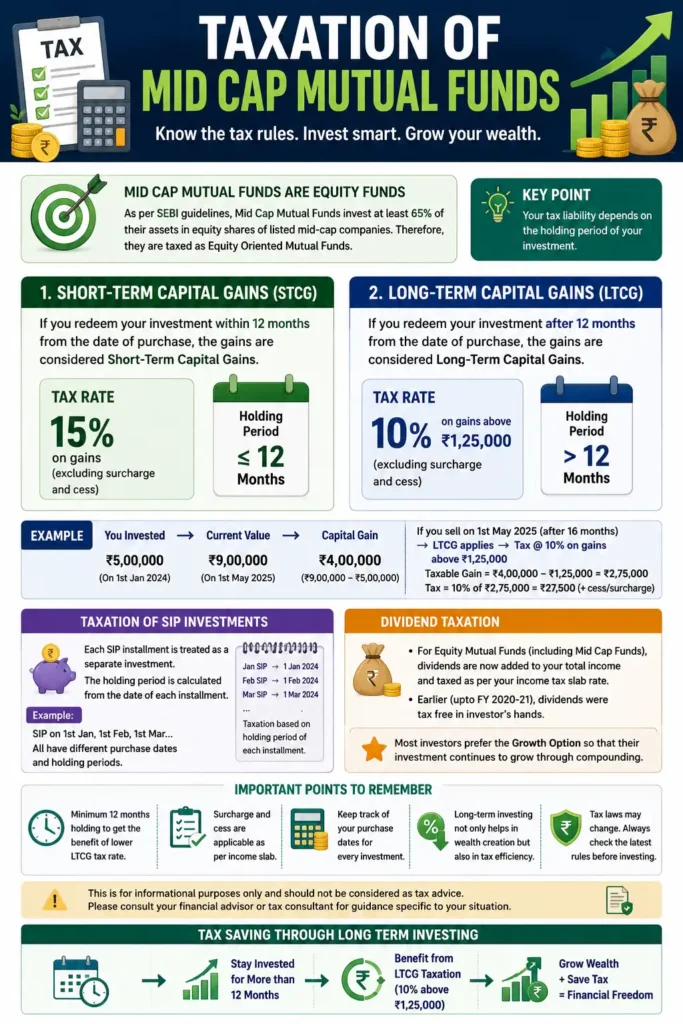
Mid-cap mutual funds are classified as equity mutual funds because they invest at least 65% of their assets in equity shares of listed companies. Therefore, they follow the taxation rules applicable to equity-oriented mutual funds.
How Are Mid Cap Mutual Funds Taxed?
Your tax liability depends on how long you remain invested before redeeming your units.
If you sell your investment within a specified period, the gains are treated as short-term capital gains. If you stay invested beyond that period, they become long-term capital gains.
Short-Term Capital Gains (STCG)
If you redeem your investment before completing the prescribed holding period for equity mutual funds, your profit is treated as a Short-Term Capital Gain (STCG).
Short-term investments generally attract a higher tax rate than long-term investments.
Long-Term Capital Gains (LTCG)
If you remain invested beyond the prescribed holding period, your gains qualify as Long-Term Capital Gains (LTCG).
Long-term investing not only benefits from compounding but also generally receives more favorable tax treatment than short-term investing.
Why Long-Term Investing Is Better
Remaining invested for many years offers several advantages:
- Lower impact of market volatility
- Better compounding
- Potentially better tax efficiency
- Reduced transaction costs
- Greater opportunity for wealth creation
This is another reason why experts recommend holding mid-cap mutual funds for at least seven to ten years.
Example of Capital Gains
Suppose you invest ₹5,00,000.
After several years, your investment grows to ₹9,00,000.
Your capital gain becomes:
₹9,00,000 – ₹5,00,000 = ₹4,00,000
The applicable tax depends on the holding period and the prevailing tax rules at the time of redemption.
Since tax regulations can change through Union Budgets and government notifications, always verify the latest rules before redeeming your investments.
Taxation of SIP Investments
Many investors believe an SIP is taxed as a single investment.
This is incorrect.
Each monthly SIP installment is treated as a separate investment.
For example:
January SIP
↓
February SIP
↓
March SIP
↓
April SIP
Each installment has its own purchase date and holding period.
When you redeem your units, taxation is calculated separately for every SIP installment.
This is an important concept that many beginners overlook.
Dividend Taxation
Most investors today prefer the Growth Option instead of the Income Distribution option because it allows investments to continue compounding.
If you choose a distribution option, the tax treatment may differ.
Before selecting any option, understand how distributions affect your overall financial plan.
Expense Ratio Explained
The expense ratio is one of the most overlooked factors in mutual fund investing.
Even a small difference in annual expenses can reduce your final wealth significantly over long investment periods.
What Is an Expense Ratio?
An expense ratio represents the annual fee charged by the Asset Management Company (AMC) to manage your investments.
This fee covers:
- Fund management
- Research
- Administrative expenses
- Compliance
- Record keeping
- Distribution costs
The expense ratio is deducted from the fund’s assets, so investors do not pay it separately.
Why Does It Matter?
Many investors ignore a difference of 0.50%.
However, because of compounding, this seemingly small percentage can translate into lakhs of rupees over decades.
Illustration
Imagine two funds generate identical gross returns.
Fund A charges a lower expense ratio.
Fund B charges a higher expense ratio.
After twenty years, Fund A may produce significantly higher final wealth simply because less money was deducted annually.
Direct Plan vs Regular Plan
Mutual funds are available in two options.
Direct Plan
Purchased directly from the Asset Management Company.
Advantages:
- Lower expense ratio
- Higher long-term returns
- No distributor commission
Regular Plan
Purchased through distributors or advisors.
Advantages:
- Professional investment guidance
- Assistance with documentation
- Portfolio review support
Disadvantage:
- Higher expense ratio
Long-term investors who are comfortable managing their investments often prefer Direct Plans.
Exit Load Explained
Exit load is another important factor that investors should understand.
What Is Exit Load?
Exit load is a fee charged if you redeem your investment before the specified holding period.
Every mutual fund has its own exit load structure.
Many mid-cap funds impose an exit load only during the initial investment period.
After that period, investors usually redeem units without paying exit charges.
Why Do AMCs Charge Exit Load?
Exit loads discourage frequent buying and selling.
They encourage investors to remain invested for longer periods, which aligns with the objective of equity investing.
Should Exit Load Influence Your Decision?
Exit load should not be the primary factor while selecting a fund.
Instead, focus on:
- Investment quality
- Consistency
- Portfolio
- Fund manager
- Long-term performance
Understanding NAV
Many beginners mistakenly believe that a mutual fund with a lower Net Asset Value (NAV) is cheaper and therefore offers better returns.
This is one of the biggest myths in mutual fund investing.
What Is NAV?
NAV stands for Net Asset Value.
It represents the per-unit value of the mutual fund.
It is calculated every business day.
Does Lower NAV Mean Better Returns?
No.
A fund with an NAV of ₹50 is not necessarily cheaper than another fund with an NAV of ₹500.
Future returns depend on:
- Portfolio quality
- Fund manager decisions
- Business performance
- Market conditions
NAV simply indicates the value of one unit.
Example
Suppose you invest ₹1,00,000.
Fund A NAV = ₹50
You receive 2,000 units.
Fund B NAV = ₹500
You receive 200 units.
If both funds generate identical returns, your final investment value will also be identical.
The number of units differs, but your wealth creation does not.
Therefore, never choose a mutual fund solely because its NAV appears lower.
Understanding Market Cycles
Every equity market passes through different phases.
Mid-cap mutual funds also experience these cycles.
Investors who understand them usually make better long-term decisions.
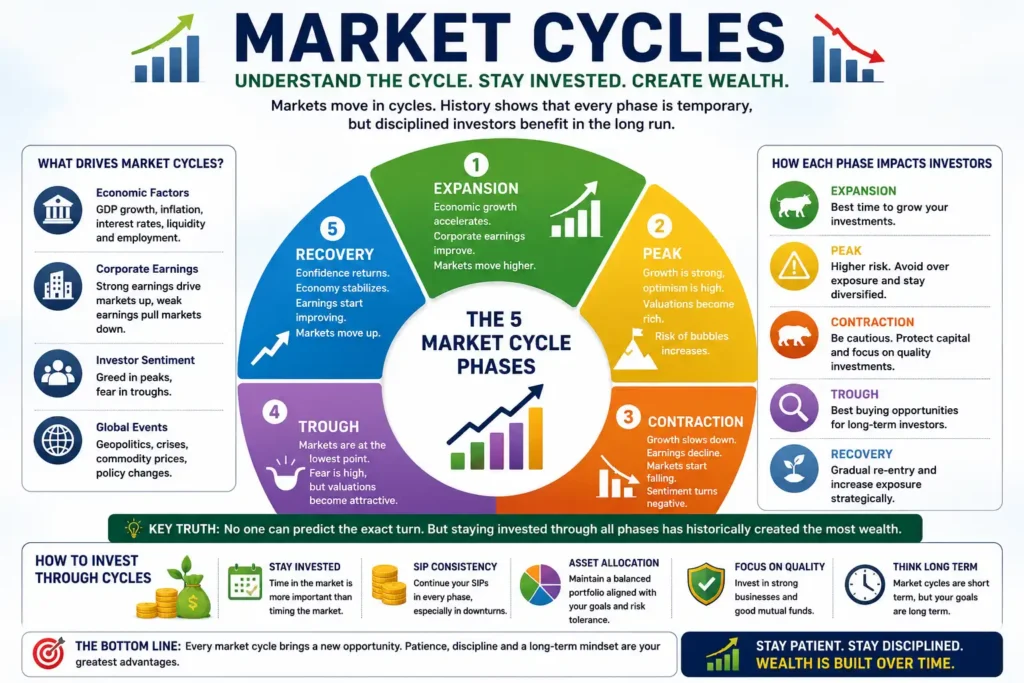
Bull Market
During a bull market:
- Corporate earnings improve.
- Investor confidence increases.
- Stock prices rise.
- Mid-cap companies often outperform.
Many investors become overly optimistic during this phase.
Bear Market
During a bear market:
- Stock prices decline.
- Investor sentiment weakens.
- Volatility increases.
- Quality companies may become attractively valued.
Long-term investors often continue their SIPs during bear markets.
Recovery Phase
Markets eventually recover.
Corporate earnings improve.
Investor confidence returns.
Historically, quality mid-cap companies have recovered strongly after major corrections.
Expansion Phase
Economic expansion usually benefits:
- Manufacturing
- Infrastructure
- Banking
- Consumer Businesses
- Industrials
Many mid-cap companies operate in these sectors.
Why Should Investors Continue SIPs During Market Corrections?
Market declines often create opportunities.
Suppose your SIP invests ₹10,000 every month.
When NAV falls, your ₹10,000 purchases more units.
When markets recover, these additional units contribute significantly to long-term wealth.
This is the power of rupee cost averaging.
Portfolio Allocation Strategies
A diversified portfolio generally performs better than concentrating all investments in one category.
Conservative Portfolio
| Category | Allocation |
|---|---|
| Large Cap Funds | 40% |
| Mid Cap Funds | 15% |
| Hybrid Funds | 20% |
| Debt Funds | 25% |
Suitable for:
- Conservative investors
- Investors nearing retirement
Moderate Portfolio
| Category | Allocation |
| Large Cap Funds | 35% |
| Mid Cap Funds | 25% |
| Flexi Cap Funds | 20% |
| Debt Funds | 20% |
Suitable for:
- Salaried professionals
- Families planning long-term goals
Aggressive Portfolio
| Category | Allocation |
| Large Cap Funds | 25% |
| Mid Cap Funds | 35% |
| Small Cap Funds | 20% |
| Flexi Cap Funds | 10% |
| International Equity | 10% |
Suitable for:
- Young investors
- Long investment horizons
- High risk tolerance
Model Investment Portfolios
₹10 Lakh Portfolio
| Category | Amount |
| Large Cap Funds | ₹3,00,000 |
| Mid Cap Funds | ₹2,50,000 |
| Flexi Cap Funds | ₹1,50,000 |
| Small Cap Funds | ₹1,00,000 |
| Debt Funds | ₹2,00,000 |
₹25 Lakh Portfolio
| Category | Amount |
| Large Cap Funds | ₹7,50,000 |
| Mid Cap Funds | ₹6,00,000 |
| Flexi Cap Funds | ₹4,00,000 |
| Small Cap Funds | ₹2,50,000 |
| Debt Funds | ₹5,00,000 |
₹50 Lakh Portfolio
| Category | Amount |
| Large Cap Funds | ₹15,00,000 |
| Mid Cap Funds | ₹12,50,000 |
| Flexi Cap Funds | ₹7,50,000 |
| Small Cap Funds | ₹5,00,000 |
| Debt Funds | ₹10,00,000 |
These examples are illustrative only. Your allocation should match your financial goals, age, and risk profile.
Common Mistakes Investors Make
Even experienced investors occasionally make mistakes.
Avoiding these errors can improve your long-term investment outcomes.
Investing Based Only on Past Returns
Yesterday’s top-performing fund may not remain tomorrow’s winner.
Always evaluate consistency rather than recent performance.
Ignoring Risk
Higher returns usually come with higher risk.
Never invest without understanding the volatility of mid-cap funds.
Stopping SIP During Market Crashes
Many investors stop investing when markets decline.
Ironically, market corrections often provide the best long-term buying opportunities.
Redeeming Too Early
Mid-cap investing requires patience.
Selling after one or two years often prevents investors from benefiting from compounding.
Investing Without Financial Goals
Every investment should have a purpose.
Examples include:
- Retirement
- Child’s education
- House purchase
- Wealth creation
Goal-based investing helps investors remain disciplined.
Choosing Too Many Mid Cap Funds
Owning five or six mid-cap funds does not necessarily improve diversification.
Many funds hold similar stocks.
For most investors, one or two carefully selected mid-cap funds are sufficient.
Ignoring Portfolio Review
Review your investments at least once every year.
Check whether:
- The fund manager has changed.
- Performance remains consistent.
- Portfolio quality has declined.
- Your financial goals have changed.
Do not review your portfolio every week.
Frequent monitoring often leads to emotional decisions.
Trying to Time the Market
Consistently predicting market highs and lows is extremely difficult.
Instead, remain invested and continue your SIPs.
Long-term discipline usually delivers better results than frequent trading.
Advanced Investment Strategies for Mid Cap Mutual Funds
Once you understand the basics of mid-cap mutual funds, you can use more advanced strategies to improve long-term wealth creation. These strategies help you invest with discipline, reduce emotional decisions, and make the most of market opportunities.
Start Investing Early
Time is one of the biggest advantages in investing.
The earlier you begin, the more time your money has to compound.
For example, two investors each invest ₹10,000 per month. The investor who starts ten years earlier can accumulate significantly more wealth, even if both earn the same annual return.
Do not wait for the “perfect” market condition. Instead, start with the amount you can comfortably invest and increase it over time.
Increase Your SIP Every Year
Your income is likely to grow over time.
Your investments should grow as well.
Instead of keeping your SIP amount fixed, increase it every year.
For example:
| Year | Monthly SIP |
|---|---|
| Year 1 | ₹5,000 |
| Year 2 | ₹6,000 |
| Year 3 | ₹7,000 |
| Year 4 | ₹8,000 |
| Year 5 | ₹10,000 |
This strategy is known as a Step-Up SIP.
A Step-Up SIP can significantly increase your final corpus without placing a large burden on your monthly budget.
Rebalance Your Portfolio
Different mutual fund categories perform differently each year.
Suppose your target allocation is:
- Large Cap: 40%
- Mid Cap: 30%
- Flexi Cap: 20%
- Debt: 10%
After a strong market rally, your mid-cap allocation may increase to 40%.
Instead of allowing your portfolio to become more aggressive than planned, rebalance it back to your original allocation.
Portfolio rebalancing helps control risk and maintain diversification.
Invest During Market Corrections
Market corrections are uncomfortable, but they often create opportunities.
Many quality mid-cap companies become available at attractive valuations during these periods.
Rather than stopping your investments, continue your SIPs and consider investing additional money if your financial situation allows.
Focus on Long-Term Goals
Do not invest simply because a fund delivered excellent returns last year.
Instead, match your investments with long-term goals.
Examples include:
- Retirement
- Children’s education
- Financial independence
- Buying a home
- Creating passive wealth
Goal-based investing reduces emotional decision-making.
Best Mid Cap Mutual Funds for Different Financial Goals
Different investors have different objectives.
The same mutual fund may not be suitable for everyone.
Best for Long-Term Wealth Creation
Characteristics to look for:
- Consistent long-term returns
- Strong rolling returns
- Experienced fund manager
- Diversified portfolio
- Reasonable expense ratio
Best for SIP Investors
Ideal features include:
- Consistent performance across market cycles
- Strong downside management
- Long operating history
- High-quality portfolio
Best for Young Investors
Young investors generally have longer investment horizons.
They can tolerate greater volatility in exchange for higher growth potential.
A portfolio with a meaningful allocation to mid-cap funds may help maximize long-term wealth.
Best for Retirement Planning
If retirement is more than fifteen years away, mid-cap funds can contribute to capital appreciation.
As retirement approaches, gradually shift part of your investments toward less volatile asset classes.
Best for Child’s Higher Education
Parents investing for children who are still young may use mid-cap funds to pursue higher long-term growth.
As the education goal approaches, gradually transfer funds into lower-risk investments.
Expert Tips Before Investing
Experienced investors often follow simple principles that help them achieve better long-term results.
Invest Consistently
Consistency matters more than timing.
A regular monthly SIP often performs better than repeatedly trying to predict market movements.
Think Like a Business Owner
Remember that a mutual fund invests in businesses, not just stock prices.
Focus on companies that can grow over many years.
Ignore Short-Term Noise
Daily market movements rarely affect long-term investment success.
Avoid checking your portfolio every day.
Instead, review it periodically.
Stay Invested During Volatility
Temporary declines are a normal part of equity investing.
History shows that markets have recovered from every major correction over the long term.
Patience is one of the most valuable investment skills.
Avoid Chasing Star Performers
The fund with the highest one-year return may not remain the best performer in the future.
Look for consistency rather than short-term success.
Keep Your Portfolio Simple
Owning too many similar funds creates overlap.
For most investors:
- One Large Cap Fund
- One Mid Cap Fund
- One Flexi Cap Fund
- One Debt Fund
may provide sufficient diversification.
Review Annually
Once every year, evaluate:
- Fund performance
- Asset allocation
- Financial goals
- Risk tolerance
- Portfolio overlap
Avoid making frequent changes.
Real-Life Investment Examples
Case Study 1: Long-Term SIP Investor
Rahul started investing ₹5,000 every month in a mid-cap mutual fund at the age of 25.
He increased his SIP by 10% every year.
Although markets experienced several corrections during his investment journey, he continued investing consistently.
After twenty years, the combination of disciplined investing and compounding created substantial wealth.
Lesson
Consistency often produces better results than trying to predict market movements.
Case Study 2: Investor Who Stopped SIP During a Market Crash
Neha began investing through SIP but stopped when markets declined sharply.
She resumed investing only after markets recovered.
As a result, she missed the opportunity to purchase additional units at lower prices.
Lesson
Continuing SIPs during market corrections generally benefits long-term investors.
Case Study 3: Lumpsum Investor
Amit received a large annual bonus.
Instead of investing the entire amount immediately, he invested part of the money during market corrections while continuing his monthly SIP.
This balanced approach reduced market timing risk and maintained investment discipline.
Lesson
Combining SIPs with occasional lumpsum investments can be an effective long-term strategy.
Frequently Asked Questions
Which is the best mid-cap mutual fund?
There is no single best fund for every investor. Choose a fund based on consistency, portfolio quality, fund manager experience, risk-adjusted returns, and your financial goals.
Are mid-cap mutual funds safe?
Mid-cap funds carry higher risk than large-cap funds because they invest in growing companies. However, they may offer higher long-term return potential.
How long should I stay invested?
Experts generally recommend remaining invested for at least seven to ten years.
Can beginners invest in mid-cap funds?
Yes.
Beginners with long investment horizons and moderate to high risk tolerance may invest through SIPs.
Should I invest through SIP or lumpsum?
SIP suits most investors because it reduces market timing risk.
Lumpsum investing may be suitable when market valuations are attractive.
Can I lose money in a mid-cap mutual fund?
Yes.
Like all equity investments, mid-cap funds can decline in value during market corrections.
However, long-term investing has historically improved the probability of positive returns.
How many mid-cap funds should I own?
One or two carefully selected mid-cap funds are generally sufficient for most investors.
Are direct plans better than regular plans?
Direct plans usually have lower expense ratios because they do not include distributor commissions.
Lower expenses may improve long-term returns.
How often should I review my investments?
Review your portfolio once or twice each year.
Avoid reacting to short-term market fluctuations.
Should senior citizens invest in mid-cap funds?
Senior citizens may allocate a small portion of their portfolio to mid-cap funds if they have a long investment horizon and can tolerate volatility.
However, they should avoid depending on mid-cap funds for regular income.
What is the minimum amount required to invest?
Many fund houses allow SIP investments starting from ₹100 or ₹500.
What happens if markets crash?
Market declines are a normal part of investing.
Quality companies often recover over time.
Continuing SIPs during corrections may improve long-term returns.
Can I switch from one mid-cap fund to another?
Yes.
However, evaluate taxation, exit load, and the reasons for switching before making a decision.
Avoid switching solely because another fund performed better over a short period.
Should I invest in more than one fund house?
Diversification across reputable Asset Management Companies can reduce dependence on a single investment philosophy.
However, avoid unnecessary duplication of similar portfolios.
What is the biggest mistake investors make?
The most common mistakes include:
- Chasing recent returns
- Stopping SIPs
- Selling during market corrections
- Ignoring asset allocation
- Investing without clear financial goals
Final Verdict
Mid-cap mutual funds occupy an important place in a diversified investment portfolio. They provide the opportunity to invest in companies that are still growing and have the potential to become tomorrow’s market leaders. While these funds experience greater volatility than large-cap funds, they have historically rewarded patient investors with attractive long-term returns.
If your investment horizon is seven years or longer and you are comfortable with temporary market fluctuations, mid-cap mutual funds can become a powerful wealth creation tool.
Before investing, always evaluate:
- Investment objectives
- Risk tolerance
- Financial goals
- Portfolio allocation
- Fund manager experience
- Expense ratio
- Rolling returns
- Risk-adjusted performance
Avoid selecting a fund solely because it delivered the highest recent returns. Instead, focus on consistency, portfolio quality, and long-term investment discipline.
When combined with regular SIPs, periodic portfolio reviews, and patience, mid-cap mutual funds can help investors achieve important financial milestones such as retirement, children’s education, wealth creation, and financial independence.
Key Takeaways
- Mid-cap mutual funds invest primarily in companies ranked 101st to 250th by market capitalization.
- They offer higher long-term growth potential than large-cap funds but involve greater volatility.
- A minimum investment horizon of seven to ten years is generally recommended.
- SIP investing helps reduce market timing risk through rupee cost averaging.
- Diversification remains essential. Do not invest your entire portfolio in one category.
- Evaluate rolling returns, fund manager experience, expense ratio, and portfolio quality before investing.
- Continue investing during market corrections instead of making emotional decisions.
- Review your portfolio annually rather than reacting to daily market movements.
Glossary
| Term | Meaning |
| AUM | Total Assets Managed by the Mutual Fund |
| AMC | Asset Management Company |
| NAV | Net Asset Value of one mutual fund unit |
| SIP | Systematic Investment Plan |
| STP | Systematic Transfer Plan |
| SWP | Systematic Withdrawal Plan |
| CAGR | Compound Annual Growth Rate |
| XIRR | Annualized return considering multiple cash flows |
| Alpha | Excess return over the benchmark |
| Beta | Sensitivity to market movements |
| Sharpe Ratio | Return generated per unit of total risk |
| Sortino Ratio | Return generated per unit of downside risk |
| Expense Ratio | Annual fee charged by the fund |
| Exit Load | Fee charged for early redemption |
| Rolling Returns | Returns calculated over overlapping time periods |
Conclusion
Mid-cap mutual funds are well suited for investors who seek long-term capital appreciation and are willing to accept moderate to high market volatility. They invest in businesses with significant growth potential, making them an attractive choice for building wealth over time.
Success with mid-cap investing does not come from selecting the fund that performed best last year. It comes from disciplined investing, maintaining realistic expectations, staying invested during market fluctuations, and allowing compounding to work over many years.
Build a diversified portfolio, invest regularly, review your investments periodically, and remain focused on your financial goals. These habits are far more important than trying to predict short-term market movements.