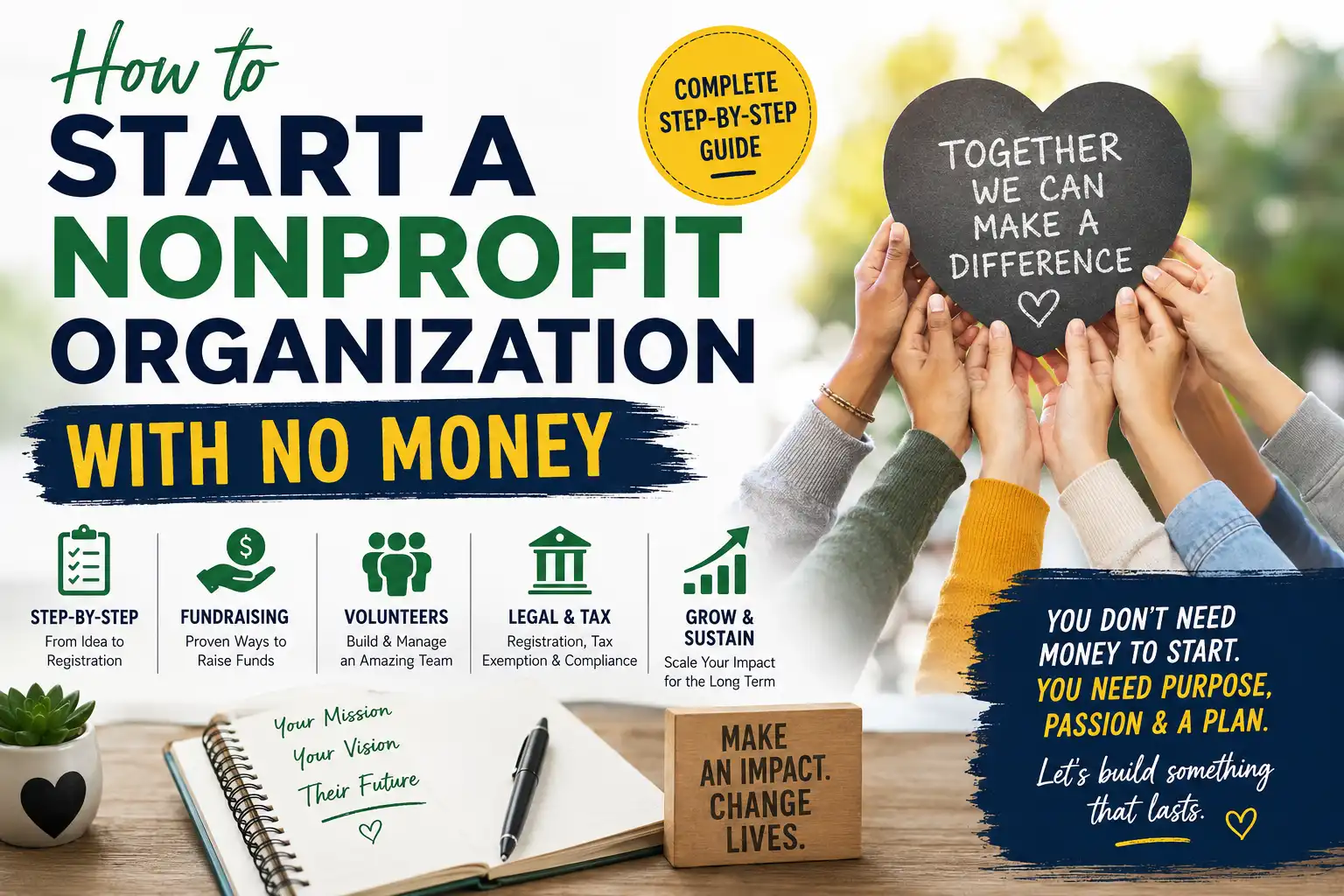
Starting a nonprofit organization is one of the most meaningful ways to create lasting change in your community. Whether your passion is helping children receive quality education, feeding hungry families, protecting animals, supporting senior citizens, promoting environmental conservation, or improving healthcare access, a nonprofit gives you the opportunity to turn your vision into real impact.
Many people believe that starting a nonprofit requires thousands of dollars, a large office, paid employees, or wealthy donors. Fortunately, that is one of the biggest misconceptions. Countless successful nonprofit organizations started with little more than a clear mission, dedicated volunteers, and a strong commitment to solving a problem. Today’s digital tools, free fundraising platforms, volunteer networks, and grant opportunities have made it easier than ever to launch a nonprofit without significant upfront capital.
However, starting without money does not mean starting without planning. A nonprofit must operate legally, maintain financial transparency, build public trust, and demonstrate measurable impact. Skipping these foundations can lead to compliance issues, fundraising challenges, and loss of credibility.
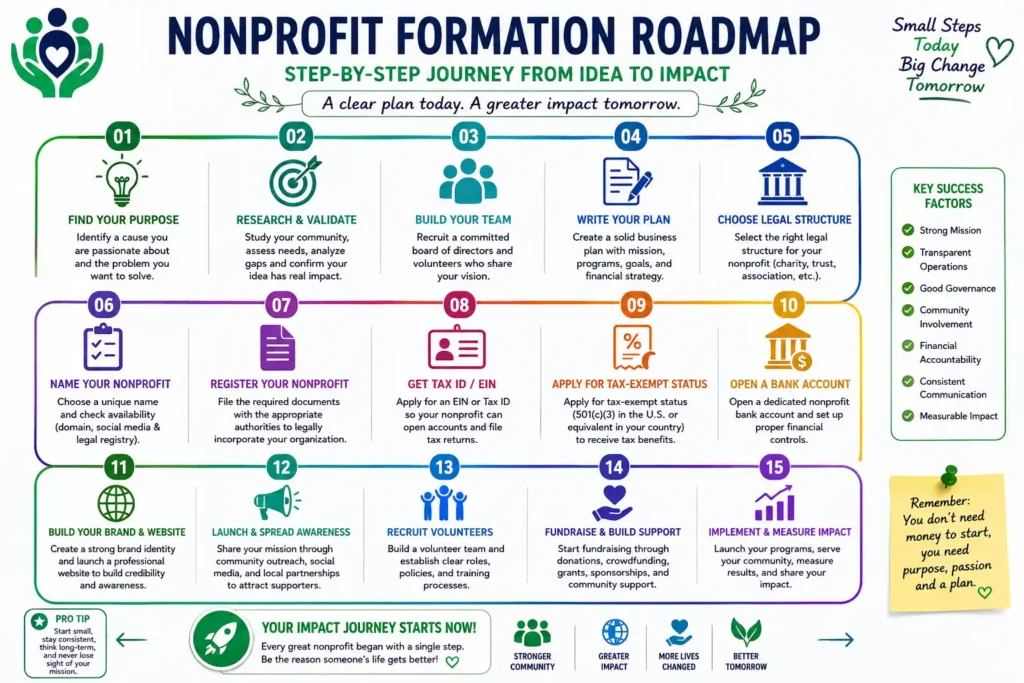
This comprehensive guide walks you through every step of creating a nonprofit organization from scratch, even if your budget is zero. You will learn how to define your mission, validate your idea, recruit volunteers, register your organization, raise funds, build an online presence, and grow sustainably. By the end of this guide, you will have a practical roadmap to launch a nonprofit that serves people effectively and stands the test of time.
Why Start a Nonprofit Organization?
People start nonprofits for many different reasons, but the common goal is always to make a positive difference.
You may want to:
- Help underserved communities
- Improve education
- Support healthcare initiatives
- Rescue abandoned animals
- Protect the environment
- Promote financial literacy
- Assist disaster victims
- Empower women
- Support veterans
- Improve mental health awareness
- Feed homeless individuals
- Preserve culture and heritage
- Promote sports among youth
- Support people with disabilities
- Reduce poverty
- Encourage entrepreneurship
- Provide scholarships
- Promote digital education
Unlike traditional businesses, nonprofits focus on solving social problems rather than maximizing profits. Any surplus income is reinvested into programs and services that support the organization’s mission.
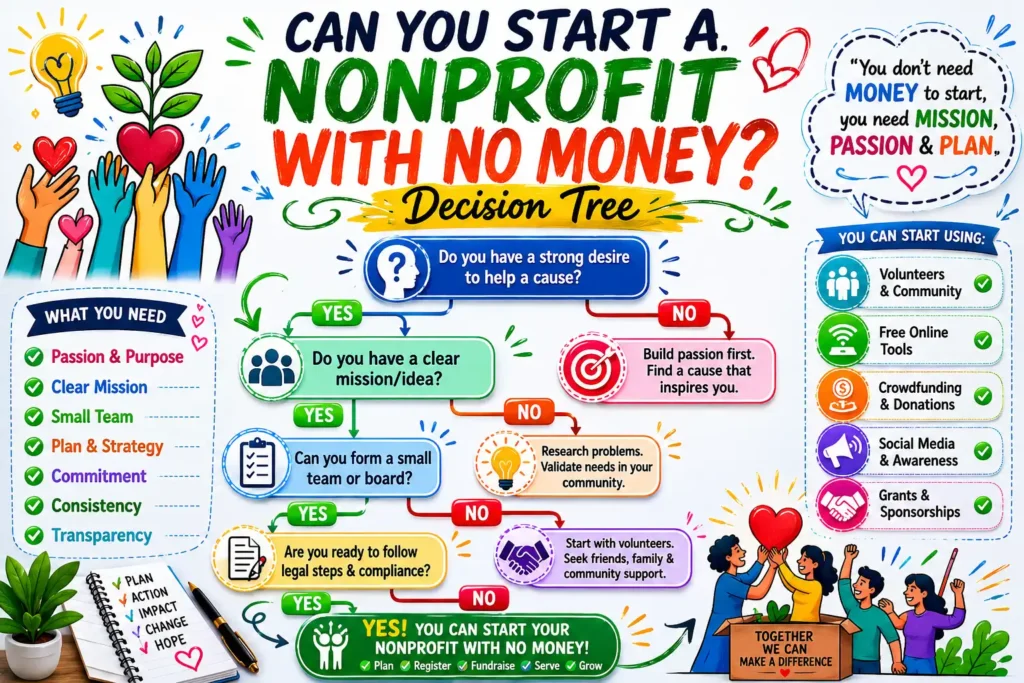
Can You Really Start a Nonprofit With No Money?
The short answer is yes.
Many successful nonprofits started with almost no financial investment.
Instead of relying on money, they relied on:
- Passion
- Volunteers
- Community support
- Free digital tools
- Local partnerships
- Crowdfunding
- Social media
- Grants
- Donations of goods and services
Although some legal registration fees may eventually arise depending on your country or state, many startup expenses can be significantly reduced or eliminated through careful planning.
For example:
| Typical Startup Expense | Average Cost | Free or Low-Cost Alternative |
|---|---|---|
| Office Space | High | Work from home or use community centers |
| Website | Moderate | Free WordPress.com, Google Sites, GitHub Pages |
| Logo Design | Moderate | Canva Free |
| Accounting Software | Moderate | Wave Accounting or spreadsheets |
| Marketing | High | Organic social media and SEO |
| Team Members | High | Volunteers and interns |
| Graphic Design | Moderate | Canva Free |
| Video Meetings | Moderate | Google Meet |
| Moderate | Gmail or Google Workspace for Nonprofits (after approval) | |
| File Storage | Moderate | Google Drive Free |
Starting lean allows you to focus your resources where they matter most—serving your beneficiaries.
How Much Does It Cost to Start a Nonprofit?
The actual cost depends on several factors.
These include:
- Country of registration
- State regulations
- Filing fees
- Legal assistance
- Website development
- Insurance
- Office requirements
- Licenses
- Marketing
Below is a general comparison.
| Expense Category | Traditional Startup | Low-Budget Startup |
|---|---|---|
| Registration | $$ | Minimal |
| Office | $$$ | Home office |
| Website | $$ | Free |
| Staff | $$$$ | Volunteers |
| Marketing | $$$ | Organic marketing |
| Software | $$ | Free nonprofit tools |
| Branding | $$ | DIY branding |
| Accounting | $$ | Free software |
Many organizations successfully launch with less than the cost of registration.
Is Starting a Nonprofit Right for You?
Before starting a nonprofit, ask yourself these important questions.
Do you genuinely care about solving a problem?
A nonprofit should exist to solve a real issue rather than generate income.
Ask yourself:
- What problem am I trying to solve?
- Who benefits?
- Why does this issue matter?
Are you willing to commit your time?
Many nonprofit founders work without salary during the early stages.
You may need to:
- Recruit volunteers
- Organize events
- Write grant proposals
- Manage finances
- Build partnerships
- Promote your mission
Passion and consistency are often more valuable than money during the first year.
Can you build trust?
People donate because they trust organizations.
Transparency is essential.
Your nonprofit should always maintain:
- Honest communication
- Financial accountability
- Ethical leadership
- Clear reporting
- Strong governance
Common Myths About Starting a Nonprofit
Many first-time founders avoid launching because of misinformation.
Let’s clear up some common myths.
Myth 1: You Need Thousands of Dollars
Reality:
Many nonprofits begin from a home office with volunteers and free online tools.
Myth 2: Only Large Organizations Receive Donations
Reality:
Small local nonprofits often receive generous community support because donors can directly see their impact.
Myth 3: You Need Paid Employees
Reality:
Many nonprofits operate successfully for years using volunteers, interns, and board members.
Myth 4: You Must Be a Lawyer
Reality:
Most registration processes can be completed by following official guidelines carefully.
Professional legal advice is helpful for complex cases but is not always mandatory.
Myth 5: You Must Be Famous
Reality:
People support meaningful missions, not celebrity status.
Authenticity matters far more than popularity.
Benefits of Starting a Nonprofit
A nonprofit offers many rewards beyond financial success.
Create Lasting Social Impact
Your work can improve lives for years to come.
Build Strong Community Relationships
Nonprofits naturally bring together volunteers, donors, businesses, and local leaders.
Access Grants
Many governments, corporations, and foundations provide funding exclusively to nonprofit organizations.
Tax Benefits
Registered nonprofits often qualify for valuable tax exemptions.
Corporate Partnerships
Many companies actively seek nonprofit partners through corporate social responsibility (CSR) initiatives.
Volunteer Support
People are often willing to donate their time when they believe in a meaningful cause.
Personal Satisfaction
Helping others can provide a deep sense of purpose and fulfillment.
Challenges You Should Expect
Every nonprofit faces obstacles.
Knowing them in advance helps you prepare.
Limited Funding
The first year may involve raising awareness before raising significant funds.
Volunteer Turnover
Volunteers may leave due to changing schedules or commitments.
Strong leadership helps retain dedicated supporters.
Administrative Work
Running a nonprofit involves more than helping people.
You must also manage:
- Documentation
- Compliance
- Budgets
- Reports
- Meetings
- Policies
Competition
Thousands of nonprofits compete for grants and donations.
A unique mission helps your organization stand out.
Building Credibility
Trust takes time.
Consistent communication and measurable impact gradually establish your reputation.
Characteristics of Successful Nonprofit Founders
Successful founders usually share these qualities.
Passion
They genuinely care about the mission.
Leadership
They inspire volunteers and supporters.
Integrity
They always act honestly and transparently.
Persistence
They continue working even during difficult periods.
Communication Skills
They clearly explain the organization’s purpose.
Adaptability
They adjust strategies when circumstances change.
Financial Responsibility
They manage every donation carefully.
Types of Nonprofit Organizations
There are many types of nonprofits.
Choosing the right focus helps define your future programs.
Educational Organizations
Examples:
- Scholarships
- Schools
- Libraries
- Skill development
- Digital education
Healthcare Organizations
Examples:
- Free clinics
- Health awareness
- Medical camps
- Mental health support
Animal Welfare Organizations
Examples:
- Animal rescue
- Adoption services
- Wildlife conservation
Environmental Organizations
Examples:
- Tree plantation
- Recycling
- Clean water
- Climate action
Poverty Relief Organizations
Examples:
- Food banks
- Shelter programs
- Employment support
Youth Development Organizations
Examples:
- Sports
- Career guidance
- Leadership training
- Mentorship
Women’s Empowerment Organizations
Examples:
- Skill training
- Legal support
- Entrepreneurship
- Health education
Senior Citizen Support Organizations
Examples:
- Healthcare
- Social activities
- Home assistance
Disability Support Organizations
Examples:
- Accessibility
- Employment assistance
- Therapy programs
Arts and Culture Organizations
Examples:
- Museums
- Cultural preservation
- Community events
- Music education
Nonprofit vs Charity vs NGO vs Foundation
Many people use these terms interchangeably, but they have different meanings depending on the country and legal framework.
| Feature | Nonprofit | Charity | NGO | Foundation |
|---|---|---|---|---|
| Primary Goal | Public benefit | Charitable work | Social development | Grant making or charitable work |
| Can Receive Donations | Yes | Yes | Yes | Yes |
| Tax Benefits | Usually | Usually | Depends on country | Usually |
| Earn Revenue | Yes | Yes | Yes | Yes |
| Profit Distribution | Not allowed | Not allowed | Not allowed | Not allowed |
| Common Activities | Education, healthcare, community programs | Relief, poverty support | Advocacy, development projects | Funding other organizations or operating programs |
Understanding these differences helps you choose the most appropriate legal structure during registration.
Choosing the Right Mission
Your mission is the foundation of your nonprofit.
Every future decision will depend on it.
A strong mission should answer three questions.
What problem exists?
Example:
Many rural children lack access to quality education.
Who needs help?
Example:
Children between the ages of 6 and 14 living in underserved villages.
How will your nonprofit help?
Example:
Provide free digital learning resources and teacher training.
When combined, these answers become a mission statement.
Example:
“Our mission is to provide free, high-quality digital education and learning resources to underserved rural children, empowering them with the knowledge and skills needed for a brighter future.”
How to Find the Right Cause
Many aspiring founders struggle to choose a mission because they care about multiple issues. The best nonprofit ideas usually emerge at the intersection of three factors:
- A real community need
- Your knowledge or experience
- Long-term sustainability
Use the following exercise.
Step 1: List Problems You Care About
Write down at least ten issues that matter to you.
Examples:
- Lack of education
- Food insecurity
- Plastic pollution
- Animal abandonment
- Financial illiteracy
- Youth unemployment
- Mental health stigma
- Domestic violence
- Water scarcity
- Digital divide
Step 2: Assess Your Skills
Consider what you can contribute.
Examples:
- Teaching
- Public speaking
- Fundraising
- Accounting
- Healthcare
- Graphic design
- Marketing
- Technology
- Event management
- Legal knowledge
Step 3: Identify Community Needs
Research your local area.
Ask questions such as:
- What problems do residents frequently discuss?
- Which groups receive little support?
- Are existing organizations addressing these issues effectively?
- Where are the biggest service gaps?
The strongest nonprofit ideas solve a clearly identified need while leveraging the founder’s strengths.
Mission Statement Formula
A simple formula can help you craft a clear and compelling mission statement:
We help [target beneficiaries] by [providing a solution] so they can [achieve a positive outcome].
Examples:
- We help low-income students by providing free tutoring so they can improve academic performance.
- We help abandoned animals by offering rescue, rehabilitation, and adoption services so they can find permanent homes.
- We help unemployed youth by delivering vocational training and career guidance so they can secure meaningful employment.
Avoid vague statements like “We want to make the world a better place.” Instead, focus on specific beneficiaries, measurable actions, and intended outcomes.
Validate Your Nonprofit Idea Before Launching
Having a meaningful mission is important, but validating the need ensures your organization addresses a genuine problem rather than assuming one exists.
Before registering your nonprofit, you should:
- Conduct surveys within your target community.
- Interview potential beneficiaries.
- Speak with local leaders and stakeholders.
- Review government reports and census data.
- Analyze existing nonprofits serving similar causes.
- Identify unmet needs or service gaps.
- Assess whether your proposed programs are practical and sustainable.
Validation not only strengthens your strategy but also makes future grant applications and fundraising campaigns more persuasive because you can demonstrate evidence of need rather than relying on assumptions.
Choose the Perfect Name for Your Nonprofit Organization
Your nonprofit’s name is much more than a legal requirement. It is your identity, your brand, and often the first impression donors, volunteers, grant providers, and beneficiaries will have of your organization.
A well-chosen name should instantly communicate your mission, be easy to remember, and build trust.
Before finalizing a name, ask yourself:
- Is it easy to pronounce?
- Is it memorable?
- Does it reflect our mission?
- Is the domain name available?
- Are social media usernames available?
- Is it legally available for registration?
- Is it unique enough to avoid confusion?
A strong nonprofit name makes marketing easier and helps establish credibility from day one.
Characteristics of a Great Nonprofit Name
The best nonprofit names usually share several qualities.
Simple
Avoid complicated words or difficult spellings.
Good Example
- Hope For Tomorrow
Poor Example
- International Community Development Advancement Organization Initiative
Meaningful
The name should communicate your purpose.
Examples
- Clean Water Project
- Animal Rescue Alliance
- Future Scholars Foundation
Easy to Remember
People should be able to recall your name after hearing it once.
Flexible
Choose a name that allows future expansion.
Instead of
“Delhi School Support”
consider
“Education For Every Child”
The second option allows expansion into other cities and programs.
Positive
People naturally support organizations that inspire hope.
Words that often work well include:
- Hope
- Future
- Together
- Care
- Trust
- Helping Hands
- Bright
- Community
- Smile
- Foundation
Naming Mistakes to Avoid
Avoid these common errors.
Using Difficult Words
Complicated names reduce word-of-mouth marketing.
Limiting Future Growth
Avoid including a city name unless your mission will always remain local.
Copying Existing Organizations
This creates legal risks and confusion.
Choosing Long Names
Very long names become difficult to remember and fit poorly on logos.
Ignoring SEO
Search online before choosing your name.
If hundreds of organizations already use similar names, your website may struggle to rank.
Brainstorming Your Nonprofit Name
One effective approach is to combine words from different categories.
| Mission | Positive Word | Community Word |
|---|---|---|
| Education | Bright | Foundation |
| Health | Hope | Alliance |
| Animals | Caring | Society |
| Environment | Green | Initiative |
| Poverty | Better | Network |
Examples
- Bright Future Foundation
- Hope Community Alliance
- Green Earth Initiative
- Better Tomorrow Society
- Caring Hearts Foundation
Check Name Availability
Before registering your nonprofit, verify that the name is available.
Check:
- Government nonprofit registry
- Business registry
- Trademark database
- Domain availability
- YouTube
- X (Twitter)
Using the same name across all platforms strengthens your brand.
Secure Your Online Identity
Even if you do not plan to build a website immediately, secure your digital assets.
Register:
- Domain name
- Social media accounts
- Professional email address
Example
instead of
Professional communication builds donor confidence.
Create a Memorable Tagline
A tagline reinforces your mission.
Examples
Education nonprofit
“Every Child Deserves a Chance.”
Animal rescue
“Saving Lives One Paw at a Time.”
Environment
“Together for a Greener Tomorrow.”
Healthcare
“Health for Every Family.”
Financial literacy
“Knowledge Today. Financial Freedom Tomorrow.”
A good tagline usually contains fewer than ten words.
Build Your Founding Team Without Paying Salaries
One of the biggest myths is that nonprofits need employees from the beginning.
In reality, most successful nonprofits start with volunteers.
Your first team may include:
- Board members
- Volunteers
- Advisors
- Mentors
- Students
- Interns
- Community leaders
A passionate volunteer often contributes more value than a highly paid employee who lacks commitment.
Build Your Core Leadership Team
Every nonprofit needs leaders who share responsibility.
Typical leadership includes:
Executive Director
Responsible for overall operations.
Board Chair
Provides strategic oversight.
Treasurer
Manages finances.
Secretary
Maintains documentation.
Program Manager
Coordinates projects.
Volunteer Coordinator
Recruits and manages volunteers.
Marketing Lead
Handles communication and awareness.
Fundraising Lead
Builds donor relationships.
Initially, one person may perform multiple roles.
Where to Find Volunteers
Many organizations underestimate how many people are willing to help meaningful causes.
Good places include:
Universities
Students often require volunteer experience.
Retired Professionals
Retired teachers, doctors, accountants, and executives possess valuable experience.
Religious Organizations
Many faith communities actively support charitable work.
Community Centers
Local organizations frequently connect volunteers with nonprofits.
Corporate Volunteer Programs
Many companies encourage employees to volunteer.
Friends and Family
Never underestimate personal networks.
Social Media
Facebook groups
Community WhatsApp groups
Volunteer websites
Many websites specialize in connecting volunteers with nonprofits.
How to Attract Volunteers
People rarely volunteer because they are asked.
They volunteer because they believe in the mission.
Instead of saying
“We need volunteers.”
Say
“Help 500 children receive free education this year.”
People connect with impact.
Volunteer Recruitment Checklist
Your volunteer page should answer:
What is your mission?
Why does it matter?
Who can volunteer?
How much time is required?
What skills are needed?
What impact will volunteers create?
How do they apply?
Retaining Volunteers
Recruitment is only the first step.
Retention matters even more.
Ways to retain volunteers
Recognize achievements
Provide certificates
Celebrate milestones
Offer training
Give leadership opportunities
Share success stories
Maintain regular communication
Happy volunteers become your strongest ambassadors.
Build a Strong Board of Directors
The board governs the nonprofit.
They ensure accountability.
Most countries require multiple board members.
Choose individuals who bring different skills.
Examples
Lawyer
Accountant
Teacher
Business owner
Healthcare professional
Marketing expert
Community leader
Technology specialist
Fundraising expert
Avoid selecting board members solely because they are friends.
Skill diversity strengthens governance.
Responsibilities of Board Members
Approve budgets
Review strategy
Monitor compliance
Hire executive leadership
Approve policies
Manage organizational risk
Protect donor trust
Represent the nonprofit publicly
Create a Professional Business Plan
A nonprofit also needs a business plan.
Although your goal is social impact instead of profit, donors and grant providers still expect clear planning.
A business plan demonstrates:
Professionalism
Long-term sustainability
Financial responsibility
Operational readiness
Grant readiness
Executive Summary
Provide a concise overview.
Include
Mission
Vision
Programs
Beneficiaries
Funding strategy
Goals
Expected impact
Keep it under one page.
Organization Description
Explain
Why the organization exists
Who it serves
What problems it solves
Long-term vision
Legal structure
Problem Statement
Clearly explain the issue.
Support your statements with statistics.
Example
Over 40% of students in rural communities lack access to quality digital education.
Specific data strengthens grant proposals.
Mission Statement
State exactly what your nonprofit does.
Example
“Our mission is to improve financial literacy among underserved youth through free education, mentorship, and community programs.”
Vision Statement
Describe the future you hope to create.
Example
“A world where every young adult possesses the financial knowledge necessary for lifelong prosperity.”
Core Values
Examples
Integrity
Transparency
Compassion
Innovation
Collaboration
Inclusion
Respect
Accountability
Target Beneficiaries
Describe your audience.
Include
Age
Location
Income
Education
Challenges
Needs
Example
Young adults aged 18–30 from low-income communities seeking financial education.
Programs and Services
Explain each planned program.
Example
Financial literacy workshops
Scholarship assistance
Online learning platform
Career mentoring
Emergency financial counseling
Include measurable outcomes whenever possible.
Marketing Strategy
How will people discover your nonprofit?
Examples
SEO
Social media
Email newsletters
Community events
Partnerships
Local newspapers
Schools
Universities
Referral programs
Public speaking
Fundraising Strategy
Explain funding sources.
Individual donations
Corporate sponsors
Membership fees
Grants
Crowdfunding
Events
Major donors
Recurring donors
Merchandise
Online campaigns
Diversifying income improves long-term stability.
Financial Plan
Estimate
Income
Expenses
Program costs
Administrative costs
Marketing
Technology
Insurance
Emergency reserve
Review this budget every quarter.
Key Performance Indicators (KPIs)
Measure your progress using indicators such as:
Volunteers recruited
Beneficiaries served
Funds raised
Donor retention
Programs completed
Website visitors
Social media engagement
Volunteer retention
Community partnerships
Grant approvals
KPIs help demonstrate impact to donors and funding organizations.
Validate Your Nonprofit Idea Before Registration
Many nonprofits fail because they assume a problem exists without conducting research.
Validation reduces risk.
Conduct Community Surveys
Ask questions such as:
What challenges do you face?
Which services are missing?
Would you use this program?
How could the program improve?
Collect responses from at least 100 people if possible.
Interview Stakeholders
Speak with:
Teachers
Doctors
Local businesses
Government officials
Community leaders
Religious leaders
Social workers
These conversations provide valuable insights.
Study Existing Organizations
Research organizations working in the same field.
Identify
Programs
Strengths
Weaknesses
Funding methods
Volunteer models
Community reach
This analysis helps you identify gaps rather than duplicating existing services.
Conduct a SWOT Analysis
Evaluate your organization’s internal and external environment.
| Strengths | Weaknesses |
|---|---|
| Passionate volunteers | Limited funding |
| Strong mission | Small team |
| Community support | New organization |
| Opportunities | Threats |
|---|---|
| Government grants | Economic downturn |
| Corporate CSR | Competition |
| Social media | Changing regulations |
| Community partnerships | Donor fatigue |
Review your SWOT analysis regularly as your nonprofit grows.
Analyze Community Needs
Look beyond assumptions.
Gather information from:
Government reports
Research studies
School statistics
Healthcare records
Employment data
Population surveys
Local newspapers
Community meetings
Evidence-based planning significantly improves grant approval chances.
Test Your Programs Before Launch
Rather than creating a large organization immediately, run a small pilot project.
Example
Instead of planning education for 5,000 students,
start by teaching 30 students.
Measure:
Participation
Feedback
Outcomes
Costs
Challenges
Lessons learned
Pilot programs demonstrate proof of concept and strengthen future funding applications.
Develop a Strategic Roadmap
A roadmap keeps your nonprofit focused during its first year.
Example
Month 1
Research community needs
Develop mission
Choose name
Recruit board
Month 2
Write business plan
Create policies
Develop branding
Month 3
Register organization
Open bank account
Launch website
Month 4
Recruit volunteers
Start fundraising
Pilot first program
Breaking large goals into monthly milestones makes progress more manageable and measurable.
Prepare Essential Organizational Documents
Before filing for registration, begin drafting the documents that nearly every nonprofit will need:
- Mission statement
- Vision statement
- Core values
- Board member profiles
- Conflict of interest policy
- Code of ethics
- Volunteer policy
- Financial management policy
- Data privacy policy
- Child and vulnerable adult protection policy (if applicable)
- Risk management policy
- Strategic plan
- Annual budget
- Program descriptions
Having these documents ready demonstrates professionalism to regulators, donors, banks, and grant makers.
Choose the Right Legal Structure for Your Nonprofit
Selecting the correct legal structure is one of the most important decisions you will make. It affects taxation, governance, fundraising opportunities, legal compliance, and public trust.
Choosing the wrong structure can result in unnecessary taxes, compliance issues, or restrictions on receiving grants and donations.
Before registering your nonprofit, understand the different legal options available in your country.
Common Types of Nonprofit Organizations
Although the terminology varies by country, most nonprofit organizations fall into one of the following categories.
Charitable Organization
A charitable organization primarily serves the public by providing programs or services in areas such as education, healthcare, poverty relief, environmental protection, religion, or disaster relief.
Best suited for:
- Education
- Healthcare
- Community development
- Poverty reduction
- Religious activities
Advantages
- Eligible for grants
- Eligible for tax exemptions
- Public trust
- Can receive donations
Disadvantages
- Strict reporting requirements
- Regular compliance filings
Foundation
A foundation generally provides grants to individuals or organizations rather than operating programs directly.
Best suited for
- Family philanthropy
- Corporate giving
- Scholarship programs
- Research funding
Advantages
- Long-term impact
- Investment-based funding
Disadvantages
- More complex administration
Association
Associations are membership-based organizations.
Examples
- Sports clubs
- Trade associations
- Professional societies
- Alumni organizations
Advantages
- Democratic governance
- Strong community engagement
Disadvantages
- Member management can become complex
Trust
A trust manages assets for charitable purposes.
Common examples
- Educational trusts
- Religious trusts
- Scholarship trusts
Advantages
- Long-term asset protection
Disadvantages
- Less operational flexibility in some jurisdictions
Which Structure Is Right for You?
Use the following comparison.
| Goal | Recommended Structure |
|---|---|
| Education | Charitable Organization |
| Animal Rescue | Charitable Organization |
| Scholarships | Foundation |
| Research Funding | Foundation |
| Community Sports | Association |
| Religious Activities | Trust or Charity |
| Environmental Projects | Charitable Organization |
| Financial Literacy | Charitable Organization |
Always review your country’s regulations before making a final decision.
Country-Specific Registration Overview
The registration process varies depending on where you live.
United States
Most nonprofits register at both the state and federal levels.
Typical steps include
- Choose a name
- File Articles of Incorporation
- Obtain an Employer Identification Number (EIN)
- Draft bylaws
- Hold the first board meeting
- Apply for federal tax-exempt status
- Register for charitable solicitation if required
United Kingdom
Organizations commonly register as
- Charitable Incorporated Organisation (CIO)
- Charitable Trust
- Company Limited by Guarantee
Registration usually involves
- Governing document
- Trustees
- Charity registration
- Annual reporting
Canada
Registration generally includes
- Incorporation
- Charitable registration
- Tax account setup
- Annual returns
Australia
Organizations often register as
- Incorporated Association
- Company Limited by Guarantee
Additional registration may be required for tax concessions.
India
Common nonprofit structures include
- Trust
- Society
- Section 8 Company
Each structure has different registration requirements, governance rules, and compliance obligations.
Documents Required Before Registration
Prepare all documents before beginning the registration process.
Typical documents include
- Organization name
- Mission statement
- Vision statement
- Objectives
- Registered office address
- Identity proof of founders
- Address proof
- Board member information
- Bylaws
- Articles of Incorporation or Memorandum
- Conflict of Interest Policy
- Meeting minutes
- Financial plan
Creating a checklist helps avoid delays.
Registration Checklist
| Task | Status |
|---|---|
| Organization Name Finalized | □ |
| Mission Statement Completed | □ |
| Board Members Selected | □ |
| Bylaws Drafted | □ |
| Registration Forms Prepared | □ |
| Office Address Available | □ |
| Identity Documents Ready | □ |
| Initial Budget Prepared | □ |
| Strategic Plan Completed | □ |
Draft Your Nonprofit Bylaws
Bylaws are the operating rules of your organization.
They define how the nonprofit will function.
Well-written bylaws reduce confusion and future conflicts.
Your Bylaws Should Include
Organization Name
Official registered name.
Mission
Purpose of the nonprofit.
Board Structure
Number of directors
Eligibility
Term limits
Election process
Removal process
Meetings
Frequency
Notice requirements
Voting procedures
Quorum requirements
Officer Responsibilities
Chairperson
Treasurer
Secretary
Executive Director
Committee Leaders
Financial Policies
Budget approval
Expense authorization
Record keeping
Annual audits
Conflict of Interest Policy
Board members should disclose any personal interests that could influence decisions.
Amendment Procedures
Explain how bylaws may be updated in the future.
Hold Your First Board Meeting
The first board meeting officially launches your nonprofit’s governance.
Prepare an agenda covering
- Welcome
- Mission approval
- Adoption of bylaws
- Appointment of officers
- Approval of registration
- Budget discussion
- Bank account authorization
- Future meeting schedule
Always record meeting minutes.
These records may be required during audits or grant applications.
Apply for Tax-Exempt Status
Tax exemption allows qualifying nonprofits to reduce or eliminate certain taxes.
Benefits include
- Tax savings
- Increased donor confidence
- Eligibility for grants
- Corporate partnerships
- Donation deductions in many jurisdictions
Before Applying
Ensure you have
- Registered organization
- Governing documents
- Financial projections
- Board information
- Program descriptions
Common Reasons Applications Are Rejected
Incomplete documentation
Missing signatures
Poor mission description
Private benefit concerns
Weak governance
Incomplete financial information
Carefully reviewing every document before submission improves approval chances.
Obtain a Tax Identification Number
Most nonprofits require a tax identification number before opening a bank account or hiring employees.
Depending on your country, this may be called
- EIN
- Tax ID
- Business Number
- PAN-based registration
- Organization Tax Number
Apply immediately after registration.
Open a Nonprofit Bank Account
Never mix personal and nonprofit finances.
Separate banking protects your organization and improves transparency.
Documents Usually Required
Registration certificate
Tax identification number
Board resolution
Identification documents
Proof of address
Organization bylaws
Features to Look For
Low fees
Online banking
Multiple signatories
Donation tracking
Mobile app
Payment gateway integration
Good customer service
Best Practices for Managing Donations
Transparency is essential.
Always
Issue receipts
Maintain donation records
Separate restricted and unrestricted funds
Track expenses
Publish annual reports
Maintain accurate bookkeeping
These practices build donor trust.
Create a Financial Management Policy
Every nonprofit should establish financial policies before receiving donations.
Include
Budget preparation
Expense approval limits
Cash handling procedures
Donation acceptance
Petty cash rules
Procurement guidelines
Asset management
Financial reporting schedule
Audit procedures
A written policy protects both donors and board members.
Build Your Nonprofit Website for Free
A professional website is your digital headquarters.
Fortunately, you do not need an expensive web developer.
Essential Pages
Home
About Us
Our Mission
Programs
Volunteer
Donate
Success Stories
Annual Reports
Blog
Contact
Privacy Policy
Terms of Use
Accessibility Statement
Free Website Platforms
| Platform | Best For | Cost |
|---|---|---|
| WordPress.com | Blogs and nonprofits | Free |
| Google Sites | Small organizations | Free |
| GitHub Pages | Technical users | Free |
| Wix | Beginners | Free Plan |
| Weebly | Simple websites | Free Plan |
If your budget allows later, migrate to self-hosted WordPress for better flexibility.
Build a Professional Brand
Strong branding increases recognition and trust.
Create a Logo
A good nonprofit logo should be
Simple
Memorable
Scalable
Relevant
Timeless
Avoid excessive colors or complex graphics.
Choose Brand Colors
Example palette
Blue
Trust
Green
Growth
Orange
Energy
Purple
Compassion
Select two to four primary colors.
Select Fonts
Use readable fonts throughout your website and marketing materials.
Maintain consistency.
Create Your Brand Voice
Every communication should sound consistent.
Your nonprofit’s voice should be
Helpful
Honest
Positive
Professional
Encouraging
Avoid exaggerated claims.
Develop a Content Strategy
Content helps educate supporters and attract donors.
Publish articles about
Your mission
Success stories
Volunteer experiences
Community impact
Educational resources
Program updates
Fundraising campaigns
Frequently asked questions
Consistency matters more than volume.
Create Social Media Profiles
Reserve your organization name on
YouTube
X
Threads
Post regularly.
Focus on impact rather than promotion.
Set Up a Professional Email
Instead of using a personal email address, create an official email.
Example
Professional communication improves credibility with donors and grant providers.
Create Essential Policies
Many organizations overlook policies until problems arise.
Prepare these before launching.
Privacy Policy
Explain how personal data is collected and protected.
Volunteer Policy
Describe expectations and responsibilities.
Child Protection Policy
Required if working with minors.
Anti-Harassment Policy
Promote a respectful environment.
Code of Ethics
Guide ethical decision-making.
Data Retention Policy
Specify how records will be stored and retained.
Build a Risk Management Plan
Every nonprofit faces risks.
Examples include
Financial fraud
Volunteer injuries
Cybersecurity threats
Natural disasters
Reputation damage
Legal disputes
Identify
Likelihood
Impact
Mitigation strategies
Review risks annually.
Create Your First Annual Budget
A simple startup budget may include
| Income | Estimated Amount |
|---|---|
| Individual Donations | $2,000 |
| Crowdfunding | $1,500 |
| Local Sponsors | $1,000 |
| Community Events | $500 |
| Total Income | $5,000 |
| Expenses | Estimated Amount |
|---|---|
| Registration Fees | $300 |
| Website | $100 |
| Marketing | $250 |
| Program Costs | $3,000 |
| Insurance | $500 |
| Administrative Costs | $350 |
| Emergency Reserve | $500 |
| Total Expenses | $5,000 |
Adjust these figures based on your country and organization size.
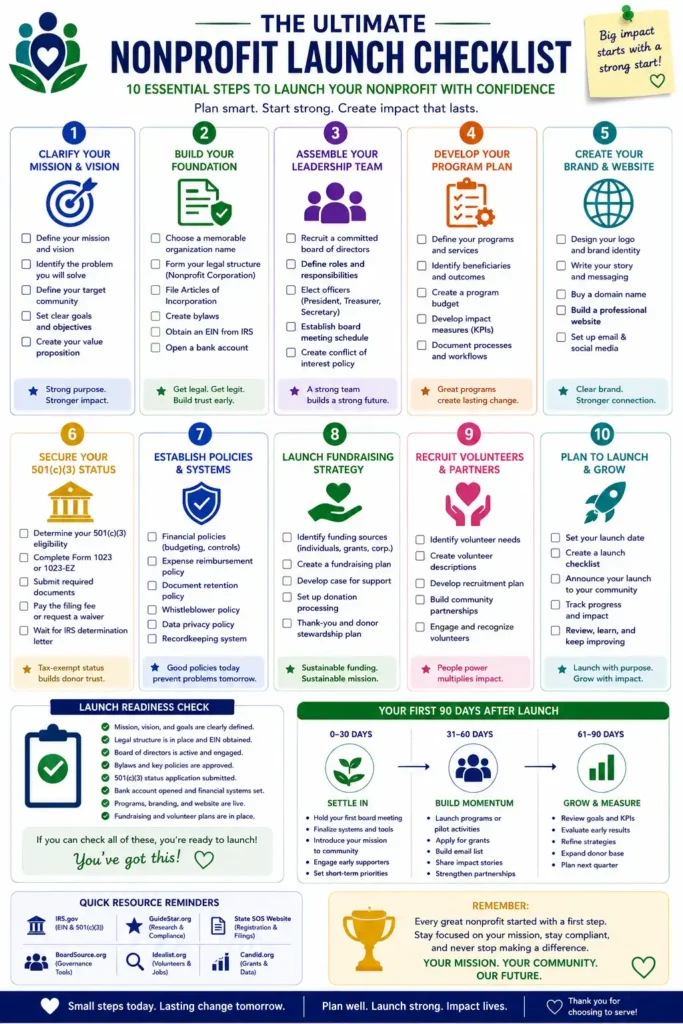
Prepare for Your Public Launch
Before announcing your nonprofit, ensure the following are complete.
Launch Checklist
- Registered organization
- Bank account opened
- Website published
- Social media accounts active
- Donation page working
- Volunteer application ready
- Branding completed
- Board members onboarded
- Financial policies approved
- First project planned
- Press release prepared
- Email newsletter configured
Launching with a strong foundation helps build confidence among donors, volunteers, and community partners.
Raise Your First Funds Without Spending Money

One of the biggest concerns for new nonprofit founders is fundraising. Many believe that donors only support large, well-established organizations. In reality, donors support organizations that solve real problems and clearly communicate their impact.
You do not need a large fundraising budget to raise your first donation. What you need is a compelling mission, transparency, and consistency.
During your first year, focus on building trust before asking for large contributions.
Start With Your Inner Circle
Your first supporters are usually people who already know you.
Reach out to:
- Friends
- Family members
- Neighbors
- Former colleagues
- Classmates
- Local business owners
- Community leaders
Instead of asking for money immediately, explain your mission and invite them to become part of your journey.
Tell a Powerful Story
People donate because they connect with stories, not statistics alone.
Your story should answer:
- What problem exists?
- Why does it matter?
- Who is affected?
- What solution are you providing?
- How will each donation make a difference?
Example
Instead of saying:
“We need donations.”
Say:
“A donation of just $20 provides school supplies for one child for an entire semester.”
Specific examples create emotional connection.
Create a Donation Page That Converts
Your donation page should make giving simple and trustworthy.
Include:
- Mission statement
- Photos
- Success stories
- Donation impact examples
- Secure payment options
- Frequently Asked Questions
- Tax information (if applicable)
- Contact details
Example Donation Impact Table
| Donation Amount | Impact Created |
|---|---|
| $10 | School supplies for one student |
| $25 | Food package for one family |
| $50 | Tree plantation for an entire neighborhood |
| $100 | One medical camp participant |
| $250 | Sponsor vocational training for one student |
| $500 | Fund a community awareness program |
Showing the impact of every donation encourages higher contributions.
Best Free Fundraising Methods
Individual Donations
Ask individuals who believe in your mission.
Use:
- Community meetings
Crowdfunding
Crowdfunding allows hundreds of people to contribute small amounts.
Successful campaigns usually include:
- Clear goal
- Emotional story
- Videos
- Photos
- Progress updates
- Transparent budgeting
Peer-to-Peer Fundraising
Supporters create their own fundraising pages and encourage friends to donate.
Benefits:
- Expands your reach
- Builds community engagement
- Requires little investment
Community Events
You can organize low-cost events such as:
- Charity walks
- Tree plantation drives
- Health camps
- Food drives
- Blood donation camps
- Educational workshops
- Awareness rallies
- Local sports tournaments
Many venues are available free through schools, religious institutions, or community centers.
Corporate Sponsorship
Local businesses often support nonprofit initiatives as part of their corporate social responsibility (CSR) programs.
Approach companies with:
- Sponsorship proposal
- Expected impact
- Marketing benefits
- Recognition opportunities
Monthly Giving Programs
Recurring donations create predictable income.
Even small monthly contributions accumulate significantly over time.
Examples:
- $5 monthly
- $10 monthly
- $25 monthly
- $50 monthly
Recurring donors usually stay engaged longer than one-time contributors.
Create Your First Fundraising Campaign
Every fundraising campaign should answer five questions.
Why?
Explain the problem.
Who?
Identify the beneficiaries.
How?
Describe your solution.
How Much?
Set a realistic fundraising goal.
What Happens Next?
Show exactly how donations will be used.
Campaign Timeline Example
| Week | Activity |
|---|---|
| Week 1 | Prepare campaign materials |
| Week 2 | Launch on website and social media |
| Week 3 | Share beneficiary stories |
| Week 4 | Publish progress updates |
| Week 5 | Thank donors |
| Week 6 | Publish impact report |
Apply for Grants
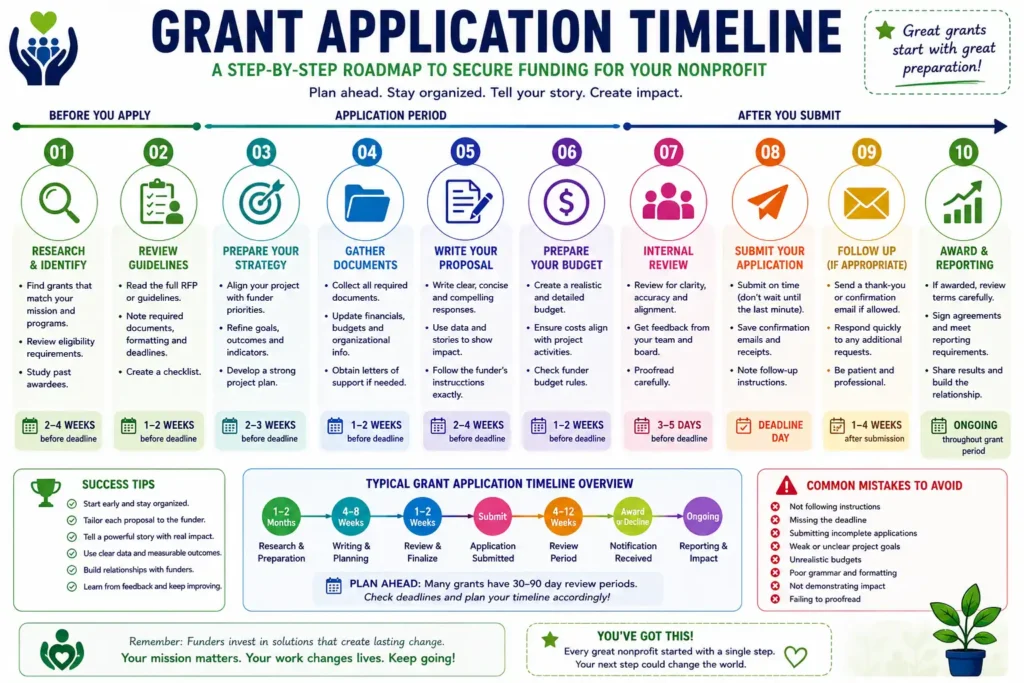
Grants are one of the most reliable funding sources for nonprofits.
However, grant providers rarely fund ideas alone.
They fund organizations with:
- Clear mission
- Proven impact
- Strong governance
- Financial transparency
- Measurable outcomes
Types of Grants
Government grants
Corporate grants
Private foundations
Community foundations
International organizations
Educational grants
Healthcare grants
Environmental grants
Research grants
Technology grants
Prepare Before Applying
Grant applications usually require:
Organization profile
Registration documents
Mission statement
Board information
Financial statements
Annual budget
Strategic plan
Program description
Impact metrics
Monitoring plan
Having these documents prepared saves significant time.
Free Resources Available to Nonprofits
Many companies provide valuable services free or at significant discounts.
Examples include:
Cloud storage
Email services
Graphic design tools
Project management software
Video conferencing
Collaboration tools
Website hosting discounts
CRM software
These resources can save thousands of dollars annually.
Build Partnerships
Partnerships allow nonprofits to grow faster without increasing costs.
Potential partners include:
Schools
Universities
Hospitals
Religious organizations
Community centers
Local governments
Businesses
Media organizations
Volunteer groups
Technology companies
A good partnership benefits both organizations.
Create a Volunteer Program
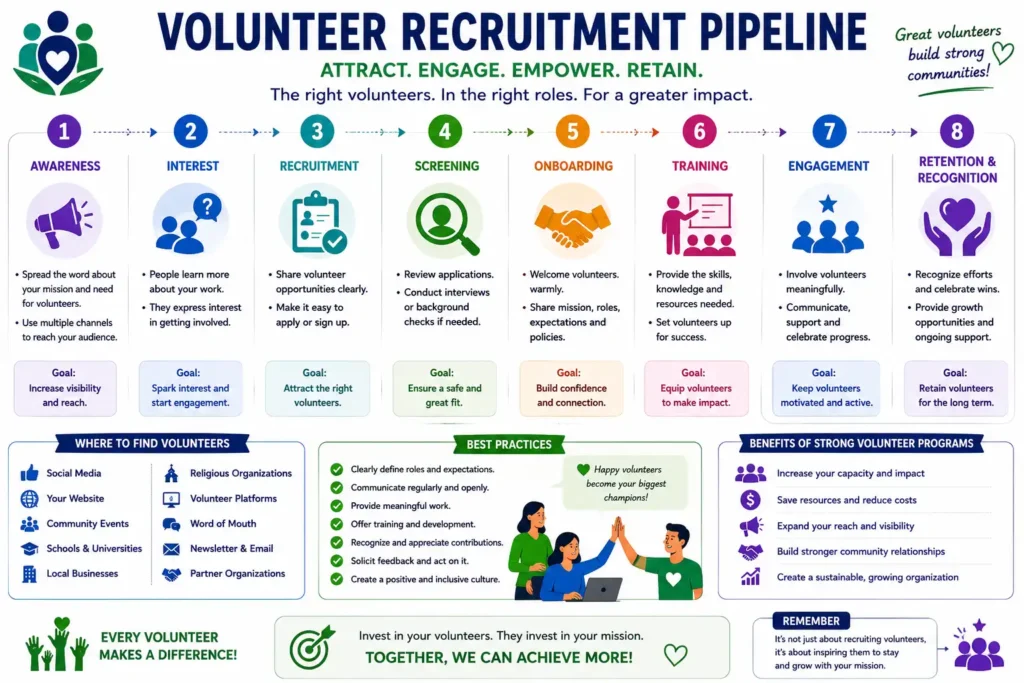
Volunteers are the backbone of many nonprofits.
Instead of assigning random tasks, build a structured program.
Volunteer Roles
Administrative support
Teaching
Fundraising
Photography
Graphic design
Social media
Website management
Event coordination
Community outreach
Translation
Data entry
Accounting
Legal assistance
Volunteer Onboarding Process
Application
Interview
Background verification (if required)
Orientation
Training
Role assignment
Regular feedback
Recognition
A structured process improves volunteer retention.
Train Your Volunteers
Training helps volunteers feel confident and perform effectively.
Topics should include:
Mission and vision
Organization values
Code of conduct
Safety procedures
Communication guidelines
Beneficiary interaction
Reporting process
Emergency contacts
Provide training manuals whenever possible.
Recognize Volunteer Contributions
Recognition improves motivation.
Ideas include:
Certificates
Appreciation letters
Volunteer of the Month
Public recognition
Social media posts
Annual appreciation events
Professional recommendations
Small gestures create lasting loyalty.
Develop a Marketing Strategy
Marketing is not about promoting your organization.
It is about communicating your impact.
Focus on educating your audience rather than constantly asking for donations.
Search Engine Optimization (SEO)
SEO allows potential donors and beneficiaries to discover your nonprofit through search engines.
Publish articles answering common questions related to your mission.
Examples:
How to help homeless families
How to reduce plastic waste
Benefits of financial literacy
Signs of depression
How to volunteer locally
Educational resources naturally attract visitors.
Email Marketing
Email remains one of the highest-converting communication channels.
Send:
Monthly newsletters
Volunteer opportunities
Program updates
Success stories
Upcoming events
Donation campaigns
Annual reports
Maintain a consistent schedule.
Social Media Strategy
Each platform serves a different purpose.
| Platform | Best Use |
|---|---|
| Community engagement | |
| Visual storytelling | |
| Corporate partnerships | |
| YouTube | Educational videos |
| Infographics | |
| X | News and updates |
Focus on storytelling rather than promotion.
Content Ideas for One Month
Week 1
Mission story
Week 2
Volunteer spotlight
Week 3
Beneficiary success story
Week 4
Educational article
Week 5
Fundraising campaign
Week 6
Impact report
Planning content in advance improves consistency.
Build an Email List
Never rely solely on social media.
Create an email subscriber list.
Offer:
Free guides
Educational resources
Volunteer updates
Community news
Event invitations
Email gives you direct communication with supporters.
Measure Your Impact
Donors increasingly want evidence that their contributions create meaningful results.
Measure outcomes rather than activities.
Instead of saying:
“We conducted ten workshops.”
Say:
“Ten workshops helped 450 students improve their financial literacy.”
Impact metrics strengthen fundraising and grant applications.
Example Impact Dashboard
| Metric | Target | Achieved |
|---|---|---|
| Volunteers | 50 | 62 |
| Beneficiaries | 500 | 640 |
| Trees Planted | 2,000 | 2,450 |
| Donations Raised | $10,000 | $11,800 |
| Community Events | 12 | 14 |
Update this dashboard regularly.
Maintain Financial Transparency
Financial transparency is one of the strongest trust-building tools.
Publish:
Annual reports
Program reports
Financial statements
Impact reports
Board information
Major donors (where appropriate)
Policies
Transparency encourages long-term donor relationships.
Create an Annual Report
Every nonprofit should publish an annual report.
Include:
Chairperson’s message
Mission
Vision
Programs completed
Impact statistics
Financial summary
Volunteer recognition
Donor recognition
Future goals
Professional photographs
Annual reports strengthen credibility.
Develop a Risk Management Strategy
Potential risks include:
Fraud
Cybersecurity
Natural disasters
Volunteer injuries
Funding shortages
Reputation damage
Regulatory changes
Board conflicts
Create response plans for each risk.
Maintain Legal Compliance
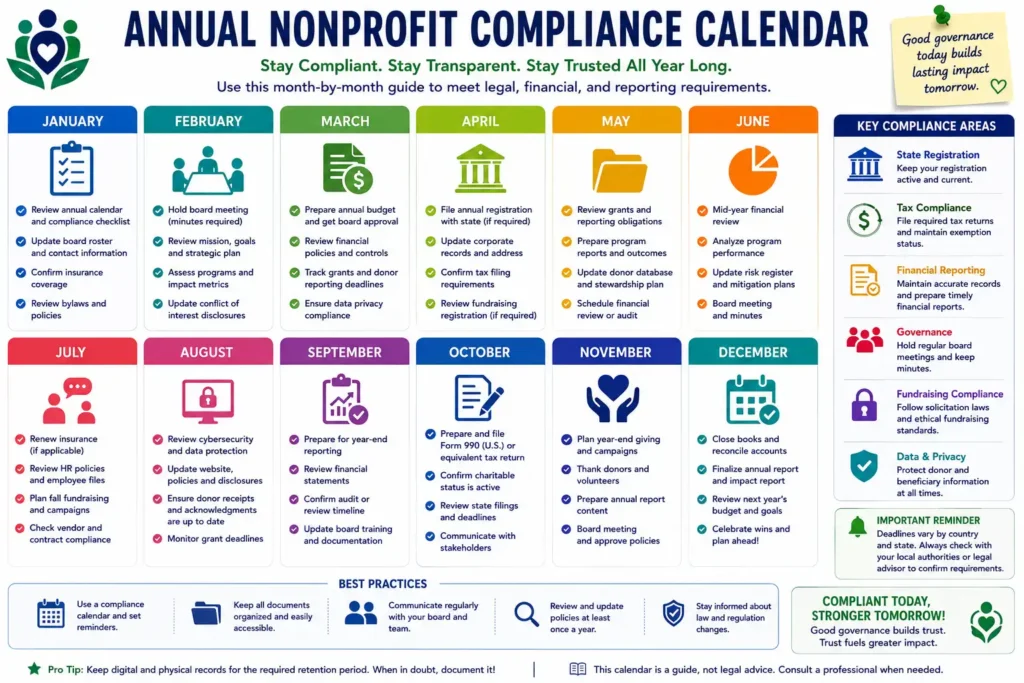
Compliance responsibilities vary by country but often include:
Annual returns
Financial reports
Board meetings
Tax filings
Renewing licenses
Maintaining accurate records
Employment compliance
Fundraising regulations
Missing deadlines can result in penalties or loss of nonprofit status.
Common Mistakes New Nonprofits Make
Avoid these frequent mistakes.
Starting Without Research
Always validate community needs first.
Weak Mission
A vague mission confuses donors.
Depending on One Donor
Diversify funding sources.
Ignoring Marketing
Even excellent programs require visibility.
Poor Financial Records
Maintain accurate bookkeeping from the beginning.
Recruiting the Wrong Board Members
Choose expertise over friendship.
Lack of Strategic Planning
Review goals every quarter.
Doing Everything Alone
Delegate responsibilities.
Measuring Activities Instead of Outcomes
Focus on impact.
Losing Donor Trust
Always communicate honestly.
First-Year Growth Roadmap
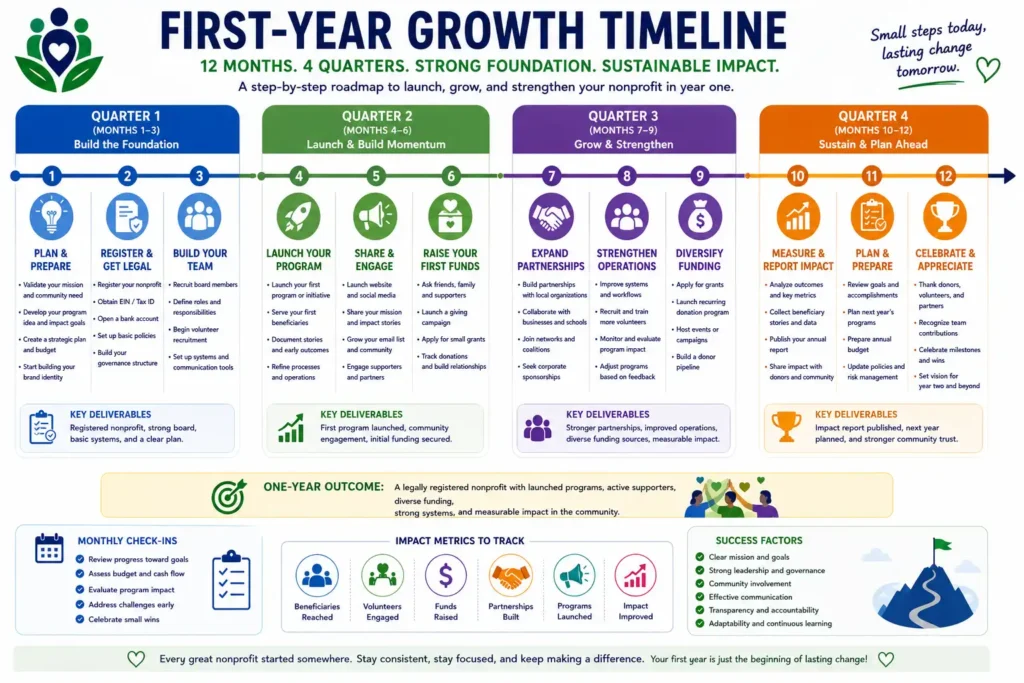
Months 1–3
- Complete registration
- Recruit board members
- Launch website
- Open bank account
- Begin volunteer recruitment
Months 4–6
- Launch first program
- Publish educational content
- Build donor database
- Apply for grants
- Host community events
Months 7–9
- Expand partnerships
- Launch recurring donation program
- Recruit additional volunteers
- Measure program impact
Months 10–12
- Publish annual report
- Review strategic goals
- Prepare next year’s budget
- Expand fundraising campaigns
- Plan future growth
Long-Term Sustainability Strategies
A successful nonprofit focuses on sustainability rather than short-term fundraising.
Diversify your income through:
- Individual donations
- Corporate sponsorships
- Grants
- Membership fees (where applicable)
- Events
- Merchandise
- Training programs
- Consulting services (if permitted)
- Planned giving
- Endowment funds
Never depend on a single funding source.
Expert Tips for Building a Successful Nonprofit
- Solve one problem exceptionally well before expanding.
- Listen to beneficiaries regularly.
- Invest in volunteer development.
- Build strong relationships with local businesses.
- Keep administrative costs reasonable while ensuring quality operations.
- Measure and communicate your impact consistently.
- Stay transparent with finances and governance.
- Continue learning from other successful nonprofit leaders.
- Review your strategic plan annually.
- Celebrate every milestone with your team and supporters.
Frequently Asked Questions
Can I start a nonprofit alone?
You can begin planning alone, but many jurisdictions require a board of directors or trustees for registration.
Can I receive a salary from my nonprofit?
Yes, in many countries, nonprofit employees may receive reasonable compensation for legitimate work, provided it complies with applicable laws and governance policies.
Can a nonprofit earn money?
Yes. A nonprofit can generate revenue through donations, grants, membership fees, program fees, events, and other lawful activities. Any surplus must generally be reinvested in the organization’s mission rather than distributed to owners or shareholders.
How long does registration take?
The timeline varies depending on the country and the completeness of your application. It can range from a few weeks to several months.
What is the biggest reason nonprofits fail?
The most common reasons include unclear missions, weak governance, poor financial management, lack of sustainable funding, and insufficient community engagement.
Final Thoughts
Starting a nonprofit organization with no money is entirely possible when you combine a meaningful mission with thoughtful planning, strong leadership, and consistent action. While financial resources can accelerate growth, they are not the foundation of a successful nonprofit. Trust, transparency, community support, and measurable impact matter far more in the early stages.
Begin by solving one clearly defined problem, build credibility through small but meaningful successes, and document every achievement. As your organization demonstrates real impact, volunteers, donors, partners, and grant providers are far more likely to support your mission.
Remember that every well-established nonprofit started somewhere. With persistence, accountability, and a genuine commitment to serving others, your organization can grow from a simple idea into a lasting force for positive change.