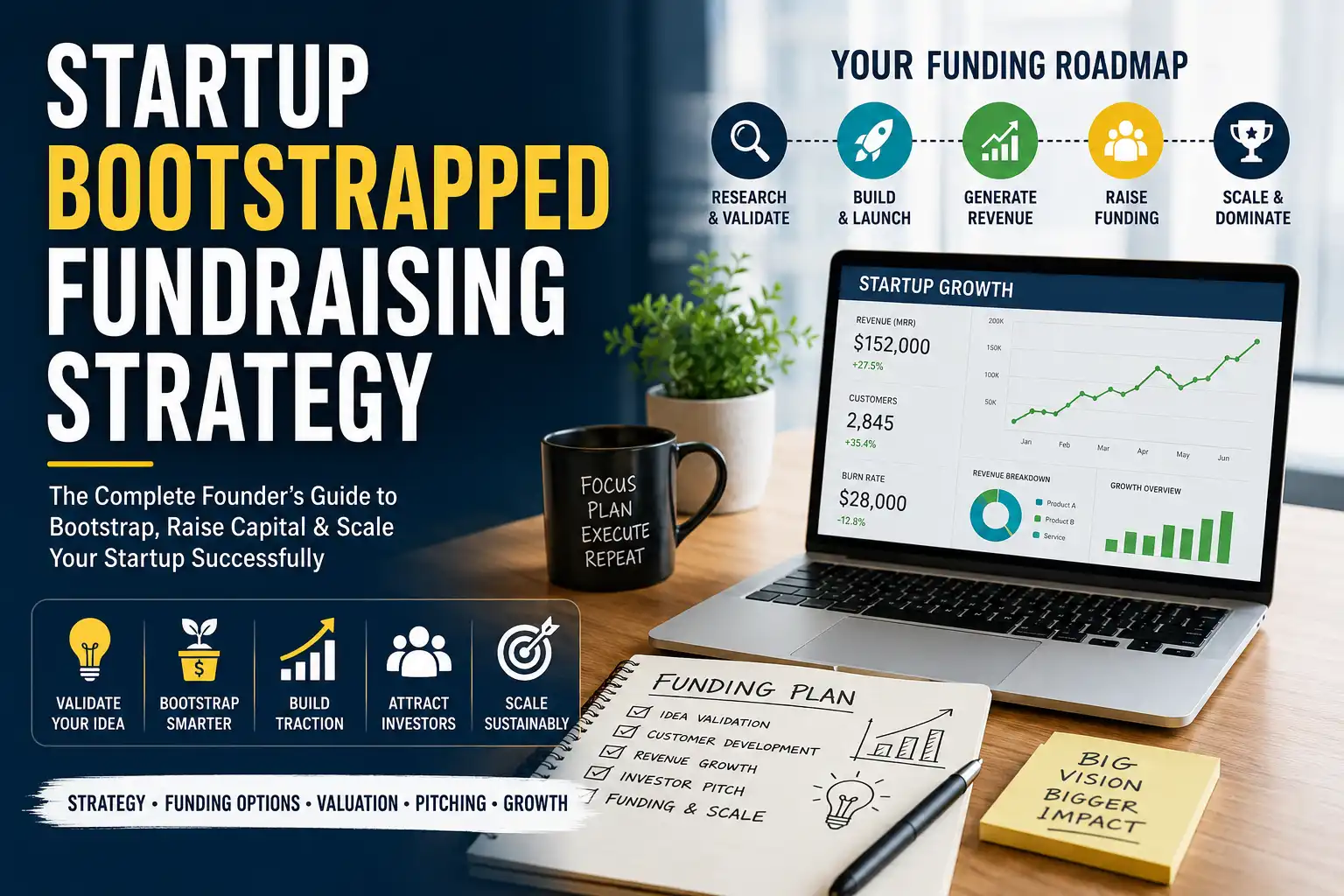
Starting a business has never been easier, but securing funding remains one of the biggest challenges for entrepreneurs. Many founders believe they need venture capital or angel investors from day one. In reality, thousands of successful startups have proven that a Startup Booted Fundraising Strategy can help build a profitable company without giving away ownership too early.
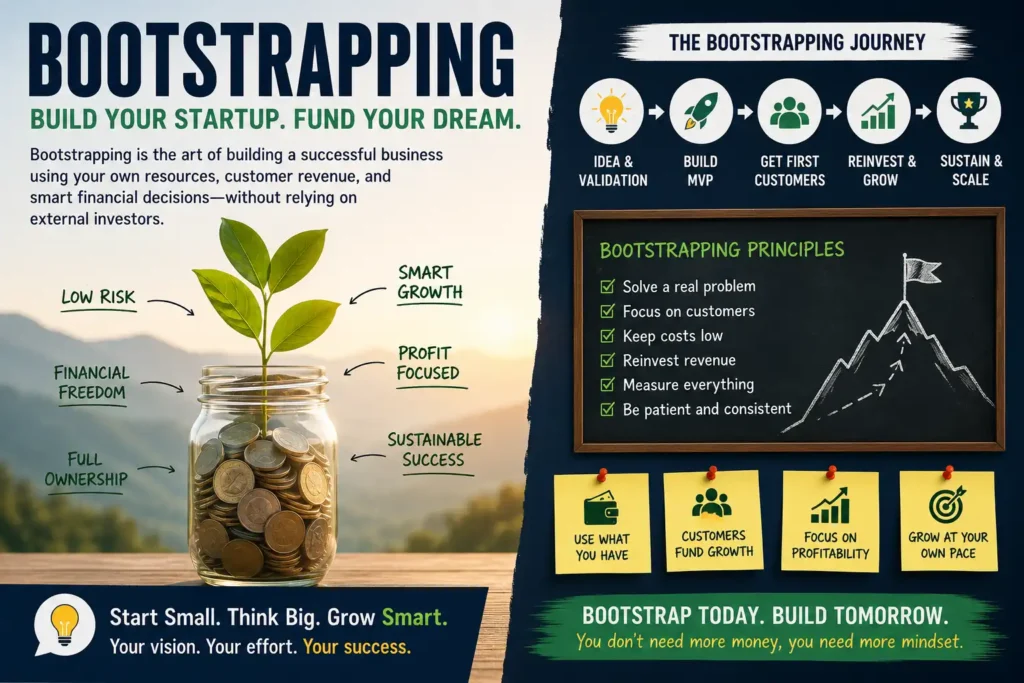
Bootstrapping is more than using your own savings. It is a mindset of building a business through disciplined spending, customer revenue, and sustainable growth. A well-planned startup booted fundraising strategy allows founders to maintain control, improve valuation, and negotiate better terms when they eventually decide to raise external capital.
This guide explains everything you need to know about startup bootstrapped fundraising. Whether you are launching your first business or preparing for your next funding round, you will learn practical strategies that successful founders use to grow efficiently.
What Is a Startup Booted Fundraising Strategy?
A startup booted fundraising strategy is a financial approach where founders build and grow a company using personal resources, early customer revenue, and low-cost financing before seeking institutional investors.
Instead of depending on venture capital from the beginning, founders focus on creating a product that customers are willing to pay for. Revenue generated from these customers becomes the primary source of growth capital.
Unlike traditional fundraising, bootstrapped fundraising emphasizes sustainable expansion rather than rapid scaling at any cost.
The strategy usually includes:
- Founder savings
- Revenue reinvestment
- Customer prepayments
- Small business loans
- Grants
- Strategic partnerships
- Revenue-based financing
- Limited angel investment after achieving traction
The main objective is to increase company value before raising external capital.
Why Bootstrapping Is Becoming More Popular in 2026
The startup ecosystem has changed significantly over the last few years. Investors have become more selective, and startups must now demonstrate stronger financial performance before receiving funding.
Several factors have made bootstrapping more attractive.
Higher Investor Expectations
Investors now expect startups to show:
- Revenue growth
- Product-market fit
- Customer retention
- Efficient operations
- Positive unit economics
Companies that already generate revenue often receive much better funding offers.
AI Has Reduced Startup Costs
Modern AI tools help startups lower expenses by automating tasks such as:
- Customer support
- Marketing
- Content creation
- Coding assistance
- Financial analysis
- Sales outreach
This allows founders to build more with fewer employees.
Cloud Software Is Affordable
Subscription-based software eliminates the need for expensive infrastructure.
Instead of investing millions in technology, startups can access enterprise-level tools for a small monthly fee.
Customers Fund Growth Faster
Digital payments, subscription businesses, and online marketplaces enable startups to generate revenue much earlier than before.
Customer revenue can replace a significant portion of external funding.
How Bootstrapping Differs from Traditional Fundraising
| Factor | Bootstrapped Startup | Investor-Funded Startup |
|---|---|---|
| Ownership | Founder keeps most equity | Equity gets diluted |
| Decision Making | Founder controls strategy | Investors influence decisions |
| Growth | Sustainable | Aggressive |
| Risk | Lower financial pressure | High growth expectations |
| Profitability | Early focus | Often delayed |
| Burn Rate | Low | High |
| Valuation | Improves gradually | Depends on funding rounds |
| Flexibility | High | Lower |
Many successful startups combine both approaches by bootstrapping first and raising capital later.
Why Every Founder Should Bootstrap Before Raising Capital
Bootstrapping provides advantages that many first-time entrepreneurs overlook.
Better Negotiation Power
Companies with paying customers attract stronger investor interest.
Instead of asking investors to believe in an idea, founders can present measurable business results.
This often leads to:
- Higher valuation
- Better investment terms
- Less equity dilution
Greater Financial Discipline
Limited resources encourage founders to focus on activities that directly create value.
Every expense receives careful evaluation.
This discipline often remains even after the company receives funding.
Stronger Product Validation
Customers validate products better than investors.
If customers repeatedly purchase your product, investors gain confidence that your business has market demand.
Long-Term Wealth Creation
Giving away less equity means founders retain a larger share of future profits and company value.
A small reduction in early dilution can translate into millions of dollars during acquisition or IPO.
Benefits of a Startup Booted Fundraising Strategy
You Keep Ownership
Founders maintain decision-making authority.
There is no pressure to satisfy investor expectations during the early stages.
Faster Decision Making
Without investor approvals, founders can:
- Launch products faster
- Experiment quickly
- Pivot when necessary
- Test pricing
- Improve customer experience
Lower Financial Risk
Bootstrapped startups usually spend less.
Lower operating costs reduce financial pressure during uncertain market conditions.
Strong Company Culture
Bootstrapped companies often build cultures based on efficiency, customer satisfaction, and long-term thinking.
Better Capital Efficiency
Every dollar generates maximum impact.
This mindset often creates healthier businesses than companies built through excessive fundraising.
Challenges of Bootstrapped Fundraising
Bootstrapping also has limitations.
Understanding these challenges helps founders prepare better.
Limited Resources
Growth may take longer because funding is limited.
Hiring employees, marketing aggressively, and expanding internationally become more difficult.
Founder Stress
Managing:
- Product development
- Sales
- Marketing
- Customer support
- Finance
can become overwhelming.
Slower Scaling
Competitors with large investments may grow faster.
Bootstrapped startups must compete through innovation and efficiency.
Cash Flow Pressure
Unexpected expenses can quickly reduce available capital.
Careful financial planning becomes essential.
Is Bootstrapping Right for Every Startup?
Not necessarily.
Some industries require significant upfront investment.
Examples include:
- Biotechnology
- Semiconductor manufacturing
- Electric vehicles
- Aerospace
- Pharmaceutical research
However, many businesses can bootstrap successfully.
Examples include:
- SaaS
- Consulting
- Digital marketing agencies
- Software development
- E-commerce
- Education technology
- Creator businesses
- AI tools
- Marketplaces
- Mobile applications
The Different Types of Bootstrapped Funding
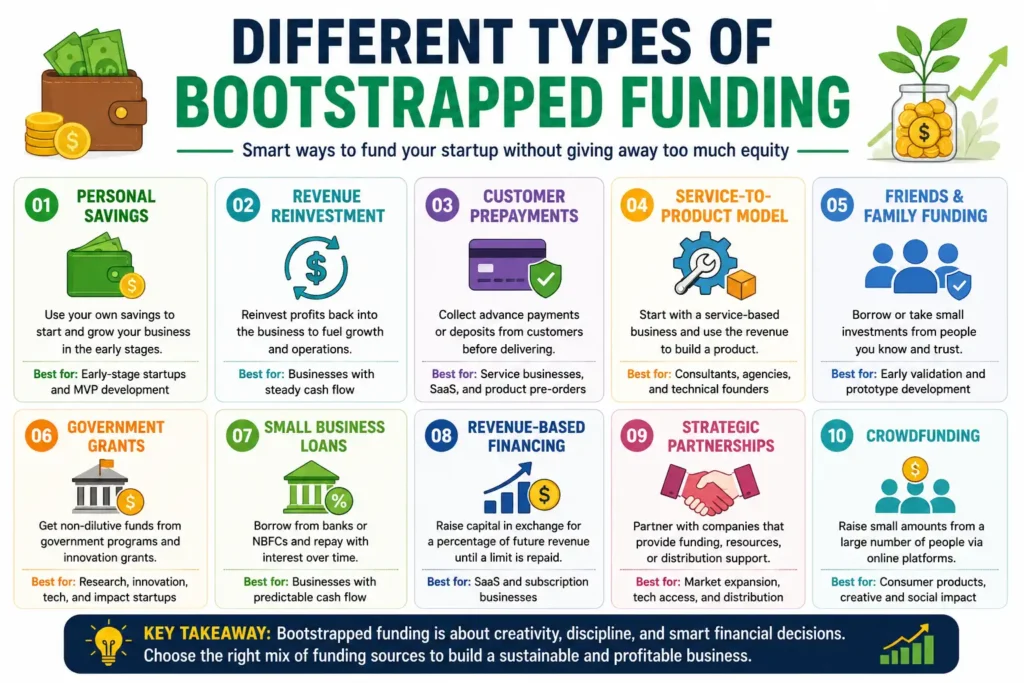
Bootstrapping is not limited to personal savings. Founders often combine multiple funding sources.
Personal Savings
This remains the most common funding source.
Advantages include:
- Full ownership
- Immediate availability
- No repayment obligations
Disadvantages include:
- Personal financial risk
- Limited capital
Revenue Reinvestment
The healthiest startups continuously reinvest profits into growth.
Revenue can fund:
- Marketing
- Hiring
- Technology
- Inventory
- Research
This creates a self-sustaining growth cycle.
Customer Prepayments
Many startups collect payments before delivering products.
Examples include:
- Annual software subscriptions
- Pre-orders
- Memberships
- Enterprise contracts
Customer money finances future operations.
Service-to-Product Model
Many founders begin by offering consulting services.
Revenue from consulting funds product development.
This strategy reduces dependency on investors.
Examples include:
- Marketing agencies developing SaaS
- Software consulting firms launching products
- Designers creating digital templates
Friends and Family Funding
Close friends or relatives may provide early capital.
Always document:
- Investment amount
- Ownership percentage
- Repayment terms
- Legal agreements
Professional documentation helps avoid future disputes.
Government Grants
Many governments support startups through:
- Innovation grants
- Technology grants
- Export assistance
- Research funding
- Incubation programs
Unlike investment, grants generally do not require equity.
Small Business Loans
Debt financing allows founders to retain ownership.
However, repayment obligations require stable cash flow.
Loans work best for businesses with predictable revenue.
The Bootstrapped Growth Cycle
Successful founders usually follow a repeatable growth cycle.
Step 1: Build a simple solution.
↓
Step 2: Launch quickly.
↓
Step 3: Acquire first customers.
↓
Step 4: Collect feedback.
↓
Step 5: Improve the product.
↓
Step 6: Increase revenue.
↓
Step 7: Reinvest profits.
↓
Step 8: Scale operations.
↓
Step 9: Improve valuation.
↓
Step 10: Raise external funding only when necessary.
This cycle minimizes waste while maximizing company value.
Characteristics of Highly Successful Bootstrapped Founders
Successful founders often share similar habits.
They:
- Focus on solving customer problems.
- Spend carefully.
- Measure every business metric.
- Learn quickly from failures.
- Avoid unnecessary hiring.
- Prioritize cash flow over vanity metrics.
- Build products customers genuinely need.
- Think long term instead of chasing short-term growth.
These characteristics create businesses that remain resilient even during economic uncertainty.
Common Myths About Bootstrapping
Myth 1: Bootstrapped Companies Cannot Become Large
Many global businesses started with little or no external funding before expanding significantly.
Myth 2: Investors Only Fund Venture-Backed Companies
Investors often prefer startups that have already demonstrated traction through bootstrapping.
Myth 3: Growth Is Always Slow
Smart execution can produce impressive growth without raising millions of dollars.
Myth 4: Marketing Requires Huge Budgets
Content marketing, SEO, partnerships, referrals, and social media can generate consistent customer acquisition at relatively low cost.
Preparing Your Startup Before Raising Any Money
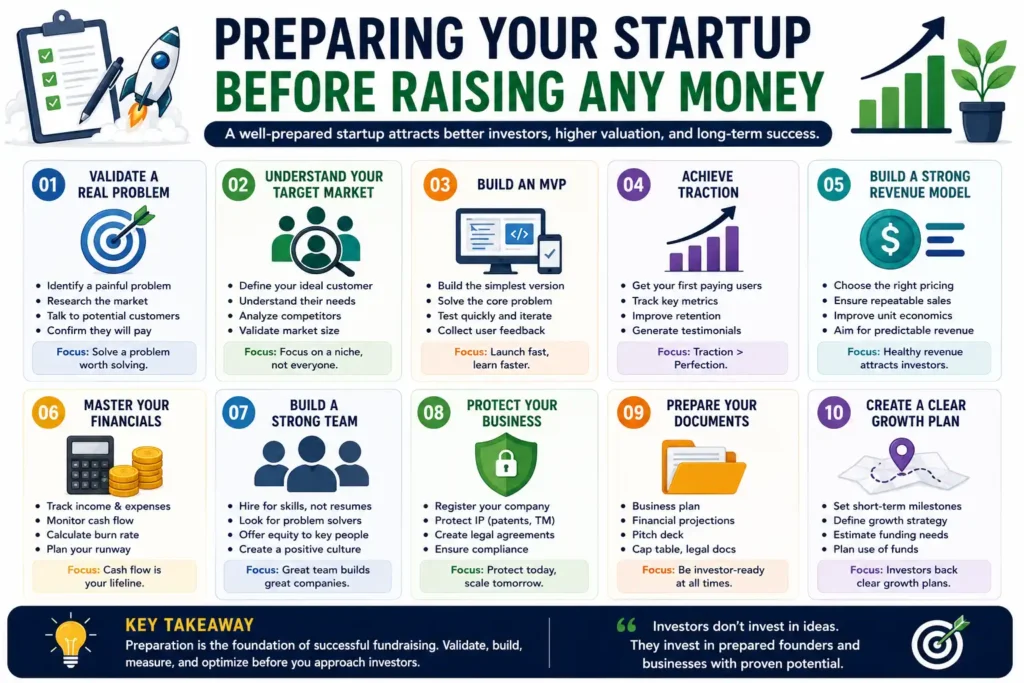
Many founders think fundraising begins when they contact investors. In reality, fundraising starts much earlier. Investors prefer startups that have already solved important business problems before asking for capital.
If your startup has a validated product, paying customers, healthy financial metrics, and a clear growth plan, raising money becomes much easier.
Before approaching any investor, build a strong business foundation.
Validate a Real Market Problem
Investors rarely invest in ideas alone. They invest in businesses that solve real problems.
Start by identifying a pain point that customers face every day.
Ask questions such as:
- What problem are you solving?
- How expensive is the current solution?
- How often does this problem occur?
- Who experiences this problem?
- How urgent is it?
- Are customers already paying for alternatives?
The more painful the problem, the easier it becomes to sell your solution.
Signs You Have Identified the Right Problem
A strong business opportunity usually has these characteristics:
- Customers actively search for solutions.
- Existing products have poor reviews.
- Businesses spend money to solve the problem.
- Customers complain on forums and social media.
- The market continues to grow.
Avoid building products that solve problems customers do not care about.
Understand Your Target Market
Many startups fail because they target everyone.
Successful founders focus on a clearly defined audience.
Instead of saying:
“Our product helps businesses.”
Say:
“Our software helps small accounting firms with fewer than 50 employees automate invoice collection.”
Specific positioning increases marketing effectiveness.
Create an Ideal Customer Profile (ICP)
Build a detailed profile including:
| Category | Example |
|---|---|
| Industry | Healthcare |
| Company Size | 10–100 Employees |
| Annual Revenue | $1M–$20M |
| Location | North America |
| Decision Maker | CEO |
| Biggest Problem | Manual reporting |
| Budget | $5,000–$20,000 annually |
Knowing your ideal customer reduces marketing costs and improves conversion rates.
Validate Product-Market Fit
Product-market fit means customers genuinely want your product.
Without product-market fit, fundraising becomes extremely difficult.
Investors often ask:
- Are customers returning?
- Are they referring others?
- Would they be disappointed if your product disappeared?
- Is demand increasing?
Positive answers indicate strong product-market fit.
How to Measure Product-Market Fit
Useful indicators include:
- Monthly recurring revenue (MRR)
- Customer retention rate
- Churn rate
- Referral rate
- Net Promoter Score (NPS)
- Customer lifetime value (LTV)
- Daily active users
- Monthly active users
Strong metrics increase investor confidence.
Build a Minimum Viable Product (MVP)
An MVP is the simplest version of your product that solves the customer’s primary problem.
The objective is learning—not perfection.
Many founders waste months adding unnecessary features.
Instead:
Launch quickly.
Collect feedback.
Improve continuously.
Characteristics of a Good MVP
A strong MVP should:
- Solve one major problem.
- Be simple to use.
- Require minimal development.
- Be affordable to build.
- Generate customer feedback quickly.
Examples include:
- Landing page
- Mobile app prototype
- No-code SaaS
- Spreadsheet solution
- Manual service before automation
Many billion-dollar companies started with extremely simple MVPs.
Build Early Customer Traction
Revenue speaks louder than presentations.
Investors prefer startups with paying customers.
Even a small number of customers demonstrates market demand.
Focus on acquiring your first:
- 10 customers
- 50 customers
- 100 customers
- 500 customers
Each milestone increases business credibility.
Low-Cost Customer Acquisition Strategies
Instead of expensive advertising, consider:
- SEO
- LinkedIn outreach
- Cold email
- Referral programs
- Content marketing
- Webinars
- YouTube
- Community building
- Industry newsletters
- Strategic partnerships
These channels often produce sustainable long-term growth.
Develop a Sustainable Revenue Model
Investors want predictable revenue.
Choose a pricing model that matches customer behavior.
Common startup revenue models include:
Subscription Model
Customers pay monthly or annually.
Best for:
- SaaS
- Membership platforms
- AI tools
Advantages:
- Predictable cash flow
- High customer lifetime value
- Better valuation
Transaction-Based Model
Revenue comes from each transaction.
Examples:
- Marketplaces
- Payment platforms
- Ticket booking
Freemium Model
Basic features remain free.
Advanced features require payment.
Works well when:
- Customer acquisition costs are low.
- Product usage increases naturally.
One-Time Purchase
Customers pay once.
Common in:
- Online courses
- Digital downloads
- Software licenses
Build Financial Discipline Early
Investors closely examine financial management.
Poor financial discipline often signals poor leadership.
Create systems before raising money.
Track:
- Revenue
- Expenses
- Profit
- Cash flow
- Customer acquisition cost
- Gross margin
- Taxes
- Payroll
Even early-stage startups should maintain organized financial records.
Separate Personal and Business Finances
Many founders mix personal and business expenses.
Avoid this mistake.
Open:
- Business bank account
- Business credit card
- Accounting software
- Expense tracking system
This improves financial transparency.
Create a Startup Budget
Every expense should have a purpose.
A simple startup budget includes:
| Category | Percentage of Budget |
| Product Development | 35% |
| Marketing | 25% |
| Sales | 15% |
| Operations | 10% |
| Customer Support | 5% |
| Legal & Compliance | 5% |
| Emergency Reserve | 5% |
Adjust these percentages according to your industry.
Understand Burn Rate
Burn rate measures how quickly your startup spends cash.
Formula:
Monthly Burn Rate = Monthly Expenses − Monthly Revenue
Example:
Monthly expenses = $40,000
Monthly revenue = $15,000
Burn rate = $25,000
A lower burn rate gives founders more flexibility.
Calculate Your Runway
Runway indicates how long your startup can survive before running out of cash.
Formula:
Runway = Available Cash ÷ Monthly Burn Rate
Example:
Cash available = $300,000
Monthly burn = $25,000
Runway = 12 months
Most investors prefer startups with at least 12–18 months of runway after fundraising.
Monitor Cash Flow Every Week
Profit and cash flow are not the same.
A profitable business can still fail because of poor cash flow.
Track:
- Cash received
- Cash spent
- Outstanding invoices
- Upcoming payments
- Payroll
- Tax obligations
Weekly monitoring helps prevent financial surprises.
Build Strong Unit Economics
Unit economics measure profitability per customer.
Investors study these numbers carefully.
Customer Acquisition Cost (CAC)
CAC measures how much it costs to acquire one customer.
Formula:
CAC = Marketing + Sales Expenses ÷ New Customers
Example:
Marketing spend = $20,000
Sales spend = $10,000
New customers = 500
CAC = $60
Lower CAC usually indicates efficient growth.
Customer Lifetime Value (LTV)
LTV estimates total revenue generated by one customer.
Formula:
Average Revenue × Customer Lifetime
Example:
Monthly subscription = $100
Customer lifetime = 30 months
LTV = $3,000
Higher LTV increases company valuation.
LTV Ratio
Investors prefer a ratio above 3:1.
Example:
LTV = $3,000
CAC = $750
Ratio = 4:1
This indicates healthy customer profitability.
Gross Margin
Gross margin measures profitability after direct costs.
Formula:
(Revenue − Cost of Goods Sold) ÷ Revenue
Higher gross margins generally indicate stronger businesses.
Software companies often maintain margins above 70%.
Build an Investor Dashboard
Create a one-page dashboard showing important business metrics.
Include:
- Monthly Recurring Revenue (MRR)
- Annual Recurring Revenue (ARR)
- Revenue Growth
- Burn Rate
- Runway
- Gross Margin
- Customer Acquisition Cost
- Customer Lifetime Value
- Churn Rate
- Active Customers
- Monthly Signups
- Net Revenue Retention
Update this dashboard every month.
Investors appreciate organized reporting.
Create Standard Operating Procedures (SOPs)
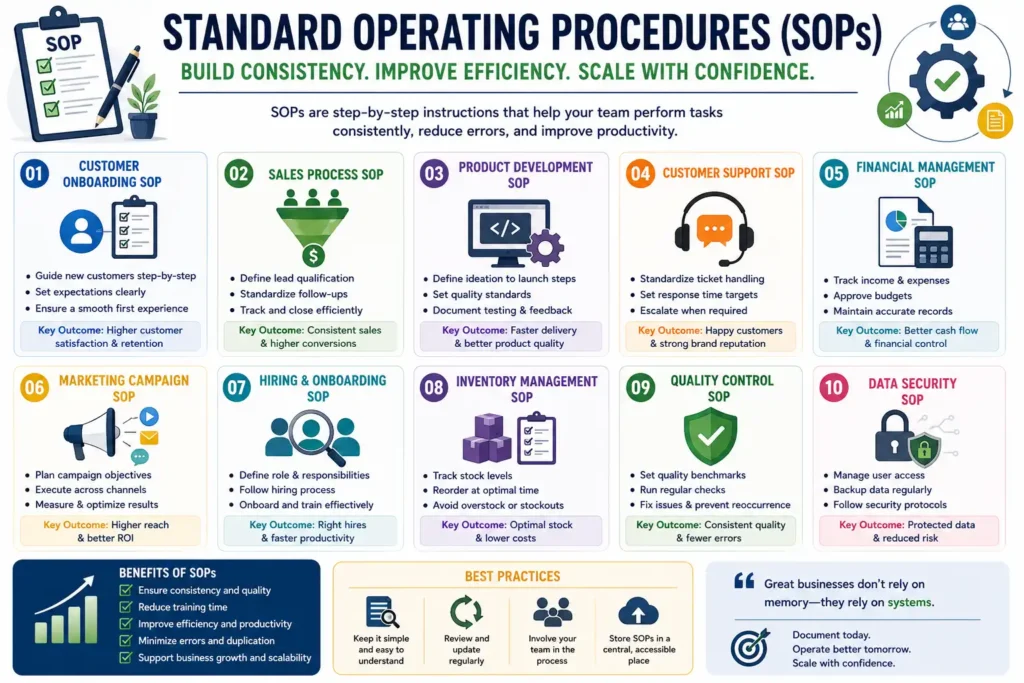
Businesses become more valuable when they rely on systems instead of individuals.
Document processes for:
- Customer onboarding
- Sales
- Marketing
- Product development
- Hiring
- Customer support
- Finance
- Quality assurance
Well-documented operations improve scalability.
Build a Strong Team Before Fundraising
Investors often invest in founders more than products.
Build a team with complementary skills.
A balanced founding team typically includes expertise in:
- Product
- Technology
- Marketing
- Sales
- Finance
- Operations
If skills are missing, advisors can strengthen your startup.
Create an Advisory Board
Experienced advisors increase investor confidence.
Good advisors provide:
- Industry expertise
- Customer introductions
- Hiring support
- Fundraising guidance
- Strategic partnerships
Quality matters more than quantity.
Build Your Brand
Brand trust reduces customer acquisition costs.
Develop consistent:
- Logo
- Website
- Messaging
- Social media presence
- Thought leadership
- Case studies
- Customer testimonials
Professional branding signals credibility.
Protect Your Intellectual Property
Investors want assurance that your innovations are protected.
Consider securing:
- Trademarks
- Copyrights
- Patents
- Domain names
- Software licenses
- Confidentiality agreements
Strong intellectual property can increase valuation.
Create a Data Room
Preparing documents before fundraising speeds up due diligence.
Include:
- Company registration documents
- Financial statements
- Cap table
- Customer contracts
- Employee agreements
- Product roadmap
- Business plan
- Market research
- KPI reports
- Tax filings
- Legal documents
- Intellectual property records
An organized data room creates a positive impression.
Build a Fundraising Roadmap
Do not raise money simply because your cash balance is declining.
Instead, establish milestones.
Example roadmap:
Stage 1
Validate the problem.
↓
Build MVP.
↓
Acquire first 50 customers.
↓
Reach $10,000 MRR.
↓
Improve retention.
↓
Expand marketing.
↓
Reach profitability.
↓
Raise seed funding at a higher valuation.
This approach allows founders to negotiate from a position of strength.
Common Mistakes Before Fundraising
Avoid these errors:
- Building products without customer validation.
- Hiring too quickly.
- Spending heavily on branding before revenue.
- Ignoring financial reporting.
- Raising capital too early.
- Overestimating market size.
- Underestimating customer acquisition costs.
- Lacking a clear revenue model.
- Failing to measure key metrics.
- Waiting until cash runs out before fundraising.
Choosing the Right Funding Source for Your Startup
Once your startup has product-market fit, paying customers, and healthy financial metrics, the next step is deciding where to raise capital. Every funding source has its own advantages, disadvantages, and expectations.
The best founders choose investors who align with their long-term vision rather than accepting the first available offer.
Before raising money, ask yourself these questions:
- How much capital do I actually need?
- What will I use the money for?
- How much ownership am I willing to give away?
- Can I repay debt if I choose financing?
- Do I need strategic guidance or only capital?
Your answers will determine the most suitable funding option.
Bootstrap or Raise External Capital?
Many founders face this important decision.
Use the following comparison to decide.
| Situation | Continue Bootstrapping | Raise External Capital |
|---|---|---|
| Revenue is growing steadily | ✔ | |
| Business is profitable | ✔ | |
| Market opportunity is time-sensitive | ✔ | |
| Competitors are scaling rapidly | ✔ | |
| Large product investment is required | ✔ | |
| Customer demand exceeds capacity | ✔ | |
| You want full ownership | ✔ | |
| Expansion requires significant hiring | ✔ | |
| International growth is planned | ✔ | |
| Cash flow comfortably funds operations | ✔ |
There is no universal answer. The right choice depends on your business goals and industry.
Angel Investors
Angel investors are wealthy individuals who invest their own money in early-stage startups.
They usually invest before venture capital firms become interested.
Advantages
- Fast decision-making
- Industry expertise
- Valuable mentorship
- Business introductions
- Flexible investment terms
Disadvantages
- Equity dilution
- Limited funding capacity
- Different expectations among investors
Typical Investment Size
- $25,000
- $50,000
- $100,000
- $250,000
- $500,000
The amount depends on the startup’s traction and valuation.
Venture Capital
Venture capital firms invest institutional money into startups with high growth potential.
VC funding is suitable for businesses that can scale rapidly.
Examples include:
- Artificial Intelligence
- SaaS
- FinTech
- HealthTech
- DeepTech
- ClimateTech
Advantages
- Large investments
- Industry connections
- Global expansion support
- Hiring assistance
- Strategic guidance
Disadvantages
- Significant equity dilution
- Aggressive growth expectations
- Board oversight
- Higher reporting requirements
VC funding is not suitable for every startup.
Revenue-Based Financing
Revenue-based financing allows startups to receive capital in exchange for a percentage of future revenue.
Unlike venture capital, founders usually keep ownership.
Advantages
- No equity dilution
- Flexible repayment
- Founder retains control
- Works well for SaaS businesses
Disadvantages
- Regular repayments reduce cash flow.
- Revenue must remain consistent.
- Not suitable for pre-revenue startups.
Venture Debt
Venture debt provides loans to startups that already have investor backing.
Instead of issuing new equity, founders borrow money.
This option is commonly used to:
- Extend runway
- Finance expansion
- Purchase equipment
- Delay the next funding round
Government Grants
Governments worldwide support innovative startups.
Common grant categories include:
- Artificial Intelligence
- Healthcare
- Agriculture
- Renewable Energy
- Education
- Manufacturing
- Export Businesses
Benefits
- No equity loss
- No repayment
- Improved credibility
- Additional networking opportunities
Grant applications often require detailed documentation and business plans.
Startup Accelerators
Accelerators help startups grow faster through mentorship, education, and networking.
Most accelerator programs last between three and six months.
They usually provide:
- Seed investment
- Office space
- Mentors
- Investor introductions
- Demo Day presentations
Accelerators can significantly improve fundraising success.
Startup Incubators
Incubators focus on helping very early-stage startups develop their ideas.
Support often includes:
- Business coaching
- Office facilities
- Legal guidance
- Technical assistance
- Product development
Incubators generally work before accelerators.
Crowdfunding
Crowdfunding allows founders to raise money directly from the public.
Several crowdfunding models exist.
Reward-Based Crowdfunding
Customers receive products or rewards.
Suitable for:
- Consumer products
- Gadgets
- Creative projects
Equity Crowdfunding
Investors receive company shares.
Suitable for:
- High-growth startups
- Technology businesses
Donation-Based Crowdfunding
Supporters donate without expecting financial returns.
Common among:
- Social enterprises
- Nonprofits
Debt Crowdfunding
Investors lend money that founders repay over time.
Strategic Corporate Investors
Large companies often invest in startups that complement their business.
Benefits include:
- Industry expertise
- Customer access
- Distribution channels
- Technical resources
- Brand credibility
However, founders should carefully evaluate strategic conflicts before accepting corporate investment.
Friends and Family Funding
Many startups receive their first funding from relatives or close friends.
Although this funding may appear informal, treat it professionally.
Always prepare:
- Shareholder agreement
- Investment contract
- Exit terms
- Ownership allocation
Transparent communication prevents future disputes.
Creating a Fundraising Strategy
Fundraising should never happen randomly.
Instead, develop a structured plan.
Step 1: Define Your Funding Goal
Calculate exactly how much capital you need.
Avoid raising excessive money.
Too much capital can reduce efficiency.
Too little capital creates unnecessary pressure.
Estimate funding requirements for:
- Product development
- Hiring
- Marketing
- Operations
- Legal expenses
- Technology
- Working capital
Step 2: Decide How Long the Money Should Last
Investors expect startups to maintain adequate runway.
A funding round should generally support operations for:
- 18 months
- 24 months
Longer runways reduce fundraising pressure.
Step 3: Decide Your Ideal Valuation
Founders should understand valuation before speaking with investors.
Valuation depends on:
- Revenue
- Growth rate
- Market size
- Team quality
- Intellectual property
- Customer traction
- Competitive advantage
Avoid unrealistic expectations.
Overpricing often discourages investors.
Step 4: Prepare Financial Projections
Financial forecasts demonstrate strategic thinking.
Create projections for:
- Revenue
- Expenses
- Gross profit
- Operating profit
- Cash flow
- Customer growth
- Hiring
- Marketing spend
Investors usually expect three- to five-year projections.
Building a Winning Investor Pitch Deck
Your pitch deck tells your startup’s story.
Keep it concise.
Aim for 12 to 15 slides.
Slide 1: Company Introduction
Include:
- Company name
- Logo
- Mission
- Tagline
Slide 2: Problem
Explain the customer’s pain clearly.
Support it with:
- Statistics
- Customer quotes
- Industry research
Slide 3: Solution
Show how your product solves the problem.
Use screenshots or product demonstrations whenever possible.
Slide 4: Market Opportunity
Present:
- Total Addressable Market (TAM)
- Serviceable Addressable Market (SAM)
- Serviceable Obtainable Market (SOM)
Demonstrate that the opportunity is large enough.
Slide 5: Business Model
Explain:
- Pricing
- Revenue streams
- Customer acquisition
- Profitability strategy
Investors should quickly understand how your startup makes money.
Slide 6: Product
Show:
- Features
- Technology
- Competitive advantages
- Product roadmap
Avoid overwhelming investors with technical details.
Slide 7: Traction
Highlight measurable achievements.
Examples include:
- Revenue growth
- Active customers
- Monthly recurring revenue
- Partnerships
- User growth
- Customer retention
Traction is often the most important slide.
Slide 8: Competitive Landscape
Compare your startup with competitors.
Highlight your unique advantages.
Possible comparison factors include:
- Price
- Features
- Technology
- Customer experience
- Speed
- Scalability
Slide 9: Marketing Strategy
Explain how customers discover your business.
Include acquisition channels such as:
- SEO
- Paid advertising
- Partnerships
- Social media
- Email marketing
- Referral programs
Slide 10: Financial Overview
Present:
- Revenue
- Expenses
- Burn rate
- Gross margin
- Runway
Keep charts simple.
Slide 11: Team
Introduce founders and key employees.
Highlight relevant experience.
Strong teams reduce investor risk.
Slide 12: Investment Ask
Clearly explain:
- Amount requested
- Planned use of funds
- Expected milestones
- Future vision
End with confidence.
Creating an Outstanding Financial Model
A professional financial model helps investors understand future growth.
Your model should include:
Revenue Forecast
Estimate monthly revenue.
Separate revenue by:
- Product
- Customer type
- Geography
- Subscription plan
Expense Forecast
Include:
- Salaries
- Marketing
- Software
- Rent
- Customer support
- Taxes
- Insurance
Hiring Plan
Forecast future hiring.
Investors want to know:
- Who will be hired?
- Why?
- When?
Cash Flow Statement
Show monthly cash movement.
This demonstrates financial planning.
Profit and Loss Statement
Include projected:
- Revenue
- Gross profit
- Operating expenses
- Net profit
Balance Sheet
Prepare projected:
- Assets
- Liabilities
- Equity
Professional financial models increase investor confidence.
How Investors Evaluate Startups
Every investor asks similar questions.
Can this startup become a large business?
Does the team have execution ability?
Is the market growing?
Can competitors easily copy this business?
How profitable can it become?
Will customers continue buying?
Understanding these questions helps founders prepare stronger presentations.
Due Diligence Preparation
Once investors show interest, they begin due diligence.
Typical documents requested include:
- Financial statements
- Tax records
- Customer contracts
- Intellectual property
- Employment agreements
- Shareholder agreements
- Product documentation
- Sales pipeline
- Customer metrics
- Legal compliance records
Preparation speeds up investment decisions.
Red Flags That Make Investors Walk Away
Many startups lose funding opportunities because of avoidable mistakes.
Major warning signs include:
- No paying customers.
- High customer churn.
- Weak financial controls.
- Founder disagreements.
- Unrealistic revenue forecasts.
- Poor product-market fit.
- Excessive monthly burn.
- Legal disputes.
- Incomplete documentation.
- No competitive advantage.
Address these issues before approaching investors.
Building Long-Term Investor Relationships
Fundraising does not begin with your pitch.
It begins months before.
Share regular updates with potential investors.
Include:
- Revenue growth
- Product launches
- Customer milestones
- Team expansion
- Industry recognition
Consistent communication builds trust.
Many investors fund founders they have followed for several months.
Understanding Startup Valuation Before Raising Funds
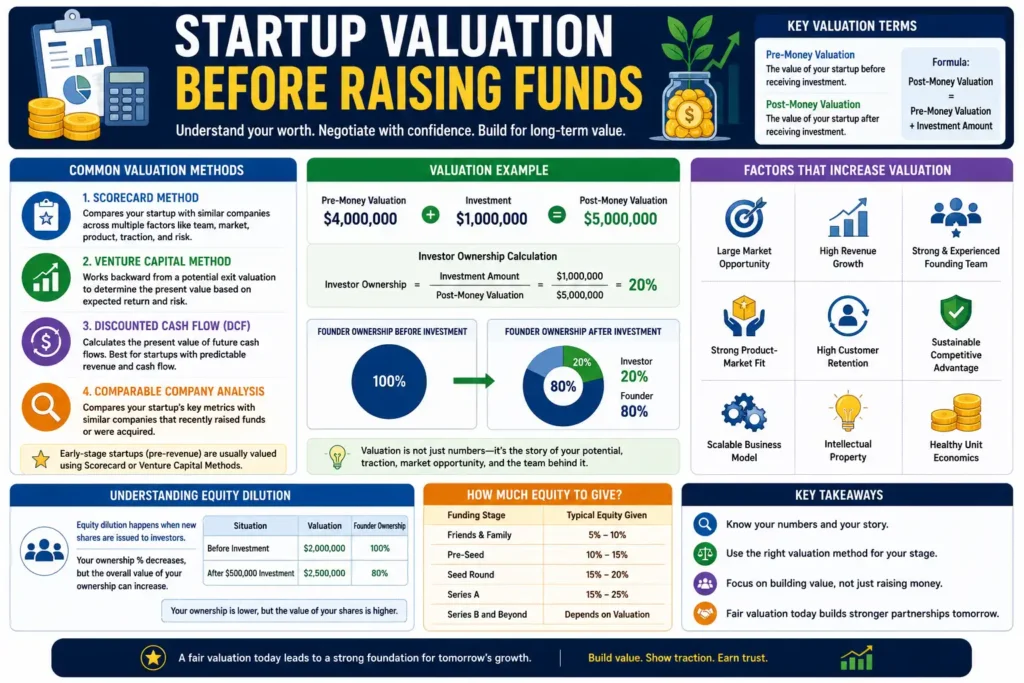
Startup valuation is one of the most important parts of fundraising. It determines how much your company is worth and how much equity you must give away in exchange for investment.
Many first-time founders either overvalue or undervalue their startups. Both mistakes can hurt future fundraising.
A realistic valuation helps build investor confidence and creates a healthy long-term relationship.
What Is Startup Valuation?
Startup valuation is the estimated market value of your business before or after receiving investment.
There are two common valuation terms:
Pre-Money Valuation
The value of your startup before new investment.
Post-Money Valuation
The value of your startup after receiving investment.
Formula:
Post-Money Valuation = Pre-Money Valuation + Investment Amount
Example:
- Pre-money valuation: $4 million
- Investment: $1 million
Post-money valuation = $5 million
If an investor contributes $1 million to a company worth $5 million after investment, they own 20% of the business.
Common Startup Valuation Methods
Investors use different methods depending on the stage of the startup.
Scorecard Valuation Method
This method compares your startup with similar companies.
Factors include:
- Strength of management team
- Market opportunity
- Product quality
- Competitive advantage
- Sales traction
- Technology
- Investment risk
This method is common for pre-revenue startups.
Venture Capital Method
This method estimates the company’s future exit value and works backward to determine today’s valuation.
Investors estimate:
- Future acquisition value
- Expected return
- Investment risk
- Ownership required
Discounted Cash Flow (DCF)
DCF calculates the present value of future cash flows.
This method works better for startups with predictable revenue.
Comparable Company Analysis
Investors compare your startup with similar companies that recently raised funding or were acquired.
Comparison factors include:
- Revenue
- Industry
- Growth rate
- Gross margin
- Market size
This is one of the most commonly used valuation methods.
Factors That Increase Startup Valuation
Investors pay higher valuations to startups that demonstrate strong fundamentals.
Rapid Revenue Growth
Consistent month-over-month revenue growth significantly increases company value.
Large Addressable Market
Businesses operating in multi-billion-dollar industries generally receive higher valuations.
Strong Product-Market Fit
Satisfied customers reduce investment risk.
High Customer Retention
Recurring customers indicate sustainable revenue.
Low Customer Churn
Lower churn means customers continue paying over time.
Experienced Founding Team
A capable team often increases investor confidence more than the product itself.
Intellectual Property
Patents, trademarks, proprietary technology, and exclusive algorithms strengthen valuation.
Competitive Advantage
Your startup should have a clear advantage that competitors cannot easily replicate.
Examples include:
- Unique technology
- Exclusive partnerships
- Strong brand recognition
- Network effects
- Proprietary data
Understanding Equity Dilution
Equity dilution happens whenever new shares are issued to investors.
Although founders own a smaller percentage after fundraising, the overall value of their ownership may increase.
Example of Equity Dilution
Initially:
Founder owns 100%.
Company valuation = $2 million.
Investor invests $500,000.
Post-money valuation = $2.5 million.
Founder ownership becomes 80%.
Investor owns 20%.
Although ownership decreases, the founder’s shares are now worth approximately $2 million instead of holding 100% of a smaller company.
Dilution is not always negative.
The key is ensuring that investment accelerates business growth.
How Much Equity Should Founders Give Away?
There is no fixed rule, but many successful startups follow these general guidelines.
| Funding Stage | Typical Equity Given |
|---|---|
| Friends & Family | 5–10% |
| Pre-Seed | 10–15% |
| Seed Round | 15–20% |
| Series A | 15–25% |
| Series B and Beyond | Depends on valuation |
Avoid giving away excessive equity during the first funding round.
Retaining meaningful ownership motivates founders and supports future fundraising.
What Is a Cap Table?
A capitalization table (Cap Table) records company ownership.
It includes:
- Founders
- Employees
- Angel investors
- Venture capital firms
- Advisors
- Employee Stock Option Pool (ESOP)
Every fundraising round updates the cap table.
Maintaining an accurate cap table is essential.
Example Cap Table
| Shareholder | Ownership Before | Ownership After Seed Round |
| Founder A | 60% | 48% |
| Founder B | 40% | 32% |
| Employee Option Pool | 0% | 10% |
| Investors | 0% | 10% |
A clean cap table makes due diligence faster.
Why Investors Review the Cap Table
Investors examine ownership carefully.
They look for:
- Founder commitment
- Previous dilution
- Existing investor rights
- Option pool availability
- Share distribution
A complicated ownership structure often delays investment.
Understanding Term Sheets
A term sheet outlines the proposed investment terms before legal agreements are finalized.
Although generally non-binding, it sets the framework for the investment.
Every founder should understand each section before signing.
Key Sections of a Term Sheet
Investment Amount
How much capital the investor will provide.
Company Valuation
The agreed pre-money valuation.
Equity Ownership
The percentage of ownership the investor receives.
Board Composition
Defines who will sit on the company’s board of directors.
Liquidation Preference
Explains how proceeds are distributed if the company is sold.
A common structure is 1x non-participating liquidation preference, which is generally considered founder-friendly.
Voting Rights
Some investors require approval rights for major company decisions.
These may include:
- Selling the company
- Raising additional funding
- Issuing new shares
- Large capital expenditures
Anti-Dilution Protection
Protects investors if future funding occurs at a lower valuation.
Understand this clause carefully because it can significantly affect founder ownership.
Founder Vesting
Investors often require founder shares to vest over time.
A common structure is:
- Four-year vesting
- One-year cliff
This ensures founders remain committed to building the business.
Negotiating with Investors
Negotiation is about creating a mutually beneficial partnership.
Do not focus only on valuation.
Evaluate the entire investment offer.
Important Points to Negotiate
- Valuation
- Equity percentage
- Board seats
- Voting rights
- Founder vesting
- Liquidation preferences
- Option pool size
- Investor reporting requirements
The highest valuation is not always the best deal.
Strategic investors who provide expertise and introductions may deliver greater long-term value.
Questions Founders Should Ask Investors
Before accepting funding, ask questions such as:
- How many startups have you invested in?
- What industries do you specialize in?
- How involved are you after investing?
- Can you introduce potential customers?
- Can you support future fundraising?
- What happens if the company misses projections?
- Have you invested alongside other venture firms?
- How long is your investment horizon?
Fundraising is a long-term partnership.
Choose investors carefully.
Building Strong Investor Relationships
Investors appreciate transparency.
Communicate regularly.
Share updates even when challenges arise.
A monthly investor update should include:
- Revenue
- Customer growth
- Product updates
- Hiring
- Major wins
- Challenges
- Goals for the next month
- Key metrics
Consistent communication builds trust.
Legal Compliance Before Closing the Round
Professional legal preparation speeds up fundraising.
Ensure your startup has:
- Company registration documents
- Shareholder agreements
- Employment contracts
- Intellectual property assignments
- Data privacy compliance
- Tax registrations
- Financial statements
- Board resolutions
- Stock option documentation
- Customer agreements
Missing legal documents often delay investment.
Protecting Intellectual Property
Investors want assurance that your technology belongs to the company.
Protect assets through:
- Patents
- Copyrights
- Trademarks
- Software ownership agreements
- Confidentiality agreements
- Employee IP assignment contracts
Clear ownership reduces legal risk.
Using AI to Improve Fundraising
Artificial intelligence has transformed startup fundraising.
Founders now use AI throughout the fundraising process.
Market Research
AI helps analyze:
- Industry trends
- Customer demand
- Competitor activity
- Investment patterns
Financial Forecasting
AI models can generate:
- Revenue projections
- Expense forecasts
- Cash flow scenarios
- Burn rate analysis
Pitch Deck Improvement
AI tools assist with:
- Storytelling
- Design suggestions
- Grammar
- Presentation flow
- Investor personalization
CRM Automation
AI can organize investor outreach by tracking:
- Meetings
- Follow-ups
- Responses
- Next actions
This improves fundraising efficiency.
Recommended AI Tools for Founders
| Tool | Primary Use |
| ChatGPT | Business strategy, content drafting, financial explanations, investor communication |
| Claude | Long-form document review and business writing |
| Perplexity | Market research and competitor analysis |
| Gamma | AI-powered pitch deck creation |
| Notion AI | Documentation and startup knowledge management |
| Canva AI | Presentation graphics and investor visuals |
| HubSpot AI | Sales pipeline and investor CRM management |
| Fireflies AI | Meeting transcription and action summaries |
Use AI to save time, but always review the output for accuracy and tailor it to your business.
What Happens After You Successfully Raise Funds?
Raising capital is a milestone, not the finish line. Many startups fail after fundraising because they lose focus and spend aggressively without a clear execution plan.
Investors expect founders to use the capital efficiently and achieve the milestones promised during the fundraising process.
The first 12 to 24 months after funding are critical for building trust and preparing for future growth.
Create a 100-Day Execution Plan
Instead of making decisions reactively, prepare a structured plan for the first 100 days.
Days 1–30
Focus on laying a strong operational foundation.
Tasks include:
- Finalize hiring priorities.
- Set up financial reporting systems.
- Allocate the fundraising budget.
- Define company-wide KPIs.
- Improve cybersecurity and compliance.
- Communicate the company vision to the team.
Days 31–60
Accelerate product development and customer acquisition.
Priorities include:
- Launch planned product features.
- Expand marketing campaigns.
- Improve onboarding.
- Strengthen customer support.
- Track customer feedback.
- Optimize conversion rates.
Days 61–100
Measure performance and refine your strategy.
Review:
- Revenue growth
- Customer retention
- Burn rate
- Marketing ROI
- Team productivity
- Product roadmap
A structured execution plan keeps everyone aligned.
Allocate Capital Wisely
One of the biggest mistakes founders make is spending too quickly.
A balanced budget may look like this:
| Category | Suggested Allocation |
|---|---|
| Product Development | 35% |
| Sales & Marketing | 25% |
| Hiring | 15% |
| Technology Infrastructure | 10% |
| Operations | 5% |
| Legal & Compliance | 5% |
| Emergency Reserve | 5% |
Every expense should help the company reach measurable milestones.
Track Key Performance Indicators (KPIs)
Successful startups make decisions based on data.
Monitor these KPIs every month:
Financial KPIs
- Monthly Recurring Revenue (MRR)
- Annual Recurring Revenue (ARR)
- Gross Margin
- Burn Rate
- Runway
- Net Profit
- Cash Flow
Customer KPIs
- Customer Acquisition Cost (CAC)
- Customer Lifetime Value (LTV)
- Churn Rate
- Retention Rate
- Net Promoter Score (NPS)
- Referral Rate
Product KPIs
- Daily Active Users (DAU)
- Monthly Active Users (MAU)
- Feature Adoption Rate
- User Engagement
- Product Usage Frequency
A dashboard with these metrics helps founders and investors evaluate progress quickly.
Build a Culture of Financial Discipline
Funding should never encourage unnecessary spending.
Maintain habits such as:
- Reviewing expenses weekly.
- Negotiating vendor contracts.
- Avoiding unnecessary office costs.
- Hiring only when justified.
- Measuring ROI before increasing marketing budgets.
Capital efficiency often separates successful startups from failed ones.
Maintain Transparent Investor Communication
Investors appreciate honest and regular updates.
A monthly investor update should include:
- Revenue performance
- Customer growth
- Product releases
- Hiring updates
- Challenges
- Cash position
- Upcoming milestones
- Support required from investors
Transparency strengthens long-term relationships.
Five Successful Bootstrapped Startup Case Studies
Learning from successful founders provides practical insights into building sustainable businesses.
1. Mailchimp
Industry: Email Marketing
Mailchimp started as a side project funded by client service revenue. The founders focused on profitability instead of raising venture capital.
Key Lessons
- Reinvest customer revenue.
- Build features customers request.
- Prioritize long-term profitability.
- Scale only when demand justifies it.
Mailchimp eventually became one of the largest email marketing platforms before being acquired for billions of dollars.
2. Basecamp
Industry: Project Management Software
Basecamp grew without following the traditional venture capital model.
The company emphasized:
- Simplicity
- Sustainable growth
- Customer satisfaction
- Profitability
Its disciplined approach proved that software companies can achieve long-term success without massive funding rounds.
3. Zoho
Industry: Business Software
Zoho expanded into a global software company while remaining privately owned for many years.
Its strategy included:
- Continuous product innovation
- Reinvestment of profits
- Conservative financial management
- Long-term customer relationships
Zoho demonstrates that patient growth can create a highly valuable enterprise.
4. GitHub
GitHub initially focused on building a product developers loved before pursuing large-scale funding.
Strong community engagement helped create rapid organic growth.
Key lesson:
Build loyal users before chasing investors.
5. Spanx
Founder Sara Blakely started Spanx using her personal savings.
Instead of raising outside investment, she focused on:
- Product quality
- Customer experience
- Creative marketing
Spanx eventually became a global brand while allowing the founder to retain significant ownership.
Common Fundraising Mistakes Founders Should Avoid
Even strong startups lose funding opportunities because of preventable mistakes.
Raising Money Too Early
Without traction, founders usually receive lower valuations.
Build measurable progress before approaching investors.
Raising Too Much Capital
Excess funding can encourage unnecessary spending and reduce operational discipline.
Raise enough to achieve your next major milestone.
Ignoring Customer Feedback
Customers—not investors—determine whether your business succeeds.
Continuously improve your product based on user feedback.
Overestimating Revenue
Investors value realistic financial projections.
Conservative estimates backed by evidence are more credible than overly optimistic forecasts.
Poor Investor Targeting
Research potential investors carefully.
Approach investors who regularly fund businesses in your industry and stage.
Weak Pitch Story
Investors remember compelling stories more than complex spreadsheets.
Clearly explain:
- The problem
- Your solution
- Market opportunity
- Traction
- Vision
Neglecting Due Diligence
Incomplete legal or financial documents can delay or even end funding discussions.
Prepare all documents before meeting investors.
Future Trends in Startup Fundraising
The fundraising landscape continues to evolve.
Founders should prepare for these emerging trends.
AI-Powered Investment Analysis
Investors increasingly use artificial intelligence to evaluate startups.
AI can analyze:
- Financial performance
- Market trends
- Competitive positioning
- Customer reviews
- Growth patterns
Founders should maintain accurate and organized data.
Revenue-Based Financing Growth
More startups are choosing non-dilutive funding instead of giving away equity.
Revenue-based financing is expected to become more popular, particularly among SaaS companies.
Global Remote Investment
Geographic barriers are disappearing.
Investors now regularly fund startups located in different countries through virtual meetings and digital due diligence.
Greater Focus on Profitability
Instead of prioritizing growth at all costs, investors increasingly value:
- Positive cash flow
- Capital efficiency
- Sustainable growth
- Strong gross margins
Climate and Impact Investing
Startups addressing environmental and social challenges continue to attract significant investor interest.
Businesses with measurable impact often have access to specialized funding programs.
Ultimate Startup Fundraising Checklist
Use this checklist before approaching investors.
Business Readiness
- Clear business model
- Validated market problem
- Product-market fit
- Paying customers
- Competitive advantage
- Defined revenue streams
Financial Readiness
- Profit and loss statement
- Cash flow forecast
- Balance sheet
- Burn rate calculation
- Runway analysis
- Budget plan
- Financial projections
Legal Readiness
- Company registration
- Shareholder agreements
- Intellectual property protection
- Employment contracts
- Tax compliance
- Customer agreements
Investor Materials
- Pitch deck
- Executive summary
- One-page company overview
- Product demo
- KPI dashboard
- Market research
- Data room
Founder Readiness
- Clear vision
- Strong leadership
- Industry knowledge
- Communication skills
- Negotiation strategy
- Growth roadmap
Completing this checklist significantly improves fundraising readiness.
Frequently Asked Questions
What is a startup booted fundraising strategy?
It is a strategy where founders use personal savings, customer revenue, grants, and other low-cost funding sources before seeking external investors.
Is bootstrapping better than venture capital?
Neither approach is universally better. Bootstrapping offers greater ownership and control, while venture capital provides faster access to growth capital.
When should a startup raise external funding?
A startup should consider fundraising after validating its product, gaining customer traction, and demonstrating sustainable growth potential.
How much equity should founders give investors?
This depends on the funding stage and valuation, but many early-stage startups give away between 10% and 20% in a funding round.
What is the ideal runway after fundraising?
Most investors prefer startups to maintain 18 to 24 months of runway.
What financial metrics matter most to investors?
Investors often evaluate:
- Monthly Recurring Revenue (MRR)
- Customer Acquisition Cost (CAC)
- Customer Lifetime Value (LTV)
- Gross Margin
- Burn Rate
- Churn Rate
- Revenue Growth
- Cash Runway
Can a startup succeed without venture capital?
Yes. Many globally successful companies have grown through customer revenue, disciplined financial management, and gradual expansion before considering external investment.
How long does fundraising usually take?
A typical fundraising process can take anywhere from three to six months, depending on the startup’s stage, investor interest, and due diligence requirements.
Key Takeaways
A startup booted fundraising strategy is more than a financing approach—it is a philosophy of building a resilient, customer-focused, and financially disciplined business. By validating your idea, generating early revenue, managing cash flow carefully, and raising external capital only when it accelerates growth, you can preserve ownership while increasing your company’s value.
Successful fundraising is built on preparation, not persuasion. Investors are drawn to startups that demonstrate real traction, efficient execution, strong leadership, and a clear path to profitability. Whether you choose to remain bootstrapped or eventually raise capital from angel investors or venture capital firms, the principles remain the same: solve meaningful problems, create exceptional customer value, manage resources wisely, and scale with intention.
Founders who master these fundamentals are not only more likely to secure funding but are also better positioned to build enduring companies that thrive through changing market conditions.
Conclusion
The modern startup ecosystem rewards founders who combine innovation with financial discipline. A thoughtful bootstrapped fundraising strategy enables entrepreneurs to test ideas, validate demand, refine operations, and improve valuation before seeking outside investment. Rather than viewing fundraising as the goal, treat it as a tool that supports sustainable growth.
As your startup evolves, continue measuring key performance indicators, listening to customers, strengthening your team, and maintaining transparent relationships with stakeholders. With careful planning, strategic execution, and a long-term mindset, your startup can build a strong foundation for lasting success while maximizing both business value and founder ownership.