
The HDFC Balanced Advantage Fund has become one of India’s largest and most trusted dynamic asset allocation mutual funds. Investors who want equity-like growth with lower volatility often consider this scheme because it actively changes its allocation between equity, debt, arbitrage, and cash based on market valuations instead of emotions.
Unlike traditional hybrid funds that maintain a fixed allocation, the HDFC Fund follows a dynamic investment strategy. When equity markets become expensive, the fund reduces its net equity exposure and increases debt or arbitrage positions. When markets correct, it gradually increases equity exposure to capture long-term growth opportunities.
This disciplined approach helps investors avoid making emotional investment decisions during market highs and market crashes.
For long-term investors, retirement planners, and first-time mutual fund investors, this Fund offers an attractive balance between wealth creation and capital preservation.
HDFC Balanced Advantage Fund NAV Performance
Latest NAV and historical movement update automatically from NAV data source.
Data source: MFAPI/AMFI NAV feed. NAV may update after market close.
What is HDFC Balanced Advantage Fund?
It is an open-ended Dynamic Asset Allocation (Balanced Advantage) mutual fund managed by HDFC Mutual Fund.
The primary objective of the fund is to generate long-term capital appreciation while controlling downside risk through active asset allocation.
Instead of maintaining a fixed percentage in equity and debt, the fund manager continuously adjusts exposure depending on market valuations, earnings outlook, interest rates, and macroeconomic conditions.
This flexibility allows the fund to participate in bull markets while protecting investors during market corrections.
Why Has HDFC Balanced Advantage Fund Become So Popular?
As a portfolio manager, I always tell investors that successful investing is not about predicting the market. It is about managing risk.
That is exactly what the Balanced Advantage Fund attempts to achieve.
Some of the major reasons behind its popularity include:
- Dynamic equity allocation
- Lower volatility than pure equity funds
- Suitable for SIP and lump sum investing
- Long investment history
- Experienced fund management team
- Massive investor trust
- Consistent risk-adjusted performance
- Suitable for uncertain market conditions
During periods of market euphoria, many investors continue buying expensive stocks. However, the Balanced Advantage Fund automatically reduces equity exposure whenever valuations become stretched, which helps lower portfolio risk.
Similarly, during market corrections, it gradually increases equity allocation to take advantage of lower valuations.
This disciplined process removes emotions from investing.
Latest HDFC Balanced Advantage Fund Snapshot
The following table gives an overview of the scheme based on the latest publicly available information.
| Particular | Details |
|---|---|
| Fund Category | Dynamic Asset Allocation / Balanced Advantage Fund |
| Fund House | HDFC Mutual Fund |
| Fund Type | Open-ended Hybrid Scheme |
| Benchmark | NIFTY 50 Hybrid Composite Debt 50:50 Index |
| Minimum SIP | ₹100 |
| Minimum Lump Sum | ₹100 |
| Exit Load | 1% on redemption beyond specified limit within 1 year; Nil thereafter |
| Direct Plan Expense Ratio | Around 0.77% (subject to periodic change) |
| Riskometer | Very High |
| Investment Horizon | 5 years or longer |
| Suitable For | Long-term wealth creation with moderated volatility |
The fund has grown into one of India’s largest actively managed mutual fund schemes with assets exceeding ₹1 lakh crore, reflecting strong investor confidence and long-term performance.
Latest Key Statistics of HDFC Balanced Advantage Fund
| Metric | Latest Status |
|---|---|
| Approximate AUM | ₹1.04 lakh crore+ |
| Scheme Age | More than 30 years |
| Investment Style | Dynamic Asset Allocation |
| Equity Allocation | Changes according to market valuation |
| Debt Allocation | Dynamic |
| Arbitrage Allocation | Used for risk management and tax efficiency |
| Cash Allocation | Tactical |
One of the biggest strengths of the HDFC Fund is that the allocation is not fixed. Instead, it continuously adapts to changing market conditions.
Investment Objective
The investment objective of the HDFC Balanced Advantage Fund is straightforward.
It aims to:
- Generate long-term capital appreciation.
- Reduce downside risk during market corrections.
- Deliver smoother investment returns.
- Maintain tax-efficient equity exposure through dynamic allocation.
- Balance risk and return across market cycles.
Unlike aggressive equity funds, the focus is not only on maximizing returns. Instead, the goal is to maximize risk-adjusted returns over complete market cycles.
How Does HDFC Balanced Advantage Fund Work?
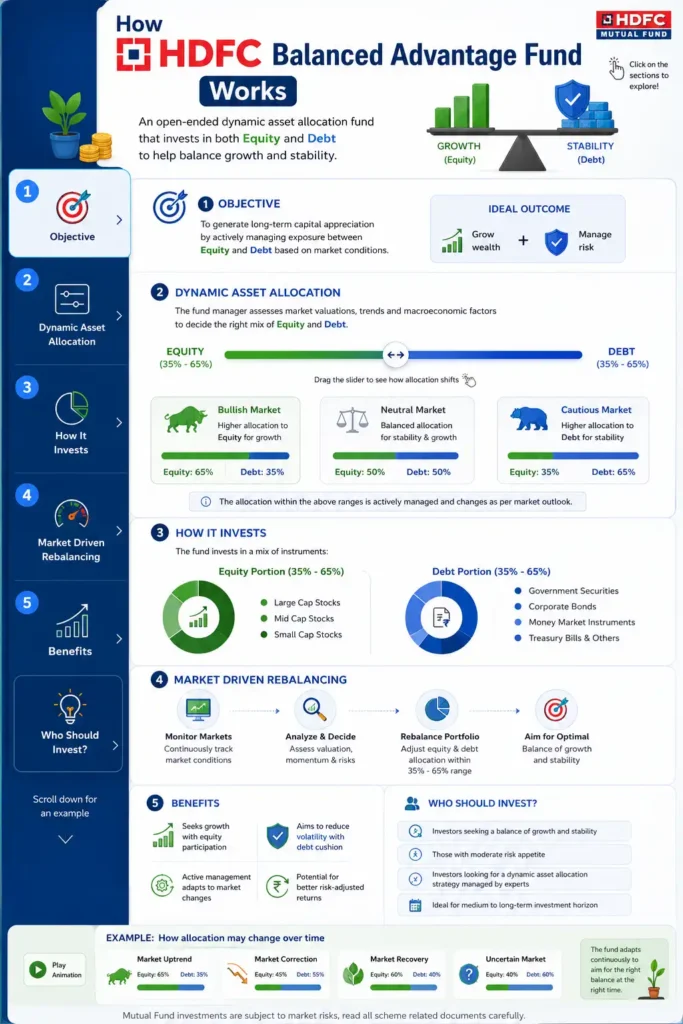
Many investors think a balanced advantage fund simply invests half in equity and half in debt.
That is not true.
This Fund uses a dynamic asset allocation model.
The process generally works like this:
Step 1: Market Valuation Analysis
The investment team studies:
- Price-to-Earnings ratio
- Price-to-Book ratio
- Earnings growth
- Bond yields
- Interest rates
- Economic indicators
- Market sentiment
Step 2: Decide Equity Allocation
If markets appear undervalued:
- Increase equity allocation.
If markets become expensive:
- Reduce net equity exposure.
Step 3: Increase Debt Allocation
When equity valuations are unattractive, the fund shifts part of the portfolio into:
- Government securities
- Corporate bonds
- Treasury bills
- Money market instruments
Step 4: Use Arbitrage Positions
Arbitrage helps the fund maintain equity-oriented taxation while reducing market risk wherever appropriate.
Step 5: Portfolio Rebalancing
The portfolio is reviewed regularly.
Instead of reacting emotionally, the HDFC Balanced Advantage Fund follows a structured investment framework to rebalance holdings based on changing market conditions.
Asset Allocation Framework
A simplified representation of the investment process is shown below.
| Market Condition | Fund Strategy |
|---|---|
| Market Cheap | Increase Equity |
| Fair Valuation | Balanced Allocation |
| Expensive Market | Reduce Net Equity |
| High Volatility | Increase Debt & Arbitrage |
| Strong Recovery | Gradually Add Equity |
This disciplined process is one of the biggest reasons why the HDFC Balanced Advantage Fund appeals to investors who prefer steadier long-term wealth creation over chasing short-term market momentum.
Why Dynamic Asset Allocation Matters
Consider two investors.
Investor A invests everything when the market reaches an all-time high.
Investor B invests through the HDFC Balanced Advantage Fund.
If markets suddenly decline by 25%, Investor A may experience significant losses because of full equity exposure.
Investor B benefits from the fund’s dynamic allocation, which generally reduces net equity exposure when valuations are elevated and increases exposure after corrections. This disciplined approach can help cushion volatility over market cycles, although it cannot eliminate investment risk.
That is why balanced advantage funds have become increasingly popular among long-term investors seeking a smoother investment journey.
Who Manages HDFC Balanced Advantage Fund?
The HDFC Balanced Advantage Fund is managed by experienced professionals at HDFC Mutual Fund. The fund management team combines expertise in equity research, fixed income, asset allocation, and risk management to implement the scheme’s dynamic strategy. The direct growth plan is currently managed by Anil Bamboli.
Rather than relying on a single market forecast, the investment process incorporates research, valuation models, macroeconomic analysis, and ongoing portfolio monitoring.
Major Strengths of HDFC Balanced Advantage Fund
From a professional portfolio management perspective, the HDFC Balanced Advantage Fund offers several advantages.
Proven Track Record
The scheme has navigated multiple market cycles over more than three decades, including global financial crises, pandemic-driven volatility, and high inflation environments.
Strong Asset Base
A very large asset base reflects investor confidence and provides the resources needed for robust research and portfolio management.
Dynamic Risk Management
Unlike many hybrid funds with static allocations, the HDFC Balanced Advantage Fund actively adjusts exposure according to market valuations.
Suitable Across Market Cycles
Whether markets are rising, falling, or moving sideways, the strategy aims to adapt instead of remaining fixed.
Ideal for Long-Term SIP Investors
Regular SIP investors benefit from both rupee cost averaging and the fund’s dynamic asset allocation strategy, making it an attractive choice for building long-term wealth.
Latest Portfolio Allocation of HDFC Balanced Advantage Fund
One of the biggest reasons behind the success of the HDFC Balanced Advantage Fund is its diversified portfolio. Instead of depending on a handful of stocks, the fund invests across hundreds of securities while actively adjusting exposure between equity, debt, and arbitrage based on market valuations.
As of the latest portfolio disclosure, the fund manages assets of over ₹1.04 lakh crore, making it one of India’s largest actively managed hybrid schemes.
Current Asset Allocation
The exact allocation changes every month depending on market conditions. However, the portfolio broadly resembles the following structure.
| Asset Class | Approximate Allocation | Purpose |
|---|---|---|
| Equity | 65–71% | Long-term wealth creation |
| Debt Instruments | 26–35% | Stability and regular income |
| Cash & Money Market | 1–4% | Liquidity management |
| Arbitrage Positions | Dynamic | Risk reduction and tax efficiency |
The fund maintains sufficient equity exposure to qualify for equity taxation while using debt and arbitrage to reduce overall portfolio volatility.
Equity Portfolio Analysis
Unlike thematic funds, the HDFC Balanced Advantage Fund focuses on high-quality businesses with strong balance sheets, healthy cash flows, and long-term earnings potential.
The investment team generally prefers:
- Market-leading companies
- Strong corporate governance
- Reasonable valuations
- Consistent earnings growth
- High return on capital
- Sustainable competitive advantages
This quality-first approach has helped the scheme navigate multiple market cycles.
Top Equity Holdings
The latest disclosures show that the portfolio is concentrated in India’s leading blue-chip companies.
| Company | Approximate Weight |
|---|---|
| ICICI Bank | 4.7% |
| HDFC Bank | 4.3% |
| Reliance Industries | 3.8% |
| State Bank of India | 3.2% |
| Bharti Airtel | 3.0% |
| Larsen & Toubro | 2.6% |
| Axis Bank | 2.5% |
| NTPC | 2.4% |
These companies represent sectors that continue to benefit from India’s long-term economic growth story.
Sector Allocation
Diversification across sectors is another important strength of the HDFC Balanced Advantage Fund.
| Sector | Approximate Exposure |
|---|---|
| Financial Services | 21–22% |
| Energy | 9–10% |
| Automobile | 5–6% |
| Information Technology | 4–5% |
| Healthcare | 4–5% |
| Industrials | Meaningful Allocation |
| Communication Services | Meaningful Allocation |
| Others | Remaining Portfolio |
Financial services remain the largest allocation because Indian banks continue to benefit from credit growth, improving asset quality, and increasing financial penetration.
Why Does the Fund Prefer Large-Cap Stocks?
As a portfolio manager, I consider large-cap companies the foundation of any balanced portfolio.
The HDFC Balanced Advantage Fund also follows this philosophy.
Large-cap companies generally provide:
- Better liquidity
- Stronger corporate governance
- Stable earnings
- Lower business risk
- Faster recovery after market corrections
At the same time, the fund selectively invests in mid-cap and small-cap companies whenever valuations become attractive.
This combination improves return potential without taking excessive risk.
Debt Portfolio Strategy
Many investors focus only on the equity portion of the HDFC Balanced Advantage Fund. However, the debt portfolio plays an equally important role.
The debt allocation is designed to:
- Reduce volatility
- Generate regular accrual income
- Preserve capital during market declines
- Maintain liquidity for portfolio rebalancing
The debt portfolio typically includes:
- Government securities
- Treasury Bills
- State Development Loans
- Corporate Bonds
- Money Market Instruments
- TREPS
Rather than chasing high yields through low-quality issuers, the fund generally emphasizes liquidity and overall portfolio stability.
How Dynamic Rebalancing Creates Value
Many investors buy equity after markets rise sharply and sell during corrections.
The HDFC Balanced Advantage Fund follows the opposite discipline.
During Expensive Markets
The fund generally:
- Reduces net equity exposure.
- Books partial profits.
- Adds debt exposure.
- Increases arbitrage positions where appropriate.
During Market Corrections
The fund generally:
- Increases equity allocation.
- Purchases quality businesses at better valuations.
- Reduces defensive allocations gradually.
This disciplined approach helps investors avoid emotional decision-making.
Market-Cap Allocation
The equity portfolio is diversified across different market-cap segments.
| Market Cap | Approximate Allocation |
|---|---|
| Large Cap | 54% |
| Mid Cap | 9% |
| Small Cap | 8% |
| Others | Remaining Allocation |
The dominant allocation to large-cap stocks provides stability, while measured exposure to mid- and small-cap companies supports long-term growth potential.
Portfolio Diversification
The HDFC Balanced Advantage Fund owns investments across more than 300 securities.
Diversification helps reduce company-specific risk.
If one sector underperforms, other sectors can support the portfolio, resulting in a smoother investment experience over time.
Investment Philosophy
The investment philosophy of the HDFC Balanced Advantage Fund can be summarized in five principles.
| Principle | Objective |
|---|---|
| Buy Quality Businesses | Sustainable wealth creation |
| Diversify Across Sectors | Lower concentration risk |
| Dynamic Asset Allocation | Control market risk |
| Valuation-Based Investing | Avoid overpaying |
| Long-Term Compounding | Maximize risk-adjusted returns |
This disciplined framework explains why the scheme has remained relevant through multiple bull and bear markets.
Portfolio Strengths
From a professional portfolio management perspective, the HDFC Balanced Advantage Fund offers several advantages.
Diversified Portfolio
The scheme avoids excessive concentration in a single stock or sector.
Strong Banking Exposure
Leading private and public sector banks continue to benefit from India’s structural economic growth.
Valuation Discipline
The fund does not maintain a fixed equity allocation. Instead, it adjusts exposure based on market valuations.
High Liquidity
The portfolio primarily consists of liquid securities, making it easier for the fund manager to rebalance efficiently.
Risk Management
The combination of equity, debt, and arbitrage aims to reduce downside risk compared with a pure equity fund.
Expert Portfolio Manager’s View
If I were constructing a long-term portfolio for a moderate-risk investor, the HDFC Balanced Advantage Fund would deserve consideration as a core holding rather than a tactical allocation.
Its biggest strength is not that it always delivers the highest returns in a bull market. Instead, it seeks to participate in equity upside while managing downside risk through dynamic asset allocation. That can make it easier for many investors to stay invested through market cycles, which is often more important than chasing short-term performance.
HDFC Balanced Advantage Fund Historical Performance

Performance is one of the first things investors check before selecting any mutual fund. However, as a portfolio manager, I always advise looking beyond recent one-year returns. A balanced advantage fund is designed to perform across complete market cycles rather than outperform pure equity funds every single year.
The HDFC Balanced Advantage Fund has delivered strong long-term wealth creation while maintaining a relatively smoother investment journey than many diversified equity funds. Since its inception in 1994, the scheme has generated annualized returns in the mid-teen range over the long term, demonstrating the effectiveness of its dynamic asset allocation strategy.
Latest CAGR Returns
The table below summarizes the recent annualized performance of the direct plan.
| Investment Period | Annualized Return* |
|---|---|
| 1 Year | Around 1% |
| 3 Years | Around 14.7% CAGR |
| 5 Years | Around 15.8% CAGR |
| 10 Years | Around 15.0% CAGR |
| Since Launch | Around 14.7% CAGR |
*Returns change daily based on NAV and market conditions.
The one-year return appears modest because equity markets experienced consolidation during the period. However, long-term investors should focus more on the 5-year and 10-year CAGR, which better reflects the fund’s ability to compound wealth over different market environments.
Growth of ₹10,000 Investment
The real strength of the HDFC Balanced Advantage Fund becomes evident when you observe long-term compounding.
| Investment | Estimated Value Today |
|---|---|
| ₹10,000 Invested at Launch | Several lakhs of rupees |
| ₹1 Lakh Invested Long Ago | Significant long-term appreciation |
| Monthly SIP ₹10,000 Since Launch | Nearly ₹16 crore (approx.) |
A monthly SIP of ₹10,000 since the fund’s launch has grown to nearly ₹15.9 crore with an XIRR of about 18.4%, highlighting the power of disciplined long-term investing and compounding.
Rolling Returns Tell the Real Story
Many investors compare only point-to-point returns.
Professional portfolio managers rarely do that.
Instead, we study rolling returns, which measure performance across thousands of different investment periods.
Rolling return analysis helps answer an important question:
“How consistently has the fund generated returns regardless of when an investor entered?”
This provides a far more realistic picture than comparing returns from a single start date.
The HDFC Balanced Advantage Fund has historically demonstrated relatively consistent rolling returns because its dynamic allocation reduces the impact of investing during expensive market phases.
Performance Across Different Market Cycles
One reason the HDFC Balanced Advantage Fund has built investor trust is its ability to adapt during changing market conditions.
| Market Phase | Expected Behaviour |
|---|---|
| Strong Bull Market | Participates in equity upside, though it may slightly lag pure equity funds |
| Market Correction | Generally falls less because of lower net equity exposure |
| Bear Market | Debt and arbitrage help cushion downside |
| Sideways Market | Dynamic allocation aims to improve risk-adjusted returns |
This balanced behaviour makes the fund suitable for investors who prefer steadier wealth creation over aggressive short-term gains.
Calendar Year Performance
Like every equity-oriented mutual fund, the HDFC Balanced Advantage Fund has experienced both strong and weak years.
A simplified pattern looks like this.
| Market Condition | Typical Fund Outcome |
|---|---|
| Strong Equity Rally | Double-digit positive returns |
| Moderate Market | Stable positive returns |
| Flat Market | Low single-digit returns |
| Major Correction | Better downside protection than many equity funds |
No mutual fund can deliver positive returns every calendar year. However, a balanced advantage fund aims to reduce the severity of losses during difficult periods.
Performance During Major Market Events
The HDFC Balanced Advantage Fund has successfully navigated several major market events over its long history.
These include:
- The Dot-com crash
- The Global Financial Crisis of 2008
- The European debt crisis
- COVID-19 market crash
- High inflation and rising interest-rate cycles
Instead of maintaining a fixed equity allocation during these periods, the fund adjusted its portfolio according to market valuations, helping reduce overall volatility.
Risk-Adjusted Performance
Professional investors evaluate much more than returns.
They also assess whether those returns were achieved by taking excessive risk.
The HDFC Balanced Advantage Fund has historically maintained healthy risk-adjusted performance because it combines equity growth potential with active risk management.
Some commonly used metrics include:
| Metric | What It Measures |
|---|---|
| Standard Deviation | Volatility of returns |
| Sharpe Ratio | Return generated per unit of risk |
| Beta | Sensitivity to market movements |
| Alpha | Excess return over benchmark |
| Maximum Drawdown | Largest decline from peak |
Recent published statistics indicate a beta of around 0.56, suggesting that the fund has historically been less volatile than the broader equity market.
Volatility Analysis
A common misconception is that balanced advantage funds eliminate risk.
They do not.
Instead, they aim to manage risk more effectively.
Compared with many diversified equity funds, the HDFC Balanced Advantage Fund generally exhibits:
- Lower portfolio volatility
- Smaller drawdowns during market declines
- Reduced emotional pressure on investors
- Smoother long-term return patterns
This makes it easier for many investors to remain invested during periods of market uncertainty.
Drawdown Comparison
The table below illustrates the general behaviour of different fund categories during sharp market corrections.
| Fund Category | Expected Drawdown During Severe Corrections |
|---|---|
| Large Cap Fund | Moderate to High |
| Flexi Cap Fund | High |
| Mid Cap Fund | Very High |
| Small Cap Fund | Extremely High |
| HDFC Balanced Advantage Fund | Moderate |
Actual drawdowns vary depending on market conditions, but balanced advantage funds are specifically designed to reduce downside risk through dynamic asset allocation.
Benchmark Comparison
The HDFC Balanced Advantage Fund follows the NIFTY 50 Hybrid Composite Debt 50:50 Index as its benchmark.
The objective is not simply to beat the benchmark in every year.
Instead, the fund seeks to deliver:
- Better downside protection
- Competitive long-term returns
- Lower volatility
- Improved risk-adjusted performance
This investment philosophy makes it attractive for investors with a medium- to long-term investment horizon.
Professional Portfolio Manager’s Opinion
If I compare the HDFC Balanced Advantage Fund with a traditional aggressive equity fund, I would expect the equity fund to outperform during prolonged bull markets.
However, investing is not just about maximizing returns.
It is equally important to protect capital when markets become expensive.
That is where the HDFC Balanced Advantage Fund stands out.
Its dynamic allocation strategy allows investors to stay invested through different market cycles without needing to constantly time the market. For long-term investors who value consistency over chasing the highest annual returns, this disciplined approach can be a significant advantage.
Risk Analysis of HDFC Balanced Advantage Fund

Every investment carries risk, including the HDFC Balanced Advantage Fund. However, the objective of this scheme is not to eliminate risk but to manage it intelligently through dynamic asset allocation.
Unlike a pure equity fund that remains almost fully invested in stocks, the HDFC Balanced Advantage Fund actively shifts investments between equity, debt, arbitrage, and cash depending on market valuations and economic conditions.
As a result, investors usually experience a smoother investment journey during market volatility.
Understanding the Riskometer
According to the latest disclosure, the HDFC Balanced Advantage Fund falls under the Very High Risk category.
This classification surprises many investors because the fund also invests in debt.
The reason is simple.
The scheme maintains equity-oriented taxation by keeping effective equity exposure above the prescribed regulatory limits using a combination of equity and arbitrage strategies. Therefore, its long-term performance is still influenced by stock market movements.
What Does “Very High Risk” Actually Mean?
It does not mean that the fund is as risky as a small-cap fund.
Instead, it indicates that:
- Returns are market-linked.
- Short-term losses are possible.
- NAV can fluctuate.
- Long-term investment is recommended.
- Investors should remain invested through market cycles.
Major Risks Investors Should Know
Before investing in the HDFC Balanced Advantage Fund, understand these key risks.
1. Equity Market Risk
If Indian equity markets decline sharply, the fund’s NAV may also decline.
However, because of dynamic allocation, the decline is often lower than many diversified equity funds.
2. Interest Rate Risk
The debt portion of the portfolio can be affected by changing interest rates.
When interest rates rise:
- Bond prices generally fall.
When interest rates decline:
- Bond prices generally rise.
3. Credit Risk
The debt portfolio may invest in corporate bonds.
Although the fund generally maintains a high-quality debt portfolio, there remains a small possibility of issuer-related credit events.
4. Liquidity Risk
Some securities may become less liquid during periods of market stress.
The fund manages this risk by maintaining exposure to highly liquid instruments.
5. Rebalancing Risk
Dynamic asset allocation depends on valuation models.
No model can perfectly predict market tops or bottoms.
Therefore, there may be periods when the strategy temporarily underperforms aggressive equity funds during strong bull markets.
Risk Compared with Other Mutual Fund Categories
| Fund Category | Return Potential | Volatility | Suitable for Beginners |
|---|---|---|---|
| Large Cap Fund | High | Moderate | Yes |
| Flexi Cap Fund | High | High | Yes |
| Mid Cap Fund | Very High | High | Moderate |
| Small Cap Fund | Extremely High | Very High | No |
| Aggressive Hybrid Fund | High | Moderate to High | Yes |
| HDFC Balanced Advantage Fund | High | Moderate | Yes |
From a risk-adjusted perspective, the HDFC Balanced Advantage Fund is an attractive choice for investors who want exposure to equities without accepting the full volatility of an equity-only portfolio.
Expense Ratio
The expense ratio represents the annual fee charged by the fund house to manage the scheme.
For the Direct Plan, the latest expense ratio is approximately 0.77%, although it may change periodically in accordance with regulatory guidelines.
| Plan | Approximate Expense Ratio |
|---|---|
| Direct Plan | 0.77% |
| Regular Plan | Around 1.29% |
Why Does Expense Ratio Matter?
A lower expense ratio leaves more of the investment return with the investor.
For example:
If two funds generate the same gross return over 20 years, the fund with the lower expense ratio can produce noticeably higher final wealth because costs compound over time.
This is one reason long-term investors often prefer Direct Plans when they are comfortable making their own investment decisions.
Exit Load
Exit load discourages short-term trading.
The latest exit load structure is:
| Redemption | Exit Load |
|---|---|
| Up to 15% of investment | Nil |
| Units exceeding 15% redeemed within 1 year | 1% |
| After 1 year | Nil |
This structure encourages investors to remain invested for the long term rather than attempting to time short-term market movements.
Taxation of HDFC Balanced Advantage Fund in 2026
One of the biggest advantages of the HDFC Balanced Advantage Fund is its equity-oriented taxation.
Because the scheme maintains equity-oriented status under current tax rules, the following taxation generally applies.
Short-Term Capital Gains (STCG)
If units are redeemed within one year:
- Gains are taxed at 20% plus applicable surcharge and cess under current tax provisions.
Long-Term Capital Gains (LTCG)
If units are held for more than one year:
- Long-term capital gains above the applicable annual exemption limit (currently ₹1.25 lakh) are taxed at 12.5% without indexation.
Always verify the latest tax rules before making redemption decisions, as tax laws may change.
SIP vs Lump Sum: Which Is Better?
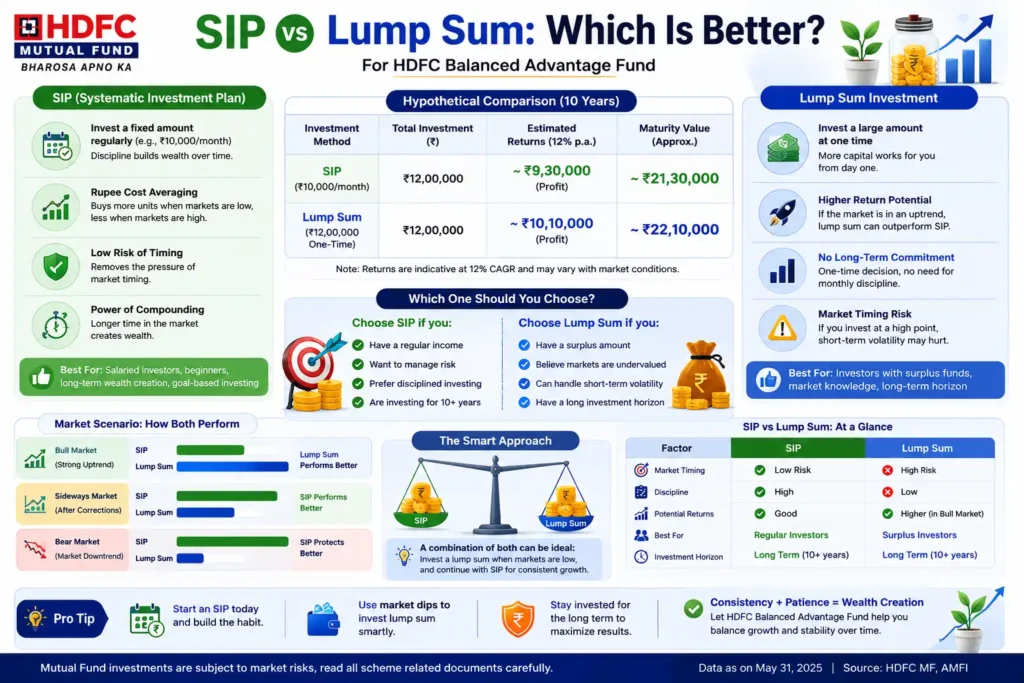
One of the most common questions investors ask is whether they should invest through SIP or lump sum.
SIP is Suitable When:
- You earn a regular monthly income.
- You are a first-time investor.
- You want disciplined investing.
- You wish to reduce market timing risk.
- You have a long investment horizon.
Lump Sum is Suitable When:
- You receive a bonus or inheritance.
- You sell another investment.
- Markets have corrected significantly.
- You already have an emergency fund.
SIP vs Lump Sum Comparison
| Feature | SIP | Lump Sum |
|---|---|---|
| Investment Style | Monthly | One-time |
| Market Timing Risk | Lower | Higher |
| Rupee Cost Averaging | Yes | No |
| Best For | Salaried Investors | Investors with surplus cash |
| Emotional Investing | Lower | Higher |
From my experience as a portfolio manager, a SIP is the preferred approach for most retail investors because it builds discipline and reduces the need to predict market movements.
Investment Horizon
The HDFC Balanced Advantage Fund should not be viewed as a short-term investment.
| Investment Period | Recommendation |
|---|---|
| Less than 1 Year | Not Recommended |
| 1–3 Years | Only if risk is understood |
| 3–5 Years | Good |
| 5–10 Years | Very Good |
| More than 10 Years | Excellent |
The longer the investment horizon, the greater the opportunity for compounding and for the dynamic allocation strategy to work effectively across multiple market cycles.
Who Should Invest in HDFC Balanced Advantage Fund?
The HDFC Balanced Advantage Fund is suitable for:
- First-time mutual fund investors.
- Salaried professionals.
- Long-term SIP investors.
- Retirement planners.
- Conservative equity investors.
- Investors shifting from fixed deposits.
- Moderate-risk investors seeking balanced growth.
- Parents investing for children’s future goals.
Who Should Avoid This Fund?
It may not be suitable for:
- Investors seeking guaranteed returns.
- Traders with a short-term horizon.
- Investors who need money within one year.
- Those willing to accept the higher volatility of pure mid-cap or small-cap funds for potentially higher returns.
Portfolio Manager’s Recommendation
From a professional portfolio construction perspective, the HDFC Balanced Advantage Fund works best as a core portfolio holding rather than a tactical investment.
It can serve as:
- A starting point for new investors.
- A stabilizer alongside aggressive equity funds.
- A retirement accumulation vehicle.
- A long-term SIP destination.
- A wealth-preservation strategy during expensive market conditions.
Instead of attempting to predict every market movement, investors can allow the fund’s disciplined asset allocation process to make gradual adjustments over time. That approach often leads to a more consistent investment experience.
HDFC Balanced Advantage Fund vs Other Balanced Advantage Funds
The Balanced Advantage Fund category has become one of the fastest-growing segments in the Indian mutual fund industry. Investors today have several excellent options, including the HDFC Balanced Advantage Fund, each following a different asset allocation model.
Although all these schemes belong to the same category, their investment philosophy, valuation models, portfolio construction, and risk management strategies differ significantly.
As a portfolio manager, I believe investors should compare more than just recent returns. The quality of portfolio management, downside protection, consistency, fund size, and investment process are equally important.
Comparison of Leading Balanced Advantage Funds
| Fund | AUM (Approx.) | Investment Style | Best For |
|---|---|---|---|
| HDFC Balanced Advantage Fund | ₹1.04 Lakh Crore | Dynamic Asset Allocation | Long-term core investment |
| ICICI Prudential Balanced Advantage Fund | ₹70,500+ Crore | Valuation-based Dynamic Allocation | Conservative equity investors |
| SBI Balanced Advantage Fund | ₹40,000+ Crore | Dynamic Hybrid | Moderate-risk investors |
| Kotak Balanced Advantage Fund | ₹17,000+ Crore | Tactical Asset Allocation | Investors seeking diversification |
| Aditya Birla Sun Life Balanced Advantage Fund | ₹9,000+ Crore | Dynamic Asset Allocation | Long-term investors |
The HDFC Balanced Advantage Fund currently has the largest asset base among these schemes, reflecting strong investor confidence and long-term acceptance.
HDFC Balanced Advantage Fund vs ICICI Prudential Balanced Advantage Fund
This is the comparison most investors search for because both funds are industry leaders.
| Feature | HDFC Balanced Advantage Fund | ICICI Prudential Balanced Advantage Fund |
|---|---|---|
| Fund Size | Larger | Large |
| Investment Style | Dynamic valuation-based allocation | Proprietary valuation model |
| Equity Exposure | Dynamic | Dynamic |
| Debt Allocation | Dynamic | Dynamic |
| Portfolio Style | Quality large-cap focused | More tactical allocation |
| Suitable For | Long-term wealth creation | Conservative investors |
Which One Has Better Risk Management?
Both schemes actively reduce equity exposure when markets become expensive.
However:
- HDFC generally focuses on high-quality businesses and long-term compounding.
- ICICI Prudential is well known for its proprietary valuation framework that actively changes equity allocation based on market valuations.
Both are excellent funds, and the better choice depends on an investor’s objectives rather than short-term performance alone.
HDFC Balanced Advantage Fund vs SBI Balanced Advantage Fund
| Parameter | HDFC | SBI |
|---|---|---|
| Track Record | Longer | Relatively shorter |
| Asset Base | Higher | Lower |
| Portfolio Diversification | Excellent | Very Good |
| Market Cycle Experience | Extensive | Good |
| Suitable For | Long-term investors | Moderate-risk investors |
The HDFC Balanced Advantage Fund benefits from a much longer operating history across multiple bull and bear markets.
HDFC Balanced Advantage Fund vs Kotak Balanced Advantage Fund
| Parameter | HDFC | Kotak |
|---|---|---|
| Scheme Age | More than 25 years | Around 8 years |
| AUM | Very Large | Moderate |
| Historical Consistency | Excellent | Good |
| Long-term CAGR | Higher | Moderate |
| Portfolio Stability | High | Moderate |
For investors seeking a proven long-term track record, the HDFC Balanced Advantage Fund has a clear advantage because of its long operating history and larger asset base.
HDFC Balanced Advantage Fund vs Aditya Birla Sun Life Balanced Advantage Fund
| Feature | HDFC | Aditya Birla |
|---|---|---|
| Experience | Longer | Good |
| AUM | Higher | Lower |
| Portfolio Size | Large | Moderate |
| Investment Style | Dynamic | Dynamic |
| Long-term Focus | Strong | Strong |
Both schemes are professionally managed and suitable for long-term investors, although HDFC enjoys a larger scale and longer history.
Why Investors Choose HDFC Balanced Advantage Fund
From my experience managing portfolios, the HDFC Balanced Advantage Fund stands out for several reasons.
1. Proven Investment Process
The fund follows a disciplined asset allocation framework rather than reacting emotionally to market movements.
2. Large Research Team
HDFC Mutual Fund has one of India’s largest investment research teams, supporting equity, debt, and macroeconomic analysis.
3. Long Market Experience
The scheme has successfully navigated:
- The Dot-com crash
- The Global Financial Crisis
- COVID-19
- High inflation periods
- Rising interest-rate cycles
This demonstrates the resilience of its investment process across different economic environments.
4. Diversified Portfolio
The HDFC Balanced Advantage Fund invests across multiple sectors, market capitalizations, and asset classes, reducing concentration risk.
5. Dynamic Allocation
Instead of maintaining a fixed 65:35 ratio, the fund adjusts allocations based on changing market valuations.
This approach helps investors avoid excessive exposure during expensive market phases.
Advantages of HDFC Balanced Advantage Fund
The HDFC Balanced Advantage Fund offers several benefits for long-term investors.
| Advantage | Benefit |
|---|---|
| Dynamic Asset Allocation | Better risk management |
| Equity Taxation | Tax-efficient structure |
| Diversified Portfolio | Lower company-specific risk |
| Experienced Fund House | Strong research capabilities |
| Long Track Record | Proven across market cycles |
| Suitable for SIP | Disciplined wealth creation |
| Suitable for Lump Sum | Good for phased investing |
Disadvantages of HDFC Balanced Advantage Fund
No mutual fund is perfect.
The HDFC Balanced Advantage Fund also has certain limitations.
May Underperform During Strong Bull Markets
When equity markets rise sharply, aggressive flexi-cap or mid-cap funds may generate higher returns because they remain more fully invested in equities.
Not Suitable for Short-Term Investors
Balanced advantage funds are designed for investors with a horizon of at least five years.
Returns Can Be Moderate
Investors seeking exceptionally high returns every year may find the fund relatively conservative.
Market Risk Still Exists
Although volatility may be lower than many equity funds, losses are still possible during market declines.
Common Mistakes Investors Make
Many investors fail to achieve satisfactory returns because of behavioural mistakes rather than poor fund selection.
Avoid these common errors.
Investing Only After Markets Rally
Many investors begin investing when markets are at all-time highs.
Instead, maintain a disciplined SIP regardless of market conditions.
Redeeming During Corrections
Temporary market declines are a normal part of investing.
Selling during corrections often locks in losses and prevents participation in future recoveries.
Comparing with Small-Cap Funds
The HDFC Balanced Advantage Fund has a different objective.
It aims to deliver smoother, risk-adjusted returns rather than maximizing returns during bull markets.
Frequent Portfolio Switching
Switching between funds every few months usually reduces long-term wealth creation.
Allow the fund’s dynamic allocation strategy enough time to work.
Expert Rating
From a portfolio manager’s perspective, I would evaluate the HDFC Balanced Advantage Fund as follows.
| Parameter | Rating |
|---|---|
| Portfolio Quality | ⭐⭐⭐⭐⭐ |
| Diversification | ⭐⭐⭐⭐⭐ |
| Risk Management | ⭐⭐⭐⭐⭐ |
| Fund House Reputation | ⭐⭐⭐⭐⭐ |
| Long-Term Consistency | ⭐⭐⭐⭐⭐ |
| SIP Suitability | ⭐⭐⭐⭐⭐ |
| Retirement Planning | ⭐⭐⭐⭐⭐ |
| Overall Rating | 4.9 / 5 |
Portfolio Manager’s Final Opinion Before the Verdict
If I were building a ₹1 crore long-term investment portfolio for a moderate-risk investor, the HDFC Balanced Advantage Fund would be one of the first hybrid funds I would consider.
Its strengths are not limited to historical returns. The combination of disciplined asset allocation, diversification, risk management, and long-term consistency makes it suitable as a core holding for investors who want equity participation with a smoother investment experience.
Frequently Asked Questions
Is HDFC Balanced Advantage Fund a good investment in 2026?
Yes, the HDFC Balanced Advantage Fund remains one of the strongest choices for investors seeking long-term wealth creation with relatively lower volatility than pure equity funds. Its dynamic asset allocation strategy allows the portfolio to adjust according to changing market valuations, making it suitable for uncertain market conditions.
Is HDFC Balanced Advantage Fund safe?
No mutual fund is completely safe because market-linked investments always carry risk.
However, the HDFC Balanced Advantage Fund generally experiences lower volatility than many diversified equity funds because it invests in a mix of equity, debt, and arbitrage while actively managing asset allocation.
What is the minimum SIP amount?
The minimum SIP investment is ₹100, making the HDFC Balanced Advantage Fund accessible even for beginners.
What is the minimum lump sum investment?
The minimum lump sum investment is ₹100.
Can beginners invest in HDFC Balanced Advantage Fund?
Yes.
The HDFC Balanced Advantage Fund is often considered suitable for first-time mutual fund investors because it automatically adjusts equity exposure based on market conditions.
Is HDFC Balanced Advantage Fund suitable for retirement planning?
Yes.
Investors planning retirement over 10 to 20 years can consider the HDFC Balanced Advantage Fund as part of a diversified retirement portfolio because of its balanced approach to growth and risk management.
Does the fund pay dividends?
The scheme offers Income Distribution cum Capital Withdrawal (IDCW) options, but long-term investors generally prefer the Growth option to benefit from compounding.
Can I withdraw my money anytime?
Yes.
Since the HDFC Balanced Advantage Fund is an open-ended scheme, investors can redeem units on any business day. However, exit load and applicable taxes may apply depending on the holding period.
Is SIP better than lump sum?
For most investors, yes.
A SIP reduces market timing risk and encourages disciplined investing.
However, if markets experience a significant correction and you have surplus funds, a lump sum investment can also be considered as part of a well-planned asset allocation strategy.
How long should I stay invested?
Although there is no mandatory holding period, the HDFC Balanced Advantage Fund is best suited for investors with an investment horizon of at least five years, while seven to ten years or longer is generally preferable for maximizing the benefits of compounding and dynamic asset allocation.
Sample SIP Investment Plan
The table below illustrates how different investors can use the HDFC Balanced Advantage Fund within their monthly investment plan.
| Monthly SIP | Suggested Allocation | Investment Goal |
|---|---|---|
| ₹5,000 | ₹5,000 | Beginner Wealth Creation |
| ₹10,000 | ₹10,000 | Long-Term Savings |
| ₹25,000 | ₹15,000 | Core Portfolio Holding |
| ₹50,000 | ₹20,000 | Diversified Portfolio |
| ₹1,00,000 | ₹30,000 | Balanced Asset Allocation |
The remaining investment amount can be allocated to flexi-cap, large-cap, international, gold ETF, debt funds, or other asset classes depending on your financial goals and risk tolerance.
Suggested Portfolio Allocation
As a portfolio manager, I rarely recommend investing your entire portfolio in a single scheme.
Instead, consider a diversified allocation.
| Asset Class | Suggested Allocation |
|---|---|
| HDFC Balanced Advantage Fund | 30% |
| Flexi Cap Fund | 20% |
| Large Cap Index Fund | 15% |
| Mid Cap Fund | 15% |
| Gold ETF | 10% |
| Liquid Fund | 10% |
This allocation balances growth opportunities with risk management and can be adjusted based on individual circumstances.
When Should You Invest in HDFC Balanced Advantage Fund?
The answer is simple.
Do not wait for the perfect market.
Instead, invest when:
- You have completed your emergency fund.
- You have adequate health and life insurance.
- You have no high-interest debt.
- Your financial goals are at least five years away.
- You are willing to stay invested during market fluctuations.
Time in the market generally matters more than trying to perfectly time the market.
Who Should Avoid This Fund?
Although the HDFC Balanced Advantage Fund is suitable for many investors, it may not fit everyone.
You should avoid investing if:
- You need guaranteed returns.
- Your investment horizon is less than one year.
- You require regular income without market fluctuations.
- You cannot tolerate temporary declines in portfolio value.
- You are seeking very high-risk, high-return investments.
Professional Tips Before Investing
Based on more than a decade of portfolio management experience, here are my recommendations for investors considering the HDFC Balanced Advantage Fund.
Start Early
Compounding becomes significantly more powerful when investments begin early.
Continue SIP During Market Corrections
Market declines allow your SIP to purchase more units at lower prices.
Review Once a Year
Avoid checking your portfolio every day. An annual review is usually sufficient unless your financial goals or risk profile change.
Do Not Stop SIP During Bear Markets
Bear markets often create the best long-term buying opportunities.
Maintain Asset Allocation
Even an excellent fund should form only one part of a diversified investment portfolio.
Key Pros and Cons at a Glance
| Pros | Cons |
|---|---|
| Dynamic asset allocation | Can underperform pure equity funds during strong bull markets |
| Lower volatility than many equity funds | Not suitable for very short-term investing |
| Experienced fund management | Returns are market-linked |
| Diversified portfolio | No guaranteed returns |
| Equity-oriented taxation | Performance depends on market conditions |
| Suitable for SIP and lump sum | Requires patience for best results |
Final Verdict
The HDFC Balanced Advantage Fund has earned its position as one of India’s leading balanced advantage funds through a disciplined investment process, strong risk management, and consistent long-term performance. Instead of relying on market predictions, the fund dynamically adjusts its exposure to equity, debt, and arbitrage based on prevailing market valuations. This approach aims to help investors participate in market growth while managing downside risk.
For first-time investors, salaried professionals, retirees building long-term wealth, and anyone seeking a smoother investment journey, the HDFC Balanced Advantage Fund can serve as a strong core holding. It may not deliver the highest returns during every bull market, but its ability to navigate changing market cycles makes it a valuable option for investors who prioritize consistency and risk-adjusted returns.
As with any mutual fund, investment decisions should align with your financial goals, risk tolerance, and time horizon. Reviewing the latest Scheme Information Document (SID) and consulting a qualified financial adviser before investing is always recommended.
Quick Summary
| Feature | Details |
|---|---|
| Category | Dynamic Asset Allocation Fund |
| Risk Level | Very High |
| Suitable For | Moderate-risk long-term investors |
| Investment Horizon | 5 years or more |
| Ideal Investment Mode | SIP and Lump Sum |
| Taxation | Equity-oriented taxation |
| Portfolio Style | Dynamic Equity + Debt + Arbitrage |
| Best Use | Core portfolio allocation |
Why FundzWise Recommends HDFC Balanced Advantage Fund
After evaluating portfolio quality, fund management, historical consistency, risk-adjusted performance, expense ratio, diversification, and long-term investment philosophy, the HDFC Balanced Advantage Fund stands out as one of the strongest balanced advantage funds available to Indian investors.
Rather than chasing short-term market trends, the fund focuses on disciplined asset allocation and long-term compounding. For investors who want a professionally managed solution that adapts to changing market conditions, it deserves a place on the shortlist.


