Generating a regular monthly income from your investments without selling everything at once is one of the biggest financial goals for retirees and passive income seekers. While many people still rely on fixed deposits, pension plans, or rental income, a growing number of investors are choosing Systematic Withdrawal Plans (SWPs) offered by mutual funds. An SWP allows you to withdraw a fixed amount from your mutual fund investment at regular intervals while the remaining money continues to stay invested and has the potential to grow over time.
The popularity of SWPs has increased significantly in India because they offer flexibility, tax efficiency, and the opportunity to earn market-linked returns. Unlike traditional income sources that often provide fixed returns, an SWP combines regular cash flow with long-term wealth creation. This makes it particularly suitable for retirees, senior citizens, early retirees, freelancers, and anyone looking for a dependable income stream without locking their money into long-term products.
However, not every mutual fund is suitable for an SWP. Selecting the wrong fund can reduce your investment corpus faster than expected, especially during volatile market conditions. Factors such as asset allocation, fund category, historical consistency, volatility, expense ratio, withdrawal rate, taxation, and inflation all play a crucial role in determining whether your SWP remains sustainable for years or gradually depletes your investment.
Many investors simply search for the “best SWP mutual funds” and choose a fund based on recent returns alone. Unfortunately, this approach often leads to poor investment decisions because a fund that has delivered excellent short-term returns may not necessarily be the most suitable option for generating stable monthly income. The ideal SWP fund should not only deliver competitive returns but also maintain consistency across different market cycles.
This comprehensive guide explains everything you need to know about SWP mutual funds in India. You will learn how SWPs work, how to choose the right mutual funds, the top-performing fund categories, taxation rules, withdrawal strategies, retirement planning techniques, common mistakes to avoid, and practical examples based on different investment amounts. Whether you plan to invest ₹5 lakh or ₹5 crore, this guide will help you make informed decisions.
Unlike most articles available online that simply provide a list of funds, this guide focuses on helping you understand the complete SWP strategy. By the end of this article, you will know not only which funds have performed well but also why they are suitable, how much you can safely withdraw, and how to maximize your retirement income while preserving your wealth.
Quick Summary
| Feature | Details |
|---|---|
| Best For | Regular Monthly Income |
| Suitable Investors | Retirees, Senior Citizens, Passive Income Seekers |
| Investment Type | Mutual Funds |
| Withdrawal Frequency | Monthly, Quarterly, Half-Yearly, Yearly |
| Minimum SWP Amount | Varies by AMC |
| Risk Level | Depends on Fund Category |
| Return Type | Market Linked |
| Capital Appreciation | Yes |
| Tax Efficient | Yes (Compared with Many Traditional Income Options) |
| Inflation Protection | Better Than Most Fixed Income Products |
| Liquidity | High |
| Lock-in | Usually None (Except Certain Schemes) |
Why You Can Trust This Guide
Selecting the best mutual fund for an SWP requires more than comparing annual returns. Throughout this guide, every recommendation is evaluated using multiple parameters that experienced investors and financial planners consider before recommending a fund.
These include:
- Long-term performance consistency
- Rolling returns across market cycles
- Risk-adjusted returns
- Portfolio quality
- Expense ratio
- Asset allocation
- Fund manager track record
- Volatility analysis
- Drawdown history
- Assets Under Management (AUM)
- Suitability for retirement income
- Tax efficiency
- Withdrawal sustainability
Rather than focusing only on the highest returns, this guide emphasizes consistency and long-term sustainability, which are far more important for investors depending on SWPs to meet their regular expenses.
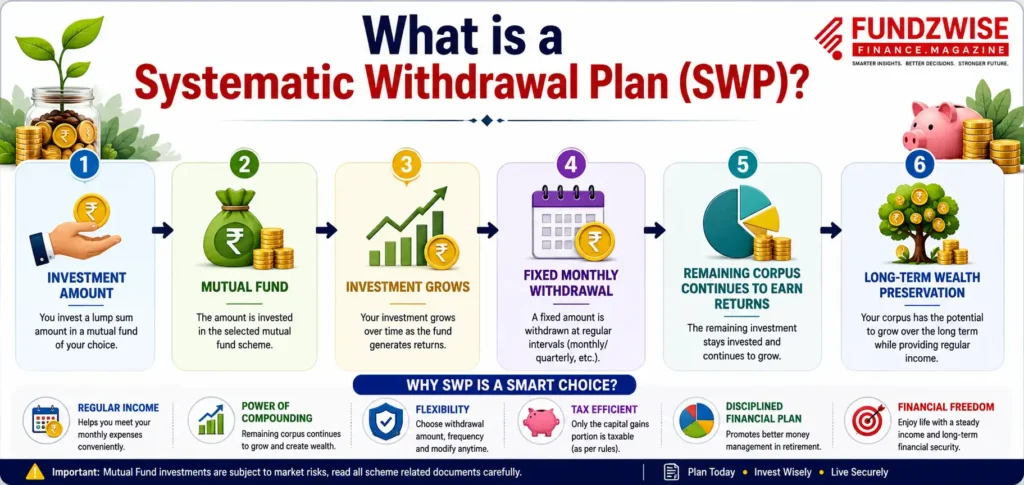
What is a Systematic Withdrawal Plan (SWP)?
A Systematic Withdrawal Plan (SWP) is a facility offered by mutual fund companies that allows investors to withdraw a fixed amount of money from their mutual fund investment at regular intervals while the remaining investment continues to stay invested.
Instead of redeeming the entire investment in one go, an SWP enables investors to receive a steady cash flow based on a predefined schedule. Depending on your financial requirements, you can choose to receive the money monthly, quarterly, half-yearly, or annually.
When an SWP is activated, the mutual fund redeems only the number of units required to generate the withdrawal amount. The remaining units stay invested in the fund and continue to participate in market growth. As a result, your investment has the opportunity to appreciate over time while also providing regular income.
This approach makes SWPs particularly useful for retirement planning, passive income generation, and systematic wealth distribution.
What is SWP in mutual funds?
A Systematic Withdrawal Plan (SWP) is a mutual fund facility that lets investors withdraw a fixed amount of money at regular intervals while the remaining investment stays invested and continues to earn market-linked returns. SWPs are commonly used to generate regular income during retirement or for meeting recurring financial expenses.
Example of an SWP
Suppose you invest ₹30 lakh in a mutual fund.
You instruct the fund house to transfer ₹20,000 every month to your bank account.
Each month, the mutual fund redeems only enough units to provide the ₹20,000 withdrawal. The remaining units continue to remain invested and can potentially grow if the market performs well.
As a result:
- You receive a regular monthly income.
- Your remaining investment continues to earn returns.
- Your money remains relatively liquid.
- Your investment has the potential to last for many years if withdrawals are sustainable.
Key Characteristics of an SWP
- Provides regular income from mutual fund investments.
- Offers flexible withdrawal frequencies.
- Allows investors to change or stop withdrawals.
- Keeps the remaining corpus invested.
- Can help combat inflation through market-linked growth.
- Suitable for long-term financial planning.
- Available across many mutual fund categories.
- Ideal for retirement and passive income strategies.
Expert Tip Box
Don’t choose an SWP mutual fund solely based on the highest recent returns. For long-term income, prioritize funds with consistent performance across market cycles, manageable volatility, reasonable expense ratios, and a sustainable withdrawal strategy. A fund that delivers stable returns over many years is often a better choice than one with exceptional short-term performance.
How Does a Systematic Withdrawal Plan (SWP) Work?
Understanding how a Systematic Withdrawal Plan works is essential before choosing the best SWP mutual fund. Many investors assume that an SWP works like a fixed deposit where interest is credited every month. However, the mechanism is completely different.
In an SWP, you invest a lump sum amount in a mutual fund scheme. Instead of withdrawing the entire investment whenever you need money, you instruct the Asset Management Company (AMC) to transfer a fixed amount to your bank account at regular intervals.
The AMC redeems only the required number of mutual fund units to generate the withdrawal amount. The remaining units stay invested and continue participating in market movements. If the fund performs well over the long term, your remaining investment may continue growing even while you’re receiving regular income.
Unlike fixed-income products, the amount you withdraw does not come solely from the profits earned by the fund. It is a combination of appreciation (if any) and redemption of units. Because of this, your investment can potentially last for many years if your withdrawal rate is sustainable.
This unique feature makes SWPs one of the most popular retirement income strategies in India.
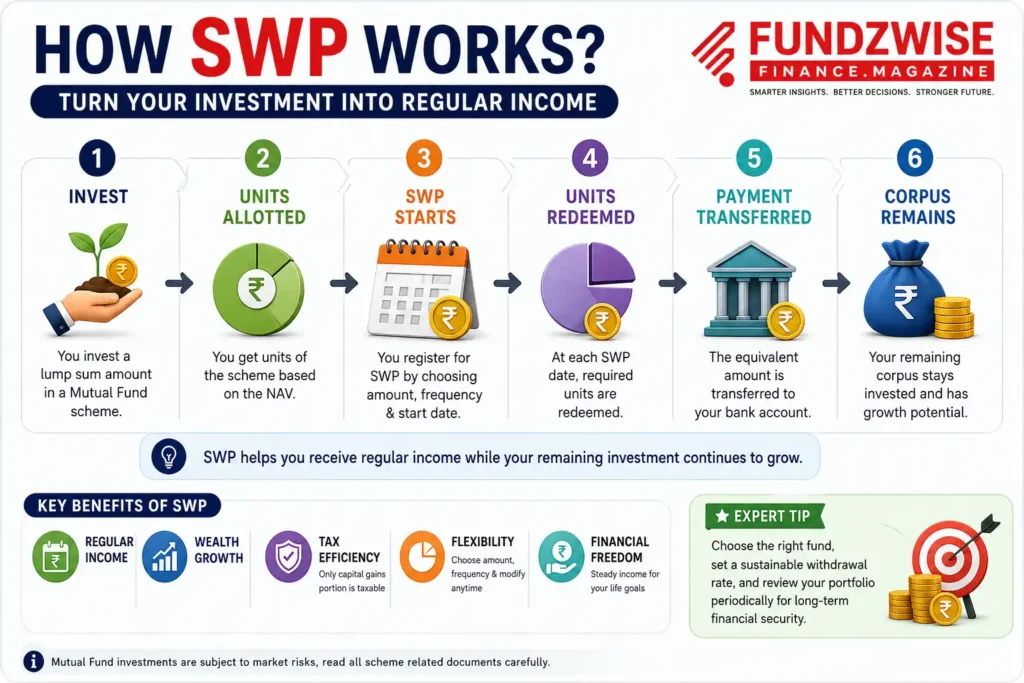
Step-by-Step Working of an SWP
Let’s understand the complete process.
Step 1: Invest a Lump Sum Amount
The first step is investing your money in a mutual fund scheme.
For example,
Investment = ₹50,00,000
This amount is used to purchase mutual fund units based on the fund’s Net Asset Value (NAV).
Suppose the NAV on the investment date is ₹100.
Number of units purchased:
₹50,00,000 ÷ ₹100 = 50,000 units
You now own 50,000 units of the mutual fund.
Step 2: Select the SWP Amount
Now decide how much money you want to receive regularly.
Example:
Monthly withdrawal = ₹30,000
You can usually choose:
- Weekly
- Monthly
- Quarterly
- Half-Yearly
- Annually
Monthly withdrawals are the most preferred option among retirees.
Step 3: Units Are Redeemed Automatically
Suppose after one month, the NAV becomes ₹105.
To pay you ₹30,000, the mutual fund redeems:
₹30,000 ÷ ₹105 = 285.71 units
Remaining units:
50,000 − 285.71 = 49,714.29 units
Notice that your entire investment has not been withdrawn.
Only a small portion of units has been redeemed.
Step 4: Remaining Investment Continues to Grow
The remaining units continue participating in market growth.
If the NAV increases further,
your remaining investment also increases.
This is the biggest advantage of SWP compared with traditional income options.
Step 5: Monthly Withdrawal Continues
Every month,
the same process repeats.
Only enough units are redeemed to generate the selected withdrawal amount.
The rest of the investment remains in the market.
What Happens When Markets Rise?
Suppose
Investment: ₹50 lakh
Annual Return: 12%
Monthly SWP: ₹25,000
Because the fund earns returns, your corpus may reduce much more slowly than expected. In strong bull markets, it may even continue growing despite regular withdrawals.
What Happens During Market Corrections?
During market declines, the NAV falls. This means more units are redeemed to generate the same withdrawal amount.
Example:
NAV = ₹80
Withdrawal = ₹25,000
Units redeemed: ₹25,000 ÷ ₹80 = 312.5 units
Compared with 238 units when NAV was ₹105, more units are now sold. This phenomenon is known as sequence of returns risk, one of the most important concepts in retirement planning. We’ll discuss this in detail later in this guide.
Understanding NAV in an SWP
NAV stands for Net Asset Value.
It represents the per-unit price of a mutual fund.
Formula:
NAV = Total Assets – Liabilities ÷ Total Outstanding Units
Whenever your SWP is processed,
the AMC redeems units based on the NAV applicable on that transaction date.
If NAV rises,
fewer units are redeemed.
If NAV falls,
more units are redeemed.
This is why choosing a consistent and less volatile fund is crucial for long-term SWPs.
Does an SWP withdraw only profits?
No.
A Systematic Withdrawal Plan does not withdraw only the profits earned by your mutual fund. It redeems the required number of units to generate the selected withdrawal amount. Depending on market performance, the withdrawal may include both capital appreciation and a portion of your invested capital.
SWP Formula
Although investors don’t need to calculate withdrawals manually, understanding the formula helps you estimate how your investment works.
Units Redeemed
Withdrawal Amount ÷ NAV
Example
Withdrawal: ₹20,000
NAV: ₹125
Units Redeemed: ₹20,000 ÷ ₹125 = 160 units
Remaining Units Formula
Remaining Units = Existing Units − Redeemed Units
Example:
Existing Units: 40,000
Redeemed: 160
Remaining Units: 39,840
Investment Value Formula
Remaining Units × Current NAV
If
Remaining Units: 39,840
NAV: ₹126
Portfolio Value: ₹50,19,840
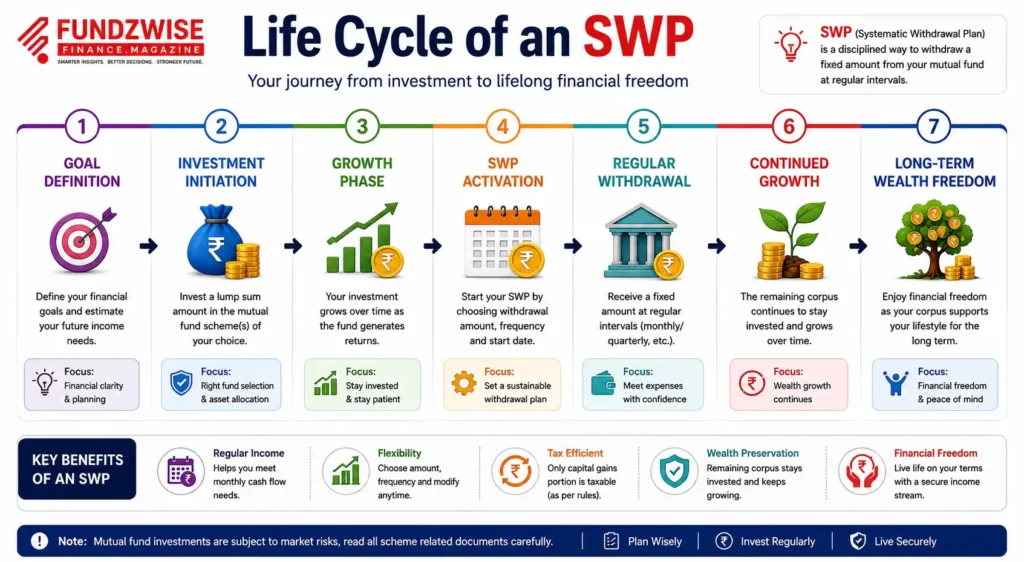
Example 1 – ₹10 Lakh Investment
Investment
₹10,00,000
Annual Return
10%
Monthly Withdrawal
₹7,000
Potential Outcome
- Regular monthly income
- Investment continues earning returns
- Suitable for conservative investors
Example 2 – ₹25 Lakh Investment
Investment
₹25 lakh
Annual Return
11%
Monthly Withdrawal
₹15,000
Suitable For
- Early retirees
- Passive income seekers
- Parents planning recurring expenses
Example 3 – ₹50 Lakh Investment
Investment
₹50 lakh
Expected Return
11%
Monthly SWP
₹30,000
Suitable For
- Senior citizens
- Retired couples
- Family monthly expenses
Example 4 – ₹1 Crore Investment
Investment
₹1 crore
Expected Return
11%
Monthly Withdrawal
₹55,000
Potential Benefits
- Long-term passive income
- Better inflation protection
- Potential capital appreciation
- Flexible withdrawals
Example 5 – ₹2 Crore Investment
Investment
₹2 crore
Expected Return
11%
Monthly Withdrawal
₹1,00,000
Ideal For
- Financially independent investors
- High-net-worth individuals
- Business owners seeking stable cash flow
Comparison Table: SWP Scenarios
| Investment Corpus | Suggested Monthly SWP* | Suitable For |
|---|---|---|
| ₹10 lakh | ₹6,000–₹8,000 | Beginners |
| ₹25 lakh | ₹12,000–₹18,000 | Passive Income |
| ₹50 lakh | ₹25,000–₹35,000 | Retirees |
| ₹1 crore | ₹50,000–₹70,000 | Comfortable Retirement |
| ₹2 crore | ₹90,000–₹1.2 lakh | Wealth Preservation |
*Illustrative only. Actual sustainable withdrawal depends on returns, inflation, taxes, fund category, and investment horizon.
Monthly vs Quarterly vs Half-Yearly vs Annual SWP
| Frequency | Best For | Advantages | Considerations |
|---|---|---|---|
| Monthly | Retirees | Regular cash flow | Most popular option |
| Quarterly | Freelancers | Fewer redemptions | Better for irregular expenses |
| Half-Yearly | Long-term investors | Larger periodic withdrawals | Less frequent income |
| Annual | Wealth management | Potentially lower transaction frequency | Not suitable for monthly budgeting |
Did You Know?
If your annual withdrawal rate remains lower than or close to your long-term average portfolio return, your investment may continue supporting withdrawals for many years. However, no return is guaranteed, and market fluctuations can significantly affect outcomes.
Expert Tip
Many investors focus only on the highest-returning fund. A better approach for SWP is to select funds with:
- Consistent rolling returns
- Lower downside volatility
- Reasonable expense ratios
- Strong risk-adjusted performance
- Diversified portfolios
- Experienced fund management
- A withdrawal rate aligned with your financial goals
These characteristics often matter more than chasing short-term performance.
Advanced SWP Calculator
Calculate monthly income, corpus longevity, inflation-adjusted withdrawals, and download a PDF report.
₹0
Monthly Withdrawal
₹0
Estimated Final Corpus
₹0
Total Withdrawn
–
Corpus Longevity
Year-Wise SWP Projection
| Year | Opening Corpus | Annual Withdrawal | Estimated Growth | Closing Corpus |
|---|
Disclaimer: This calculator is for educational purposes only. Mutual fund investments are subject to market risks. Actual returns may vary.
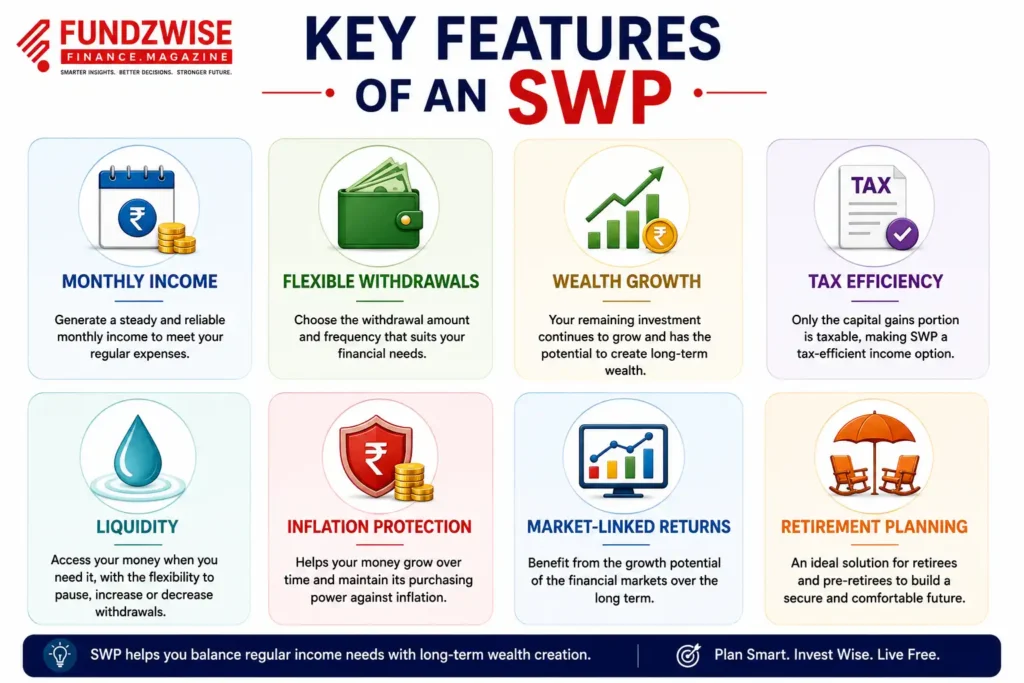
Features of a Systematic Withdrawal Plan (SWP)
A Systematic Withdrawal Plan is much more than a facility to receive monthly income. It is a flexible investment strategy designed to help investors generate regular cash flow while allowing the remaining investment to continue participating in market growth. Understanding its features will help you decide whether it fits your financial goals.
1. Regular Income at Fixed Intervals
The primary feature of an SWP is that it provides a regular stream of income from your mutual fund investment.
You can choose to receive money:
- Every month
- Every quarter
- Every six months
- Every year
Monthly withdrawals are generally preferred by retirees because they closely resemble a salary or pension.
2. Flexible Withdrawal Amount
Unlike pension products that offer fixed payouts, SWPs allow investors to decide how much they want to withdraw.
For example, if your monthly expenses increase due to inflation, you can request the AMC to increase your withdrawal amount. Similarly, you can reduce the amount if you don’t need as much income.
This flexibility makes SWPs suitable for changing financial situations.
3. Choice of Withdrawal Frequency
Every investor has different cash flow requirements.
An SWP allows you to customize the frequency according to your needs.
| Frequency | Suitable For |
|---|---|
| Monthly | Retirees and salaried replacement income |
| Quarterly | Freelancers and consultants |
| Half-Yearly | Education or insurance payments |
| Annually | Long-term wealth management |
4. Remaining Investment Continues to Grow
One of the biggest advantages of an SWP is that your entire investment is not redeemed at once.
Only the required units are sold, while the remaining units continue earning market-linked returns.
This provides an opportunity for long-term capital appreciation.
5. No Need to Time the Market
Many investors worry about redeeming their investments at the wrong time.
An SWP eliminates this concern by automatically redeeming units at predefined intervals.
This systematic approach reduces emotional investing.
6. Easy to Start and Stop
You can start, modify, pause, or stop an SWP whenever required, subject to the scheme’s terms and conditions.
This flexibility makes it more convenient than many traditional income products.
7. Suitable for Multiple Fund Categories
An SWP can generally be started in various mutual fund categories, including:
- Hybrid Funds
- Flexi Cap Funds
- Large Cap Funds
- Conservative Hybrid Funds
- Multi Asset Funds
- Debt Funds
- Liquid Funds
- Arbitrage Funds
Each category has different risk and return characteristics, which we will explore later in this guide.
8. Market-Linked Returns
Unlike fixed deposits, SWPs are linked to the performance of the underlying mutual fund.
If markets perform well over the long term, your remaining investment may continue to grow while you receive regular withdrawals.
However, returns are not guaranteed, and market fluctuations can affect your investment value.
9. High Liquidity
Most open-ended mutual funds allow investors to redeem their investments whenever needed.
This provides easy access to your money in case of emergencies.
However, always check whether the chosen scheme has an exit load or other restrictions.
10. Tax Efficiency
SWPs are generally considered more tax-efficient than many traditional income options because taxation depends on the capital gains generated through unit redemption rather than treating the entire withdrawal as taxable income.
We will discuss taxation in detail later in this guide.
Benefits of Investing Through an SWP
An SWP offers several advantages that make it one of the most preferred withdrawal strategies for long-term investors.
Let’s understand each benefit in detail.
Creates a Reliable Source of Passive Income
Perhaps the biggest advantage of an SWP is that it converts your investment into a predictable income stream.
This income can be used to pay for:
- Household expenses
- Medical bills
- Utility payments
- Children’s education
- Travel
- Lifestyle expenses
Instead of worrying about selling investments manually every month, withdrawals happen automatically.
Ideal for Retirement Planning
Retirement usually means the end of a regular salary.
An SWP helps replace that salary by generating consistent monthly income while keeping the remaining corpus invested.
This makes retirement financially more comfortable.
Better Inflation Protection
Traditional fixed-income investments often struggle to beat inflation over long periods.
A well-selected mutual fund has the potential to generate market-linked returns, helping your remaining corpus grow and better preserve purchasing power.
While inflation can never be completely eliminated, investing in growth-oriented assets may help reduce its long-term impact.
Flexible Cash Flow
Life is unpredictable.
Medical emergencies, family events, vacations, and rising living costs can increase your financial needs.
Unlike many pension products, SWPs allow you to adjust your withdrawal amount according to changing circumstances.
Potential for Long-Term Wealth Creation
Because only a portion of the investment is redeemed, the remaining amount continues participating in market growth.
If your annual returns exceed your withdrawal rate over time, your investment may continue growing despite regular withdrawals.
This is one of the biggest reasons many financial planners recommend SWPs instead of withdrawing the entire investment at once.
More Tax Efficient Than Frequent Lump Sum Withdrawals
Frequent full redemptions may result in larger taxable capital gains at once.
An SWP spreads redemptions over time, which can make taxation more manageable depending on the type of fund and prevailing tax rules.
Eliminates Emotional Investing
Many investors panic during market corrections.
An SWP introduces discipline because withdrawals happen automatically based on your instructions rather than emotions.
This reduces the temptation to make impulsive investment decisions.
Helps Preserve Wealth
One of the biggest mistakes retirees make is withdrawing large amounts too quickly.
A properly planned SWP can help preserve the investment corpus for many years by withdrawing only a sustainable amount.
Convenient and Automated
Once the SWP is registered, withdrawals happen automatically.
There is no need to submit redemption requests every month.
This convenience is particularly valuable for senior citizens.
Supports Financial Independence
Instead of depending on family members or pension income alone, investors can create their own monthly income stream through mutual funds.
This increases financial confidence and independence.
Comparison: SWP vs Traditional Income Sources
| Feature | SWP | Fixed Deposit | Rental Income | Dividend Option |
|---|---|---|---|---|
| Regular Income | Yes | Yes | Yes | Depends on company or fund |
| Capital Appreciation Potential | Yes | Limited | Possible | Limited |
| Flexibility | High | Low | Low | Low |
| Liquidity | High | Moderate | Low | Moderate |
| Inflation Protection | Better potential | Limited | Moderate | Depends |
| Withdrawal Control | Complete | Limited | No | No |
| Market Linked | Yes | No | Partially | Yes |
Who Should Invest in an SWP?
An SWP is not designed for every investor. It works best for individuals seeking regular income while allowing the remaining investment to stay in the market.
Retired Individuals
Retirees often need a predictable monthly income to meet daily expenses after their salary stops.
An SWP can provide this income while helping the remaining investment continue growing.
Senior Citizens
Senior citizens looking for flexibility and liquidity may find SWPs useful as part of a diversified retirement strategy.
However, the choice of mutual fund should match their risk tolerance and income needs.
Early Retirees
People who retire before the traditional retirement age often need their investments to last for decades.
A carefully planned SWP, combined with a sustainable withdrawal rate, can support long-term financial independence.
Freelancers and Consultants
Freelancers may experience irregular income throughout the year.
An SWP can provide a consistent monthly cash flow during periods of lower earnings.
Business Owners
Entrepreneurs with surplus funds can use SWPs to generate regular income without completely liquidating their investments.
Homemakers
Homemakers managing household expenses can benefit from receiving regular monthly income from family investments through an SWP.
High-Net-Worth Individuals (HNIs)
HNIs often use SWPs to manage cash flow efficiently while preserving wealth for future generations.
NRIs
Many Non-Resident Indians invest in Indian mutual funds to create a regular income stream for themselves or their families in India, subject to applicable regulations and taxation.
Expert Tip
An SWP should ideally be started only after building:
- An emergency fund
- Adequate health insurance
- Life insurance (if required)
- A diversified investment portfolio
Using an SWP as your only financial strategy may expose you to unnecessary risks, especially during prolonged market downturns.
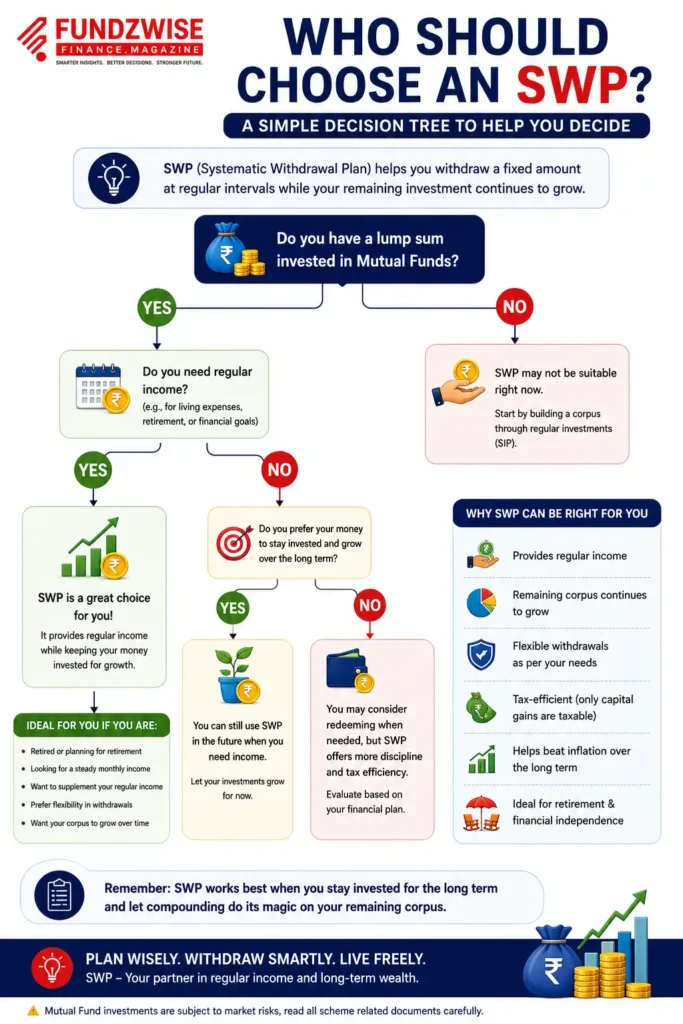
How We Selected the Best SWP Mutual Funds in India
Choosing the best mutual fund for a Systematic Withdrawal Plan is very different from selecting a fund for long-term wealth creation. A fund that delivers the highest one-year return may not necessarily be the best option for generating sustainable monthly income.
For an SWP, the focus should be on consistency, downside protection, tax efficiency, portfolio quality, and the ability to withstand different market conditions. This guide uses multiple qualitative and quantitative factors to identify funds that are better suited for long-term withdrawals rather than simply chasing recent performance.
Instead of relying on short-term rankings, we evaluate funds using long-term data, risk-adjusted metrics, fund management quality, and portfolio characteristics. This approach helps investors make more informed decisions based on their financial goals and risk tolerance.
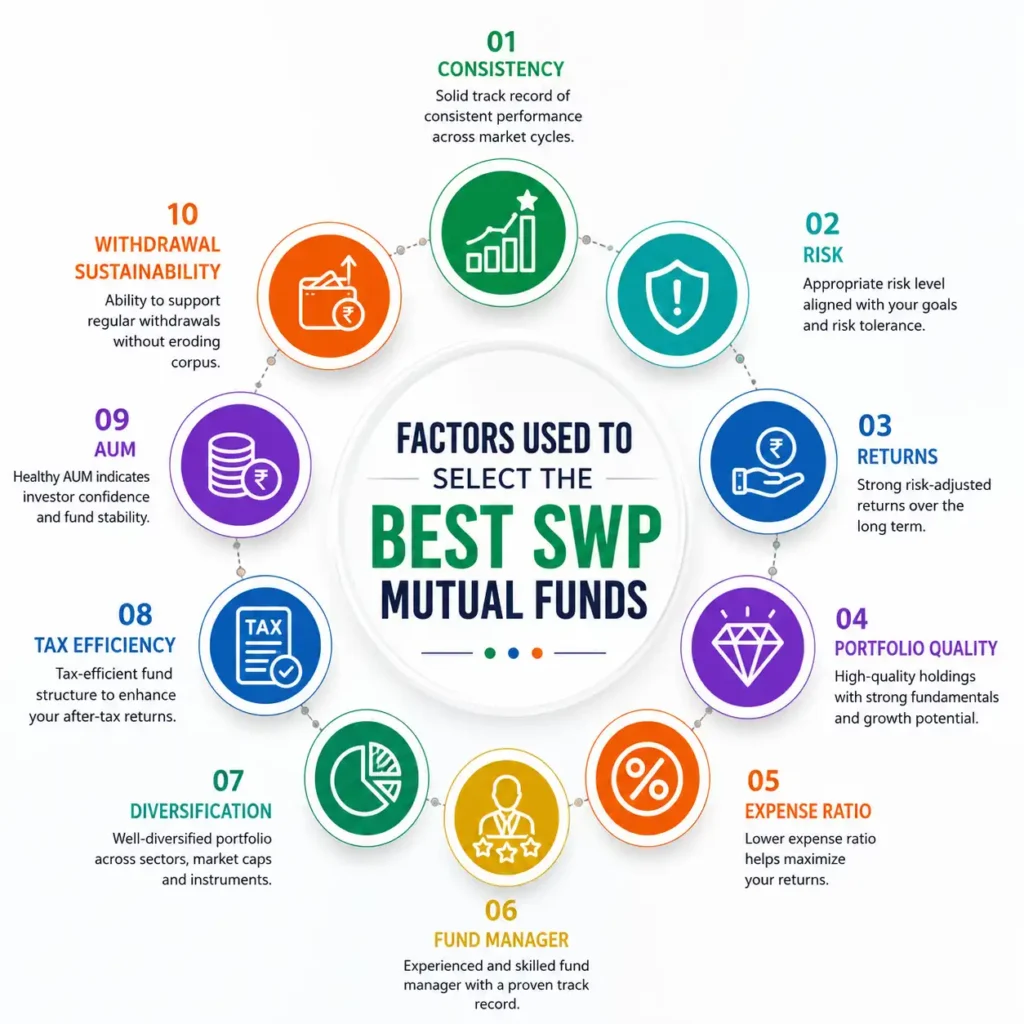
Selection Criteria Used in This Guide
The following parameters were considered while evaluating mutual funds for SWP suitability.
Long-Term Performance Consistency
Consistency is one of the most important factors for an SWP.
A fund that has consistently delivered competitive returns over five to ten years is generally more reliable than a fund that has performed exceptionally well in only one or two years.
Consistent performance across different market cycles helps reduce the risk of significant corpus erosion during withdrawals.
Rather than focusing only on the highest CAGR, investors should also evaluate how steadily the fund has generated returns over time.
Rolling Returns
Rolling returns provide a better picture of fund performance than point-to-point returns.
Instead of measuring returns between two specific dates, rolling returns analyze performance across multiple overlapping periods.
This helps identify whether a fund has consistently rewarded investors regardless of when they invested.
Funds with stronger rolling returns generally indicate better management and lower dependence on favorable market timing.
Risk-Adjusted Returns
Higher returns do not always mean better investments.
If a fund generates excellent returns by taking excessive risk, it may not be suitable for investors relying on monthly withdrawals.
Risk-adjusted performance measures whether a fund has generated adequate returns relative to the amount of risk taken.
This is particularly important for retirees who depend on stable income.
Sharpe Ratio
The Sharpe Ratio measures how much return a fund generates for every unit of risk taken.
A higher Sharpe Ratio generally indicates that investors are receiving better compensation for the risk assumed.
For SWP investors, funds with stronger Sharpe Ratios may provide more efficient long-term performance.
Although the Sharpe Ratio should not be used alone, it is an important indicator when comparing funds within the same category.
Sortino Ratio
While the Sharpe Ratio considers total volatility, the Sortino Ratio focuses only on downside volatility.
This makes it particularly useful for retirement planning because investors are generally more concerned about losses than upward price movements.
A higher Sortino Ratio suggests that the fund has managed downside risk more effectively.
Maximum Drawdown
Maximum Drawdown measures the largest decline experienced by a fund from its highest point to its lowest point during a specific period.
This metric is especially important for SWPs because large market declines may force investors to redeem more units to generate the same monthly income.
Funds with relatively lower drawdowns may help preserve the investment corpus during difficult market conditions.
Downside Capture Ratio
This metric evaluates how much a fund falls compared to its benchmark during market declines.
Lower downside capture generally indicates better downside protection.
For retirees, minimizing losses during bear markets can significantly improve the sustainability of an SWP.
Expense Ratio
Every mutual fund charges a fee known as the Expense Ratio.
Although the percentage may appear small, it can have a meaningful impact on long-term returns.
Lower expenses leave more money invested, which may help improve the longevity of an SWP.
Investors should compare expense ratios among similar funds rather than across different categories.
Portfolio Diversification
Diversification reduces concentration risk.
Funds that invest across multiple sectors, industries, and companies may be better positioned to manage volatility than highly concentrated portfolios.
A diversified portfolio can improve stability during market fluctuations.
Portfolio Quality
While diversification is important, the quality of underlying investments matters even more.
When evaluating a mutual fund, consider factors such as:
- Strong underlying businesses
- Healthy balance sheets
- Consistent earnings growth
- Sustainable competitive advantages
- Reasonable valuations
- Corporate governance standards
Higher-quality portfolios often demonstrate greater resilience during economic uncertainty.
Fund Manager Experience
An experienced fund manager plays a significant role in long-term performance.
When selecting a fund for SWP, evaluate:
- Years of experience
- Performance across different market cycles
- Investment philosophy
- Portfolio turnover
- Risk management approach
- Stability of the fund management team
Frequent changes in fund management may affect future consistency.
Assets Under Management (AUM)
AUM represents the total value of assets managed by a mutual fund.
While larger AUM does not guarantee better returns, it often reflects investor confidence and operational stability.
However, investors should balance AUM with performance consistency rather than selecting funds based solely on size.
Exit Load
Many mutual funds charge an exit load if units are redeemed within a specified period.
Before starting an SWP, investors should understand:
- Exit load percentage
- Applicable holding period
- Conditions for redemption
- Impact on withdrawals
Choosing funds with suitable exit load structures can help improve overall returns.
Volatility
Every market experiences periods of ups and downs.
Highly volatile funds may produce excellent returns during bull markets but can also experience sharper declines during corrections.
For SWPs, lower volatility generally supports more predictable withdrawals.
Tax Efficiency
Taxation significantly influences post-withdrawal income.
A tax-efficient fund may help investors retain more of their investment over the long term.
When comparing funds, evaluate:
- Type of fund
- Applicable capital gains tax
- Holding period
- Tax implications of redemptions
A detailed taxation section appears later in this guide.
Withdrawal Sustainability
Perhaps the most overlooked factor in selecting an SWP fund is whether the withdrawal amount can be sustained for many years.
A sustainable SWP depends on:
- Expected long-term returns
- Inflation
- Withdrawal percentage
- Market volatility
- Investment horizon
- Taxation
- Asset allocation
Selecting a fund solely because it delivered high returns in the recent past may reduce the longevity of your investment.
Evaluation Parameters
| Parameter | Why It Matters for SWP | Importance |
|---|---|---|
| 5-Year Performance | Measures medium-term consistency | ⭐⭐⭐⭐⭐ |
| 10-Year Performance | Indicates long-term reliability | ⭐⭐⭐⭐⭐ |
| Rolling Returns | Shows consistency across different periods | ⭐⭐⭐⭐⭐ |
| Sharpe Ratio | Risk-adjusted return | ⭐⭐⭐⭐☆ |
| Sortino Ratio | Downside risk measurement | ⭐⭐⭐⭐☆ |
| Maximum Drawdown | Capital protection during corrections | ⭐⭐⭐⭐⭐ |
| Expense Ratio | Improves net returns | ⭐⭐⭐⭐☆ |
| AUM | Reflects fund stability | ⭐⭐⭐☆☆ |
| Portfolio Quality | Supports long-term growth | ⭐⭐⭐⭐⭐ |
| Diversification | Reduces concentration risk | ⭐⭐⭐⭐⭐ |
| Exit Load | Affects redemption cost | ⭐⭐⭐☆☆ |
| Fund Manager Experience | Influences investment decisions | ⭐⭐⭐⭐☆ |
Common Mistakes Investors Make While Selecting SWP Mutual Funds
Many investors unknowingly make decisions that reduce the effectiveness of their SWP strategy.
Avoid these common mistakes:
- Choosing funds based only on the highest recent returns.
- Ignoring portfolio volatility.
- Starting withdrawals immediately after investing without considering market conditions.
- Selecting sectoral or thematic funds for regular income.
- Overlooking taxation.
- Ignoring inflation while deciding the withdrawal amount.
- Withdrawing too much from the corpus.
- Not reviewing the portfolio periodically.
- Investing the entire corpus in a single fund.
- Ignoring exit load conditions.
- Selecting funds without understanding the underlying asset allocation.
Expert Insight
When building an SWP portfolio, capital preservation and consistency should generally take priority over chasing the highest returns. A fund that delivers slightly lower but more stable returns may support a longer-lasting withdrawal plan than a highly volatile fund with exceptional short-term performance. Align your withdrawal rate, risk tolerance, and investment horizon with the characteristics of the chosen fund rather than relying solely on recent performance rankings.
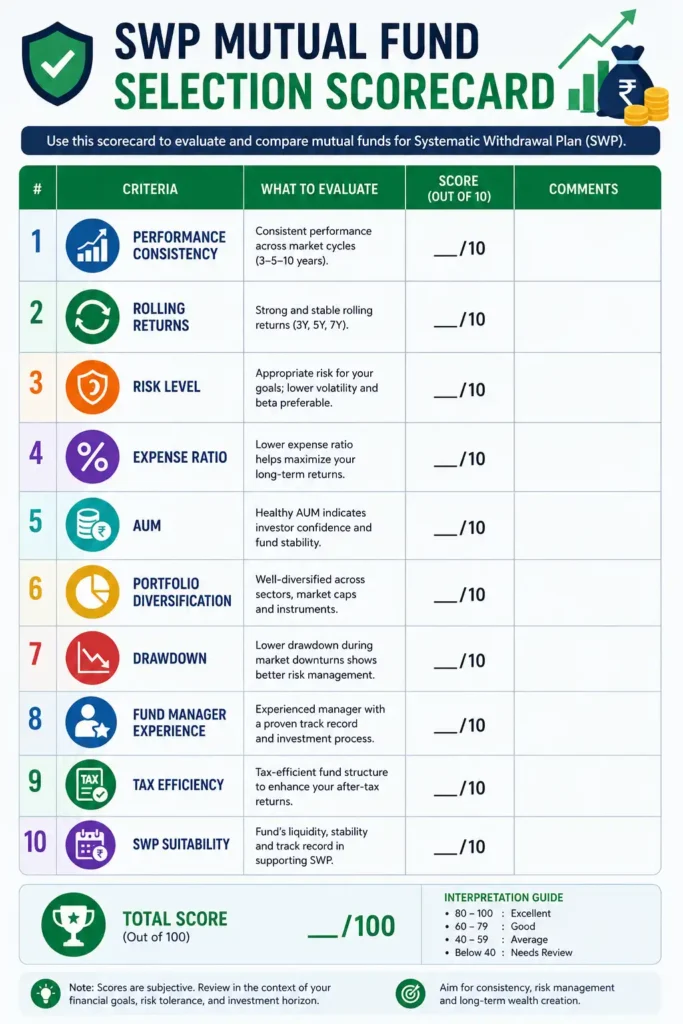
SWP Suitability Score Calculator
Rate each factor from 1 to 10 to check whether a mutual fund is suitable for a Systematic Withdrawal Plan.
Best Mutual Fund Categories for SWP
Selecting the right mutual fund category is even more important than selecting an individual fund. Many investors spend hours comparing returns between different schemes but completely ignore whether the underlying category is suitable for generating regular income.
For example, a small cap fund may deliver exceptional returns during a bull market, but its higher volatility can make it less suitable for investors depending on regular monthly withdrawals. On the other hand, a balanced advantage fund may provide comparatively moderate returns while helping reduce the impact of market fluctuations.
The ideal fund category depends on several factors, including:
- Your age
- Investment horizon
- Monthly income requirement
- Existing retirement corpus
- Risk tolerance
- Other sources of income
- Inflation expectations
- Tax considerations
Rather than asking, "Which mutual fund is best for SWP?" a better question is, "Which mutual fund category is best for my financial goals?"
This section explains every major category that investors commonly consider for SWPs.
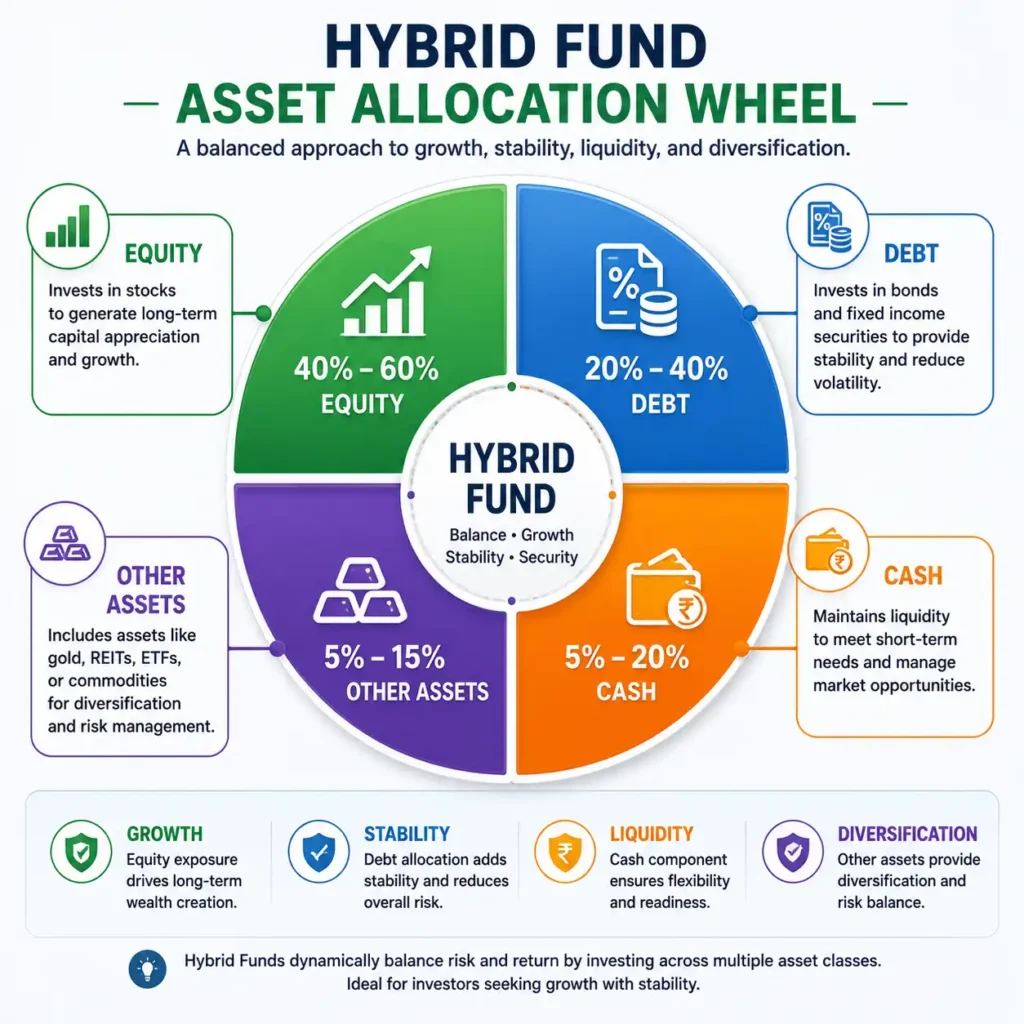
Hybrid Mutual Funds
Hybrid mutual funds invest in a combination of equity, debt, and sometimes cash or other asset classes. The allocation between equity and debt varies depending on the type of hybrid fund.
Because they balance growth with relative stability, hybrid funds are among the most preferred choices for Systematic Withdrawal Plans.
Why Hybrid Funds Are Suitable for SWP
Hybrid funds aim to reduce portfolio volatility while still providing opportunities for capital appreciation.
During rising markets, the equity portion helps generate growth.
During falling markets, the debt allocation can reduce the overall decline compared to pure equity funds.
This balanced approach makes hybrid funds particularly attractive for retirees seeking regular income.
Advantages
- Lower volatility than pure equity funds
- Better inflation-beating potential than traditional fixed-income products
- Diversified portfolio
- Suitable for long-term withdrawals
- Better downside protection in many market environments
Limitations
- Returns are market-linked
- Equity allocation can still cause temporary declines
- Performance varies depending on fund strategy
Suitable For
- Retirees
- Senior citizens with moderate risk appetite
- Passive income seekers
- Investors with a horizon of seven years or more
Balanced Advantage Funds
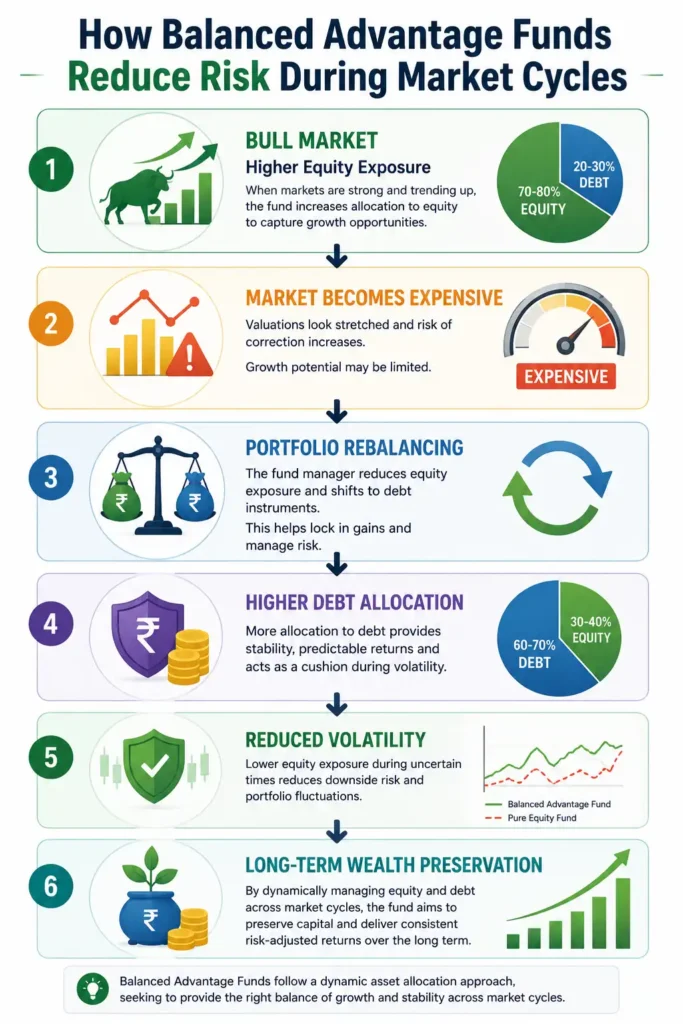
Balanced Advantage Funds, also known as Dynamic Asset Allocation Funds, automatically adjust their equity and debt allocation depending on market valuations.
When markets appear expensive, equity exposure is generally reduced.
When markets become attractive, equity allocation is increased.
This dynamic strategy helps manage market volatility.
Why They Are Popular for SWPs
Balanced Advantage Funds can help reduce the impact of sharp market corrections because the asset allocation changes according to market conditions.
This makes them one of the most recommended categories for retirement income planning.
Advantages
- Automatic asset allocation
- Better downside management
- Lower emotional investing
- Suitable for long-term withdrawals
- Potential tax efficiency depending on portfolio structure
Limitations
- Returns may lag during strong bull markets
- Different fund houses follow different allocation models
Suitable For
- Conservative retirees
- First-time SWP investors
- Investors looking for moderate risk
Flexi Cap Mutual Funds
Flexi Cap Funds invest across large-cap, mid-cap, and small-cap companies without fixed allocation limits.
Fund managers can shift investments depending on market opportunities.
This flexibility allows them to capture growth across different market segments.
Why Consider Flexi Cap Funds for SWP
Although they carry higher risk than hybrid funds, quality Flexi Cap Funds have historically delivered strong long-term returns.
Investors with longer retirement horizons may allocate a portion of their SWP portfolio to this category.
Advantages
- High long-term growth potential
- Dynamic market allocation
- Diversified across company sizes
- Inflation-beating potential
Limitations
- Higher volatility
- Not ideal for very conservative investors
- Corpus fluctuations may be significant during bear markets
Suitable For
- Early retirees
- Investors with 15+ year horizons
- Moderate to aggressive investors
Large Cap Mutual Funds
Large Cap Funds invest primarily in India's largest listed companies.
These businesses are generally well-established and financially stronger than smaller companies.
Although returns may be comparatively moderate, large-cap funds often experience lower volatility.
Advantages
- Stable businesses
- Lower risk compared with mid-cap and small-cap funds
- Suitable for long-term SWPs
- Better resilience during economic downturns
Limitations
- Moderate return potential
- Slower growth during strong bull markets
Suitable For
- Conservative investors
- Senior citizens
- Long-term retirement planning
Multi Asset Allocation Funds
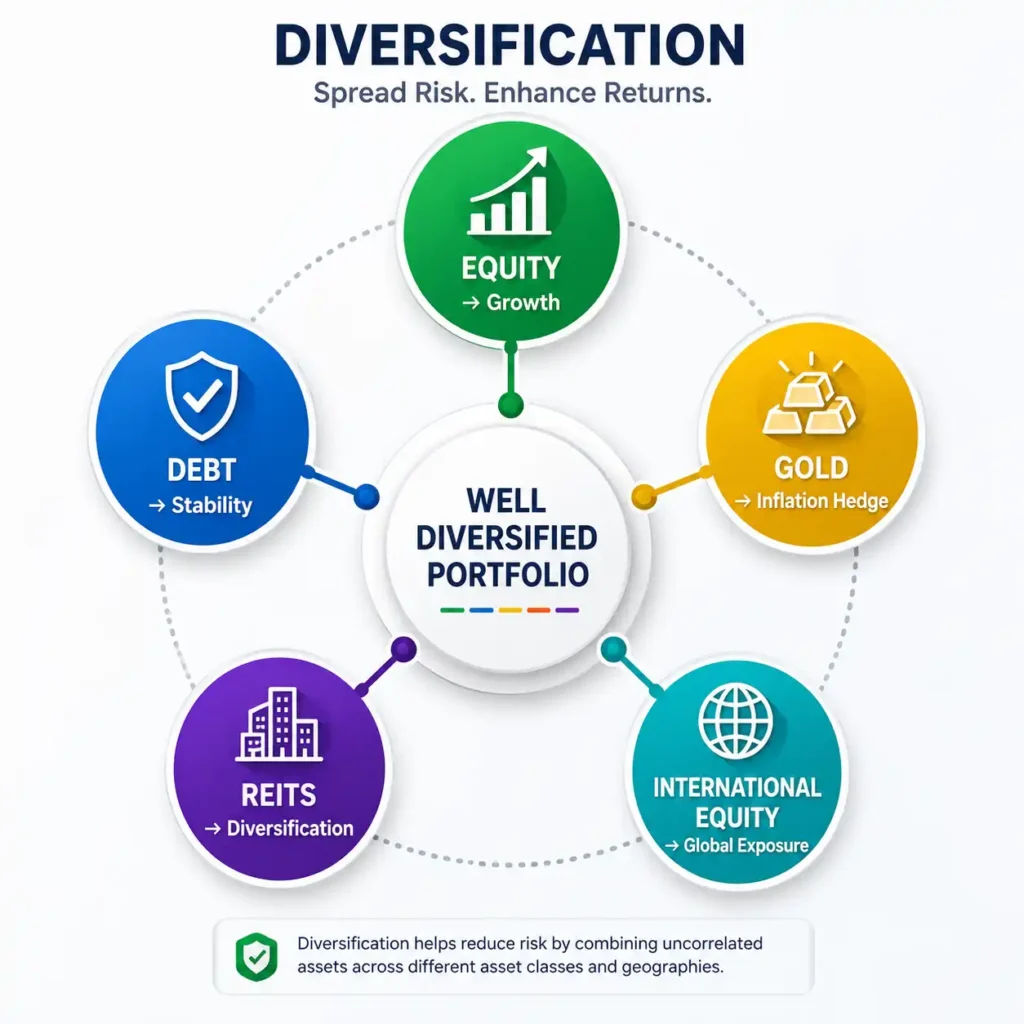
Multi Asset Funds invest across three or more asset classes such as:
- Equity
- Debt
- Gold
- REITs
- International equities
- Commodities
Diversification across multiple asset classes helps reduce dependence on any single investment type.
Why Multi Asset Funds Are Good for SWPs
Different asset classes often perform differently during various economic cycles.
For example,
Gold may perform well during uncertain markets, while equities may perform better during economic expansion.
This diversification helps stabilize portfolio returns.
Advantages
- Excellent diversification
- Reduced concentration risk
- Inflation hedge
- Lower dependence on one market
Limitations
- Performance depends on asset allocation strategy
- Slightly more complex to understand
Suitable For
- Long-term investors
- Retirees with moderate risk appetite
- Wealth preservation strategies
Conservative Hybrid Funds
Conservative Hybrid Funds maintain a larger allocation towards debt while investing a smaller portion in equities.
This makes them one of the least volatile hybrid categories.
Advantages
- Lower volatility
- Better capital preservation
- Suitable for conservative investors
- Regular income potential
Limitations
- Lower long-term growth potential
- Inflation may reduce purchasing power over extended periods
Suitable For
- Senior citizens
- Risk-averse investors
- Investors nearing retirement
Debt Mutual Funds
Debt Funds invest primarily in fixed-income securities such as government securities, treasury bills, corporate bonds, certificates of deposit, and money market instruments.
Their primary objective is capital preservation and income generation rather than aggressive growth.
Why Investors Choose Debt Funds
Debt funds generally experience lower volatility than equity-oriented funds.
They are commonly used by investors seeking stability and relatively predictable returns.
Advantages
- Lower market volatility
- Better capital protection
- Suitable for conservative SWPs
- Relatively stable performance
Limitations
- Lower long-term return potential
- Interest rate risk
- Credit risk in some categories
Suitable For
- Conservative retirees
- Emergency income planning
- Short to medium-term income needs
Arbitrage Funds
Arbitrage Funds generate returns by exploiting price differences between cash and derivatives markets.
These funds generally exhibit lower equity-related volatility while maintaining equity-oriented taxation if they meet applicable regulatory requirements.
Advantages
- Lower volatility
- Useful for short-term parking of funds
- Relatively stable return profile
Limitations
- Moderate return expectations
- Dependent on arbitrage opportunities
Suitable For
- Conservative investors
- Temporary SWP strategies
- Short-term financial goals
Liquid Mutual Funds
Liquid Funds invest in high-quality money market instruments with very short maturities.
Although they are generally not designed for long-term wealth creation, they can be useful for short-term income planning.
Advantages
- High liquidity
- Low volatility
- Quick redemption
- Suitable for emergency funds
Limitations
- Lower return potential
- May not adequately beat inflation over long periods
Suitable For
- Emergency corpus
- Temporary SWPs
- Parking funds before long-term investments
Index Mutual Funds
Index Funds aim to replicate the performance of a benchmark index rather than trying to outperform it.
Because they are passively managed, they generally have lower expense ratios.
Advantages
- Low costs
- Transparent investment strategy
- Broad diversification
- Suitable for long-term investors
Limitations
- Cannot outperform the benchmark before expenses
- Full participation in market declines
Suitable For
- Long-term passive investors
- DIY investors
- Investors seeking low-cost solutions
Category Comparison Table
| Fund Category | Growth Potential | Volatility | SWP Suitability | Ideal Investment Horizon |
|---|---|---|---|---|
| Balanced Advantage | High | Low to Moderate | ⭐⭐⭐⭐⭐ | 7–15 Years |
| Hybrid | High | Moderate | ⭐⭐⭐⭐⭐ | 7–15 Years |
| Large Cap | Moderate to High | Moderate | ⭐⭐⭐⭐☆ | 10+ Years |
| Flexi Cap | High | High | ⭐⭐⭐⭐☆ | 12+ Years |
| Multi Asset | Moderate to High | Moderate | ⭐⭐⭐⭐⭐ | 10+ Years |
| Conservative Hybrid | Moderate | Low | ⭐⭐⭐⭐☆ | 5–10 Years |
| Debt | Moderate | Low | ⭐⭐⭐☆☆ | 3–7 Years |
| Arbitrage | Low to Moderate | Low | ⭐⭐⭐☆☆ | 1–3 Years |
| Liquid | Low | Very Low | ⭐⭐☆☆☆ | Up to 2 Years |
| Index | High | Moderate to High | ⭐⭐⭐⭐☆ | 10+ Years |
Which Category Is Best for Different Investors?
Every investor has unique financial objectives. The table below can help you identify the most suitable category based on your profile.
| Investor Type | Recommended Categories |
|---|---|
| Retirees | Balanced Advantage, Hybrid, Conservative Hybrid |
| Senior Citizens | Conservative Hybrid, Debt, Balanced Advantage |
| Early Retirees | Hybrid, Flexi Cap, Multi Asset |
| High-Net-Worth Individuals | Multi Asset, Flexi Cap, Hybrid |
| Young Investors Planning Future SWP | Flexi Cap, Index, Large Cap |
| Passive Income Seekers | Balanced Advantage, Hybrid |
| Risk-Averse Investors | Conservative Hybrid, Debt |
| Moderate Risk Investors | Hybrid, Multi Asset |
| Aggressive Investors | Flexi Cap, Large Cap, Index |
Suggested Asset Allocation for SWP Portfolios
Instead of investing your entire retirement corpus in a single mutual fund category, consider building a diversified portfolio aligned with your goals and risk tolerance.
Conservative Portfolio
- Conservative Hybrid Funds – 40%
- Debt Funds – 35%
- Balanced Advantage Funds – 25%
Suitable for investors who prioritize capital preservation and lower volatility.
Moderate Portfolio
- Balanced Advantage Funds – 35%
- Hybrid Funds – 30%
- Large Cap Funds – 20%
- Multi Asset Funds – 15%
Designed to balance income stability with long-term growth.
Growth-Oriented Portfolio
- Flexi Cap Funds – 35%
- Large Cap Funds – 25%
- Multi Asset Funds – 20%
- Balanced Advantage Funds – 20%
Suitable for investors with a longer investment horizon and higher risk tolerance.
Interactive Portfolio Builder
Enter your details to get a suggested asset allocation.
Expert Tip
A diversified SWP portfolio often provides a better balance between income stability and long-term growth than relying on a single mutual fund. Review your allocation periodically and rebalance if market movements cause significant deviations from your target mix. Consider consulting a qualified financial advisor before making investment decisions, especially if your SWP is intended to fund essential living expenses.
Top and Best Performing SWP Mutual Funds in India
There is no single mutual fund that can be called the "best" SWP mutual fund for every investor. The right choice depends on your investment horizon, risk appetite, expected monthly income, tax situation, and overall financial goals.
For example, a retiree looking for stable monthly income may prefer a Balanced Advantage Fund or a Conservative Hybrid Fund, while an investor planning to start withdrawals after 10 to 15 years may choose a Flexi Cap Fund or a Large Cap Fund for potentially higher long-term growth.
Instead of selecting a fund based solely on recent returns, investors should evaluate consistency, portfolio quality, downside protection, expense ratio, fund manager experience, and the ability to generate sustainable returns across different market cycles.
The funds discussed below have been shortlisted because they have historically demonstrated strong long-term performance, diversified portfolios, and characteristics that many investors consider when building an SWP strategy. However, past performance does not guarantee future returns, and investors should always review the latest fund information before investing.
Important Points Before Choosing Any SWP Fund
Before selecting a mutual fund, ask yourself the following questions:
- What is my monthly income requirement?
- How many years do I expect my investment to last?
- Do I already receive pension or rental income?
- Can I tolerate temporary market declines?
- Will inflation increase my future expenses?
- Am I investing for myself or for my spouse?
- Do I need monthly, quarterly or annual withdrawals?
- What percentage of my corpus will I withdraw every year?
Answering these questions will help narrow down the most suitable category before choosing an individual scheme.
Evaluation Parameters
Every fund discussed in this guide should ideally be evaluated using the following parameters.
| Parameter | Why It Matters |
|---|---|
| Long-term consistency | Indicates stability across market cycles |
| Portfolio quality | Reduces long-term investment risk |
| Expense ratio | Lower costs improve net returns |
| AUM | Shows investor confidence and fund stability |
| Risk-adjusted return | Measures return relative to risk |
| Maximum drawdown | Indicates downside protection |
| Fund manager experience | Reflects investment expertise |
| Portfolio diversification | Reduces concentration risk |
| Exit load | Impacts redemption cost |
| Category suitability | Helps match investor goals |
Best Balanced Advantage Funds for SWP
Balanced Advantage Funds are widely regarded as one of the most suitable categories for Systematic Withdrawal Plans because they automatically adjust their equity and debt allocation according to market conditions.
Their objective is to participate in market growth while reducing downside risk during volatile periods.
These funds can be particularly useful for retirees who want regular income without taking excessive equity risk.
Why Choose Balanced Advantage Funds?
- Dynamic asset allocation
- Lower volatility than pure equity funds
- Better downside management
- Suitable for long-term withdrawals
- Potential inflation-beating returns
Ideal Investors
- Retired individuals
- Senior citizens
- First-time SWP investors
- Moderate risk investors
- Investors seeking regular monthly income
Things to Check
- Historical downside protection
- Rolling returns
- Equity allocation strategy
- Expense ratio
- Portfolio turnover
- Fund manager track record
Best Hybrid Funds for SWP
Hybrid Funds combine equity and debt investments to balance growth and stability.
Many financial planners recommend Hybrid Funds for retirement planning because they attempt to generate long-term capital appreciation while reducing volatility compared to pure equity funds.
Advantages
- Better risk management
- Diversified portfolio
- Suitable for long-term income
- Potential for wealth preservation
- Lower volatility than equity funds
Suitable Investors
- Families
- Retirees
- Passive income seekers
- Moderate risk investors
Key Evaluation Metrics
- Equity allocation
- Debt quality
- Average maturity
- Portfolio diversification
- Rolling returns
- Expense ratio
Best Large Cap Funds for SWP
Large Cap Funds invest primarily in India's largest listed companies.
These companies generally have strong balance sheets, experienced management teams, and established business models.
Although they may not always generate the highest returns during bull markets, they have historically demonstrated greater resilience than smaller companies during market corrections.
Advantages
- Relatively stable portfolio
- Lower volatility than mid and small caps
- High-quality businesses
- Suitable for long-term investors
Suitable Investors
- Conservative investors
- Long-term retirees
- Investors with moderate risk appetite
Best Flexi Cap Funds for SWP
Flexi Cap Funds have the flexibility to invest across large-cap, mid-cap, and small-cap companies depending on market opportunities.
Because of this flexibility, they have the potential to generate attractive long-term returns.
However, they also experience greater short-term volatility.
Advantages
- Higher growth potential
- Dynamic portfolio allocation
- Suitable for long investment horizons
- Better opportunity to beat inflation
Limitations
- Higher volatility
- Greater fluctuations in portfolio value
- Not ideal for very conservative investors
Suitable Investors
- Early retirees
- Long-term investors
- Moderate to aggressive investors
Best Multi Asset Funds for SWP
Multi Asset Funds invest across different asset classes including equity, debt, gold and sometimes international investments.
Because different asset classes often perform differently during economic cycles, these funds provide an additional layer of diversification.
Advantages
- Diversification across multiple assets
- Better risk management
- Inflation hedge
- Reduced dependence on a single asset class
Suitable Investors
- Wealth preservation
- Long-term retirement planning
- Moderate risk investors
Best Conservative Hybrid Funds for SWP
Conservative Hybrid Funds generally maintain a larger allocation towards debt and a smaller allocation towards equity.
This makes them suitable for investors prioritizing capital preservation over aggressive growth.
Advantages
- Lower volatility
- Better capital protection
- Stable income potential
- Suitable for conservative retirees
Limitations
- Lower long-term growth
- Inflation may reduce purchasing power
Best Debt Funds for SWP
Debt Funds invest primarily in fixed-income instruments.
They are suitable for investors seeking relatively lower volatility.
Advantages
- Lower market fluctuations
- Better capital preservation
- Stable return expectations
- Suitable for conservative investors
Risks
- Interest rate risk
- Credit risk
- Lower long-term growth than equity-oriented funds
Category Comparison
| Category | Growth Potential | Volatility | SWP Rating | Suitable For |
| Balanced Advantage | High | Low to Moderate | ⭐⭐⭐⭐⭐ | Retirement |
| Hybrid | High | Moderate | ⭐⭐⭐⭐⭐ | Monthly Income |
| Large Cap | Moderate to High | Moderate | ⭐⭐⭐⭐☆ | Long-Term Income |
| Flexi Cap | High | High | ⭐⭐⭐⭐☆ | Early Retirement |
| Multi Asset | Moderate to High | Moderate | ⭐⭐⭐⭐⭐ | Wealth Preservation |
| Conservative Hybrid | Moderate | Low | ⭐⭐⭐⭐☆ | Senior Citizens |
| Debt | Moderate | Low | ⭐⭐⭐☆☆ | Conservative Investors |
Top 15 Best Performing SWP Mutual Funds in India
The funds discussed below belong to categories that are commonly considered by investors for Systematic Withdrawal Plans because of their long-term track records, diversified portfolios, experienced fund management teams, and suitability for different investor profiles. Remember that mutual fund performance changes over time, so always verify the latest portfolio, expense ratio, and performance before investing.
Rather than selecting a fund solely because it has delivered the highest recent returns, focus on whether it aligns with your investment horizon, withdrawal needs, and risk tolerance.
1. ICICI Prudential Balanced Advantage Fund
Category: Balanced Advantage Fund
Risk Level: Moderately High
Suitable For: Retirees, passive income seekers, moderate-risk investors
The ICICI Prudential Balanced Advantage Fund is one of the most popular dynamic asset allocation funds in India. Its strategy automatically adjusts the allocation between equity and debt depending on market valuations. This helps reduce portfolio volatility while maintaining exposure to long-term growth opportunities.
Instead of remaining fully invested in equities during expensive market conditions, the fund gradually increases its debt allocation. Similarly, when valuations become attractive, it increases equity exposure.
This disciplined approach makes it suitable for investors planning an SWP because lower volatility may help reduce the number of units redeemed during market downturns.
Why It Can Be Suitable for SWP
- Dynamic equity allocation
- Diversified portfolio
- Experienced fund management
- Long-term consistency
- Better downside management than many pure equity funds
Things to Consider
- Returns may be lower than aggressive equity funds during strong bull markets.
- Dynamic allocation strategies differ across fund houses.
Best Investor Profile
- Recently retired individuals
- Senior citizens
- Investors seeking stable monthly withdrawals
- Moderate-risk investors
Suggested Withdrawal Strategy
A conservative annual withdrawal rate may improve the sustainability of the corpus over the long term. The exact rate should depend on your financial goals, expected investment horizon, inflation, and overall asset allocation.
Pros
- Lower portfolio volatility
- Suitable for retirement income
- Automatic asset allocation
- Diversified investments
- Strong risk management philosophy
Cons
- Limited upside during sharp bull markets
- Dynamic strategy may differ from investor expectations
Expert Rating
| Parameter | Rating |
|---|---|
| Long-Term Consistency | ⭐⭐⭐⭐⭐ |
| Downside Protection | ⭐⭐⭐⭐⭐ |
| Volatility | ⭐⭐⭐⭐☆ |
| SWP Suitability | ⭐⭐⭐⭐⭐ |
| Overall | ⭐⭐⭐⭐⭐ |
2. HDFC Balanced Advantage Fund
Category: Balanced Advantage Fund
Risk Level: Moderately High
Suitable For: Long-term retirees, conservative investors, monthly income planning
The HDFC Balanced Advantage Fund aims to generate long-term capital appreciation while managing risk through dynamic allocation between equity and debt instruments.
Its investment strategy seeks to reduce portfolio volatility by adjusting exposure according to market conditions. This makes it an attractive option for investors who prefer smoother portfolio performance instead of aggressive short-term returns.
For SWP investors, this balance between growth and stability can help improve withdrawal sustainability.
Key Strengths
- Dynamic allocation strategy
- Broad diversification
- Experienced fund management
- Suitable for retirement planning
- Lower volatility compared with many equity-oriented funds
Potential Limitations
- May underperform aggressive funds during rapidly rising markets
- Returns remain market-linked and are not guaranteed
Suitable Investors
- Retired professionals
- Pension supplement seekers
- Long-term passive income investors
- Investors seeking moderate growth
Expert Score
| Metric | Rating |
| Portfolio Quality | ⭐⭐⭐⭐⭐ |
| Risk Management | ⭐⭐⭐⭐⭐ |
| Consistency | ⭐⭐⭐⭐☆ |
| SWP Suitability | ⭐⭐⭐⭐⭐ |
3. SBI Balanced Advantage Fund
Category: Balanced Advantage Fund
Risk Level: Moderately High
Suitable For: Moderate-risk investors seeking regular withdrawals
The SBI Balanced Advantage Fund combines equity and debt investments using a dynamic allocation strategy designed to respond to changing market conditions.
The objective is to participate in long-term market growth while reducing downside risk during periods of uncertainty.
Because of this balanced approach, it is often considered by investors looking for retirement income solutions.
Why It May Be Suitable
- Automatic portfolio rebalancing
- Diversified investments
- Professional fund management
- Potentially lower volatility than pure equity funds
Advantages
- Good diversification
- Long-term investment approach
- Suitable for disciplined withdrawals
- Flexible asset allocation
Limitations
- Performance depends on market conditions and allocation decisions
- Returns may fluctuate over time
Best For
- Retirement income
- Passive income planning
- Moderate-risk investors
Expert Score
| Parameter | Rating |
| Diversification | ⭐⭐⭐⭐⭐ |
| Portfolio Stability | ⭐⭐⭐⭐☆ |
| Downside Protection | ⭐⭐⭐⭐☆ |
| SWP Suitability | ⭐⭐⭐⭐⭐ |
Top Balanced Advantage Funds for SWP
| Fund | Category | Risk | Suitable For | SWP Rating |
| ICICI Prudential Balanced Advantage Fund | Balanced Advantage | Moderately High | Retirement | ⭐⭐⭐⭐⭐ |
| HDFC Balanced Advantage Fund | Balanced Advantage | Moderately High | Monthly Income | ⭐⭐⭐⭐⭐ |
| SBI Balanced Advantage Fund | Balanced Advantage | Moderately High | Passive Income | ⭐⭐⭐⭐⭐ |
Which Balanced Advantage Fund Should You Choose?
Each of the above funds follows a dynamic asset allocation strategy, but the way they manage equity exposure, debt allocation, and market valuations may differ. Instead of choosing solely on recent performance, compare:
- Investment philosophy
- Historical consistency
- Downside protection
- Portfolio composition
- Expense ratio
- Your investment horizon
- Withdrawal requirements
If your primary goal is generating stable retirement income, consistency and lower volatility should generally take priority over chasing the highest returns.
Expert Insight
Balanced Advantage Funds are often considered among the strongest starting points for an SWP strategy because they aim to balance capital appreciation with risk management. They can form the core of a retirement income portfolio, while other categories such as Hybrid, Large Cap, or Multi Asset Funds may be added for further diversification based on individual financial goals.
4. HDFC Hybrid Equity Fund
Category: Aggressive Hybrid Fund
Risk Level: Moderately High
Suitable For: Long-term investors, retirees with moderate risk appetite, investors seeking a balance between income and capital appreciation
HDFC Hybrid Equity Fund has established itself as one of India's well-known aggressive hybrid funds. The scheme primarily invests in a mix of equity and debt securities, aiming to generate long-term capital appreciation while maintaining relatively lower volatility than pure equity funds.
For investors planning an SWP over a long retirement horizon, this category can be an attractive choice because the equity allocation provides growth potential, while the debt portion helps cushion portfolio volatility during market corrections.
Since retirement can easily last 20–30 years, maintaining some exposure to equities is important to combat inflation. This fund attempts to achieve that balance.
Investment Strategy
The fund generally maintains a higher allocation towards equity while investing the remaining corpus in debt instruments. This combination seeks to provide:
- Long-term capital growth
- Better downside management than diversified equity funds
- Reduced portfolio fluctuations
- Consistent wealth creation over multiple market cycles
Why It Can Be Suitable for SWP
- Diversified equity portfolio
- Debt allocation helps reduce volatility
- Suitable for long investment horizons
- Potential to beat inflation
- Good balance between growth and stability
Best Investor Profile
- Recently retired investors
- Investors aged 50–65 planning retirement
- Investors with moderate risk tolerance
- Individuals looking for regular monthly income over 15–20 years
Things to Consider
- Market fluctuations can temporarily reduce portfolio value.
- Not suitable for investors expecting guaranteed returns.
- Long investment horizons generally improve the effectiveness of SWPs in equity-oriented hybrid funds.
Pros
- Balanced portfolio
- Inflation-beating potential
- Diversified investments
- Suitable for retirement planning
- Better long-term growth potential than conservative debt products
Cons
- Equity market volatility
- Returns are not guaranteed
- Requires patience during market corrections
Expert Rating
| Parameter | Rating |
|---|---|
| Long-Term Growth | ⭐⭐⭐⭐⭐ |
| Portfolio Stability | ⭐⭐⭐⭐☆ |
| Inflation Protection | ⭐⭐⭐⭐⭐ |
| SWP Suitability | ⭐⭐⭐⭐⭐ |
| Overall | ⭐⭐⭐⭐⭐ |
5. SBI Equity Hybrid Fund
Category: Aggressive Hybrid Fund
Risk Level: Moderately High
Suitable For: Investors seeking long-term wealth creation along with regular withdrawals
SBI Equity Hybrid Fund combines equity and debt investments to provide a balanced investment experience.
Its diversified portfolio aims to participate in long-term equity growth while maintaining comparatively lower volatility than fully equity-oriented schemes.
For investors planning SWPs after retirement, this balance can be particularly useful because it reduces dependence on a single asset class.
Key Features
- Diversified equity portfolio
- Debt allocation for stability
- Professional fund management
- Long-term investment approach
- Suitable for retirement planning
Why Investors Consider This Fund
The combination of growth and stability makes it attractive for investors who expect their investment to generate monthly income for several decades.
Suitable Investors
- Moderate-risk investors
- Retirees
- Early retirees
- Passive income seekers
Advantages
- Diversification
- Long-term growth opportunity
- Better downside management
- Inflation protection
Limitations
- Market-linked returns
- Temporary declines during bear markets
- Requires long-term investment discipline
Expert Rating
| Metric | Rating |
| Diversification | ⭐⭐⭐⭐⭐ |
| Risk Management | ⭐⭐⭐⭐☆ |
| Growth Potential | ⭐⭐⭐⭐⭐ |
| SWP Suitability | ⭐⭐⭐⭐⭐ |
6. Canara Robeco Equity Hybrid Fund
Category: Aggressive Hybrid Fund
Risk Level: Moderately High
Suitable For: Investors seeking balanced growth with systematic income
Canara Robeco Equity Hybrid Fund has built a reputation for maintaining a diversified portfolio across equity and debt while focusing on long-term wealth creation.
Its investment philosophy emphasizes quality businesses and disciplined asset allocation, making it a potential option for SWP investors who value consistency.
Why It May Be Suitable
- Quality equity portfolio
- Diversified holdings
- Long investment history
- Experienced fund management
- Suitable for retirement income
Best For
- Families planning retirement
- Investors with 10–20 year horizons
- Moderate-risk investors
Pros
- Balanced portfolio
- Long-term capital appreciation
- Diversified investments
- Suitable for monthly withdrawals
Cons
- Market risk remains
- Returns fluctuate with equity markets
Expert Rating
| Parameter | Rating |
| Portfolio Quality | ⭐⭐⭐⭐⭐ |
| Consistency | ⭐⭐⭐⭐☆ |
| Risk Management | ⭐⭐⭐⭐☆ |
| SWP Suitability | ⭐⭐⭐⭐⭐ |
Comparison of Top Hybrid Funds for SWP
| Fund | Category | Risk | Suitable For | Overall SWP Rating |
| HDFC Hybrid Equity Fund | Aggressive Hybrid | Moderately High | Retirement Planning | ⭐⭐⭐⭐⭐ |
| SBI Equity Hybrid Fund | Aggressive Hybrid | Moderately High | Monthly Income | ⭐⭐⭐⭐⭐ |
| Canara Robeco Equity Hybrid Fund | Aggressive Hybrid | Moderately High | Long-Term Income | ⭐⭐⭐⭐⭐ |
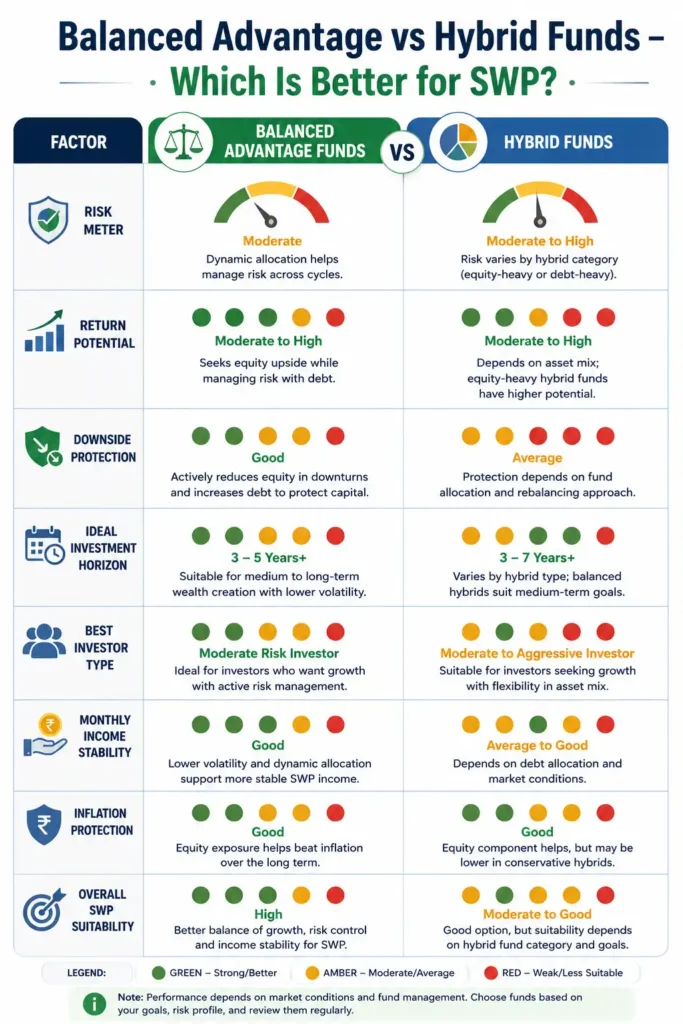
Balanced Advantage Fund vs Hybrid Fund for SWP
This is one of the most common questions investors ask before starting a Systematic Withdrawal Plan.
Although both categories combine equity and debt, their investment approach differs significantly.
Balanced Advantage Funds dynamically adjust equity and debt exposure based on market valuations. Hybrid Funds, on the other hand, generally maintain a relatively fixed allocation within regulatory limits.
Comparison Table
| Feature | Balanced Advantage Fund | Aggressive Hybrid Fund |
| Equity Allocation | Dynamic | Mostly Fixed |
| Debt Allocation | Dynamic | Fixed Range |
| Market Volatility | Lower | Moderate |
| Bull Market Performance | Moderate | Higher Potential |
| Bear Market Protection | Better | Moderate |
| Suitable for Beginners | Yes | Yes |
| Suitable for Retirees | Excellent | Excellent |
| Inflation Protection | Good | Very Good |
| Long-Term Growth | Good | Higher Potential |
| Portfolio Stability | Excellent | Good |
Which Category Should You Choose?
Choose a Balanced Advantage Fund if you:
- Prefer lower volatility.
- Want smoother portfolio performance.
- Are already retired.
- Depend heavily on monthly withdrawals.
- Prefer automatic asset allocation.
Choose an Aggressive Hybrid Fund if you:
- Can tolerate moderate market fluctuations.
- Have a retirement horizon exceeding 15 years.
- Want higher long-term growth potential.
- Wish to preserve purchasing power against inflation.
Expert Opinion
Instead of selecting only one category, many experienced investors create a diversified SWP portfolio by combining Balanced Advantage Funds with Hybrid Funds.
For example:
- 50% Balanced Advantage Fund
- 50% Aggressive Hybrid Fund
or
- 60% Balanced Advantage Fund
- 40% Hybrid Fund
Such diversification may help improve risk-adjusted returns while reducing dependence on the performance of a single strategy.
Best Flexi Cap Mutual Funds for SWP
Flexi Cap Funds have become one of the most preferred categories for long-term wealth creation because they allow fund managers to invest across large-cap, mid-cap, and small-cap companies without rigid allocation limits.
Unlike Large Cap Funds, which primarily invest in India's biggest companies, Flexi Cap Funds can shift allocations according to changing market opportunities.
For investors planning an SWP after accumulating wealth over several years, Flexi Cap Funds can provide higher long-term growth potential. However, they also experience greater short-term volatility than Balanced Advantage or Hybrid Funds.
Because SWP investors continue withdrawing money even during market corrections, Flexi Cap Funds should generally form only one part of a diversified retirement portfolio rather than the entire corpus.
Why Flexi Cap Funds Can Be Suitable for SWP
- Higher long-term wealth creation potential
- Freedom to invest across market capitalizations
- Better opportunity to outperform traditional large-cap portfolios
- Inflation-beating potential
- Dynamic portfolio management
Things to Remember
- Higher market volatility
- Greater NAV fluctuations
- Better suited for investors with a long retirement horizon
- Works best when combined with Hybrid or Balanced Advantage Funds
7. Parag Parikh Flexi Cap Fund
Category: Flexi Cap Fund
Risk Level: Very High
Suitable For: Long-term investors, early retirees, investors with 15+ year horizons
Parag Parikh Flexi Cap Fund has become one of India's most respected Flexi Cap Funds because of its disciplined investment philosophy, focus on high-quality businesses, and long-term approach.
The fund generally invests in companies with durable competitive advantages rather than chasing short-term market trends.
Instead of frequently buying and selling stocks, the investment team follows a long-term strategy that aligns well with investors seeking wealth creation over decades.
Why It Can Be Suitable for SWP
A retiree who has already built a sizeable corpus may allocate a portion of the portfolio to a quality Flexi Cap Fund to help the remaining investment continue growing despite regular withdrawals.
This growth component can help offset inflation over long retirement periods.
Key Strengths
- Long-term investment philosophy
- High-quality portfolio
- Diversified holdings
- Strong focus on business fundamentals
- Experienced investment management
Suitable Investors
- Early retirees
- FIRE investors (Financial Independence, Retire Early)
- Long-term wealth creators
- Investors with moderate to high risk tolerance
Advantages
- Excellent long-term growth potential
- High-quality businesses
- Diversification
- Inflation protection
Limitations
- Portfolio volatility
- Market corrections can temporarily reduce corpus value
- Requires patience
Expert Rating
| Parameter | Rating |
|---|---|
| Long-Term Growth | ⭐⭐⭐⭐⭐ |
| Portfolio Quality | ⭐⭐⭐⭐⭐ |
| Risk Management | ⭐⭐⭐⭐☆ |
| Inflation Protection | ⭐⭐⭐⭐⭐ |
| SWP Suitability | ⭐⭐⭐⭐☆ |
8. HDFC Flexi Cap Fund
Category: Flexi Cap Fund
Risk Level: Very High
Suitable For: Investors with long investment horizons seeking capital appreciation
HDFC Flexi Cap Fund follows a diversified investment approach across companies of different sizes and sectors.
Its objective is to identify businesses capable of generating sustainable earnings growth while maintaining portfolio diversification.
For investors planning retirement decades in advance, this category can provide an important growth engine within the overall SWP portfolio.
Key Benefits
- Diversified portfolio
- Long-term growth orientation
- Active fund management
- Suitable for wealth creation
Suitable Investors
- Investors aged below 55
- Long-term retirement planners
- Moderate to aggressive investors
Expert Rating
| Parameter | Rating |
| Growth Potential | ⭐⭐⭐⭐⭐ |
| Diversification | ⭐⭐⭐⭐⭐ |
| SWP Suitability | ⭐⭐⭐⭐☆ |
9. JM Flexi Cap Fund
Category: Flexi Cap Fund
Risk Level: Very High
JM Flexi Cap Fund seeks long-term capital appreciation by investing across market capitalizations while maintaining diversification.
Although relatively smaller than some peers, it provides another option for investors comparing Flexi Cap strategies.
Advantages
- Diversified allocation
- Active management
- Long-term investment approach
Limitations
- Higher volatility
- Suitable only for long-term investors
Expert Rating
| Parameter | Rating |
| Growth Potential | ⭐⭐⭐⭐☆ |
| Portfolio Quality | ⭐⭐⭐⭐☆ |
| SWP Suitability | ⭐⭐⭐⭐☆ |
Top Flexi Cap Funds
| Fund | Growth Potential | Risk | Retirement Suitability | SWP Rating |
| Parag Parikh Flexi Cap Fund | ⭐⭐⭐⭐⭐ | High | Very Good | ⭐⭐⭐⭐☆ |
| HDFC Flexi Cap Fund | ⭐⭐⭐⭐⭐ | High | Very Good | ⭐⭐⭐⭐☆ |
| JM Flexi Cap Fund | ⭐⭐⭐⭐☆ | High | Good | ⭐⭐⭐⭐☆ |
Best Large Cap Mutual Funds for SWP
Large Cap Funds invest primarily in India's largest and most established companies.
These businesses generally have stronger balance sheets, established market positions, and relatively stable earnings compared with smaller companies.
Although they may not generate the highest returns during bull markets, they often experience lower volatility than mid-cap and small-cap funds.
For investors seeking a balance between growth and stability, Large Cap Funds can play an important role in an SWP portfolio.
10. Nippon India Large Cap Fund
Category: Large Cap Fund
Risk Level: High
The Nippon India Large Cap Fund focuses on established market leaders across different sectors.
Because of its diversified exposure to blue-chip companies, it is commonly considered by investors looking for relatively stable equity exposure within a retirement portfolio. It has also featured in recent lists of funds suitable for SWP planning for senior citizens.
Why It May Be Suitable
- Blue-chip portfolio
- Lower volatility than mid-cap funds
- Long-term capital appreciation
- Suitable for inflation protection
Suitable Investors
- Moderate-risk retirees
- Investors building retirement wealth
- Long-term investors
Expert Rating
| Parameter | Rating |
| Stability | ⭐⭐⭐⭐⭐ |
| Growth | ⭐⭐⭐⭐☆ |
| SWP Suitability | ⭐⭐⭐⭐☆ |
11. ICICI Prudential Large Cap Fund
Category: Large Cap Fund
ICICI Prudential Large Cap Fund invests predominantly in India's largest listed companies.
The portfolio aims to provide relatively stable long-term growth while maintaining broad sector diversification.
Advantages
- Large established businesses
- Broad diversification
- Long-term wealth creation
- Suitable for retirement portfolios
Expert Rating
| Parameter | Rating |
| Portfolio Stability | ⭐⭐⭐⭐⭐ |
| Long-Term Growth | ⭐⭐⭐⭐☆ |
| SWP Suitability | ⭐⭐⭐⭐☆ |
12. HDFC Large Cap Fund
Category: Large Cap Fund
HDFC Large Cap Fund focuses on fundamentally strong companies with long operating histories.
It can serve as the stability component of an equity-oriented SWP portfolio.
Best For
- Conservative equity investors
- Long-term retirement planning
- Wealth preservation with growth
Expert Rating
| Parameter | Rating |
| Stability | ⭐⭐⭐⭐⭐ |
| Consistency | ⭐⭐⭐⭐☆ |
| SWP Suitability | ⭐⭐⭐⭐☆ |
Flexi Cap vs Large Cap for SWP
| Feature | Flexi Cap | Large Cap |
| Growth Potential | Very High | High |
| Market Volatility | High | Moderate |
| Inflation Protection | Excellent | Very Good |
| Portfolio Stability | Moderate | High |
| Suitable for Retirees | Good | Very Good |
| Suitable for Early Retirement | Excellent | Good |
| Recommended Holding Period | 10+ Years | 7+ Years |
Expert Portfolio Suggestion
Instead of selecting only one equity category, investors may consider combining different categories to balance stability and growth.
Example Portfolio for Moderate-Risk Investors
- Balanced Advantage Funds – 35%
- Hybrid Funds – 30%
- Large Cap Funds – 20%
- Flexi Cap Funds – 15%
This allocation aims to reduce volatility while maintaining exposure to long-term equity growth.
Build Your Ideal SWP Portfolio
Enter your details to get a suggested SWP portfolio allocation.
Best Multi Asset Allocation Funds for SWP
Multi Asset Allocation Funds have become increasingly popular among retirement investors because they invest across multiple asset classes such as:
- Equity
- Debt
- Gold
- REITs/InvITs (in some schemes)
- Cash & Money Market Instruments
Unlike traditional hybrid funds, these schemes are not dependent on a single asset class. When equities underperform, gold or debt may help cushion portfolio volatility. This diversification makes Multi Asset Funds attractive for long-term SWP investors.
Why Multi Asset Funds Are Suitable for SWP
- Diversification across asset classes
- Lower dependence on equity markets
- Better inflation protection
- Potentially smoother long-term returns
- Suitable for retirement portfolios
Best Multi Asset Funds to Consider
13. SBI Multi Asset Allocation Fund
Category: Multi Asset Allocation
Risk Level: Moderately High
Best For: Long-term retirement planning, diversified income portfolios
The SBI Multi Asset Allocation Fund invests across equity, debt, and gold, providing investors with broad diversification. Recent data shows it has remained one of the larger schemes in its category and has delivered competitive medium-term performance.
Why It Is Suitable
- Diversified asset allocation
- Lower concentration risk
- Better inflation hedge
- Suitable for long-term SWP
Pros
- Multiple asset classes
- Professional asset allocation
- Good diversification
- Better downside protection than pure equity funds
Cons
- Returns depend on performance across several asset classes
- May underperform during strong equity rallies
Expert Rating
| Parameter | Rating |
|---|---|
| Diversification | ⭐⭐⭐⭐⭐ |
| Stability | ⭐⭐⭐⭐☆ |
| Inflation Protection | ⭐⭐⭐⭐⭐ |
| SWP Suitability | ⭐⭐⭐⭐⭐ |
14. ICICI Prudential Multi Asset Fund
Category: Multi Asset Allocation
Risk Level: Moderately High
ICICI Prudential Multi Asset Fund combines equity, debt, and commodities with the objective of creating long-term wealth while reducing portfolio volatility.
Suitable Investors
- Moderate-risk retirees
- Long-term investors
- Wealth preservation seekers
Expert Rating
| Parameter | Rating |
| Asset Allocation | ⭐⭐⭐⭐⭐ |
| Stability | ⭐⭐⭐⭐☆ |
| SWP Suitability | ⭐⭐⭐⭐⭐ |
Best Debt Mutual Funds for SWP
Debt Funds generally invest in government securities, treasury bills, corporate bonds, certificates of deposit, and money market instruments.
Although they usually deliver lower long-term returns than equity-oriented funds, they are often preferred by conservative investors seeking lower volatility.
When Should You Choose Debt Funds?
Debt funds can be considered if you:
- Have a short to medium investment horizon
- Prioritize capital preservation
- Have low risk tolerance
- Already have sufficient equity exposure elsewhere
Suitable Debt Fund Categories
- Corporate Bond Funds
- Banking & PSU Debt Funds
- Short Duration Funds
- Money Market Funds
- Gilt Funds (depending on interest-rate outlook)
Advantages
- Lower volatility
- Better capital preservation
- Suitable for conservative SWPs
- Predictable risk profile
Limitations
- Lower growth potential
- Sensitive to interest rate movements
- May struggle to beat inflation over very long periods
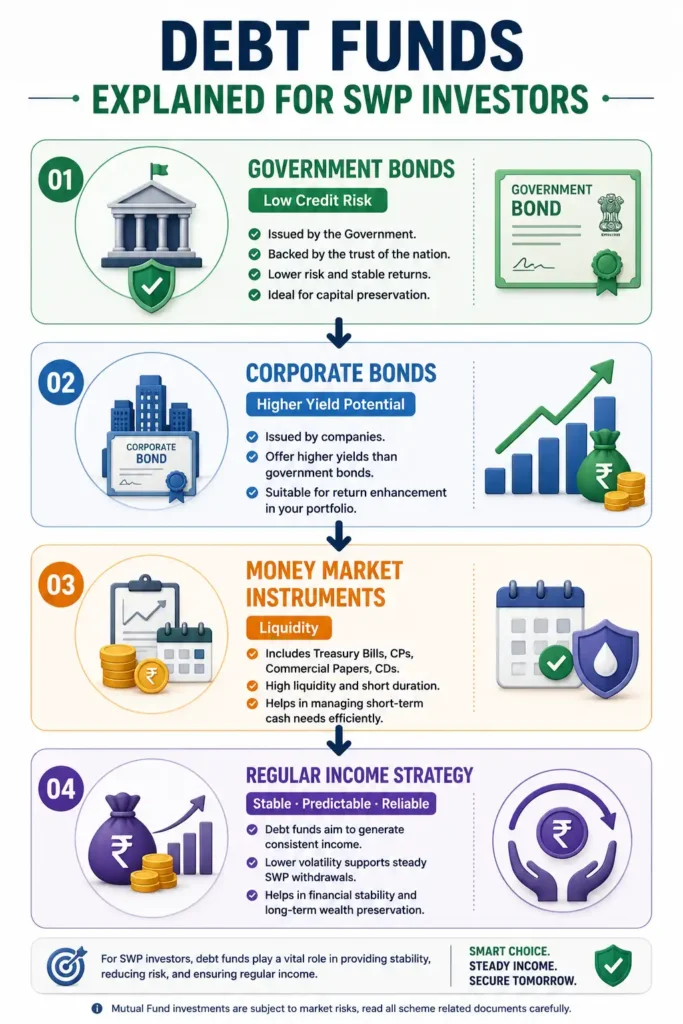
Best Conservative Hybrid Funds
Conservative Hybrid Funds invest predominantly in debt while maintaining a smaller allocation to equities.
These schemes are designed for investors who seek modest capital appreciation with lower portfolio fluctuations.
Suitable Investors
- Senior citizens
- Conservative retirees
- Investors with limited risk appetite
Advantages
- Better capital preservation
- Lower equity exposure
- More stable return profile
- Suitable for monthly income planning
Best Arbitrage Funds for SWP
Arbitrage Funds exploit price differences between the cash and derivatives markets.
Because they generally maintain lower directional equity exposure, they tend to exhibit relatively low volatility while qualifying as equity-oriented funds under applicable tax rules.
Best For
- Parking retirement corpus temporarily
- Conservative investors
- Investors expecting short-term withdrawals
Advantages
- Lower volatility
- Better tax treatment than many traditional debt options (subject to prevailing tax rules)
- High liquidity
Limitations
- Moderate return expectations
- Returns depend on arbitrage opportunities
Best Liquid Funds for SWP
Liquid Funds invest in very short-duration money market securities.
Although they are generally not designed for long-term wealth creation, they can be useful for maintaining an emergency reserve alongside an SWP strategy.
Best Uses
- Emergency fund
- Short-term income
- Parking money before transferring to long-term investments
Best Index Funds for SWP
Index Funds passively track benchmark indices such as the Nifty 50 or Sensex.
Because they follow an index rather than actively selecting stocks, they generally have lower expense ratios.
Advantages
- Low cost
- High transparency
- Broad diversification
- Suitable for passive investors
Limitations
- No downside protection
- Cannot outperform the benchmark before expenses
- Full participation in market declines
Overall Ranking – Top 15 Best Performing SWP Mutual Funds in India
The following ranking combines long-term consistency, diversification, suitability for SWP, risk management, and overall retirement usefulness rather than simply recent returns.
| Rank | Mutual Fund | Category | Suitable For | Overall Rating |
| 1 | ICICI Prudential Balanced Advantage Fund | Balanced Advantage | Retirement | ⭐⭐⭐⭐⭐ |
| 2 | HDFC Balanced Advantage Fund | Balanced Advantage | Monthly Income | ⭐⭐⭐⭐⭐ |
| 3 | SBI Balanced Advantage Fund | Balanced Advantage | Passive Income | ⭐⭐⭐⭐⭐ |
| 4 | HDFC Hybrid Equity Fund | Aggressive Hybrid | Retirement Planning | ⭐⭐⭐⭐⭐ |
| 5 | SBI Equity Hybrid Fund | Aggressive Hybrid | Long-Term Income | ⭐⭐⭐⭐⭐ |
| 6 | Canara Robeco Equity Hybrid Fund | Aggressive Hybrid | Moderate Investors | ⭐⭐⭐⭐⭐ |
| 7 | Parag Parikh Flexi Cap Fund | Flexi Cap | Early Retirement | ⭐⭐⭐⭐☆ |
| 8 | HDFC Flexi Cap Fund | Flexi Cap | Long-Term Growth | ⭐⭐⭐⭐☆ |
| 9 | Nippon India Large Cap Fund | Large Cap | Stable Equity Exposure | ⭐⭐⭐⭐☆ |
| 10 | ICICI Prudential Large Cap Fund | Large Cap | Conservative Equity | ⭐⭐⭐⭐☆ |
| 11 | HDFC Large Cap Fund | Large Cap | Wealth Preservation | ⭐⭐⭐⭐☆ |
| 12 | SBI Multi Asset Allocation Fund | Multi Asset | Diversified SWP | ⭐⭐⭐⭐⭐ |
| 13 | ICICI Prudential Multi Asset Fund | Multi Asset | Inflation Protection | ⭐⭐⭐⭐⭐ |
| 14 | Quality Corporate Bond Fund* | Debt | Conservative Income | ⭐⭐⭐⭐☆ |
| 15 | Quality Banking & PSU Debt Fund* | Debt | Low-Risk Investors | ⭐⭐⭐⭐☆ |
*Instead of recommending a single debt fund forever, compare the latest Corporate Bond and Banking & PSU Debt Funds before investing because rankings and portfolio quality change over time.
Best SWP Mutual Funds Based on Investment Amount
If Your Investment Corpus Is ₹10 Lakh
Recommended Categories:
- Balanced Advantage Funds
- Conservative Hybrid Funds
Suggested Monthly Withdrawal:
Approximately 3–5% annually, depending on your goals and market conditions.
If Your Corpus Is ₹25 Lakh
Recommended Categories:
- Balanced Advantage Funds
- Hybrid Funds
Suitable Monthly Income:
Can support a moderate supplementary income while preserving growth potential.
If Your Corpus Is ₹50 Lakh
Suggested Allocation:
- 40% Balanced Advantage
- 30% Hybrid
- 20% Large Cap
- 10% Multi Asset
If Your Corpus Is ₹1 Crore
Suggested Allocation:
- 35% Balanced Advantage
- 25% Hybrid
- 20% Flexi Cap
- 20% Multi Asset
This combination aims to balance long-term growth with income stability.
If Your Corpus Exceeds ₹2 Crore
Diversify across:
- Balanced Advantage Funds
- Hybrid Funds
- Large Cap Funds
- Flexi Cap Funds
- Multi Asset Funds
- Debt Funds
Avoid depending on a single fund or fund category for retirement income.
Best SWP Funds Based on Age
| Age | Recommended Categories |
| 40 Years | Flexi Cap, Large Cap, Multi Asset |
| 50 Years | Hybrid, Balanced Advantage, Large Cap |
| 60 Years | Balanced Advantage, Conservative Hybrid, Multi Asset |
| 70 Years | Conservative Hybrid, Debt, Balanced Advantage |
Latest Comparison of the Best SWP Mutual Funds in India (Updated 2026)
The following table compares some of the most suitable mutual funds for Systematic Withdrawal Plans based on fund category, Assets Under Management (AUM), expense ratio, historical performance, risk level, and overall suitability.
Editor's Note: Mutual fund returns, AUM, expense ratios, and fund managers change over time. Review the latest scheme factsheet before making an investment decision.
| Rank | Mutual Fund | Category | Risk | Approx. AUM (₹ Cr) | Expense Ratio* | 3-Year Return (Approx.) | 5-Year Return (Approx.) | Exit Load | Best For | SWP Score |
|---|---|---|---|---|---|---|---|---|---|---|
| 1 | HDFC Balanced Advantage Fund | Balanced Advantage | Very High | 1,04,016 | 0.75% | 15.1% | 15.7% | 1% (as applicable) | Retirement | ⭐⭐⭐⭐⭐ |
| 2 | ICICI Prudential Balanced Advantage Fund | Balanced Advantage | Very High | 70,570 | 0.72% | 12.4% | 11.5% | 1% (as applicable) | Monthly Income | ⭐⭐⭐⭐⭐ |
| 3 | SBI Balanced Advantage Fund | Balanced Advantage | Very High | 40,673 | 0.74% | 11.9% | N/A | As applicable | Passive Income | ⭐⭐⭐⭐⭐ |
| 4 | SBI Equity Hybrid Fund | Aggressive Hybrid | Very High | 84,010 | Update Latest | 13.9% | 11.8% | As applicable | Retirement Planning | ⭐⭐⭐⭐⭐ |
| 5 | HDFC Hybrid Equity Fund | Aggressive Hybrid | Very High | Update Latest | Update Latest | Update Latest | Update Latest | As applicable | Long-Term Income | ⭐⭐⭐⭐⭐ |
| 6 | Canara Robeco Equity Hybrid Fund | Aggressive Hybrid | Very High | Update Latest | Update Latest | Update Latest | Update Latest | As applicable | Moderate Investors | ⭐⭐⭐⭐☆ |
| 7 | Parag Parikh Flexi Cap Fund | Flexi Cap | Very High | 1,41,447 | ~0.53% (Direct) | 15.5% | Update Latest | As applicable | Early Retirement | ⭐⭐⭐⭐⭐ |
| 8 | HDFC Flexi Cap Fund | Flexi Cap | Very High | 1,01,822 | 0.68% | 17.8% | Update Latest | As applicable | Long-Term Growth | ⭐⭐⭐⭐☆ |
| 9 | Nippon India Large Cap Fund | Large Cap | Very High | Update Latest | Update Latest | Update Latest | Update Latest | As applicable | Stable Equity | ⭐⭐⭐⭐☆ |
| 10 | ICICI Prudential Large Cap Fund | Large Cap | Very High | Update Latest | Update Latest | Update Latest | Update Latest | As applicable | Conservative Equity | ⭐⭐⭐⭐☆ |
| 11 | HDFC Large Cap Fund | Large Cap | Very High | Update Latest | Update Latest | Update Latest | Update Latest | As applicable | Wealth Preservation | ⭐⭐⭐⭐☆ |
| 12 | ICICI Prudential Multi Asset Fund | Multi Asset | Very High | 84,165 | Update Latest | 17.4% | 17.7% | As applicable | Diversified SWP | ⭐⭐⭐⭐⭐ |
| 13 | SBI Multi Asset Allocation Fund | Multi Asset | Very High | 18,289 | Update Latest | 17.6% | 14.5% | As applicable | Inflation Protection | ⭐⭐⭐⭐⭐ |
| 14 | Banking & PSU Debt Fund (Top Rated) | Debt | Moderate | Update Latest | Low | Update Latest | Update Latest | Usually Nil/Low | Conservative Income | ⭐⭐⭐⭐☆ |
| 15 | Corporate Bond Fund (Top Rated) | Debt | Moderate | Update Latest | Low | Update Latest | Update Latest | Usually Nil/Low | Low-Risk Investors | ⭐⭐⭐⭐☆ |
*Expense ratios shown are indicative direct-plan values where available and should be verified before publication.
Quick Comparison by Fund Category
| Category | Expected Long-Term Return Potential | Volatility | Recommended SWP Holding Period | Suitable For |
| Balanced Advantage | High | Low to Moderate | 7–15 Years | Retirees |
| Aggressive Hybrid | High | Moderate | 10–15 Years | Monthly Income |
| Flexi Cap | Very High | High | 12–20 Years | Early Retirement |
| Large Cap | High | Moderate | 10–15 Years | Conservative Equity Investors |
| Multi Asset | High | Moderate | 10–20 Years | Diversification |
| Debt | Moderate | Low | 3–7 Years | Low-Risk Investors |
Editor's Awards
🏆 Best Overall SWP Mutual Fund
HDFC Balanced Advantage Fund
Why?
- Large asset base
- Strong long-term consistency
- Dynamic asset allocation
- Suitable for retirees
- Better downside management
🥈 Best Fund for Conservative Retirees
ICICI Prudential Balanced Advantage Fund
Why?
- Dynamic equity allocation
- Lower portfolio volatility
- Suitable for monthly withdrawals
- Experienced fund management
🥉 Best Growth Fund for Long-Term SWP
Parag Parikh Flexi Cap Fund
Why?
- Quality-focused investing
- Excellent long-term wealth creation potential
- Suitable for investors with long retirement horizons
- Strong portfolio diversification
🏅 Best Diversified SWP Fund
ICICI Prudential Multi Asset Fund
Ideal for investors who want exposure to equity, debt, and other asset classes within a single scheme.
🏅 Best Hybrid Fund
SBI Equity Hybrid Fund
Suitable for investors looking for a balance between long-term growth and relatively lower volatility.
Fund Selection Checklist
Before finalizing any SWP mutual fund, ask these questions:
- Has the fund performed consistently across 5–10 years?
- Is the expense ratio reasonable?
- Is the AUM too small or too large for the strategy?
- Has the fund protected downside during market corrections?
- Is the fund suitable for monthly withdrawals?
- Does the withdrawal rate match expected long-term returns?
- Is the portfolio diversified?
- Is the exit load suitable for SWP withdrawals?
- Does the fund match your age and risk profile?
- Have you checked taxation before starting withdrawals?
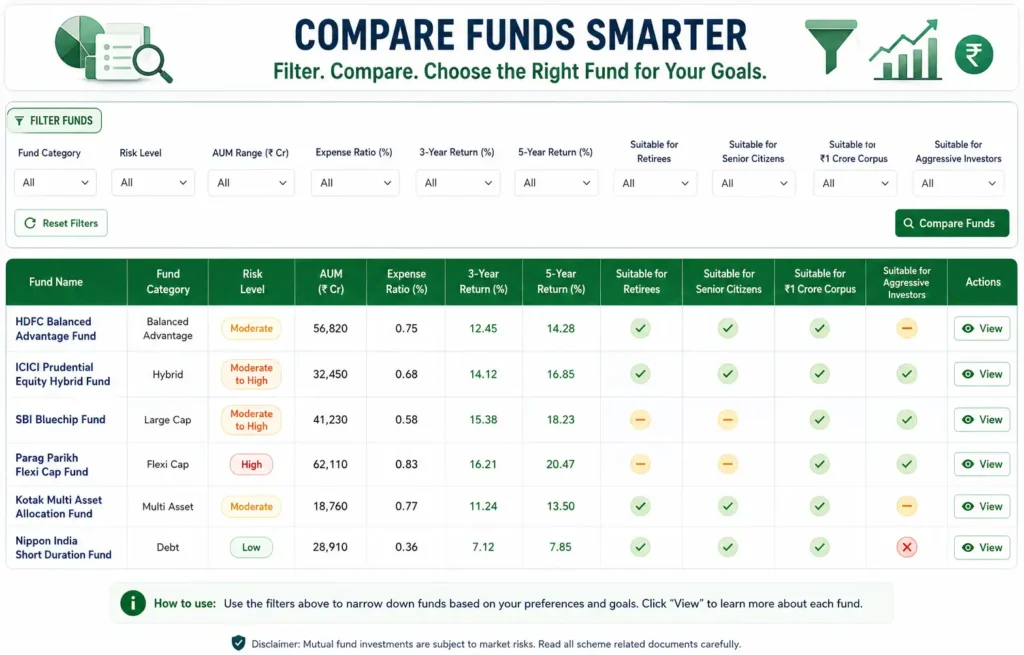
SWP Taxation in India (Updated 2026)
One of the biggest reasons investors choose a Systematic Withdrawal Plan (SWP) over traditional income options is its potential tax efficiency. However, many people mistakenly believe that the entire withdrawal amount is taxable. This is incorrect.
When you withdraw money through an SWP, only the capital gains portion of each redemption is taxed. The amount representing your original investment (principal) is generally not taxed again because it is simply your own capital being returned.
For example, if your monthly SWP is ₹30,000, the entire ₹30,000 is not taxable. Only the gain embedded in the redeemed units is subject to capital gains tax, and the applicable tax depends on the type of mutual fund and the holding period.
This makes SWPs significantly different from fixed deposits, where the entire interest earned is taxable according to your income tax slab.
How SWP Taxation Actually Works
Every SWP withdrawal involves the redemption of mutual fund units.
Each redeemed unit has:
- Purchase Cost
- Current NAV
- Capital Gain
Tax is calculated only on the capital gain associated with the redeemed units—not on the full withdrawal amount.
Example
Suppose you invested:
₹10,00,000
After one year,
your investment becomes:
₹11,20,000
Now you start an SWP of:
₹20,000 per month.
If the redeemed units include:
- ₹17,800 of original investment
- ₹2,200 of capital gain
Only ₹2,200 is considered for capital gains taxation. The remaining ₹17,800 is simply your invested capital being returned.
This is one of the biggest reasons why SWPs can be more tax-efficient than withdrawing interest from a bank fixed deposit.
Taxation of Equity Mutual Funds under SWP
If your SWP is from an equity-oriented mutual fund (generally with at least 65% equity exposure), taxation depends on the holding period of the redeemed units.
Short-Term Capital Gains (STCG)
If units are redeemed within 12 months, the gains are treated as short-term capital gains.
Current tax rate:
20%
Long-Term Capital Gains (LTCG)
If units are held for more than 12 months, gains qualify as long-term capital gains.
Current tax treatment:
- Gains up to ₹1.25 lakh in a financial year are exempt.
- Gains above ₹1.25 lakh are taxed at 12.5%.
Equity Fund Tax Table
| Holding Period | Tax Type | Tax Rate |
|---|---|---|
| Up to 12 Months | STCG | 20% |
| More than 12 Months | LTCG | 12.5% on gains above ₹1.25 lakh per financial year |
Taxation of Debt Mutual Funds under SWP
Debt fund taxation differs significantly from equity funds.
For most debt mutual fund investments made on or after 1 April 2023, gains are added to your total income and taxed according to your applicable income tax slab, irrespective of the holding period. Budget 2026 did not change this treatment.
Important Points
- No distinction between short-term and long-term treatment for these newer debt fund investments.
- Indexation benefits generally do not apply to such investments.
- Tax depends on your income tax slab.
Debt Fund Tax Table
| Investment Date | Tax Treatment |
| Before 1 April 2023 | Legacy rules may apply depending on the investment. |
| On or After 1 April 2023 | Gains generally taxed at your income tax slab rate. |
Taxation of Hybrid Mutual Funds
Hybrid funds do not all follow the same tax rules.
Their taxation depends primarily on the proportion of equity in the portfolio.
Equity-Oriented Hybrid Funds
Generally taxed like equity mutual funds if they meet the prescribed equity exposure threshold.
Debt-Oriented Hybrid Funds
Generally taxed according to debt fund taxation rules.
Always verify the fund's current tax classification before investing, as portfolio composition can affect tax treatment.
Is TDS Deducted on SWP?
One of the biggest advantages of an SWP is that there is generally no Tax Deducted at Source (TDS) on domestic mutual fund SWP withdrawals.
Unlike fixed deposits, where banks may deduct TDS under applicable conditions, SWP taxation is handled through capital gains calculations when you file your income tax return. Special rules may apply in certain situations, such as for some non-resident investors.
SWP vs Fixed Deposit Taxation
Many retirees compare SWPs with bank fixed deposits because both can generate regular income.
However, their tax treatment is very different.
| Feature | SWP | Fixed Deposit |
| Tax on Full Withdrawal | No | No |
| Tax on Interest | Not applicable | Yes |
| Tax on Capital Gains Only | Yes | No |
| Potential Capital Growth | Yes | No |
| Inflation-Beating Potential | Better Potential | Limited |
| Flexibility | High | Moderate |
Example: SWP vs Fixed Deposit
Suppose two investors each invest ₹1 crore.
Investor A
Invests in a bank fixed deposit.
Receives monthly interest.
Every rupee of interest is taxable according to the applicable income tax rules.
Investor B
Invests in a mutual fund and starts an SWP.
Only the capital gains portion of each redemption is taxable.
Depending on the holding period and applicable exemptions, the overall tax liability may be lower than that of a fixed deposit.
Common Tax Mistakes to Avoid
Many investors pay unnecessary taxes because they do not understand how SWP taxation works.
Avoid these mistakes:
- Starting withdrawals immediately after investing without considering the holding period.
- Ignoring the equity vs. debt tax treatment.
- Assuming the entire SWP amount is taxable.
- Not tracking annual capital gains.
- Choosing the wrong fund category for your tax situation.
- Ignoring changes in tax laws.
- Not consulting a qualified tax advisor for large portfolios.
Expert Tip
If you are planning retirement through an SWP, consider investing well before you need regular income. Allowing the investment to mature can improve tax efficiency (where applicable), provide a larger corpus, and increase the likelihood of sustainable withdrawals over the long term. Always review the latest tax rules before making investment decisions, as regulations may change over time.
What Is a Safe Withdrawal Rate?
Choosing the right mutual fund is only one part of a successful SWP strategy. Equally important is deciding how much money you withdraw every year.
Many investors assume that if their mutual fund generates an average annual return of 12%, they can safely withdraw 12% every year forever. Unfortunately, this assumption ignores market volatility, inflation, taxation, and the sequence of returns.
A safe withdrawal rate is the percentage of your investment corpus that you can withdraw every year while improving the chances that your money will continue to support your financial needs over a long period.
Although there is no universally perfect withdrawal rate, financial planners generally recommend tailoring withdrawals to your investment horizon, risk tolerance, expected returns, inflation, and other income sources.
Why Withdrawal Rate Matters
Even an excellent mutual fund cannot compensate for an unsustainably high withdrawal rate.
Consider these two investors:
Investor A
Investment Corpus: ₹1 Crore
Annual Withdrawal: ₹4 Lakh (4%)
Expected Investment Horizon: 25 Years
Investor A has a relatively conservative withdrawal strategy, allowing a greater portion of the corpus to remain invested.
Investor B
Investment Corpus: ₹1 Crore
Annual Withdrawal: ₹10 Lakh (10%)
Expected Investment Horizon: 25 Years
Investor B withdraws a much larger percentage each year. If markets underperform or inflation remains high, the investment corpus could reduce much faster.
This example illustrates why withdrawal discipline is as important as fund selection.
Understanding Different Withdrawal Rates
3% Withdrawal Strategy
A 3% withdrawal rate is considered conservative.
It prioritizes long-term wealth preservation over maximizing monthly income.
Suitable for:
- Early retirees
- Investors expecting retirement to last 30 years or more
- Families wanting to leave an inheritance
- Investors with high life expectancy
Advantages
- Better corpus sustainability
- Lower risk of exhausting investments
- Greater flexibility during market downturns
Limitations
- Lower monthly income
- May require a larger retirement corpus
4% Withdrawal Strategy
The 4% withdrawal rule is widely discussed in retirement planning as a starting framework rather than a guaranteed rule.
It attempts to balance monthly income with long-term portfolio sustainability.
Suitable for:
- Traditional retirees
- Moderate-risk investors
- Investors with diversified portfolios
Advantages
- Balanced income
- Better long-term sustainability than aggressive withdrawal strategies
- Suitable for many retirement plans
Limitations
- Market conditions may require adjustments.
- Inflation and taxation should still be considered.
5% Withdrawal Strategy
A 5% withdrawal rate provides higher monthly income but increases pressure on the investment corpus.
Suitable for:
- Investors with additional pension income
- Investors expecting moderate retirement duration
- Investors willing to review withdrawals regularly
Advantages
- Higher monthly cash flow
- Improved lifestyle flexibility
Limitations
- Greater risk during prolonged market declines
- Corpus may reduce faster if returns remain weak
6% Withdrawal Strategy
A 6% annual withdrawal rate is relatively aggressive.
Although it provides substantial monthly income, it requires careful monitoring and periodic review.
Suitable only if:
- Retirement corpus is significantly larger than expected expenses.
- Other income sources exist.
- The investor can reduce withdrawals during difficult market periods.
7% Withdrawal Strategy
Withdrawing 7% or more every year significantly increases the likelihood of reducing the investment corpus more quickly, particularly if markets experience extended periods of weak performance.
Such strategies are generally appropriate only in specific situations after considering individual financial circumstances and professional advice.
Withdrawal Rate Comparison
| Annual Withdrawal Rate | Monthly Income Potential | Corpus Sustainability | Suitable For |
|---|---|---|---|
| 3% | Lower | Excellent | Early Retirement |
| 4% | Moderate | Very Good | Most Retirees |
| 5% | Good | Moderate | Moderate-Risk Investors |
| 6% | High | Lower | Investors with Additional Income |
| 7%+ | Very High | Higher Risk of Corpus Depletion | Special Cases Only |
How Much Monthly Income Can Different Investment Amounts Generate?
The following illustrations assume the chosen withdrawal rate is appropriate for the investor's financial plan.
₹10 Lakh Investment
| Annual Withdrawal Rate | Approximate Monthly Withdrawal |
| 3% | ₹2,500 |
| 4% | ₹3,333 |
| 5% | ₹4,167 |
| 6% | ₹5,000 |
₹25 Lakh Investment
| Annual Withdrawal Rate | Approximate Monthly Withdrawal |
| 3% | ₹6,250 |
| 4% | ₹8,333 |
| 5% | ₹10,417 |
| 6% | ₹12,500 |
₹50 Lakh Investment
| Annual Withdrawal Rate | Approximate Monthly Withdrawal |
| 3% | ₹12,500 |
| 4% | ₹16,667 |
| 5% | ₹20,833 |
| 6% | ₹25,000 |
₹1 Crore Investment
| Annual Withdrawal Rate | Approximate Monthly Withdrawal |
| 3% | ₹25,000 |
| 4% | ₹33,333 |
| 5% | ₹41,667 |
| 6% | ₹50,000 |
₹2 Crore Investment
| Annual Withdrawal Rate | Approximate Monthly Withdrawal |
| 3% | ₹50,000 |
| 4% | ₹66,667 |
| 5% | ₹83,333 |
| 6% | ₹1,00,000 |
Sequence of Return Risk
One of the biggest risks for SWP investors is Sequence of Return Risk.
This occurs when poor market returns happen during the early years of retirement while withdrawals continue.
Because units are redeemed every month regardless of market conditions, more units may be sold during falling markets. This can reduce the long-term sustainability of the portfolio.
For example:
- Investor A retires just before a strong bull market.
- Investor B retires just before a significant market correction.
Even if both investors earn the same average return over 20 years, Investor B may end up with a smaller remaining corpus because larger numbers of units were redeemed during the initial downturn.
This is why retirement planning should focus not only on average returns but also on managing market volatility.
How Inflation Affects Your SWP
Inflation gradually increases the cost of living.
An expense of ₹50,000 per month today may require substantially more in the future.
When planning an SWP:
- Estimate future living expenses.
- Review your withdrawal amount periodically.
- Maintain exposure to growth-oriented assets where appropriate.
- Avoid investing the entire corpus in low-growth products if you have a long retirement horizon.
Balancing growth and stability can help improve purchasing power over time.
Fixed SWP vs Dynamic SWP
Fixed SWP
A fixed SWP pays the same withdrawal amount at every interval.
Example:
₹40,000 every month regardless of market conditions.
Advantages
- Predictable income
- Easy budgeting
- Suitable for retirees
Limitations
- Does not automatically adjust for inflation.
- May increase pressure on the corpus during prolonged market declines.
Dynamic SWP
In a Dynamic SWP strategy, withdrawals are reviewed periodically and adjusted based on portfolio performance, inflation, or changing financial needs.
Advantages
- Better flexibility
- Can help manage inflation
- May improve long-term sustainability
Limitations
- Income varies over time.
- Requires regular portfolio reviews.
Fixed SWP vs Dynamic SWP Comparison
| Feature | Fixed SWP | Dynamic SWP |
| Monthly Income | Constant | Variable |
| Inflation Adjustment | No | Yes |
| Flexibility | Low | High |
| Budgeting | Easy | Moderate |
| Corpus Preservation | Moderate | Potentially Better |
| Review Frequency | Low | High |
Safe Withdrawal Calculator
Estimate monthly income, withdrawal rate, corpus sustainability, and remaining corpus.
How to Start an SWP in Mutual Funds
Setting up a Systematic Withdrawal Plan is a straightforward process, but making the right decisions before activating it is essential. The mutual fund scheme, withdrawal amount, frequency, and timing should all align with your financial goals.
Whether you invest directly through an Asset Management Company (AMC), a mutual fund platform, or a registered investment advisor, the overall process remains largely similar.
Step 1: Define Your Financial Goal
Before starting an SWP, clearly identify why you need regular withdrawals.
Common goals include:
- Retirement income
- Monthly household expenses
- Pension replacement
- Children's education expenses
- Medical expenses
- Passive income
- Financial independence
Knowing your goal will help determine the most appropriate withdrawal amount and investment strategy.
Step 2: Estimate Your Monthly Expenses
Prepare a detailed monthly budget that includes:
- Household expenses
- Electricity and utility bills
- Medical expenses
- Insurance premiums
- Transportation
- Food and groceries
- Travel
- Entertainment
- Emergency expenses
Avoid withdrawing more than necessary. Keeping withdrawals within a sustainable range can improve the longevity of your investment.
Step 3: Choose the Right Mutual Fund Category
Your fund selection should match your investment horizon and risk profile.
| Investor Profile | Recommended Categories |
|---|---|
| Conservative | Conservative Hybrid, Debt |
| Moderate | Balanced Advantage, Hybrid |
| Aggressive | Flexi Cap, Large Cap, Multi Asset |
Step 4: Complete Your KYC
Before investing, ensure your Know Your Customer (KYC) process is completed.
Typically, this includes:
- PAN Card
- Aadhaar Card
- Address Proof
- Photograph
- Bank Account Details
Step 5: Invest Your Corpus
Invest the amount you intend to use for generating regular income.
Examples:
- ₹10 lakh
- ₹25 lakh
- ₹50 lakh
- ₹1 crore
- ₹2 crore
Step 6: Register the SWP
Log in to your mutual fund account or investment platform and select:
- SWP Option
- Withdrawal Amount
- Frequency
- Start Date
- Bank Account
Review the details carefully before confirming.
Step 7: Monitor Your Portfolio
Starting an SWP is not a one-time activity.
Review your portfolio at least once or twice a year to assess:
- Fund performance
- Withdrawal sustainability
- Asset allocation
- Inflation impact
- Tax implications
Real-Life SWP Case Studies
Practical examples help investors understand how SWPs can be used in different financial situations.
Case Study 1: Retired Government Employee
Age: 61 Years
Investment Corpus: ₹1.2 Crore
Other Income: Pension
Objective: Supplement pension with monthly income.
Strategy
- 40% Balanced Advantage Funds
- 30% Hybrid Funds
- 20% Multi Asset Funds
- 10% Debt Funds
Outcome
The investor receives a regular monthly withdrawal while maintaining diversification across multiple asset classes.
Case Study 2: Early Retirement at 50
Age: 50 Years
Corpus: ₹2 Crore
Objective: Financial Independence
Portfolio
- 30% Flexi Cap
- 30% Hybrid
- 20% Large Cap
- 20% Balanced Advantage
The investor reviews withdrawals annually to account for inflation and market conditions.
Case Study 3: Senior Citizen Seeking Stability
Age: 70 Years
Corpus: ₹60 Lakh
Portfolio
- 50% Conservative Hybrid
- 30% Debt Funds
- 20% Balanced Advantage
Primary focus:
- Capital preservation
- Lower volatility
- Regular monthly income
Case Study 4: NRI Supporting Parents
An NRI invests in Indian mutual funds and establishes an SWP to provide regular financial support to parents residing in India.
The portfolio emphasizes diversification and periodic review, while ensuring compliance with applicable regulations and tax requirements.
Case Study 5: Business Owner
A business owner with seasonal cash flows invests surplus funds and uses an SWP to create a predictable monthly income while retaining long-term growth potential.
Common Mistakes to Avoid While Using an SWP
Even experienced investors make mistakes that can reduce the effectiveness of their withdrawal strategy.
Choosing Funds Only Based on Recent Returns
Past short-term performance does not guarantee future success.
Evaluate consistency, risk management, and portfolio quality instead.
Ignoring Inflation
Many retirees calculate current expenses but fail to estimate future living costs.
Review your withdrawal strategy periodically to account for inflation.
Starting an SWP Immediately After Investing
Beginning withdrawals immediately after investing may reduce tax efficiency and provide less time for the investment to grow.
Investing the Entire Corpus in One Fund
Diversification reduces concentration risk.
Consider spreading investments across suitable fund categories rather than relying on a single scheme.
Withdrawing Too Much
A high withdrawal rate may reduce the longevity of your portfolio, especially during prolonged market declines.
Ignoring Portfolio Reviews
Markets change.
Your financial needs also change.
Review your SWP strategy at least annually.
Ignoring Asset Allocation
An overly aggressive or overly conservative allocation may not suit your long-term retirement goals.
Maintain an allocation that reflects your age, objectives, and risk tolerance.
Forgetting Emergency Funds
Do not rely solely on your SWP for unexpected expenses.
Maintain a separate emergency fund to avoid unnecessary redemptions during difficult market conditions.
Expert Tips for Successful SWP Investing
- Start planning retirement early.
- Increase your investment corpus before retirement whenever possible.
- Diversify across multiple mutual fund categories.
- Keep an emergency fund separate from your SWP investments.
- Review your portfolio regularly.
- Increase withdrawals gradually rather than making large jumps.
- Avoid emotional decisions during market volatility.
- Rebalance your portfolio periodically.
- Understand current tax rules before withdrawing.
- Consult a qualified financial advisor if your retirement income depends heavily on your SWP.
SWP Checklist Before You Invest
Use this checklist before activating your Systematic Withdrawal Plan.
- Define your retirement goal.
- Estimate monthly expenses.
- Build an emergency fund.
- Complete KYC.
- Choose suitable mutual fund categories.
- Review expense ratios.
- Check exit loads.
- Understand taxation.
- Decide your withdrawal rate.
- Choose withdrawal frequency.
- Nominate a beneficiary.
- Keep investment records.
- Review your plan every year.
Frequently Asked Questions
Which is the best SWP mutual fund in India?
There is no single mutual fund that is best for every investor. The ideal SWP mutual fund depends on your investment horizon, risk tolerance, retirement goals, and monthly income requirements. Balanced Advantage Funds, Aggressive Hybrid Funds, and Multi Asset Allocation Funds are commonly considered by investors looking for regular withdrawals because they aim to balance growth with risk management.
Is SWP better than a Fixed Deposit?
An SWP and a Fixed Deposit serve different purposes.
A Fixed Deposit offers predictable returns but generally has limited potential to beat inflation over the long term. An SWP invests in market-linked mutual funds, which may provide better long-term growth and tax efficiency, although returns are not guaranteed.
Can I withdraw money every month through an SWP?
Yes. Most mutual fund houses allow investors to choose monthly, quarterly, half-yearly, or yearly withdrawals.
Monthly withdrawals are the most popular option for retirees.
What is the minimum amount required to start an SWP?
The minimum investment and withdrawal amount vary from one Asset Management Company (AMC) to another. Check the latest scheme information before investing.
Is SWP suitable for senior citizens?
Yes. Many senior citizens use SWPs to supplement pension income or generate regular monthly cash flow.
However, the choice of mutual fund should match their financial goals, risk tolerance, and investment horizon.
Is SWP completely tax-free?
No.
Only the capital gains component of each redemption is subject to applicable taxation. The principal portion of your investment is generally not taxed again.
Tax treatment depends on the type of mutual fund and prevailing tax laws.
Can I stop my SWP anytime?
Yes.
Most mutual fund schemes allow investors to stop, pause, increase, or decrease the withdrawal amount by submitting a request to the fund house or investment platform.
Can I increase my monthly withdrawal later?
Yes.
Many AMCs allow investors to modify the withdrawal amount after completing the required formalities.
Can SWP continue for life?
An SWP can continue as long as sufficient units remain in the mutual fund.
The longevity of the investment depends on:
- Investment returns
- Withdrawal rate
- Inflation
- Market performance
- Portfolio allocation
Is SWP better than the dividend option?
Many investors prefer SWPs because they offer greater flexibility.
Dividend payouts depend on the fund house's distribution policy, whereas SWPs allow investors to choose the withdrawal amount and frequency.
What happens if markets fall during an SWP?
During market corrections, more mutual fund units may need to be redeemed to generate the same withdrawal amount.
This is why maintaining a sustainable withdrawal rate and diversified portfolio is important.
Should I choose one fund or multiple funds?
Diversification generally reduces concentration risk.
Many financial planners recommend spreading retirement investments across different mutual fund categories rather than relying on a single scheme.
What is the ideal withdrawal frequency?
Monthly withdrawals are the most common for retirees because they closely resemble a salary or pension.
However, quarterly or annual withdrawals may suit investors with different cash-flow needs.
Can NRIs invest in SWP mutual funds?
Yes, many NRIs can invest in Indian mutual funds and use the SWP facility, subject to applicable regulations, KYC requirements, and taxation rules.
Is SWP suitable for early retirement?
Yes.
Early retirees often use SWPs to generate regular income while allowing the remaining investment to continue participating in market growth.
However, early retirement usually requires a larger investment corpus because withdrawals may need to last for several decades.
Does inflation affect SWP planning?
Absolutely.
Inflation gradually increases living expenses over time.
Investors should periodically review their withdrawal strategy and portfolio allocation to help maintain purchasing power throughout retirement.
Can I start an SWP immediately after investing?
Although it is technically possible, many investors prefer allowing the investment to remain invested for a period before beginning withdrawals, depending on their financial plan and tax considerations.
Is there any lock-in period for SWPs?
Most open-ended mutual funds do not have a lock-in period, but some schemes may have exit loads if units are redeemed within a specified timeframe.
Always check the scheme information document before investing.
Which fund category is generally preferred for retirement SWPs?
Balanced Advantage Funds, Aggressive Hybrid Funds, Conservative Hybrid Funds, and Multi Asset Allocation Funds are commonly considered because they aim to balance growth with downside management.
Should I review my SWP portfolio regularly?
Yes.
A periodic review—often annually or after major life changes—helps ensure that your withdrawals, asset allocation, and investment strategy continue to align with your goals.
Final Thoughts
A Systematic Withdrawal Plan is one of the most flexible ways to generate regular income from mutual fund investments while allowing the remaining corpus to stay invested. When planned carefully, it can help retirees, senior citizens, and long-term investors create a sustainable cash flow without redeeming their entire investment at once.
However, the success of an SWP depends on more than selecting a high-performing mutual fund. Choosing the right asset allocation, maintaining a sustainable withdrawal rate, understanding taxation, reviewing your portfolio regularly, and accounting for inflation are all essential elements of a successful long-term strategy.
Instead of chasing the highest recent returns, focus on consistency, diversification, and alignment with your financial goals. Building a diversified portfolio across suitable fund categories can improve the balance between growth and stability while reducing dependence on a single investment style.
Remember that mutual fund performance changes over time, and no strategy can eliminate market risk. Consider reviewing your investment plan periodically and seeking professional financial advice if your retirement income depends significantly on your SWP.
Key Takeaways
- SWPs provide regular withdrawals while keeping the remaining investment in the market.
- A diversified portfolio is generally preferable to relying on a single mutual fund.
- Withdrawal rate has a major impact on the longevity of your investment.
- Taxation depends on the type of mutual fund and prevailing regulations.
- Inflation should always be considered when planning retirement income.
- Review your SWP strategy periodically to keep it aligned with your changing financial needs.