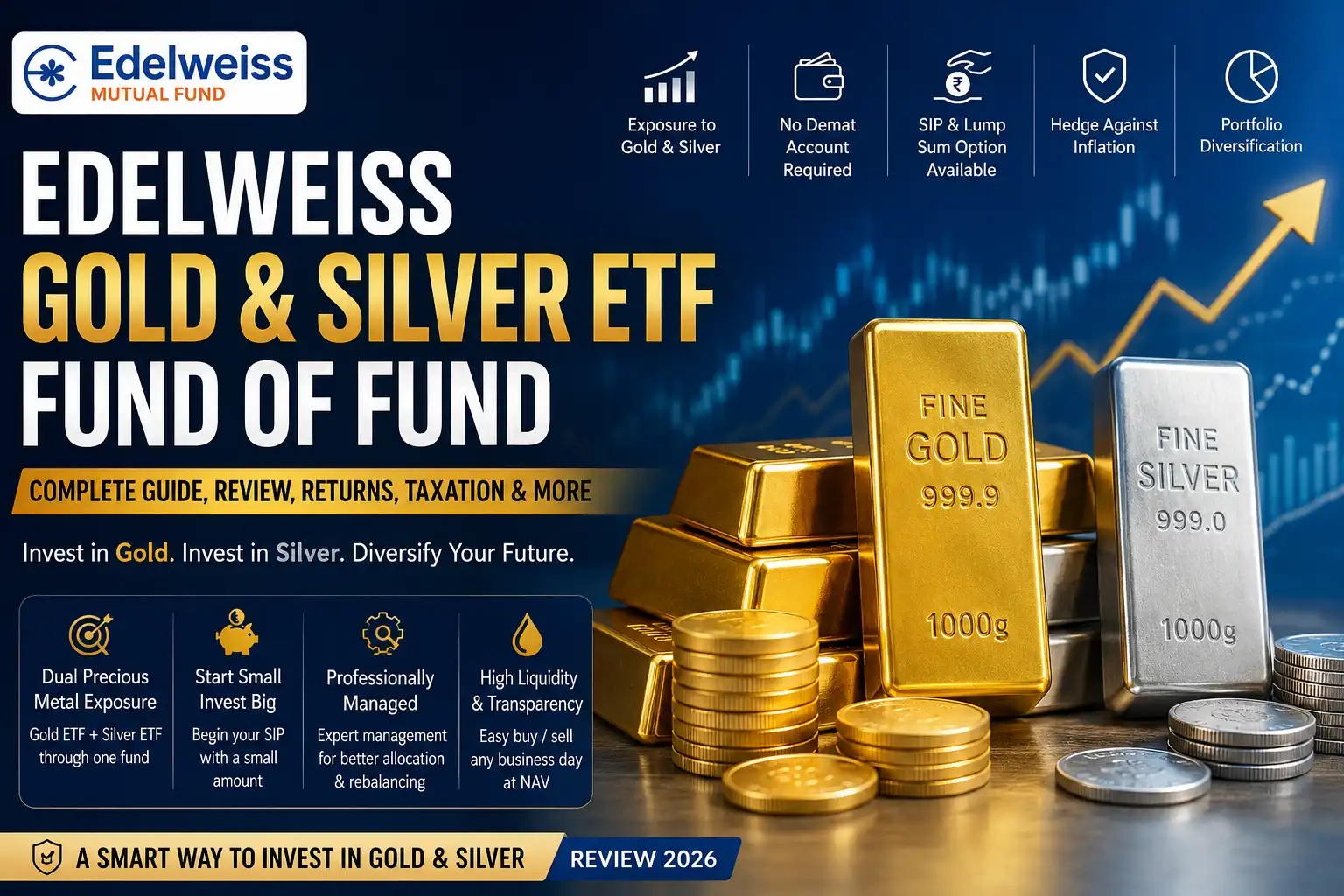
Investors often look for assets that can protect their wealth during uncertain market conditions. Gold has traditionally served as a safe-haven investment, while silver has offered both precious metal value and industrial demand. Instead of choosing between these two metals, many investors now prefer to invest in both through a single mutual fund.
The Edelweiss Gold and Silver ETF Fund of Fund (FoF) is one such investment option. It gives investors exposure to both gold and silver through Exchange Traded Funds (ETFs). You do not need a Demat account, you do not have to buy physical metals, and you can start investing with a small amount.
This fund is designed for investors who want portfolio diversification, inflation protection, and exposure to two globally recognized precious metals without worrying about storage, purity, or security.
Whether you are a beginner building your first investment portfolio or an experienced investor looking to diversify beyond equity and debt, this guide explains everything you need to know about the Edelweiss Gold and Silver ETF Fund of Fund. You will learn how the fund works, where it invests, its advantages, risks, costs, taxation, and whether it deserves a place in your portfolio.
By the end of this guide, you will have enough knowledge to decide whether this fund matches your financial goals.
What is Edelweiss Gold and Silver ETF Fund of Fund?
The Edelweiss Gold and Silver ETF Fund of Fund is an open-ended mutual fund scheme that invests primarily in units of Gold ETFs and Silver ETFs managed by Edelweiss Mutual Fund. Instead of buying physical gold or silver, investors purchase units of this mutual fund, which in turn buys Exchange Traded Funds backed by physical precious metals.
Unlike a traditional gold fund that only invests in gold, this scheme offers exposure to both gold and silver within a single investment.
This dual-metal strategy aims to provide better diversification because gold and silver often perform differently during various economic and market conditions.
In Simple Words
Think of this fund as a basket.
Instead of buying only gold, or only silver, you buy one mutual fund that invests in both.
Your investment gets divided between Gold ETFs and Silver ETFs according to the fund manager’s strategy.
You receive exposure to both precious metals without managing multiple investments.
Fund Snapshot
| Particular | Details |
|---|---|
| Fund Name | Edelweiss Gold and Silver ETF Fund of Fund |
| Fund Type | Open-ended Fund of Fund |
| Category | Commodity Mutual Fund |
| Investment Style | Passive |
| Primary Investments | Gold ETF and Silver ETF |
| Risk Level | Very High |
| Investment Mode | SIP and Lump Sum |
| Minimum SIP | ₹100 |
| Minimum Lump Sum | ₹100 |
| Lock-in Period | None |
| Exit Load | Nil (subject to Scheme Information Document) |
| Suitable For | Long-term investors seeking diversification |
Note: Scheme statistics such as AUM, expense ratio, portfolio allocation, and returns may change over time. Always refer to the latest Scheme Information Document (SID), Key Information Memorandum (KIM), and monthly factsheet before investing.
What is a Fund of Fund (FoF)?
Before understanding this scheme, it is important to know what a Fund of Fund means.
A Fund of Fund is a mutual fund that invests in other mutual funds or ETFs instead of directly buying stocks, bonds, or commodities.
In this case,
the Edelweiss Gold and Silver ETF Fund of Fund invests in:
- Edelweiss Gold ETF
- Edelweiss Silver ETF
It does not directly buy physical gold or physical silver.
Instead,
it buys units of ETFs that already hold physical precious metals.
This creates an additional layer of convenience for investors.
How a Fund of Fund Works
Investor
↓
Invests Money
↓
Edelweiss Gold and Silver ETF Fund of Fund
↓
Purchases Gold ETF Units
Purchases Silver ETF Units
↓
Gold ETF Holds Physical Gold
↓
Silver ETF Holds Physical Silver
↓
Investor Gets Combined Exposure
How Does Edelweiss Gold and Silver ETF Fund of Fund Work?
When you invest ₹10,000 in this scheme, your money does not directly purchase gold or silver bars.
Instead, the fund manager allocates your investment between Gold ETF units and Silver ETF units.
Those ETFs then invest in physical gold and physical silver of high purity stored with approved custodians.
The Net Asset Value (NAV) of the fund changes daily depending on:
- International gold prices
- International silver prices
- Rupee-Dollar exchange rate
- Domestic demand
- Global economic conditions
- ETF tracking performance
As gold and silver prices move, the NAV of the fund also changes.
Investment Objective
The primary objective of the Edelweiss Gold and Silver ETF Fund of Fund is to generate returns by investing in units of Gold ETFs and Silver ETFs.
The fund seeks to provide investors with long-term capital appreciation by tracking the performance of precious metals through underlying ETFs.
Since the scheme invests in commodity ETFs, there is no guarantee that it will achieve its investment objective.
Returns depend entirely on the movement of gold prices, silver prices, and the performance of the underlying ETFs.
Why Did Edelweiss Launch This Fund?
For years, investors had to choose between:
- Gold ETFs
- Gold Mutual Funds
- Physical Gold
- Silver ETFs
- Physical Silver
Many investors wanted exposure to both metals but did not know how much to allocate to each.
Managing two separate investments also increased complexity.
The Edelweiss Gold and Silver ETF Fund of Fund solves this problem by combining both precious metals into one mutual fund.
Investors can diversify with a single investment instead of maintaining separate portfolios.
Why Gold and Silver Together?
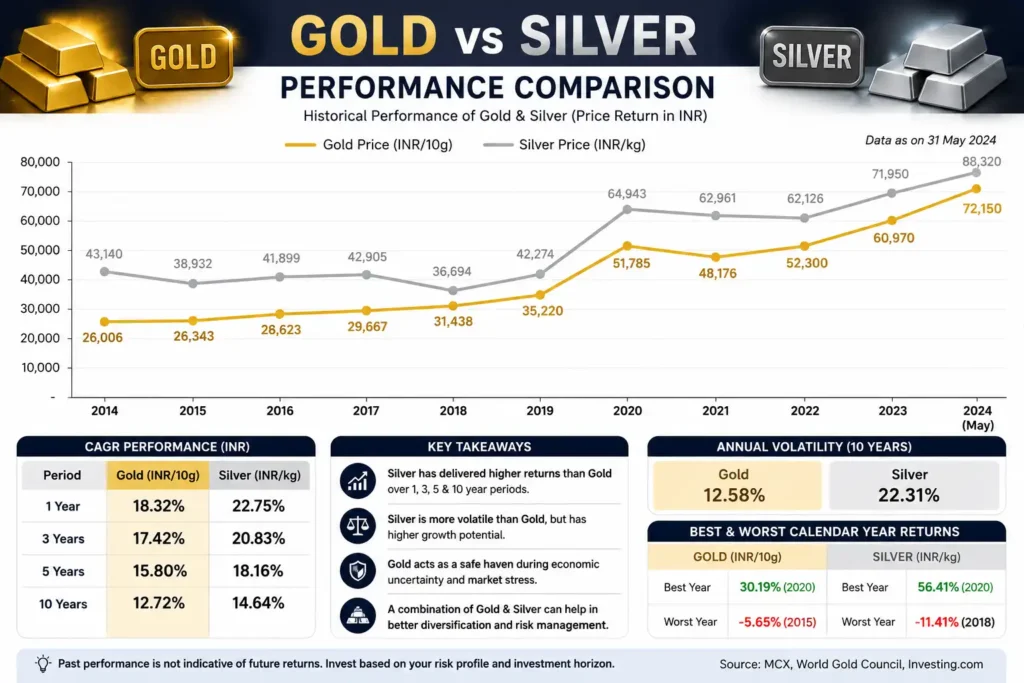
Gold and silver share similarities, but they behave differently in different economic environments.
Gold generally performs well during:
- Economic uncertainty
- High inflation
- Currency depreciation
- Geopolitical tensions
- Financial crises
Silver benefits from:
- Industrial demand
- Renewable energy growth
- Electric vehicle manufacturing
- Electronics production
- Solar panel manufacturing
- Medical equipment demand
Because silver has strong industrial use, it can outperform gold during periods of economic expansion.
Holding both metals together helps balance these different demand drivers.
Features of Edelweiss Gold and Silver ETF Fund of Fund
1. Dual Precious Metal Exposure
The biggest advantage is exposure to two precious metals through one investment.
Instead of selecting separate funds,
one investment provides diversification.
2. No Demat Account Required
Unlike ETFs, investors do not need:
- Trading account
- Demat account
- Stock broker
The fund can be purchased directly through mutual fund platforms.
3. Easy SIP Investment
Many investors cannot buy gold every month.
This fund allows SIP investments from a small amount, making disciplined investing much easier.
4. Professional Portfolio Management
The fund manager continuously manages investments in the underlying ETFs.
Investors do not need to decide when to buy or sell gold and silver individually.
5. High Liquidity
Since it is an open-ended mutual fund,
investors can redeem units on any business day at the applicable NAV.
6. No Storage Problems
Physical gold requires:
- Locker charges
- Security
- Insurance
- Purity verification
This fund eliminates all these concerns.
7. Transparent Pricing
The NAV is published daily.
Investors can easily monitor:
- Portfolio
- Holdings
- Performance
- Asset allocation
Who Manages the Investments?
Although the Fund of Fund invests in passive ETFs, the fund manager oversees:
- Asset allocation between Gold ETF and Silver ETF
- Cash management
- Liquidity
- Portfolio rebalancing
- Tracking efficiency
Professional management ensures that the scheme follows its stated investment strategy while maintaining operational efficiency.
Where Does the Fund Invest?
The portfolio generally consists of:
- Units of Edelweiss Gold ETF
- Units of Edelweiss Silver ETF
- Cash and cash equivalents for liquidity
- Money market instruments (where permitted)
The fund does not invest directly in:
- Equity shares
- Corporate bonds
- Government securities (except for cash management)
- Real estate
- International stocks
Its primary focus remains precious metal exposure through ETFs.
Asset Allocation Strategy
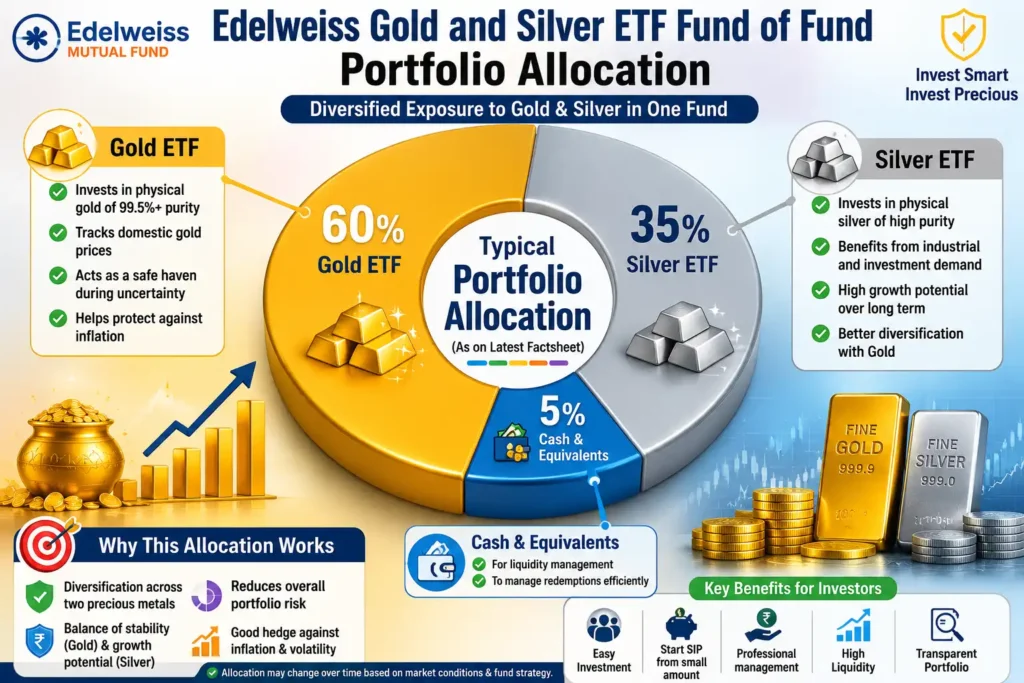
Although the allocation may change over time, the portfolio broadly remains invested in:
- Gold ETF units
- Silver ETF units
- Small cash position
The exact proportion depends on the investment strategy outlined in the Scheme Information Document and periodic portfolio disclosures.
Periodic rebalancing helps the fund maintain its intended exposure while accounting for changes in metal prices and investor flows.
Why Investors Are Showing Interest in This Fund
Several long-term trends have increased investor interest in precious metal funds:
Rising Inflation
Gold has historically been considered a hedge against inflation over long periods.
Increasing Global Uncertainty
Wars, geopolitical conflicts, banking crises, and economic slowdowns often increase demand for safe-haven assets.
Growing Industrial Demand for Silver
Silver demand continues to benefit from expanding industries such as:
- Solar energy
- Electric vehicles
- Semiconductor manufacturing
- Electronics
- Healthcare technology
Portfolio Diversification
Investors increasingly recognize that combining assets with different return patterns may help reduce overall portfolio volatility.
Easy Accessibility
A low minimum investment amount and SIP facility make the fund accessible to a wide range of investors.
How This Fund Fits Into Your Portfolio
This fund is generally considered a satellite investment rather than a core holding.
A diversified portfolio may include:
- Equity mutual funds for long-term growth
- Debt funds for stability
- International funds for geographic diversification
- Gold and silver exposure through this FoF for portfolio diversification and potential inflation protection
The appropriate allocation depends on factors such as your financial goals, investment horizon, and risk tolerance.
Quick Advantages at a Glance
- Invest in gold and silver through one fund.
- No Demat account required.
- Start with a small investment amount.
- Suitable for SIP and lump sum investments.
- No concerns about purity or storage.
- Daily NAV transparency.
- Professional management.
- Portfolio diversification.
- Convenient access to precious metals.
- Easy redemption on business days.
Portfolio Composition of Edelweiss Gold and Silver ETF Fund of Fund
One of the biggest strengths of the Edelweiss Gold and Silver ETF Fund of Fund is its simple and transparent portfolio structure. Unlike diversified equity mutual funds that may hold dozens or even hundreds of stocks, this scheme primarily invests in two underlying Exchange Traded Funds (ETFs).
These ETFs invest in physical precious metals that meet industry purity standards. As a result, investors gain indirect ownership of gold and silver without buying the metals themselves.
Typical Portfolio Structure
Although the exact allocation changes over time based on fund strategy and market movements, the portfolio generally includes:
| Asset | Purpose |
|---|---|
| Edelweiss Gold ETF | Provides exposure to physical gold prices |
| Edelweiss Silver ETF | Provides exposure to physical silver prices |
| Cash & Cash Equivalents | Maintains liquidity and manages redemptions |
| Money Market Instruments | Short-term cash management, where permitted |
The fund does not normally invest in:
- Equity shares
- Corporate bonds
- Government securities as long-term investments
- Real estate
- Cryptocurrencies
- Foreign equities
This focused approach keeps the portfolio easy to understand.
Understanding the Underlying Gold ETF
The Gold ETF held by the Fund of Fund invests in physical gold of high purity, typically 99.5% or higher, in accordance with regulatory guidelines.
Each ETF unit represents ownership in gold held securely by approved custodians.
The ETF tracks domestic gold prices as closely as possible after accounting for expenses and operational costs.
Factors Affecting Gold ETF Performance
Several factors influence gold prices:
- Inflation
- Interest rates
- US Dollar strength
- Central bank buying
- Global recessions
- Currency depreciation
- Geopolitical tensions
- Global financial uncertainty
When these factors push gold prices higher, the Gold ETF generally benefits.
Understanding the Underlying Silver ETF
The Silver ETF invests in physical silver with high purity.
Unlike gold, silver has two major demand drivers:
- Investment demand
- Industrial demand
This makes silver more volatile than gold.
Industries That Drive Silver Demand
Silver plays a vital role in:
- Solar panels
- Electric vehicles
- Battery technology
- Medical equipment
- Consumer electronics
- Semiconductors
- 5G infrastructure
- Artificial Intelligence hardware
- Industrial automation
Because of these industries, silver often performs well during periods of strong economic growth.
Why Combining Gold and Silver Makes Sense
Many investors ask why they should invest in both metals instead of choosing only one.
The answer lies in diversification.
Gold and silver do not always move at the same pace.
For example:
- During financial crises, gold often outperforms silver because investors seek safety.
- During economic recoveries, silver may outperform due to rising industrial demand.
Owning both metals helps balance these different market phases.
Comparison of Gold and Silver
| Feature | Gold | Silver |
| Primary Role | Wealth preservation | Industrial + investment demand |
| Volatility | Lower | Higher |
| Inflation Hedge | Excellent | Good |
| Industrial Usage | Limited | Very High |
| Economic Recovery Potential | Moderate | High |
| Safe Haven | Strong | Moderate |
| Price Swings | Relatively Stable | Large |
How the Fund Allocates Between Gold and Silver
The Fund of Fund does not always maintain a fixed allocation.
Instead, the allocation may vary depending on:
- Market conditions
- Investment strategy
- Underlying ETF weights
- Rebalancing requirements
- Cash flows
This flexibility allows the fund to maintain its intended exposure while ensuring operational efficiency.
Investors should check the latest monthly factsheet to know the current allocation.
What Happens When Gold Prices Rise?
Suppose gold prices increase by 15% over a year while silver remains unchanged.
In such a situation:
- Gold ETF value increases.
- Silver ETF value remains relatively stable.
- Overall NAV of the Fund of Fund rises, depending on the allocation to gold.
The exact return depends on how much of the portfolio is invested in each ETF.
What Happens When Silver Outperforms?
Now imagine silver rises 30% because industrial demand increases.
Meanwhile, gold gains only 8%.
The Silver ETF contributes a larger share of returns.
This helps investors benefit from sectors that use silver extensively, such as renewable energy and electronics.
Portfolio Rebalancing
Over time, one metal may outperform the other.
For example:
Gold Allocation
50%
Silver Allocation
50%
↓
Gold rises sharply
↓
Portfolio becomes
58% Gold
42% Silver
↓
Fund rebalances
↓
Returns to target allocation
Rebalancing helps maintain the intended investment strategy and prevents one metal from dominating the portfolio.
Historical Performance of Gold
Gold has historically performed well during periods of:
- High inflation
- Economic recessions
- Banking crises
- Global conflicts
- Weak equity markets
- Currency depreciation
Examples include:
During the Global Financial Crisis
Investors moved money into gold as stock markets declined sharply.
Gold acted as a defensive asset.
During COVID-19
Gold reached record highs in many countries as investors searched for safe investments amid uncertainty.
During High Inflation
When inflation reduces purchasing power, gold often attracts investors looking to preserve wealth over the long term.
Historical Performance of Silver
Silver has experienced larger price swings than gold.
It tends to outperform during:
- Economic expansion
- Manufacturing growth
- Renewable energy investments
- Rising industrial production
However, silver can also decline more sharply during economic slowdowns.
This higher volatility creates greater return potential but also higher risk.
How Precious Metals Behave Across Market Cycles
| Market Condition | Gold | Silver |
| Stock Market Crash | Usually Strong | Mixed |
| Inflation | Strong | Strong |
| Economic Recovery | Moderate | Very Strong |
| High Industrial Production | Moderate | Excellent |
| Currency Weakness | Strong | Strong |
| Global Crisis | Excellent | Moderate |
| Interest Rate Cuts | Positive | Positive |
This explains why many diversified portfolios include both metals.
Understanding Returns
The returns generated by the Edelweiss Gold and Silver ETF Fund of Fund depend on multiple factors.
1. Domestic Gold Prices
Indian gold prices influence the Gold ETF.
2. Domestic Silver Prices
Silver price movements directly impact the Silver ETF.
3. Currency Movement
Gold and silver are priced globally in US Dollars.
If the Indian Rupee weakens against the US Dollar, domestic metal prices may rise even if international prices remain unchanged.
4. Expense Ratio
Every mutual fund charges an expense ratio.
A lower expense ratio leaves more of the investment return with investors.
5. Tracking Efficiency
Since the fund invests in ETFs, the efficiency with which those ETFs track underlying metal prices also affects returns.
Understanding Tracking Error
Tracking error measures how closely an ETF follows the price of its underlying asset.
A lower tracking error generally indicates that the ETF is more closely matching the performance of the underlying metal.
Tracking differences may arise due to:
- Fund expenses
- Cash holdings
- Liquidity management
- Operational costs
Investors should review tracking error when evaluating any commodity ETF.
Understanding Volatility
Gold is generally less volatile than silver.
This means:
Gold
- Smaller price swings
- Lower risk
- More stable returns
Silver
- Larger price swings
- Higher risk
- Higher return potential
By investing in both, the Fund of Fund seeks to balance stability and growth potential.
How This Fund May Perform in Different Economic Scenarios
Scenario 1: Inflation Rises
Likely Outcome:
Gold strengthens.
Silver may also benefit.
Overall fund performance may improve.
Scenario 2: Equity Markets Fall
Investors often shift money toward safe-haven assets.
Gold may outperform.
The fund could provide diversification benefits.
Scenario 3: Global Manufacturing Expands
Industrial demand for silver increases.
Silver prices may rise faster than gold.
The fund benefits from its silver allocation.
Scenario 4: Strong US Dollar
A stronger US Dollar can pressure international metal prices.
However, domestic returns also depend on the Rupee-Dollar exchange rate.
Factors That Can Increase Future Returns
Several long-term trends could support demand for precious metals:
Renewable Energy Expansion
Solar panels require significant amounts of silver.
Growing solar installations may increase silver demand.
Electric Vehicles
Electric vehicles use more silver than conventional vehicles because of their electrical systems.
Artificial Intelligence Infrastructure
Data centers, advanced chips, and high-performance electronics require silver in various components.
Central Bank Gold Purchases
Many central banks continue to increase their gold reserves to diversify away from traditional reserve assets.
Geopolitical Uncertainty
Conflicts, trade disputes, and financial instability often increase demand for gold as a safe-haven asset.
Risks Investors Should Understand
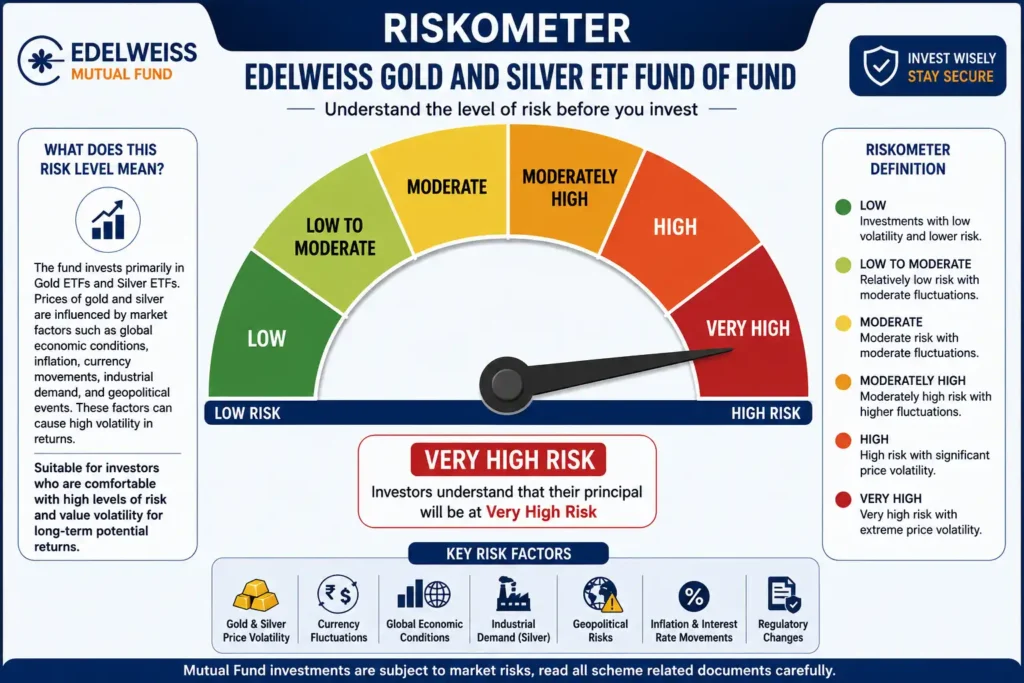
While precious metals can diversify a portfolio, they also carry risks:
- Gold and silver prices can be volatile.
- Commodity prices may remain weak for extended periods.
- Returns depend entirely on market prices.
- There is no guaranteed income like dividends or interest.
- The fund is not a capital-protected investment.
- Currency movements can affect returns.
- Industrial demand fluctuations can significantly influence silver prices.
Understanding these risks helps investors set realistic expectations and use the fund appropriately within a diversified investment portfolio.
Before you decide whether this fund deserves a place in your portfolio, you should understand its costs, taxation, suitability, and the best investment strategy. These factors can have a significant impact on your long-term returns.
Expense Ratio Explained
Every mutual fund charges a fee for managing investors’ money. This fee is known as the expense ratio.
Although the Edelweiss Gold and Silver ETF Fund of Fund is a passive investment, it still incurs costs because it invests in underlying ETFs, manages cash flows, maintains records, and handles administrative activities.
Since this is a Fund of Fund, investors indirectly bear:
- Fund of Fund expenses
- Expenses of the underlying Gold ETF
- Expenses of the underlying Silver ETF
Even though these costs are relatively low compared to actively managed equity funds, they can affect long-term returns.
Why Does the Expense Ratio Matter?
Consider two funds that both generate an annual return of 10%.
| Particular | Fund A | Fund B |
|---|---|---|
| Gross Return | 10% | 10% |
| Expense Ratio | 0.25% | 1.00% |
| Net Return | 9.75% | 9.00% |
A difference of just 0.75% every year can reduce your final wealth substantially over 15–20 years because of compounding.
How to Evaluate the Expense Ratio
Do not choose a fund only because it has the lowest expense ratio.
Also compare:
- Portfolio quality
- Tracking efficiency
- Fund size (AUM)
- Historical consistency
- Tracking error
- Overall investment strategy
A slightly higher expense ratio may still be acceptable if the fund tracks its benchmark efficiently.
Assets Under Management (AUM)
Assets Under Management (AUM) represents the total value of investments managed by the fund.
Why AUM Matters
A healthy AUM generally indicates:
- Better liquidity
- Greater investor confidence
- Lower chances of operational inefficiencies
- Better economies of scale
However, a higher AUM alone does not guarantee better returns.
Always evaluate the fund based on multiple factors instead of relying only on its size.
Net Asset Value (NAV)
NAV is the per-unit value of the mutual fund.
It is calculated every business day.
NAV Formula
NAV = (Total Assets − Total Liabilities) ÷ Total Outstanding Units
Many investors mistakenly believe that a lower NAV means a cheaper or better investment.
This is incorrect.
A fund with a NAV of ₹50 is not necessarily better or worse than one with a NAV of ₹500.
Future performance depends on the underlying assets, not the NAV.
Taxation of Edelweiss Gold and Silver ETF Fund of Fund
Taxation is one of the most important factors to understand before investing.
Since this scheme invests primarily in commodity ETFs rather than equity, it does not receive equity mutual fund taxation.
Short-Term Capital Gains (STCG)
If you sell your units before completing the long-term holding period specified under current tax rules, your gains are treated as short-term capital gains.
These gains are taxed according to the applicable income tax provisions in force at the time of redemption.
Long-Term Capital Gains (LTCG)
If you hold the investment beyond the prescribed long-term holding period, your gains qualify as long-term capital gains.
The tax treatment follows the prevailing Income Tax Act provisions applicable to specified mutual funds and Fund of Funds.
Dividend Taxation
If you choose the Income Distribution (IDCW) option:
- Any distribution is taxable according to the applicable tax rules.
- Tax laws may change over time.
- Investors should always verify the latest provisions before making investment decisions.
Tax Planning Tips
- Invest with a long-term horizon.
- Avoid frequent buying and selling.
- Maintain proper transaction records.
- Consult a qualified tax advisor if you have significant investments.
SIP vs Lump Sum Investment
One of the most common questions investors ask is:
Should I invest through SIP or Lump Sum?
The answer depends on your financial situation and market outlook.
When SIP Is Better
Choose SIP if:
- You earn a regular monthly income.
- You want disciplined investing.
- You wish to reduce the impact of price volatility.
- You are investing for long-term wealth creation.
- You are new to commodity investing.
Benefits of SIP
- Rupee cost averaging
- Better investment discipline
- Lower timing risk
- Affordable monthly investment
- Compounding benefits over time
When Lump Sum Is Better
A lumpsum investment may be suitable if:
- You receive a bonus or inheritance.
- You have idle cash available.
- Precious metal prices have corrected significantly.
- Your asset allocation requires immediate rebalancing.
SIP vs Lump Sum Comparison
| Feature | SIP | Lump Sum |
| Investment Frequency | Monthly | One-time |
| Market Timing Risk | Lower | Higher |
| Suitable for Salaried Investors | Excellent | Moderate |
| Suitable for Windfall Money | Limited | Excellent |
| Volatility Management | Better | Depends on entry point |
| Investment Discipline | High | Investor-dependent |
Ideal Investment Horizon
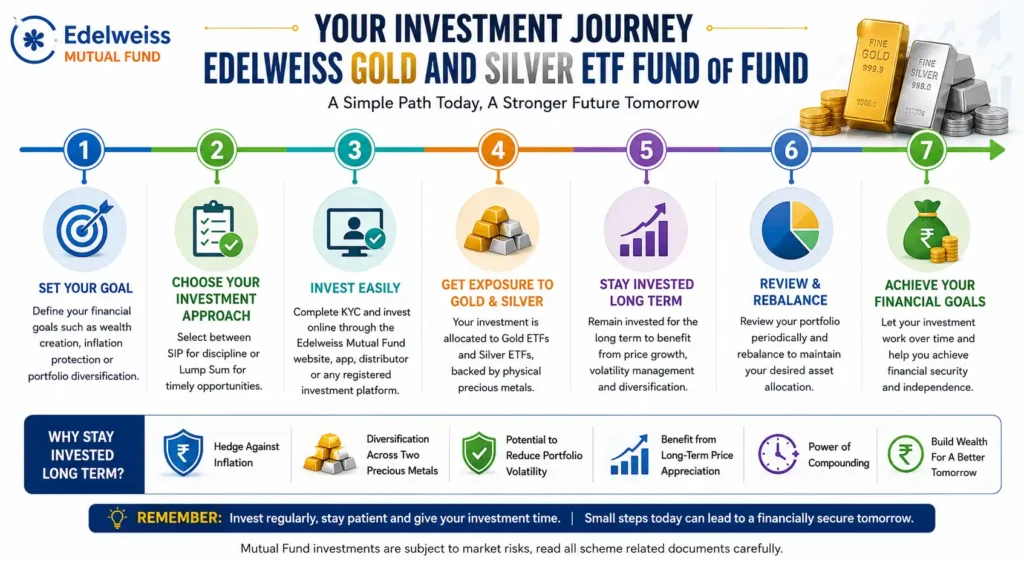
Precious metals often go through long periods of underperformance followed by strong rallies.
Therefore, investors should maintain a long-term perspective.
Suggested Holding Period
| Investment Goal | Suggested Horizon |
| Portfolio Diversification | 5+ Years |
| Inflation Protection | Long Term |
| Wealth Preservation | 5–10 Years |
| Tactical Allocation | 3–5 Years |
Avoid investing with a short-term trading mindset.
Who Should Invest?
This fund may be suitable for:
First-Time Commodity Investors
It offers exposure to both gold and silver through a single investment.
Long-Term Investors
Those who want to diversify beyond equity and debt may consider allocating a portion of their portfolio to precious metals.
Investors Seeking Inflation Protection
Gold has historically helped preserve purchasing power over long periods.
Conservative Investors
Investors looking to reduce overall portfolio volatility may use precious metals as a diversification tool.
Retirement Investors
Adding a modest allocation to precious metals may improve diversification in retirement portfolios.
Who Should Avoid This Fund?
This fund may not be suitable for:
- Investors seeking guaranteed returns.
- Investors looking for regular monthly income.
- Short-term traders.
- Investors with a very low risk tolerance.
- Investors who already have excessive exposure to gold or silver.
Advantages of Edelweiss Gold and Silver ETF Fund of Fund
Diversification in One Investment
One investment provides exposure to two precious metals.
No Demat Account Needed
Unlike ETFs, you can invest directly through mutual fund platforms.
Low Entry Barrier
You can start investing with a small amount.
Convenient SIP Facility
Regular investing becomes simple.
Professional Management
The fund manager oversees allocation, liquidity, and rebalancing.
High Transparency
Portfolio disclosures and NAV are published regularly.
No Storage Concerns
You avoid risks associated with storing physical metals.
High Liquidity
Units can generally be redeemed on any business day.
Disadvantages of the Fund
No investment is perfect.
Before investing, consider these limitations.
Commodity Price Volatility
Gold and silver prices can fluctuate sharply.
No Fixed Income
The fund does not generate interest or guaranteed income.
Returns Depend on Market Prices
There is no assurance of positive returns.
Limited Asset Class
The scheme invests only in precious metals through ETFs.
Currency Risk
International metal prices and exchange rates both influence returns.
Understanding the Riskometer
The Edelweiss Gold and Silver ETF Fund of Fund falls under the Very High Risk category.
This does not mean the investment is unsafe.
It simply indicates that:
- Prices may fluctuate significantly.
- Investors should be comfortable with market volatility.
- A long-term investment horizon is generally more appropriate.
How Much Should You Allocate?
Financial planners often recommend limiting exposure to precious metals within a diversified portfolio.
Asset Allocation Calculator
Find a suggested portfolio mix based on your age, risk profile, investment goal and time horizon.
Conservative Investors
Suggested allocation:
5%–10%
Moderate Investors
Suggested allocation:
5%–15%
Aggressive Investors
Suggested allocation:
10%–20%, depending on overall financial goals and existing asset allocation.
Avoid concentrating a large portion of your wealth in any single asset class.
Common Mistakes Investors Make
Investing Only After Prices Rise
Many investors buy gold and silver after a sharp rally.
Instead, follow a disciplined investment approach.
Ignoring Asset Allocation
Do not allow precious metals to dominate your portfolio.
Review your allocation periodically.
Chasing Short-Term Returns
Commodity markets can remain volatile.
Avoid making decisions based solely on recent performance.
Expecting Equity-Like Returns
Gold and silver serve different purposes than equities.
Their primary role is diversification and wealth preservation, not consistently high growth.
Forgetting to Rebalance
If precious metals outperform significantly, they may become a larger portion of your portfolio than intended.
Periodic rebalancing helps maintain your target allocation.
Expert Investment Strategies
Strategy 1: Monthly SIP
Ideal for salaried investors and beginners.
Strategy 2: Tactical Lump Sum
Invest additional amounts during major corrections in precious metal prices if it aligns with your asset allocation plan.
Strategy 3: Core + Diversification
Build your portfolio around equity and debt funds, then use this fund as a diversification component rather than the primary growth engine.
Strategy 4: Annual Rebalancing
Review your portfolio once a year.
If precious metals exceed your target allocation, rebalance by shifting funds into other asset classes.
Key Takeaways
- The fund provides exposure to both gold and silver through a single mutual fund.
- It eliminates the need for a Demat account and physical metal storage.
- SIPs help reduce market timing risk.
- Long-term investing is generally more suitable than short-term trading.
- Maintain disciplined asset allocation and avoid emotional investment decisions.
- Use the fund to diversify your portfolio rather than replace equity or debt investments.
Edelweiss Gold and Silver ETF Fund of Fund vs Gold ETF
Many investors get confused between a Gold ETF and the Edelweiss Gold and Silver ETF Fund of Fund. Although both provide exposure to precious metals, they work differently.
A Gold ETF invests only in gold, whereas the Edelweiss Gold and Silver ETF Fund of Fund invests in both Gold ETFs and Silver ETFs.
If you believe only gold will perform well over the next few years, a Gold ETF may be sufficient. However, if you want diversification across two precious metals, the Fund of Fund offers broader exposure.
Comparison Table
| Feature | Edelweiss Gold & Silver ETF FoF | Gold ETF |
|---|---|---|
| Gold Exposure | Yes | Yes |
| Silver Exposure | Yes | No |
| Demat Account Required | No | Yes (for exchange transactions) |
| SIP Facility | Yes | Limited through brokers |
| Diversification | Higher | Lower |
| Ease of Investment | Very Easy | Moderate |
| Portfolio Risk | Moderately Diversified | Depends only on Gold |
Which One Should You Choose?
Choose the Edelweiss Gold and Silver ETF Fund of Fund if:
- You want exposure to both precious metals.
- You do not have a Demat account.
- You prefer investing through SIPs.
- You want a single investment instead of managing multiple ETFs.
Choose a Gold ETF if:
- You only want gold exposure.
- You already use a Demat account.
- You actively trade ETFs.
Edelweiss Gold and Silver ETF Fund of Fund vs Silver ETF
Silver has become increasingly popular due to its industrial demand.
However, investing only in silver also increases portfolio volatility.
Comparison
| Feature | Gold & Silver FoF | Silver ETF |
| Gold Exposure | Yes | No |
| Silver Exposure | Yes | Yes |
| Volatility | Moderate | High |
| Diversification | Better | Lower |
| Suitable for Beginners | Excellent | Moderate |
Investors who are uncertain about silver’s future price movements may prefer the balanced exposure offered by the Fund of Fund.
Edelweiss Gold and Silver ETF Fund of Fund vs Gold Mutual Fund
Gold Mutual Funds invest only in Gold ETFs.
The Edelweiss scheme expands beyond gold by including silver.
Key Differences
| Feature | Gold & Silver FoF | Gold Mutual Fund |
| Number of Precious Metals | Two | One |
| Inflation Hedge | Strong | Strong |
| Industrial Growth Exposure | Yes | No |
| Portfolio Diversification | Better | Limited |
Edelweiss Gold and Silver ETF Fund of Fund vs Sovereign Gold Bonds (SGBs)
Sovereign Gold Bonds have historically been one of the most tax-efficient ways to invest in gold when held until maturity. However, new issuances depend on government policy.
Comparison
| Feature | Gold & Silver FoF | Sovereign Gold Bonds |
| Gold Exposure | Yes | Yes |
| Silver Exposure | Yes | No |
| Interest Income | No | Yes (fixed interest on face value) |
| Lock-in | None | Long maturity with limited early exit options |
| Liquidity | High | Depends on exchange liquidity if sold before maturity |
| SIP Available | Yes | No |
| Portfolio Diversification | Better | Gold Only |
When SGBs May Be Better
SGBs may suit investors who:
- Want only gold exposure.
- Can remain invested until maturity.
- Value the fixed interest component.
When the Fund of Fund May Be Better
The Fund of Fund may suit investors who:
- Want both gold and silver.
- Prefer regular SIPs.
- Need easier liquidity.
- Do not want long lock-in periods.
Edelweiss Gold and Silver ETF Fund of Fund vs Physical Gold
Many Indian families continue to buy jewellery and gold coins.
However, investment and consumption are different objectives.
Comparison
| Feature | Gold & Silver FoF | Physical Gold |
| Purity Concerns | None | Possible |
| Storage Risk | None | Yes |
| Making Charges | None | Applicable on jewellery |
| Liquidity | High | Moderate |
| SIP Facility | Yes | No |
| Portfolio Tracking | Easy | Difficult |
For wealth creation and diversification, investment products are often more efficient than jewellery purchases because they avoid making charges and storage issues.
Edelweiss Gold and Silver ETF Fund of Fund vs Digital Gold
Digital Gold has become popular through fintech platforms.
However, it differs from regulated mutual fund products.
Comparison
| Feature | Gold & Silver FoF | Digital Gold |
| Regulated Mutual Fund | Yes | Structure depends on provider |
| Silver Exposure | Yes | Usually No |
| SIP Facility | Yes | Platform-dependent |
| Portfolio Transparency | High | Varies |
| Diversification | Better | Lower |
Investors should always understand the regulatory framework and storage arrangements before choosing Digital Gold.
Edelweiss Gold and Silver ETF Fund of Fund vs Multi Asset Funds
Multi Asset Funds invest in three or more asset classes.
These may include:
- Equity
- Debt
- Gold
- REITs
- International assets
Comparison
| Feature | Gold & Silver FoF | Multi Asset Fund |
| Equity Exposure | No | Yes |
| Debt Exposure | No | Yes |
| Gold Exposure | Yes | Usually Yes |
| Silver Exposure | Yes | Sometimes, depending on the scheme |
| Risk Profile | Commodity-focused | Diversified |
Investors seeking complete portfolio solutions may prefer Multi Asset Funds.
Those specifically looking for precious metal exposure may find the Edelweiss scheme more suitable.
Edelweiss Gold and Silver ETF Fund of Fund vs Hybrid Funds
Hybrid Funds combine equity and debt.
They generally do not focus on commodities.
Comparison
| Feature | Gold & Silver FoF | Hybrid Fund |
| Equity | No | Yes |
| Debt | No | Yes |
| Precious Metals | Yes | Usually Minimal or None |
| Income Generation | No | Possible |
| Diversification Type | Commodity | Equity + Debt |
Both serve different purposes and are not direct substitutes.
Comparison with Popular Precious Metal Investment Options
| Investment Option | Gold | Silver | Income | Liquidity | Demat Required | Best For |
| Edelweiss Gold & Silver ETF FoF | Yes | Yes | No | High | No | Diversification |
| Gold ETF | Yes | No | No | High | Usually Yes | |
| Silver ETF | No | Yes | No | High | Usually Yes | |
| Gold Mutual Fund | Yes | No | No | High | No | |
| Sovereign Gold Bond | Yes | No | Fixed Interest | Moderate | No | |
| Physical Gold | Yes | No | No | Moderate | No | |
| Digital Gold | Yes | Usually No | No | Moderate | No |
When Should You Invest in This Fund?
The Edelweiss Gold and Silver ETF Fund of Fund may be considered during several situations.
Scenario 1: High Inflation
When inflation rises sharply, precious metals often become attractive to investors seeking to preserve purchasing power.
Scenario 2: Global Economic Uncertainty
Events such as financial crises, geopolitical conflicts, or banking instability can increase demand for safe-haven assets like gold.
Scenario 3: Portfolio Rebalancing
If your equity allocation has increased significantly after a market rally, adding exposure to precious metals may help restore your desired asset allocation.
Scenario 4: Long-Term Wealth Preservation
Investors aiming to preserve wealth over long periods may consider allocating a portion of their portfolio to precious metals as part of a diversified strategy.
When Should You Avoid Investing?
This fund may not be appropriate if:
- You need guaranteed returns.
- You require regular income.
- You plan to withdraw money within one or two years.
- Your investment goal is aggressive long-term capital growth through equities.
- You already have a high allocation to gold and silver.
Sample Portfolio Allocation
Conservative Investor
| Asset | Allocation |
| Equity | 40% |
| Debt | 50% |
| Edelweiss Gold & Silver ETF FoF | 10% |
Moderate Investor
| Asset | Allocation |
| Equity | 60% |
| Debt | 25% |
| Edelweiss Gold & Silver ETF FoF | 15% |
Aggressive Investor
| Asset | Allocation |
| Equity | 75% |
| Debt | 10% |
| Edelweiss Gold & Silver ETF FoF | 15% |
These examples are illustrative. Investors should decide allocations based on their financial goals, risk tolerance, and investment horizon.
Real-Life Investment Scenarios
Investor A: Young Professional
- Age: 28
- Goal: Long-term wealth creation
- Strategy: Invest primarily in equity mutual funds while allocating a small portion to the Edelweiss Gold and Silver ETF Fund of Fund for diversification.
Investor B: Pre-Retiree
- Age: 55
- Goal: Preserve accumulated wealth
- Strategy: Maintain a balanced portfolio with equity, debt, and a moderate allocation to precious metals.
Investor C: Retired Investor
- Goal: Reduce portfolio volatility
- Strategy: Use precious metals as a diversification tool alongside income-generating investments, while avoiding excessive exposure.
Common Myths About Precious Metal Funds
Myth 1: Gold Always Gives High Returns
Reality:
Gold has experienced periods of both strong performance and prolonged underperformance. It should not be expected to outperform equities over every time frame.
Myth 2: Silver Always Follows Gold
Reality:
Silver has significant industrial demand, so its price can move differently from gold depending on economic conditions.
Myth 3: Gold Is Completely Risk-Free
Reality:
Gold prices can fluctuate. While it is often viewed as a defensive asset, it is still subject to market risk.
Myth 4: Investing in Jewellery Is the Same as Investing in Gold
Reality:
Jewellery includes making charges, design costs, and resale deductions. Investment products such as ETFs or Fund of Funds are generally more efficient for investment purposes.
Expert Verdict
The Edelweiss Gold and Silver ETF Fund of Fund offers a convenient way to gain exposure to two important precious metals through a single mutual fund.
Its key strengths include:
- Exposure to both gold and silver.
- No need for a Demat account.
- Easy SIP and lump sum investing.
- Professional management.
- Portfolio diversification.
- High transparency.
However, investors should remember that this is a commodity-focused investment. It should complement a diversified portfolio rather than replace equity or debt investments.
For most long-term investors, a measured allocation to this fund can help improve diversification and potentially reduce overall portfolio risk during periods of market uncertainty.
How to Invest in Edelweiss Gold and Silver ETF Fund of Fund
Investing in the Edelweiss Gold and Silver ETF Fund of Fund is simple because you do not need a Demat account. You can invest directly through the Asset Management Company’s website, your mutual fund distributor, registered investment platforms, or stockbroking apps that offer mutual fund investments.
Step-by-Step Investment Process
Step 1: Complete your KYC (Know Your Customer) if it is not already done.
Step 2: Choose the investment mode:
- SIP
- Lump Sum
Step 3: Select the investment option:
- Growth Option
- IDCW Option (if available)
Step 4: Enter the investment amount.
Step 5: Complete the payment using UPI, Net Banking, or other supported payment methods.
Step 6: Confirm your investment and save the transaction details for future reference.
Once your transaction is processed, units will be allotted at the applicable NAV.
How to Track Your Investment
Monitoring your investment regularly helps you ensure it remains aligned with your financial goals.
Important Metrics to Monitor
- Fund NAV
- Gold price trends
- Silver price trends
- Portfolio allocation
- Expense ratio
- Assets Under Management (AUM)
- Tracking error
- Annual returns
- Tax implications before redemption
Reviewing these factors once every quarter is generally sufficient for long-term investors.
Monthly SIP Examples
The following examples are for illustration only and do not represent guaranteed returns.
| Monthly SIP | Investment Period | Total Investment |
|---|---|---|
| ₹500 | 10 Years | ₹60,000 |
| ₹1,000 | 10 Years | ₹1,20,000 |
| ₹2,500 | 10 Years | ₹3,00,000 |
| ₹5,000 | 10 Years | ₹6,00,000 |
| ₹10,000 | 10 Years | ₹12,00,000 |
Your actual investment value will depend on the future performance of gold and silver prices.
Checklist Before Investing
Before investing in the Edelweiss Gold and Silver ETF Fund of Fund, ask yourself the following questions:
✔ Do I understand that commodity prices can fluctuate?
✔ Am I investing for at least five years?
✔ Does my portfolio already have enough equity and debt exposure?
✔ Am I investing for diversification rather than chasing short-term returns?
✔ Am I comfortable with market-linked returns?
✔ Have I reviewed the latest Scheme Information Document (SID) and factsheet?
If your answer is “Yes” to most of these questions, the fund may be worth considering as part of a diversified portfolio.
Common Mistakes to Avoid
Investing During Market Euphoria
Many investors buy precious metals only after prices have already surged. A disciplined SIP approach can help reduce market timing risk.
Ignoring Portfolio Allocation
Avoid allocating an excessive portion of your portfolio to any single asset class.
Redeeming During Short-Term Corrections
Gold and silver often experience periods of volatility. Selling during temporary declines may not align with long-term investment goals.
Comparing It Only with Equity Funds
The role of precious metals is different from equities. They primarily provide diversification and may help during periods of market stress.
Not Reviewing the Portfolio
Review your investments at least once a year and rebalance if your allocation has drifted significantly.
Ideal Investors
This fund may be suitable for:
- First-time commodity investors
- Long-term SIP investors
- Investors seeking portfolio diversification
- Individuals looking for exposure to both gold and silver
- Investors concerned about inflation
- Retirement planners who want a diversified portfolio
- Investors without a Demat account
Investors Who May Consider Other Options
You may want to explore alternatives if you:
- Need guaranteed returns
- Want regular monthly income
- Have a very short investment horizon
- Prefer aggressive long-term capital growth through equities
- Already hold substantial investments in gold or silver
Frequently Asked Questions (FAQs)
Is Edelweiss Gold and Silver ETF Fund of Fund safe?
The fund invests in regulated mutual fund structures that hold units of Gold ETFs and Silver ETFs. However, like all market-linked investments, its value can rise or fall depending on precious metal prices. It is not a guaranteed-return investment.
Does this fund invest in physical gold?
The Fund of Fund primarily invests in Gold ETFs and Silver ETFs, which in turn are backed by physical precious metals.
Do I need a Demat account?
No. You can invest directly through mutual fund platforms without opening a Demat account.
Can I start with a SIP?
Yes. The scheme allows investors to start with a small SIP amount, subject to the latest scheme rules.
Is there a lock-in period?
No. It is an open-ended mutual fund, so there is no lock-in period. Redemption is available on business days at the applicable NAV.
Is this better than buying jewellery?
If your objective is investment, a regulated mutual fund generally avoids making charges, storage issues, and purity concerns associated with jewellery.
Can I use this fund for retirement planning?
It can form a small part of a retirement portfolio for diversification, but it should not be the only investment. A balanced mix of equity, debt, and other suitable assets is usually recommended.
How much should I invest?
There is no universal answer. Your allocation should depend on your financial goals, risk tolerance, and overall portfolio. Many investors keep only a modest portion of their portfolio in precious metals.
How often should I review this fund?
A quarterly or annual review is generally sufficient unless your financial goals change.
Can this fund outperform equity mutual funds?
During certain market phases, precious metals may outperform equities. Over very long periods, equities have historically delivered higher growth, while gold and silver have primarily served as diversification and wealth preservation assets.
Pros and Cons Summary
Pros
- Exposure to both gold and silver through one investment
- No Demat account required
- SIP and lump sum options available
- Professional portfolio management
- Eliminates storage and purity concerns
- High liquidity
- Useful for diversification
- Transparent portfolio disclosures
Cons
- Returns depend entirely on commodity prices
- No guaranteed income or dividends (Growth option)
- Commodity markets can be volatile
- Does not replace equity investments for long-term growth
- Taxation differs from equity mutual funds
Expert Rating
| Parameter | Rating (Out of 5) |
| Diversification | ⭐⭐⭐⭐⭐ |
| Ease of Investment | ⭐⭐⭐⭐⭐ |
| Liquidity | ⭐⭐⭐⭐⭐ |
| Transparency | ⭐⭐⭐⭐⭐ |
| Inflation Protection | ⭐⭐⭐⭐⭐ |
| Long-Term Wealth Preservation | ⭐⭐⭐⭐☆ |
| Growth Potential | ⭐⭐⭐⭐☆ |
| Risk Management | ⭐⭐⭐⭐☆ |
| Overall Suitability | ⭐⭐⭐⭐☆ (4.5/5) |
Final Verdict
The Edelweiss Gold and Silver ETF Fund of Fund is a convenient solution for investors who want exposure to both gold and silver through a single mutual fund.
Instead of managing separate Gold ETFs and Silver ETFs, investors can access both precious metals with one investment while also enjoying the flexibility of SIPs, professional management, and easy liquidity.
However, it is important to remember that this is not a substitute for equity mutual funds. Gold and silver play a different role in a portfolio. They are primarily used to diversify investments, protect against inflation over the long term, and potentially reduce the impact of market volatility.
For most investors, this fund works best as a satellite allocation alongside equity and debt investments rather than as the core of a portfolio.
A disciplined approach, periodic portfolio reviews, and a long-term investment horizon can help investors make the most of this fund while maintaining a balanced investment strategy.
Key Takeaways
- Invest in both gold and silver through a single mutual fund.
- No Demat account is required.
- Suitable for both SIP and lump sum investments.
- Offers diversification within the precious metals segment.
- Helps reduce the hassles of buying and storing physical metals.
- Best suited for long-term investors seeking portfolio diversification.
- Should complement—not replace—equity and debt investments.