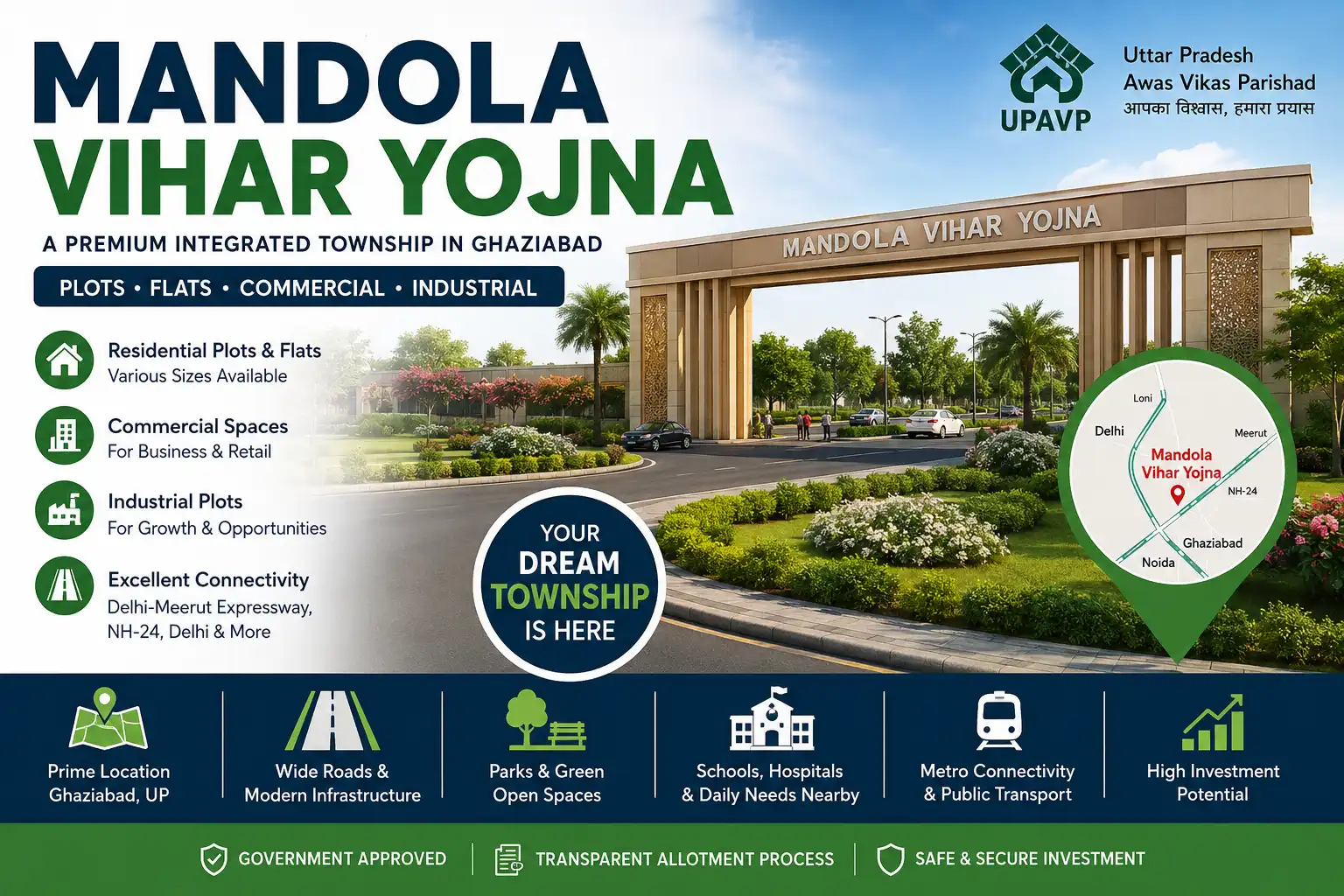
Mandola Vihar Yojna is one of the largest planned township projects developed by the Uttar Pradesh Awas Vikas Parishad (UPAVP) in Ghaziabad, Uttar Pradesh. The township aims to provide affordable and well-planned residential, commercial, institutional, and industrial spaces while supporting the growing housing demand in the National Capital Region (NCR).
The project has attracted significant attention because of its strategic location near the Delhi border and its connectivity to major highways, expressways, metro stations, and industrial hubs. As infrastructure projects continue to expand around Ghaziabad and Loni, Mandola Vihar Yojna has become a preferred destination for both homebuyers and long-term property investors.
Unlike traditional residential colonies, Mandola Vihar is designed as an integrated township where people can live, work, study, and access healthcare within the same development. Wide roads, planned green areas, schools, hospitals, commercial complexes, and public utilities make it one of the most promising government-backed housing projects in Uttar Pradesh.
Whether you are looking for your first home, a residential plot, an investment opportunity, or a commercial property, this guide explains everything you need to know about Mandola Vihar Yojna.
Latest Updates on Mandola Vihar Yojna in 2026
Mandola Vihar Yojna continues to evolve with new residential and industrial offerings introduced by the Uttar Pradesh Awas Vikas Parishad. Various phases of the township are now at different stages of development, while new applications are announced periodically through official notifications.
Some of the major developments include:
- Residential plots available under selected schemes.
- Development of new sectors.
- Expansion of road infrastructure.
- Improved connectivity with Delhi.
- Better access through expressways.
- Development of commercial zones.
- MSME industrial plot schemes.
- New residential housing projects.
- Ongoing infrastructure improvements.
- Continuous demand from Delhi-NCR buyers.
The township has gained additional attention because of several large infrastructure projects planned around Ghaziabad. As connectivity improves, property values are expected to benefit over the long term.
Applicants should always verify the latest registration dates, availability, and payment schedules on the official UPAVP portal before submitting an application because these details may change with every new scheme.
Mandola Vihar Yojna at a Glance
| Feature | Details |
|---|---|
| Project Name | Mandola Vihar Yojna |
| Developed By | Uttar Pradesh Awas Vikas Parishad (UPAVP) |
| State | Uttar Pradesh |
| District | Ghaziabad |
| Nearby City | Delhi |
| Township Type | Integrated Township |
| Property Types | Residential, Commercial, Institutional and Industrial |
| Plot Categories | Multiple Sizes |
| Flats Available | Selected Projects |
| Industrial Plots | Yes |
| Commercial Development | Yes |
| Green Areas | Planned |
| Road Network | Wide Internal Roads |
| Investment Potential | High Long-Term Potential |
| Connectivity | Excellent NCR Connectivity |
Why is Mandola Vihar Yojna Becoming Popular?
Many government housing projects offer affordable plots, but very few provide the level of planning seen in Mandola Vihar.
Some major reasons behind its increasing popularity include:
Government-backed Development
The township is developed by Uttar Pradesh Awas Vikas Parishad, one of the state’s leading housing development authorities. Government-backed projects generally attract buyers because of planned development and transparent allotment procedures.
Strategic Location
The township is located near the Delhi border, making daily commuting easier for professionals working in Delhi, Noida, Ghaziabad, and nearby industrial areas.
Planned Infrastructure
Unlike unplanned residential colonies, Mandola Vihar includes dedicated areas for:
- Parks
- Schools
- Hospitals
- Shopping complexes
- Community centers
- Commercial spaces
- Institutional buildings
- Public utilities
Affordable Entry Cost
Compared to many private township projects in NCR, government-developed plots often offer competitive pricing and structured payment options.
Strong Future Growth
Infrastructure projects around Ghaziabad continue to improve connectivity. Better roads, expressways, and metro access may support long-term appreciation.
About Uttar Pradesh Awas Vikas Parishad

The Uttar Pradesh Awas Vikas Parishad (UPAVP) is one of India’s oldest government housing development agencies.
It was established to provide planned housing, residential colonies, and urban development across Uttar Pradesh.
Over the years, UPAVP has developed numerous residential townships in cities such as:
- Lucknow
- Ghaziabad
- Kanpur
- Agra
- Prayagraj
- Meerut
- Bareilly
- Moradabad
- Ayodhya
- Varanasi
Its primary objectives include:
- Affordable housing
- Planned urban development
- Better civic infrastructure
- Sustainable townships
- Commercial development
- Balanced urban growth
Mandola Vihar is one of the organization’s flagship township developments in the NCR region.
Objectives of Mandola Vihar Yojna
Mandola Vihar Plot Cost Calculator
Estimate total plot cost, stamp duty, registration charges, and approximate EMI.
The project has been designed with several long-term objectives.
Affordable Housing
The first objective is to provide quality residential plots and housing options to middle-income and economically weaker families.
Planned Urban Development
Instead of allowing unplanned expansion, the township follows a structured master plan.
Economic Development
Commercial and industrial zones help generate employment opportunities while supporting local businesses.
Better Lifestyle
Residents benefit from modern infrastructure, parks, educational institutions, healthcare facilities, and public utilities.
Sustainable Growth
The township emphasizes balanced development through open spaces, road networks, drainage systems, and planned civic amenities.
History of Mandola Vihar Township
Mandola Vihar was conceptualized to accommodate the rapidly increasing population around Delhi and Ghaziabad.
As Delhi expanded, nearby regions experienced significant pressure on housing demand. Government authorities identified the need for planned urban expansion that could accommodate future residential and commercial growth.
Large land parcels near Loni and Mandola village were selected for township development.
The project gradually evolved into a comprehensive urban development plan that includes:
- Residential neighborhoods
- Commercial districts
- Educational institutions
- Healthcare facilities
- Public parks
- Community centers
- Industrial zones
- Green belts
- Internal road networks
Development has taken place in phases, with different sectors being introduced over time based on infrastructure readiness and demand.
Today, Mandola Vihar continues to expand through new housing schemes and infrastructure improvements.
Location of Mandola Vihar Yojna
Location plays one of the biggest roles in real estate investment.
Mandola Vihar enjoys a strategic location in Ghaziabad district near Delhi, making it attractive for both end-users and investors.
Nearby Areas
- Loni
- Ghaziabad City
- Delhi Border
- Tronica City
- Sahibabad
- Shahdara
- East Delhi
Nearby Employment Hubs
Residents can access several employment centers within a reasonable travel distance.
These include:
- Ghaziabad Industrial Area
- Sahibabad Industrial Area
- Tronica City Industrial Area
- Delhi Business Districts
- Noida Corporate Offices
This location makes the township suitable for salaried professionals as well as business owners.
Connectivity Advantages
One of the strongest reasons behind growing demand is excellent regional connectivity.
Road Connectivity
Residents can travel conveniently through multiple road networks connecting the township to Delhi and other NCR regions.
Major roads nearby include:
- Delhi–Saharanpur Road
- National Highways
- Internal Township Roads
- Regional Connecting Roads
Road connectivity continues to improve with ongoing infrastructure projects.
Expressway Connectivity
Several expressway developments around NCR have improved accessibility.
These include:
- Delhi–Dehradun Expressway
- Eastern Peripheral Expressway
- Other regional expressway links
Improved road infrastructure generally reduces travel time while increasing the attractiveness of nearby residential projects.
Metro Connectivity
Metro expansion in the NCR region has improved commuting for residents working in Delhi and Ghaziabad.
Nearby metro stations provide convenient access to various parts of Delhi.
As public transport expands further, the township’s connectivity is expected to become even stronger.
Railway Connectivity
Residents can access major railway stations in:
- Ghaziabad
- Delhi
- Shahdara
This provides convenient travel for both local and long-distance commuters.
Airport Connectivity
The township offers access to:
- Indira Gandhi International Airport
- Hindon Civil Terminal
Business travelers and frequent flyers benefit from this connectivity.
Nearby Important Landmarks
Some important landmarks around Mandola Vihar include:
- Delhi Border
- Loni
- Tronica City
- Ghaziabad Railway Station
- Hindon Air Base
- Schools
- Hospitals
- Industrial Areas
- Shopping Centers
- Religious Places
These nearby facilities improve the overall livability of the township.
Who Should Consider Buying Property in Mandola Vihar?
Mandola Vihar is suitable for different categories of buyers.
First-Time Home Buyers
Government-developed townships often provide better planning and transparent allotment procedures.
Working Professionals
Professionals employed in Delhi, Ghaziabad, Noida, and nearby industrial areas may find the location convenient for daily commuting.
Long-Term Investors
Investors looking for long-term capital appreciation may benefit from ongoing infrastructure development around the township.
Families
Families seeking spacious residential plots with planned civic amenities can consider Mandola Vihar for future home construction.
Business Owners
Industrial and commercial opportunities make the township attractive for entrepreneurs and MSMEs.
Master Plan of Mandola Vihar Yojna
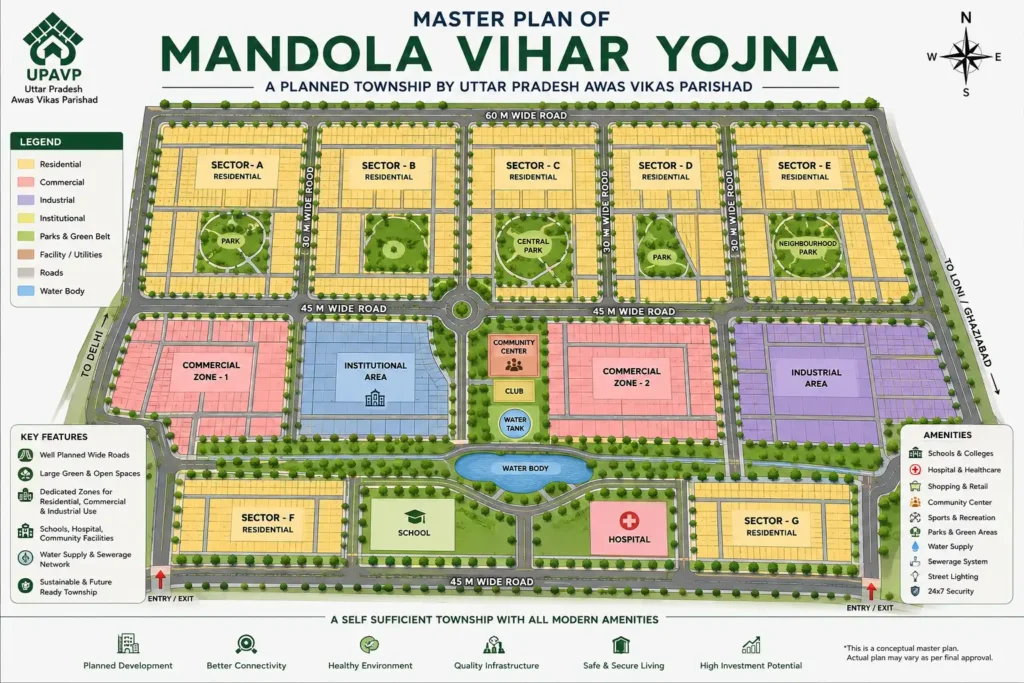
The township follows an integrated master planning approach instead of random development.
The master plan broadly includes:
- Residential sectors
- Commercial centers
- Institutional areas
- Schools
- Colleges
- Hospitals
- Community centers
- Shopping complexes
- Industrial zones
- Green belts
- Public parks
- Wide internal roads
- Water supply network
- Sewerage system
- Electricity infrastructure
- Public utility spaces
The objective is to create a self-sufficient urban township where residents can access most daily necessities without traveling long distances.
Major Components of the Township
Residential Development
The residential area includes plots of different sizes suitable for various income groups.
Commercial Development
Commercial spaces are planned to support retail businesses, offices, and local shopping requirements.
Institutional Development
Educational institutions and public buildings are integrated into the township for long-term community development.
Industrial Development
Selected sectors include industrial plots aimed at promoting manufacturing and MSME activities.
Green Infrastructure
Open parks, landscaped gardens, tree-lined roads, and recreational areas improve environmental sustainability and residents’ quality of life.
Why the Master Plan Matters
Many private colonies develop in stages without adequate public infrastructure. In contrast, Mandola Vihar’s master-planned approach aims to balance housing with roads, utilities, public services, commercial activity, and green spaces.
For buyers planning to hold property for several years, this integrated planning can contribute to better livability and stronger long-term value compared with fragmented developments.
In the next part, we will explore the township sector by sector, including residential plots, flat projects, industrial plots, commercial opportunities, available plot sizes, amenities, infrastructure, and current pricing considerations in detail.
Sector-wise Overview of Mandola Vihar Yojna
Mandola Vihar Yojna has been developed in multiple sectors to ensure organized urban planning. Each sector has been designed for a specific purpose, such as residential development, commercial activities, institutional facilities, or industrial use.
While the exact availability of plots and housing units changes with every new scheme announced by Uttar Pradesh Awas Vikas Parishad (UPAVP), the township continues to expand through phased development.
Buying property in a planned sector offers several advantages:
- Better road connectivity
- Proper drainage system
- Underground utility planning
- Parks and green belts
- Educational institutions nearby
- Commercial markets within reach
- Future appreciation potential
- Better civic infrastructure
Instead of purchasing property in an unplanned colony, buyers benefit from a township developed according to a master plan.
Residential Sectors
The residential sectors are designed to accommodate families from different income groups. The layout focuses on comfortable living with easy access to daily necessities.
Major features include:
- Wide internal roads
- Landscaped parks
- Children’s play areas
- Community centers
- Shopping complexes
- Street lighting
- Water supply system
- Underground drainage
- Public transportation access
Every residential sector is planned to reduce congestion while providing sufficient open spaces for residents.
Commercial Sectors
Commercial development plays an important role in making any township self-sufficient.
Mandola Vihar includes designated commercial zones where businesses can operate conveniently.
Commercial developments generally include:
- Retail shops
- Office spaces
- Grocery stores
- Medical stores
- Restaurants
- Banks
- ATMs
- Service centers
- Daily convenience stores
- Small business offices
Having commercial facilities inside the township reduces the need to travel long distances for everyday requirements.
Institutional Areas
Institutional zones are reserved for public facilities that improve the quality of life for residents.
These areas may include:
- Government offices
- Schools
- Colleges
- Training institutes
- Libraries
- Community halls
- Skill development centers
Such developments help transform the township into a complete residential ecosystem.
Industrial Development
One of the distinguishing features of Mandola Vihar Yojna is the inclusion of industrial areas.
Industrial plots are intended to support economic growth by encouraging manufacturing and service-based businesses.
These plots are especially attractive for:
- Small businesses
- Medium-sized enterprises
- MSMEs
- Warehousing
- Light manufacturing
- Non-polluting industries
Industrial development creates employment opportunities for residents while increasing the long-term demand for housing.
Green Zones
Modern urban planning emphasizes environmental sustainability.
Mandola Vihar includes dedicated green spaces that improve the township’s overall environment.
These areas may consist of:
- Public parks
- Walking tracks
- Gardens
- Tree plantations
- Open recreational spaces
- Children’s parks
Green infrastructure helps reduce pollution while creating a healthier lifestyle for residents.
Residential Plot Options
Residential plots remain one of the biggest attractions of Mandola Vihar Yojna.
Many buyers prefer plots over ready-built homes because they offer greater flexibility.
With a residential plot, buyers can:
- Design their own house
- Build according to their budget
- Expand the house later
- Create rental floors
- Increase long-term property value
- Customize interiors and architecture
This flexibility makes plots an attractive investment for both end-users and investors.
Common Plot Sizes
UPAVP has offered different plot categories across various schemes. Availability depends on the specific phase and notification.
Some commonly seen plot sizes include:
| Plot Size | Suitable For |
|---|---|
| 30 sq. m. | Economical housing |
| 50 sq. m. | Small families |
| 72 sq. m. | Compact independent house |
| 90 sq. m. | Medium-sized home |
| 112.5 sq. m. | Spacious residence |
| 150 sq. m. | Premium home |
| 200 sq. m. | Large independent house |
| 300 sq. m. | Luxury residence |
| 450 sq. m. | Premium villa |
| Larger categories | Institutional or special use (scheme-specific) |
The availability of each size depends on the particular scheme launched by UPAVP.
Choosing the Right Plot Size
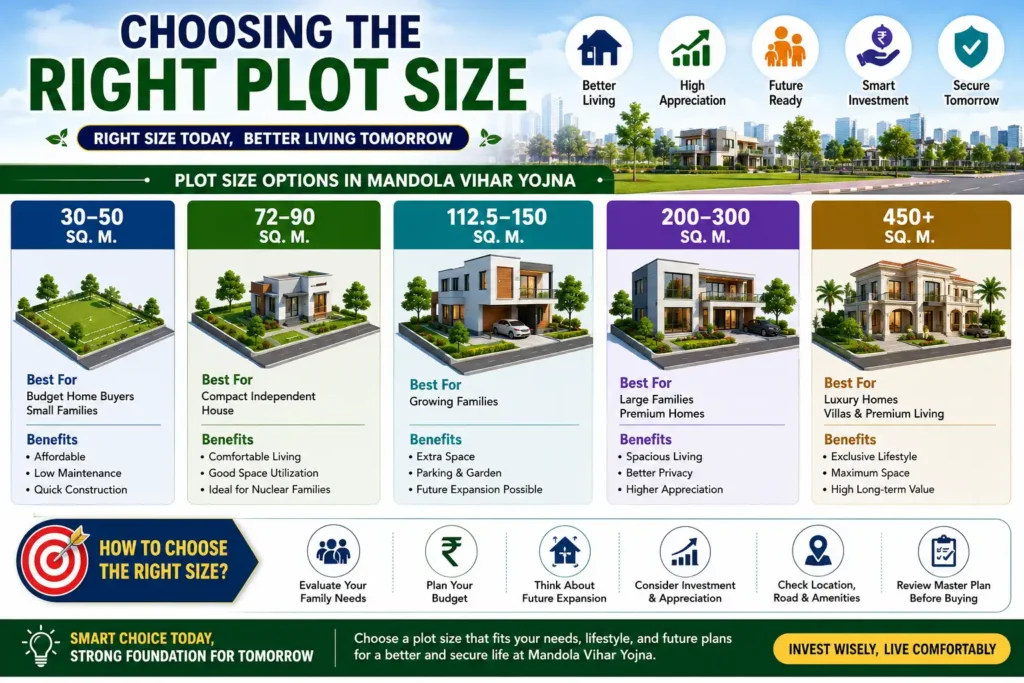
Selecting the right plot depends on your objectives.
Small Plots
Best for:
- First-time buyers
- Budget-conscious families
- Affordable housing
- Rental investment
Advantages:
- Lower investment
- Lower maintenance
- Faster construction
- Easier resale
Medium Plots
Ideal for:
- Growing families
- Independent homes
- Future expansion
Advantages:
- Better space utilization
- Parking
- Garden
- Additional floors
Large Plots
Suitable for:
- Luxury homes
- Villas
- Multi-family houses
- Premium investment
Advantages:
- Higher appreciation potential
- Better architectural flexibility
- Greater privacy
Corner Plots
Corner plots usually receive higher demand because they offer additional benefits.
Advantages include:
- Better ventilation
- More natural light
- Wider frontage
- Easier vehicle access
- Improved visibility
- Higher resale demand
However, they may also carry a premium price compared to regular plots.
Park-Facing Plots
Many buyers specifically look for park-facing plots because they provide:
- Better views
- Open surroundings
- Fresh air
- Reduced congestion
- Higher resale value
- Pleasant living environment
These plots are often preferred by families with children and senior citizens.
Road-Facing Plot Categories
The width of the road adjoining a plot can significantly influence its value.
Plots located on wider roads generally offer:
- Better accessibility
- Easier parking
- Commercial potential (where permitted)
- Higher future appreciation
When selecting a plot, buyers should also evaluate the proposed road network shown in the approved layout plan.
Residential Housing Projects
Apart from residential plots, Mandola Vihar has also seen the development of housing projects offering ready-to-move or under-construction residential units under various schemes.
These projects cater to buyers who prefer apartments instead of constructing an independent house.
Common apartment options may include:
- 1 BHK
- 2 BHK
- 3 BHK
- Multi-bedroom family apartments
Depending on the project, residential units may include:
- Balconies
- Covered parking
- Lifts
- Security systems
- Community facilities
- Landscaped open areas
Apartment projects are particularly suitable for families looking for immediate occupancy.
Semi-Finished Houses
Some government housing schemes introduce semi-finished houses.
These houses provide the structural framework while allowing buyers to customize interiors according to their preferences.
Advantages include:
- Lower initial construction effort
- Faster possession
- Interior customization
- Budget flexibility
- Reduced construction supervision
This option appeals to buyers who want a balance between ready-built homes and self-construction.
Commercial Property Opportunities
Commercial properties within Mandola Vihar provide attractive investment opportunities.
Potential commercial developments include:
- Retail shops
- Office units
- Shopping complexes
- Food outlets
- Service businesses
- Professional offices
Growing residential populations generally increase the demand for commercial establishments, making these properties valuable over time.
Industrial Plot Opportunities
Industrial development contributes significantly to the township’s economic growth.
Industrial plots are suitable for:
- Manufacturing units
- Warehouses
- Packaging businesses
- Logistics companies
- Engineering workshops
- Small factories
- MSME enterprises
Advantages include:
- Planned industrial infrastructure
- Better road connectivity
- Access to nearby markets
- Availability of workforce
- Long-term business growth
Before purchasing an industrial plot, businesses should carefully review the specific eligibility criteria and land-use conditions applicable to that scheme.
Infrastructure Within the Township
Infrastructure quality plays a major role in determining long-term property appreciation.
Mandola Vihar focuses on planned civic development rather than random expansion.
Road Network
Internal roads are designed to improve traffic movement throughout the township.
Benefits include:
- Better connectivity
- Reduced congestion
- Safer transportation
- Easier emergency access
Water Supply
A planned water supply network helps ensure reliable access to clean water for residents.
Drainage System
A proper underground drainage system helps prevent waterlogging during the monsoon season.
Electricity
Well-planned electricity infrastructure supports uninterrupted power distribution across residential and commercial areas.
Street Lighting
Street lighting improves safety while enhancing the overall appearance of the township.
Social Infrastructure
A township becomes attractive only when residents have access to essential services.
Mandola Vihar aims to provide integrated social infrastructure.
Educational Facilities
Residents may have access to:
- Primary schools
- Secondary schools
- Colleges
- Coaching centers
- Vocational institutes
Good educational infrastructure increases demand among families.
Healthcare Facilities
Healthcare services are another essential component of township development.
Nearby healthcare options may include:
- Government hospitals
- Private hospitals
- Clinics
- Diagnostic centers
- Pharmacies
Easy access to healthcare significantly improves residential convenience.
Shopping Facilities
Daily shopping requirements can be fulfilled through:
- Grocery stores
- Supermarkets
- Local markets
- Vegetable markets
- Medical stores
- Convenience shops
Commercial growth usually accelerates as residential occupancy increases.
Recreational Facilities
A healthy lifestyle requires recreational infrastructure.
Possible facilities include:
- Parks
- Walking tracks
- Children’s play areas
- Sports grounds
- Community halls
- Open spaces
These amenities improve the quality of life for residents.
Current Price Trends
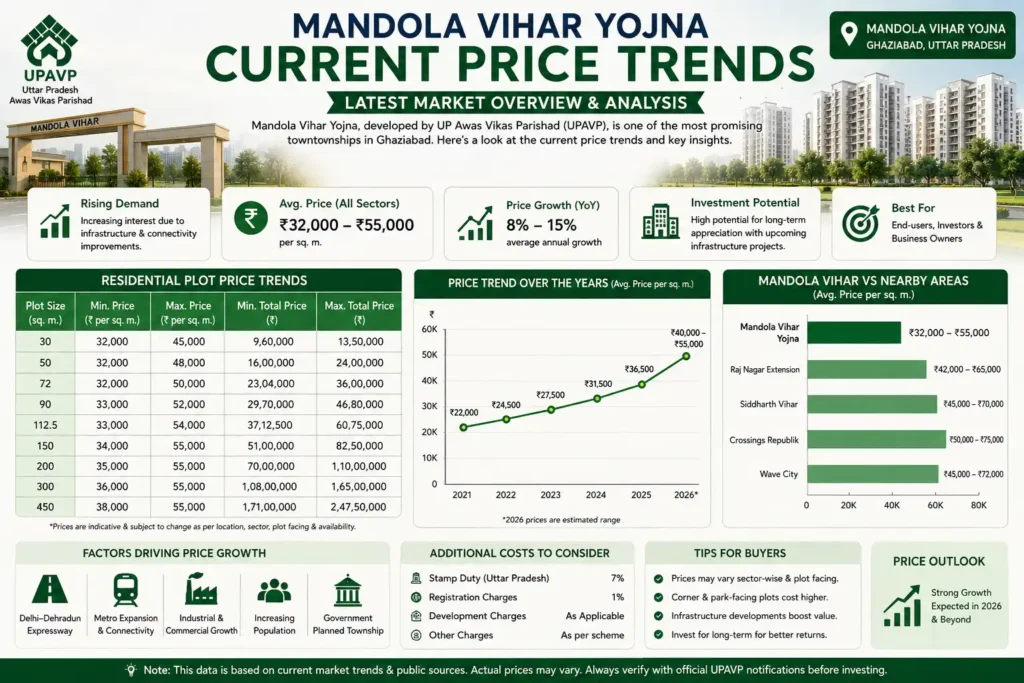
Property prices in Mandola Vihar vary depending on several factors, including:
- Plot size
- Sector location
- Road width
- Corner plot status
- Park-facing location
- Infrastructure development
- Scheme phase
- Market demand
Instead of focusing only on the base plot price, buyers should calculate the complete acquisition cost.
Additional Costs to Consider
Your overall investment may include:
- Registration charges
- Stamp duty
- Documentation fees
- Maintenance charges (if applicable)
- Development charges (where applicable)
- Construction costs (for plots)
- Utility connection charges
Preparing a complete budget helps avoid unexpected expenses after allotment.
Factors That Can Increase Property Value
Several developments can positively influence property appreciation over time.
These include:
- Expansion of expressways
- Improved metro connectivity
- Better public transport
- Commercial growth
- Industrial expansion
- Population growth
- Educational institutions
- Healthcare infrastructure
- Government investment
- Improved civic amenities
Investors should evaluate these long-term factors instead of making decisions based only on short-term price movements.
Is Buying a Plot Better Than Buying a Flat?
Both options have advantages.
| Residential Plot | Apartment |
| Complete design flexibility | Ready to move (project-dependent) |
| Future expansion possible | Minimal construction effort |
| Better long-term customization | Community living |
| Potential for additional rental floors | Shared amenities |
| Construction at your own pace | Faster occupancy |
The better choice depends on your financial goals, budget, and lifestyle requirements.
Eligibility Criteria for Mandola Vihar Yojna
Before applying for any plot, flat, or commercial property under Mandola Vihar Yojna, applicants should carefully review the eligibility conditions mentioned in the official scheme brochure. Eligibility requirements may vary depending on the type of property and the specific scheme launched by Uttar Pradesh Awas Vikas Parishad (UPAVP).
Although each scheme can have its own rules, the following conditions are commonly applicable.
Indian Citizenship
Applicants should generally be Indian citizens. Certain schemes may also permit applications from Non-Resident Indians (NRIs) if allowed under the scheme guidelines and applicable laws.
Minimum Age
The applicant should normally be at least 18 years old on the date of application.
Valid Identity Proof
Applicants should possess valid government-issued identity documents such as:
- Aadhaar Card
- PAN Card
- Passport
- Voter ID
- Driving Licence
Financial Capacity
Applicants should ensure they can meet the payment schedule, including registration amount, installments, and other applicable charges.
One Application Rule
Some schemes may restrict multiple applications under the same category. Applicants should always verify the latest brochure for specific conditions.
Who Can Apply?
Mandola Vihar Yojna is suitable for a wide range of applicants.
Eligible categories may include:
- Salaried employees
- Self-employed professionals
- Business owners
- Retired individuals
- Government employees
- Private sector employees
- NRIs (where permitted)
- MSMEs (for industrial plots)
- Educational institutions (for institutional land, if applicable)
Reservation Policy
Government housing schemes often include reservation provisions for eligible categories according to state government policies.
Reservation may be available for categories such as:
- Scheduled Castes (SC)
- Scheduled Tribes (ST)
- Other Backward Classes (OBC), where applicable
- Economically Weaker Sections (EWS), if specified
- Persons with Disabilities (PwD)
- Ex-servicemen
- Freedom Fighters or their dependents
- Government employees under eligible categories
- Women applicants (in selected schemes)
Reservation percentages and conditions vary from one scheme to another. Applicants should always refer to the latest official notification before applying.
Documents Required
Preparing all required documents in advance helps avoid delays during the application process.
Identity Proof
Any one of the following:
- Aadhaar Card
- Passport
- PAN Card
- Driving Licence
- Voter ID
Address Proof
Applicants may submit:
- Aadhaar Card
- Passport
- Electricity Bill
- Water Bill
- Telephone Bill
- Bank Passbook
- Registered Rent Agreement
PAN Card
A PAN Card is generally required for property transactions and tax-related compliance.
Passport-size Photographs
Recent color photographs should be kept ready in the required format.
Signature
Applicants may need to upload scanned signatures while submitting the online application.
Category Certificate
Applicants claiming reservation benefits should upload the relevant government-issued certificate.
Income Certificate
Certain housing schemes may require proof of income, particularly if benefits are linked to specific income groups.
Bank Account Details
Applicants should provide:
- Bank account number
- IFSC code
- Account holder’s name
This information is useful for refunds, if applicable.
Business Documents (For Industrial Plots)
Applicants seeking industrial plots may also require:
- MSME Registration Certificate
- GST Registration
- Partnership Deed
- Company Incorporation Certificate
- Udyam Registration
- Project Report
- Business Plan
Requirements depend on the industrial scheme.
How to Apply for Mandola Vihar Yojna Online
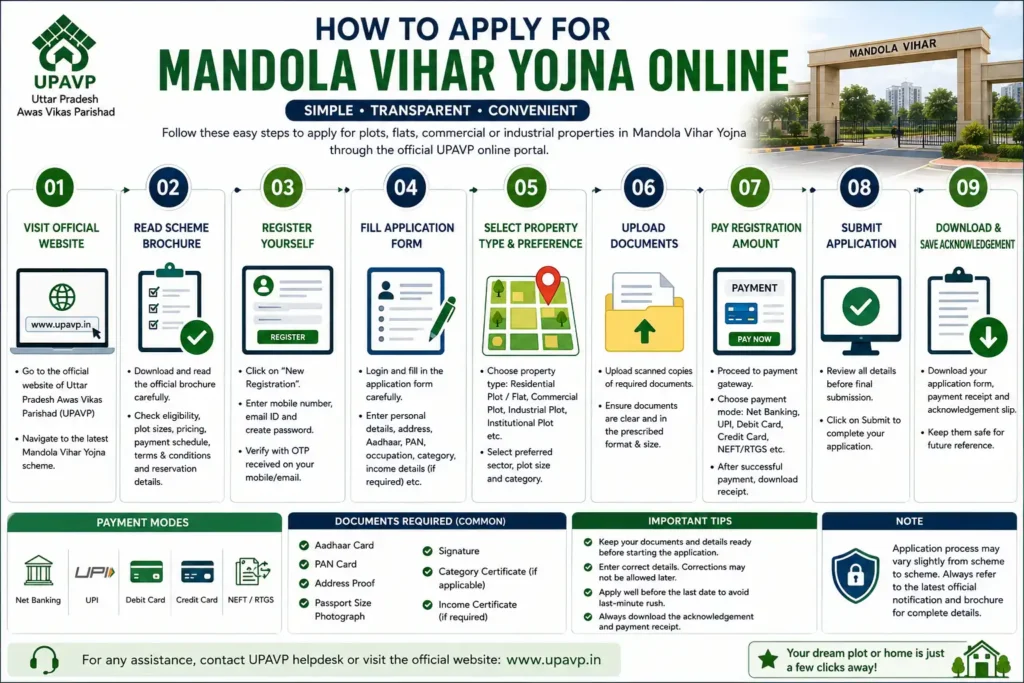
UPAVP regularly accepts applications through its official online portal whenever a new scheme is launched.
The online process is straightforward.
Step 1: Visit the Official Website
Open the official Uttar Pradesh Awas Vikas Parishad portal and navigate to the latest Mandola Vihar scheme.
Step 2: Read the Scheme Brochure
Before registering, download the official brochure and carefully read:
- Eligibility conditions
- Plot sizes
- Pricing
- Payment schedule
- Terms and conditions
- Reservation policy
Skipping this step can lead to mistakes during the application.
Step 3: Register
Create a new account using:
- Mobile number
- Email address
- Password
Verify your account through OTP or email verification, if required.
Step 4: Fill the Application Form
Enter details carefully, including:
- Applicant’s name
- Father’s or spouse’s name
- Date of birth
- Aadhaar number
- PAN number
- Address
- Occupation
- Category
- Income details (if required)
Avoid spelling mistakes because corrections may not always be allowed after submission.
Step 5: Select Property Type
Choose the desired property category.
For example:
- Residential plot
- Residential flat
- Commercial property
- Industrial plot
Also select the preferred plot size, if options are available.
Step 6: Upload Documents
Upload scanned copies of all required documents in the prescribed format.
Ensure that:
- Images are clear
- File size matches portal requirements
- Documents are not expired
Step 7: Pay the Registration Amount
Proceed to the payment gateway.
Payment options generally include:
- Net Banking
- UPI
- Debit Card
- Credit Card
- NEFT
- RTGS (where permitted)
After successful payment, save the transaction receipt.
Step 8: Submit the Application
Review every detail before clicking the final submit button.
After submission, download:
- Application form
- Payment receipt
- Acknowledgement slip
Keep both digital and printed copies for future reference.
Offline Application Process
Some schemes may also allow offline submission.
The process usually involves:
- Purchasing or downloading the application form.
- Filling in all required details.
- Attaching self-attested documents.
- Depositing the registration amount through the approved payment mode.
- Submitting the completed form at the designated UPAVP office.
Applicants should obtain an acknowledgement receipt after submission.
Application Fees
Application fees vary depending on:
- Plot category
- Property type
- Plot size
- Scheme rules
The registration amount is generally adjusted against the total property cost if the applicant receives an allotment. Refund rules for unsuccessful applicants are specified in the scheme brochure.
Payment Schedule
Once a property is allotted, buyers are required to make payments according to the official payment schedule.
A typical payment structure may include:
| Stage | Payment |
|---|---|
| Registration | Initial application amount |
| Allotment | Additional percentage of property cost |
| Installments | Periodic payments as per schedule |
| Final Payment | Balance amount before possession |
| Registration Charges | As applicable |
| Stamp Duty | As per state government rules |
Always review the payment timeline carefully to avoid penalties.
Accepted Payment Modes
Most UPAVP schemes support multiple payment options.
These may include:
- UPI
- Net Banking
- Debit Card
- Credit Card
- Demand Draft (if permitted)
- NEFT
- RTGS
Keep all payment receipts securely until the registration process is complete.
Late Payment Charges
Failure to pay installments on time may result in:
- Interest on delayed payments
- Late payment penalties
- Cancellation of allotment in severe cases
Applicants should monitor payment deadlines carefully.
Allotment Process
The allotment procedure depends on the scheme guidelines.
Depending on demand and scheme conditions, allotment may be carried out through:
Lottery System
If applications exceed available units, a computerized lottery system may be used to ensure fairness.
First Come, First Served
Certain schemes may allot properties on a first-come, first-served basis.
Special Category Allotment
Reserved category applicants are considered according to the applicable reservation policy.
After allotment, successful applicants receive an official allotment letter containing:
- Property details
- Plot number
- Payment schedule
- Terms and conditions
What Happens After Allotment?
Once the allotment letter is issued, the applicant should:
- Verify all property details.
- Pay the required installment within the stipulated time.
- Preserve the allotment letter safely.
- Follow all instructions issued by UPAVP.
Failure to comply with payment deadlines may affect the allotment.
Possession Process
After completing all required payments and fulfilling the conditions of the scheme, possession is offered according to the project’s development status.
The process generally includes:
Site Inspection
Applicants should inspect the allotted property before taking possession.
Check:
- Plot dimensions
- Boundaries
- Road access
- Utility infrastructure
Final Documentation
Complete all legal documentation before accepting possession.
Possession Letter
UPAVP issues a possession letter after all formalities are completed.
Utility Connections
After possession, owners can apply for utility services such as:
- Electricity
- Water supply
- Sewer connection
- Internet services (subject to availability)
Legal Verification Before Buying
Even though Mandola Vihar is a government-developed township, buyers should perform basic legal due diligence.
Verify the Scheme
Ensure the property belongs to the official scheme announced by UPAVP.
Check the Layout Plan
Review the approved layout to understand:
- Road network
- Parks
- Commercial areas
- Public facilities
Verify Property Details
Confirm:
- Plot number
- Plot size
- Sector
- Category
- Boundaries
Review Payment Terms
Understand all charges before making payments.
Keep Copies of All Documents
Maintain a secure file containing:
- Application form
- Payment receipts
- Allotment letter
- Possession letter
- Registration documents
- Correspondence with UPAVP
These records are valuable for future ownership verification and resale.
RERA Status and Why It Matters
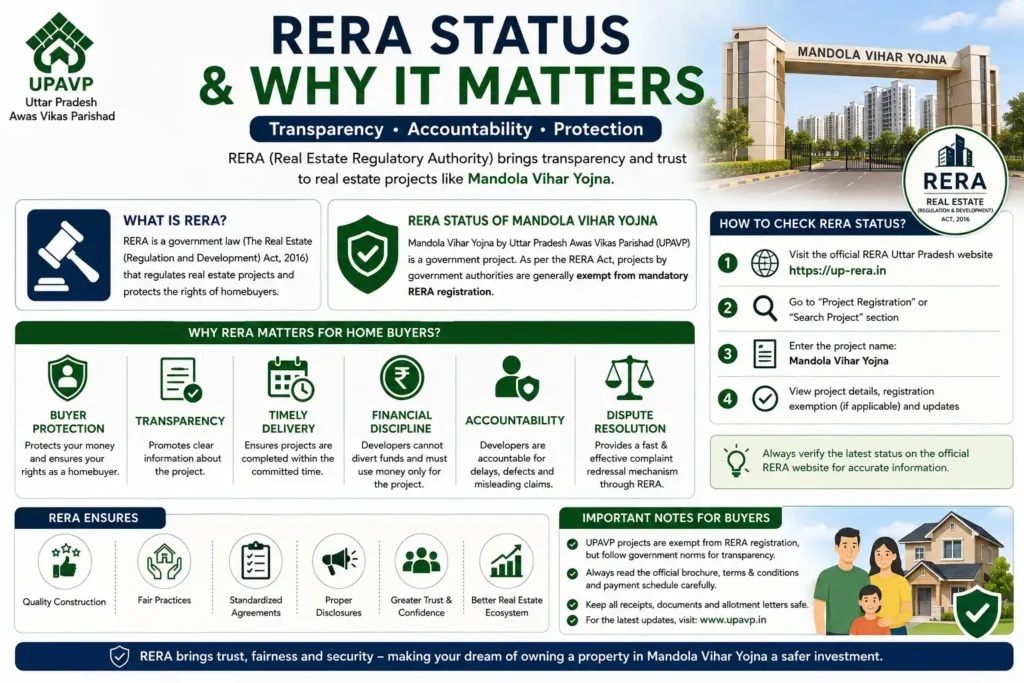
The Real Estate (Regulation and Development) Act, 2016 (RERA) was introduced to improve transparency and protect homebuyers.
For applicable projects, buyers should verify whether the specific phase or housing project is registered with the relevant RERA authority.
Checking the RERA details can help buyers:
- Verify project information
- Review approved timelines
- Understand project status
- Access legally disclosed documents
- Make informed investment decisions
If a particular project falls under RERA, always note its registration number from the official records before investing.
Common Mistakes to Avoid During Application
Many applicants lose valuable time because of simple mistakes.
Avoid the following:
- Filling incorrect personal details.
- Uploading unclear documents.
- Missing payment deadlines.
- Applying under the wrong category.
- Ignoring the official brochure.
- Entering an incorrect mobile number or email address.
- Forgetting to download the acknowledgement receipt.
- Assuming every plot size is available in every phase.
- Not checking the exact location of the allotted plot.
- Relying only on unofficial property advertisements.
Careful preparation can make the application process smoother and reduce the chances of unnecessary delays.
Investment Analysis of Mandola Vihar Yojna
Buying property is one of the biggest financial decisions for most families. Before investing in any residential or commercial project, it is important to evaluate its long-term growth potential rather than focusing only on the current price.
Mandola Vihar Yojna has attracted both homebuyers and investors because it combines government-backed planning with a strategic location in the National Capital Region (NCR). However, like any real estate investment, buyers should carefully assess both the opportunities and the risks.
Why Investors are Interested in Mandola Vihar Yojna
Several factors make this township attractive for long-term investment.
Strategic NCR Location
The township is located in Ghaziabad, close to Delhi and Loni. This location allows residents to access major employment hubs in:
- Delhi
- Ghaziabad
- Noida
- Sahibabad
- Tronica City
Properties located near employment centers often experience stronger long-term demand.
Government Development Authority
Properties developed by Uttar Pradesh Awas Vikas Parishad generally receive greater confidence among buyers because of planned development and transparent allotment procedures.
Government-developed townships usually include:
- Planned roads
- Public parks
- Water supply
- Sewerage system
- Electricity infrastructure
- Community facilities
Such infrastructure contributes to long-term livability.
Planned Township Development
Unlike many unauthorized colonies, Mandola Vihar follows a structured master plan.
A planned township generally offers:
- Better traffic management
- Organized commercial areas
- Educational institutions
- Healthcare facilities
- Recreational spaces
- Better resale value
Factors That May Drive Future Property Appreciation
Property prices depend on multiple factors rather than a single event.
Some important growth drivers include:
Infrastructure Development
Infrastructure remains one of the strongest drivers of real estate appreciation.
Major improvements include:
- Wider roads
- Better internal connectivity
- Flyovers
- Public transportation
- Improved civic infrastructure
Delhi–Dehradun Expressway
One of the biggest infrastructure projects influencing nearby real estate is the Delhi–Dehradun Expressway.
Potential benefits include:
- Faster travel between Delhi and surrounding regions
- Reduced traffic congestion
- Improved business connectivity
- Increased residential demand
- Better commercial opportunities
Properties located near major expressways often witness improved accessibility, which can positively influence demand over time. However, the extent of appreciation depends on overall market conditions, infrastructure completion, and local development.
Eastern Peripheral Expressway
Improved connectivity through the Eastern Peripheral Expressway also strengthens the township’s accessibility.
Benefits may include:
- Reduced heavy traffic
- Better logistics
- Improved freight movement
- Faster regional connectivity
Metro Expansion
Expansion of metro connectivity in NCR improves convenience for daily commuters.
Good public transport generally attracts:
- Working professionals
- Students
- Families
- Businesses
This can support long-term residential demand.
Employment Growth
Real estate performs better where employment opportunities continue to grow.
Mandola Vihar benefits from proximity to several industrial and commercial zones.
Nearby employment centers include:
- Tronica City
- Sahibabad Industrial Area
- Ghaziabad Industrial Belt
- Delhi Business Districts
- Noida IT Parks
A larger workforce often increases demand for both owned and rental housing.
Population Growth
The Delhi-NCR region continues to experience population growth due to urbanization and employment opportunities.
As cities expand, demand for planned housing projects also increases.
This long-term trend may support the value of well-planned townships like Mandola Vihar.
Rental Potential
Many investors purchase plots or apartments not only for appreciation but also for rental income.
Rental demand depends on:
- Employment opportunities
- Public transport
- Schools
- Hospitals
- Commercial development
- Connectivity
As infrastructure develops and occupancy increases, rental demand may improve over time.
Independent houses built on residential plots may also generate rental income through multiple floors, subject to local building regulations.
Residential Demand
Several buyer categories may be interested in Mandola Vihar.
These include:
- Young professionals
- Government employees
- Private sector employees
- Small business owners
- Families
- Retired individuals
A diversified buyer base generally supports stable long-term demand.
Commercial Investment Opportunities
Commercial properties often benefit from increasing residential occupancy.
Businesses that typically perform well in developing townships include:
- Grocery stores
- Medical shops
- Restaurants
- Banks
- Coaching centers
- Clinics
- Retail stores
- Service centers
As more residents move into the township, commercial demand generally increases.
Industrial Investment Potential
Industrial plots can be attractive for businesses seeking planned industrial infrastructure.
Potential users include:
- Manufacturing units
- Warehousing
- Packaging industries
- Engineering workshops
- Logistics companies
Industrial development also creates employment, which indirectly supports residential demand.
Property Appreciation Factors
The following factors may positively influence long-term property values.
| Growth Driver | Possible Impact |
|---|---|
| Expressway connectivity | Better accessibility |
| Metro expansion | Improved commuting |
| Commercial development | Higher demand |
| Industrial growth | Employment generation |
| Better schools | Family demand |
| Healthcare facilities | Improved livability |
| Government infrastructure | Long-term appreciation |
| Planned township | Better resale value |
Risks Every Buyer Should Understand
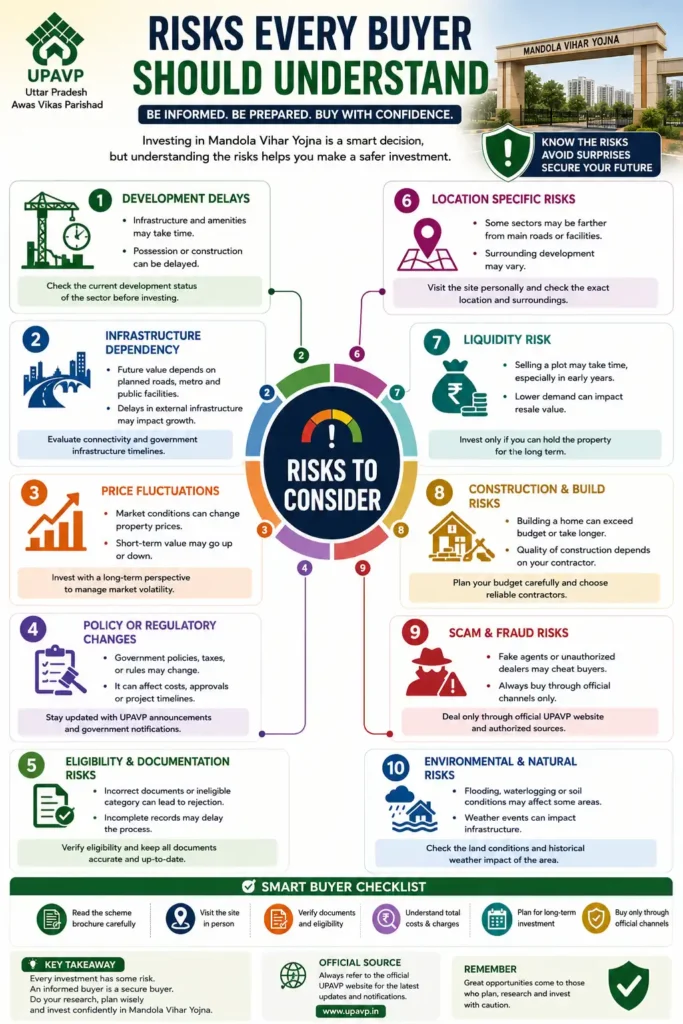
Every real estate investment carries certain risks.
Understanding these risks helps buyers make informed decisions.
Project Timeline
Large township developments are often completed in phases.
Infrastructure in some sectors may become operational earlier than others.
Market Cycles
Real estate prices do not always move upward.
They can be influenced by:
- Interest rates
- Economic conditions
- Housing demand
- Government policies
- Local supply
Investors should adopt a long-term perspective.
Liquidity
Real estate is generally less liquid than stocks or mutual funds.
Selling property may require time depending on market conditions.
Construction Costs
For residential plots, buyers should also budget for future construction costs.
These may include:
- Building materials
- Labour
- Architectural services
- Government approvals
- Utility connections
SWOT Analysis of Mandola Vihar Yojna
| Strengths | Weaknesses |
| Government-backed project | Development is phased |
| Planned township | Infrastructure completion may vary by sector |
| Delhi-NCR connectivity | Construction required for plot buyers |
| Multiple property options | Real estate requires long-term investment |
| Industrial and commercial zones | Market conditions affect prices |
| Opportunities | Threats |
| Expressway connectivity | Economic slowdown |
| Urban expansion | Regulatory changes |
| Population growth | Competition from nearby townships |
| Industrial development | Rising construction costs |
| Rental demand | Interest rate fluctuations |
Who Should Invest?
First-Time Home Buyers
Suitable for buyers planning to build their own home over the next few years.
Long-Term Investors
Investors with a time horizon of seven to fifteen years may benefit from infrastructure-led growth.
Families
Families looking for spacious independent homes rather than apartments may find residential plots attractive.
Business Owners
Industrial and commercial opportunities may suit entrepreneurs seeking business expansion.
Retired Individuals
Those looking for a peaceful residential environment with planned infrastructure may also consider the township after evaluating healthcare and daily convenience facilities.
Who Should Avoid Buying Immediately?
The project may not suit everyone.
Consider waiting if:
- You need immediate possession.
- You have a very short investment horizon.
- Your budget does not include future construction costs.
- You prefer fully developed ready-to-move neighborhoods.
Mandola Vihar vs Other Ghaziabad Townships
| Feature | Mandola Vihar | Siddharth Vihar | Raj Nagar Extension | Wave City | Crossings Republik |
| Government Development | Yes | Mostly Private | Mostly Private | Private | Private |
| Residential Plots | Available in schemes | Limited | Limited | Limited | Limited |
| Apartments | Yes | Yes | Yes | Yes | Yes |
| Commercial Development | Planned | Developed | Developed | Developing | Developed |
| Industrial Connectivity | Strong | Moderate | Moderate | Moderate | Moderate |
| Delhi Connectivity | Good | Excellent | Good | Good | Good |
| Long-Term Growth Potential | High | High | High | Moderate to High | Moderate |
Each township has its own advantages. Buyers should compare pricing, location, infrastructure, and future development before making a final decision.
Advantages of Mandola Vihar Yojna
Some of the major benefits include:
- Government-developed township.
- Planned infrastructure.
- Multiple property options.
- Residential and commercial development.
- Industrial opportunities.
- Wide roads.
- Green spaces.
- Delhi-NCR connectivity.
- Expressway access.
- Future infrastructure projects.
- Better long-term planning.
- Potential appreciation.
- Scope for custom home construction.
- Family-friendly environment.
- Growing commercial ecosystem.
Limitations of Mandola Vihar Yojna
Balanced investment decisions require understanding both advantages and limitations.
Some considerations include:
- Different sectors may progress at different speeds.
- Buyers of plots must arrange construction separately.
- Property prices can fluctuate with market conditions.
- Infrastructure development takes time.
- Construction costs may increase over the years.
- Immediate rental income may not be available in newly developing areas.
Expert Tips Before Buying
Follow these practical tips before making your investment.
- Read the latest official scheme brochure carefully.
- Verify the exact location of the plot.
- Review the approved layout plan.
- Understand all payment terms.
- Calculate your total investment, including registration and construction costs.
- Verify applicable RERA details for the specific project, where relevant.
- Visit the site personally before making a decision.
- Compare nearby property prices.
- Consider future infrastructure projects.
- Keep copies of every payment receipt.
- Check road width and plot orientation.
- Review utility infrastructure.
- Understand possession timelines.
- Avoid relying only on unofficial advertisements.
- Plan your investment with a long-term perspective.
Is Mandola Vihar Yojna Worth Investing in 2026?
For buyers seeking a government-planned township in the Delhi-NCR region, Mandola Vihar presents a compelling long-term opportunity. Its location, planned infrastructure, residential and commercial mix, and improving regional connectivity make it attractive for both end-users and investors.
However, investment decisions should always be based on your financial goals, budget, intended holding period, and careful verification of the latest scheme details. Real estate values are influenced by infrastructure progress, market demand, regulatory changes, and broader economic conditions, so no appreciation or returns can be guaranteed.
Frequently Asked Questions (FAQs)
1. What is Mandola Vihar Yojna?
Mandola Vihar Yojna is a planned township developed by the Uttar Pradesh Awas Vikas Parishad (UPAVP) in Ghaziabad. It includes residential, commercial, institutional, and industrial developments across multiple phases.
2. Where is Mandola Vihar Yojna located?
The township is located in Ghaziabad district, Uttar Pradesh, near the Delhi border and Loni area, offering good connectivity to Delhi and other NCR cities.
3. Who developed Mandola Vihar Yojna?
The project is developed by Uttar Pradesh Awas Vikas Parishad (UPAVP), a government housing authority.
4. Can I apply online for Mandola Vihar Yojna?
Yes. Whenever a new scheme is launched, applications can usually be submitted through the official UPAVP online portal.
5. What types of properties are available?
Depending on the scheme, properties may include:
- Residential plots
- Residential flats
- Commercial plots
- Industrial plots
- Institutional plots
6. Are different plot sizes available?
Yes. Plot sizes vary from scheme to scheme and are announced in the official brochure.
7. Is Mandola Vihar suitable for investment?
Many investors consider it attractive because of its planned infrastructure, government backing, and proximity to Delhi. However, investment decisions should always be based on your own financial goals and current market conditions.
8. Is the township suitable for end users?
Yes. Families looking to build an independent home may find it suitable because of the planned infrastructure and future development.
9. Is there metro connectivity?
Nearby metro connectivity is available through the NCR transport network, and accessibility continues to improve with regional infrastructure projects.
10. Is Mandola Vihar close to Delhi?
Yes. One of the major advantages of the township is its location near the Delhi border.
11. Does the township include commercial areas?
Yes. The master plan includes commercial zones for shops, offices, and daily convenience businesses.
12. Are industrial plots available?
Industrial plots are offered under selected schemes and are generally intended for eligible businesses, subject to scheme conditions.
13. Can NRIs invest?
NRIs should review the latest scheme guidelines and applicable regulations before applying.
14. Is it a freehold property?
The ownership structure depends on the specific scheme. Buyers should verify the terms in the official allotment documents.
15. Can I build my own house?
Yes. Buyers of residential plots can construct their house in accordance with the applicable building rules and approvals.
16. Is financing available?
Many banks and housing finance companies provide home loans or plot loans, subject to their eligibility criteria and project approval status.
17. What documents are required?
Common documents include Aadhaar Card, PAN Card, address proof, photographs, and category certificates (where applicable).
18. How is the allotment done?
The allotment process depends on the scheme and may be through a lottery system or a first-come, first-served basis, as specified in the official notification.
19. Is Mandola Vihar a good place for families?
The township is planned with residential areas, parks, schools, healthcare facilities, and commercial spaces, making it suitable for family living.
20. Should I visit the site before buying?
Yes. A physical site visit is highly recommended to understand the surroundings, road network, and stage of development.
Common Buyer Mistakes
Avoid these mistakes before purchasing a property:
- Buying based only on social media posts.
- Ignoring the official scheme brochure.
- Not verifying the exact plot location.
- Underestimating construction costs.
- Forgetting to include stamp duty and registration expenses in the budget.
- Not checking surrounding infrastructure.
- Assuming every sector is at the same stage of development.
- Investing without a long-term plan.
- Relying on verbal assurances from unauthorized brokers.
- Failing to keep copies of payment receipts and allotment documents.
Expert Checklist Before Applying
Use this checklist before submitting your application.
☐ Read the official brochure carefully.
☐ Verify eligibility.
☐ Decide your budget.
☐ Select the appropriate plot size.
☐ Compare available sectors.
☐ Understand the payment schedule.
☐ Keep all required documents ready.
☐ Verify applicable RERA details.
☐ Visit the site personally.
☐ Save every receipt and acknowledgement.
Final Verdict
Mandola Vihar Yojna is one of the most significant planned township developments by the Uttar Pradesh Awas Vikas Parishad in the Ghaziabad region. Its strategic location near Delhi, planned infrastructure, and integrated residential, commercial, and industrial development make it an attractive option for both homebuyers and long-term investors.
The township offers several strengths, including government-backed planning, expanding connectivity, and access to major employment hubs. Buyers looking to construct an independent home may appreciate the flexibility of residential plots, while businesses may benefit from the industrial and commercial opportunities available under different schemes.
At the same time, buyers should remember that large township projects are developed in phases. Infrastructure, amenities, and occupancy levels may differ across sectors, and construction timelines can vary. Conducting proper due diligence, reviewing the latest official scheme details, and evaluating your financial goals are essential steps before making any investment decision.
If your objective is long-term wealth creation, planned urban living, or building a future home in the Delhi-NCR region, Mandola Vihar Yojna deserves careful consideration. However, always rely on the latest official notifications and consult a qualified legal or financial professional where necessary.
Key Takeaways
- Government-developed integrated township.
- Located in Ghaziabad near the Delhi border.
- Residential, commercial, institutional, and industrial development.
- Multiple plot categories and housing options.
- Good connectivity through major roads and regional infrastructure.
- Suitable for homebuyers, investors, and eligible businesses.
- Long-term growth depends on infrastructure progress and market conditions.
- Always verify the latest scheme details before applying.