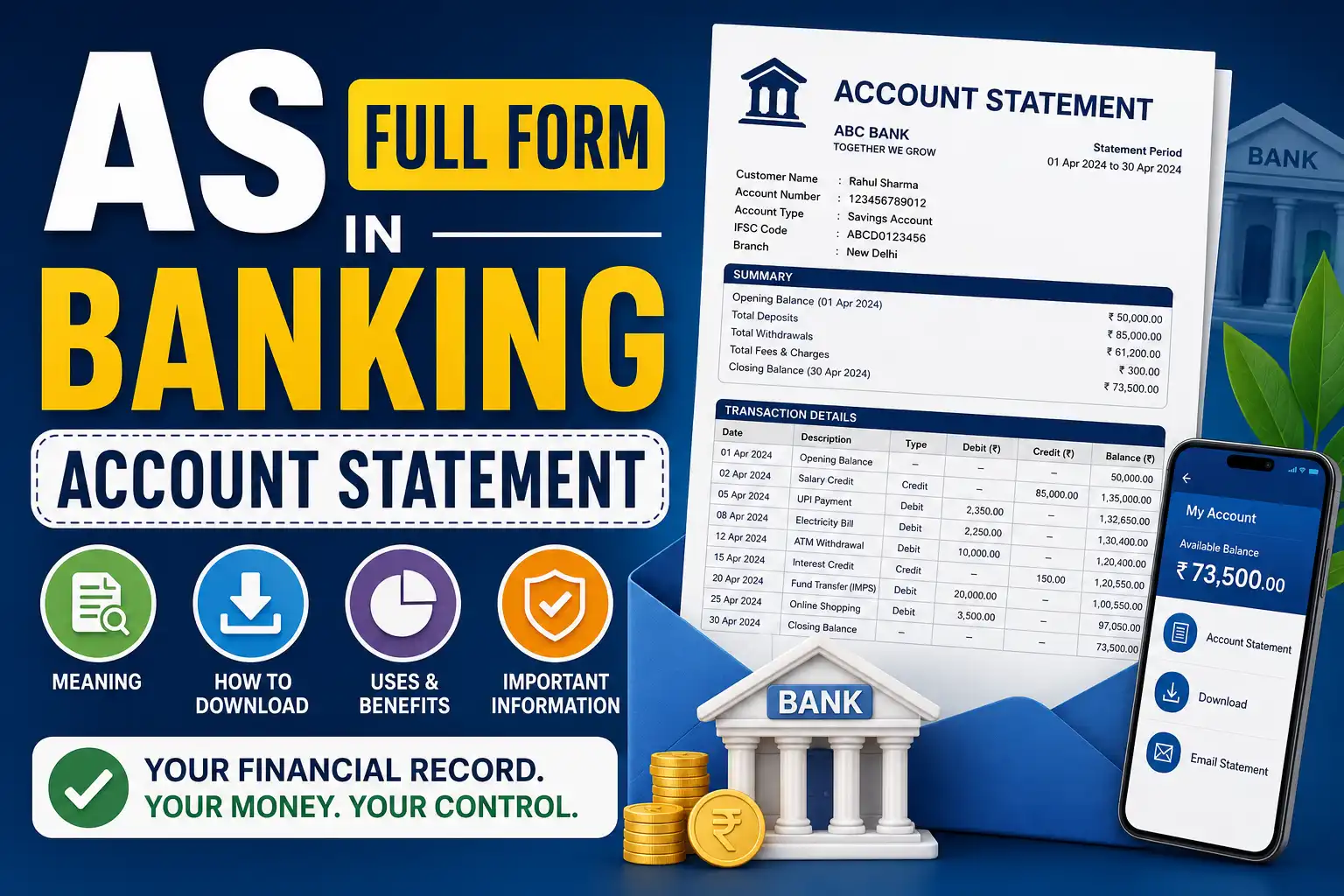
If you have ever checked your bank account online, applied for a loan, filed an income tax return, or downloaded your transaction history, you may have come across the term AS. Many people search online for the AS full form in banking because they want to understand what it means, why banks use it, and how it affects their financial activities.
In banking, AS commonly stands for Account Statement. It is one of the most important financial documents issued by banks. An account statement provides a detailed summary of every transaction made in your bank account during a selected period. Whether money is deposited, withdrawn, transferred, or credited as interest, every activity is recorded in the statement.
An account statement is much more than just a list of transactions. It acts as proof of your financial history and is widely accepted for loan applications, visa processing, tax filing, business accounting, investment tracking, and financial planning. Regularly reviewing your account statement also helps identify unauthorized transactions, unnecessary bank charges, and spending habits.
Although many websites simply mention that AS stands for Account Statement, they often fail to explain its real-world importance. This comprehensive guide goes far beyond the definition. You will learn what an account statement is, why it matters, the information it contains, different types of statements, how to download one, common banking abbreviations found in statements, security tips, practical examples, and answers to frequently asked questions.
Whether you are a student opening your first savings account, a salaried employee managing monthly expenses, a business owner reconciling accounts, or an investor tracking financial transactions, understanding the AS full form in banking will help you manage your money more confidently.
AS Full Form in Banking – Quick Answer
AS Full Form in Banking: AS stands for Account Statement.
An Account Statement is an official document issued by a bank that contains a complete record of all transactions carried out in a customer’s bank account during a specified period. It includes deposits, withdrawals, fund transfers, interest credits, service charges, debit card purchases, UPI payments, ATM withdrawals, and the available account balance.
Banks allow customers to receive account statements in printed form or download them digitally through internet banking and mobile banking applications.
Quick Definition:
AS = Account Statement, an official banking document that records every financial transaction in your account and serves as proof of your banking history.
Quick Facts About AS in Banking
| Feature | Details |
|---|---|
| Full Form | Account Statement |
| Category | Banking |
| Issued By | Banks and Financial Institutions |
| Purpose | Record of all account transactions |
| Available Formats | PDF, Printed Copy, Excel, CSV (selected banks) |
| Available Through | Internet Banking, Mobile Banking, Branch, Email |
| Used For | Loan Applications, Tax Filing, Visa Processing, Expense Tracking |
| Frequency | Monthly, Quarterly, Yearly, or Custom Period |
| Legal Validity | Accepted as an official banking document in many financial processes |
Different Meanings of AS
The abbreviation AS can have different meanings depending on the industry or context. Understanding these meanings helps avoid confusion, especially when searching online.
| Industry | AS Full Form |
| Banking | Account Statement |
| Accounting | Accounting Standard |
| Education | Assistant Secretary |
| Medical | Ankylosing Spondylitis |
| Networking | Autonomous System |
| Business | Administrative Services |
For banking-related discussions, AS almost always refers to an Account Statement. Throughout this guide, we will focus on its banking meaning.
What Is an Account Statement?
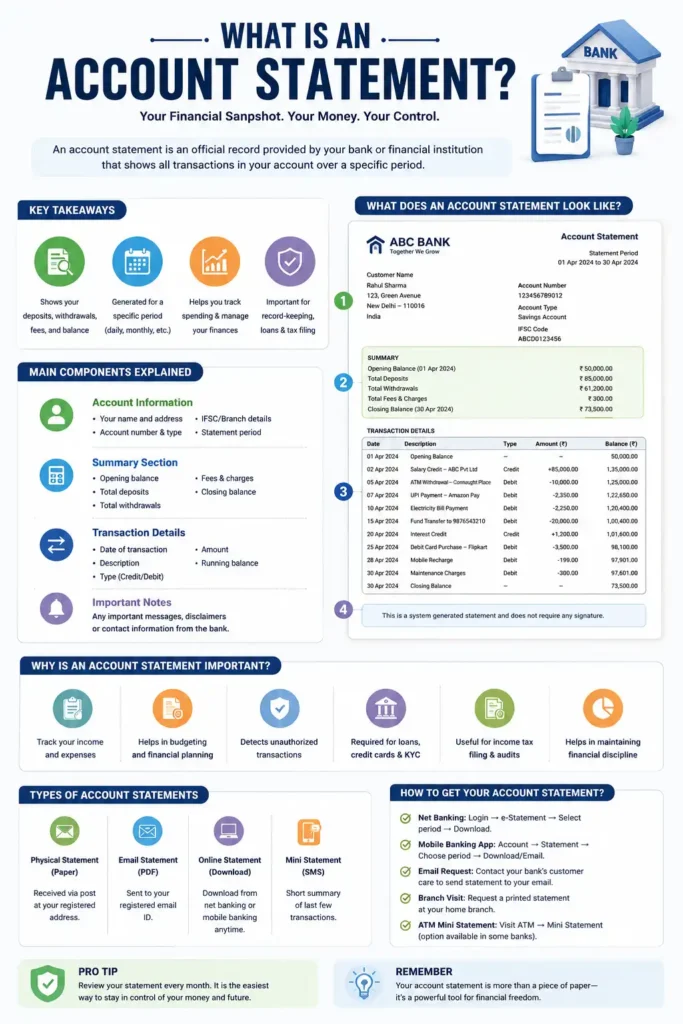
An Account Statement is an official record generated by a bank that provides a detailed summary of all financial activities in a customer’s account over a selected period.
Every transaction performed through your account is recorded automatically by the bank’s core banking system. These transactions are then organized in chronological order and presented in the account statement.
For example, if your salary is credited on the 1st of every month, you pay your electricity bill through UPI, withdraw cash from an ATM, transfer money using NEFT, and receive interest from your bank, all these activities will appear in your account statement.
Think of an account statement as your personal financial diary maintained by the bank. Instead of remembering every payment or deposit, you can simply review your statement to understand where your money came from and where it was spent.
Modern banks provide both physical and electronic statements, allowing customers to access their financial records anytime.
Why Do Banks Issue Account Statements?
Banks issue account statements for several important reasons. They help customers stay informed about their finances while maintaining transparency in banking operations.
Some of the major purposes include:
- Providing a complete record of all transactions.
- Helping customers verify account balances.
- Allowing users to detect unauthorized transactions.
- Supporting tax filing and financial planning.
- Serving as proof of banking history.
- Assisting banks during loan verification.
- Improving transparency between banks and customers.
Without account statements, customers would find it difficult to track financial activities accurately.
Why Is an Account Statement Important?
Many people only check their account balance without reviewing their account statement. However, doing so means missing valuable financial information.
Here are some of the key reasons why account statements are important.
1. Helps Track Income and Expenses
Your account statement shows every credit and debit made during the selected period.
By reviewing it regularly, you can answer questions like:
- How much salary did I receive?
- How much did I spend on shopping?
- How much money did I save?
- Which subscriptions are automatically deducted every month?
This information helps improve budgeting and financial planning.
2. Required for Loan Applications
When you apply for a home loan, personal loan, business loan, or vehicle loan, lenders usually ask for your previous six months’ account statements.
Banks analyze these statements to evaluate:
- Monthly income
- Spending habits
- Existing liabilities
- Financial discipline
- Repayment capacity
A healthy account statement can increase the chances of loan approval.
3. Useful During Income Tax Filing
Account statements make tax filing much easier because they provide a clear record of:
- Salary credits
- Interest income
- Business receipts
- Investment-related transactions
- Tax payments
Instead of searching through multiple payment receipts, taxpayers can use their statements to verify financial information.
4. Detects Fraud Quickly
Cyber fraud and unauthorized banking transactions have become more common in recent years.
Regularly checking your account statement helps identify:
- Unauthorized ATM withdrawals
- Unknown UPI payments
- Duplicate debit card transactions
- Suspicious online purchases
- Incorrect bank charges
Early detection allows customers to report fraud immediately.
5. Helps Manage Personal Finances
Financial experts recommend reviewing your account statement every month.
Doing so helps identify:
- Unnecessary expenses
- Recurring subscriptions
- High shopping costs
- Increasing savings
- Monthly cash flow
Small improvements based on statement analysis can lead to significant long-term savings.
6. Acts as Financial Proof
Account statements are accepted as supporting financial documents in many situations.
These include:
- Visa applications
- Scholarship applications
- Rental agreements
- Business audits
- Financial planning
- Investment verification
- Insurance claim processes
Because statements are issued directly by banks, they are considered reliable evidence of financial activity.
Real-Life Example of an Account Statement
Let’s understand the importance of an account statement with a simple example.
Rahul, a software engineer, receives a monthly salary of ₹75,000 directly into his savings account. Throughout the month, he pays rent through UPI, shops online using his debit card, withdraws cash from an ATM, and invests in mutual funds through automatic bank transfers.
At the end of the month, Rahul downloads his account statement. The statement clearly shows:
- Salary credited on the 1st.
- Rent payment made on the 3rd.
- Electricity bill paid through UPI.
- Grocery purchases.
- ATM cash withdrawal.
- SIP investment deduction.
- Interest credited by the bank.
- Final account balance.
A few months later, Rahul applies for a home loan. The bank asks for his last six months of account statements to verify his income and spending pattern. Since his statements are well maintained and show regular salary credits and responsible financial behavior, his loan application is processed smoothly.
This example demonstrates why an account statement is much more than just a transaction history—it serves as a trusted financial record.
Types of Account Statements
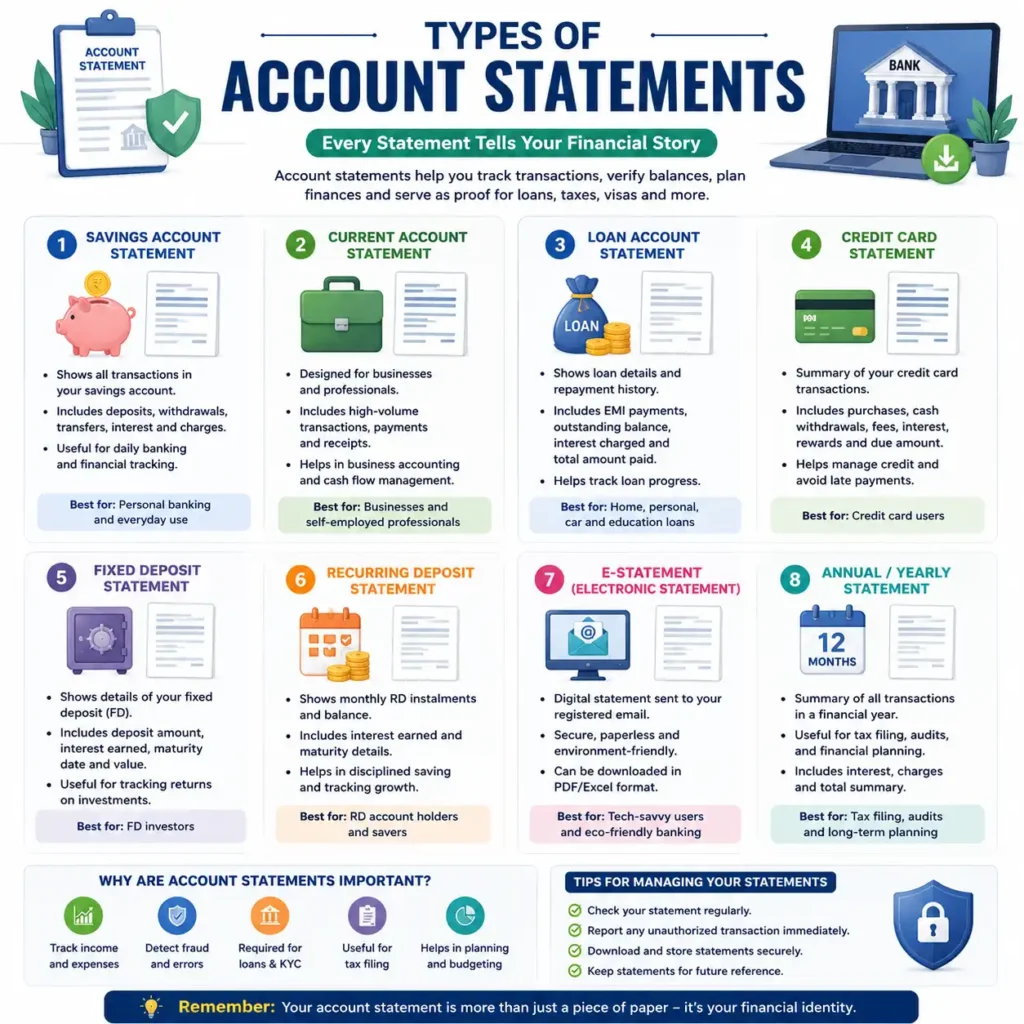
Banks provide different types of account statements depending on the account and customer requirements.
Monthly Account Statement
This is the most common type of statement. It summarizes all transactions carried out during a calendar month and helps customers monitor their monthly finances.
Quarterly Account Statement
Some banks provide statements every three months, especially for specific account categories or corporate customers.
Annual Account Statement
An annual statement summarizes transactions made during the entire financial year. It is particularly useful for tax planning and long-term financial review.
Savings Account Statement
This statement includes all deposits, withdrawals, UPI payments, ATM transactions, interest credits, and charges related to a savings account.
Current Account Statement
Businesses and professionals often use current account statements to manage daily business transactions, supplier payments, customer receipts, and cash flow.
Loan Account Statement
A loan statement records every EMI paid, outstanding balance, interest charged, principal repaid, and remaining tenure.
Credit Card Statement
Although different from a bank account statement, a credit card statement records purchases, cash withdrawals, reward points, billing dates, minimum due amounts, and payment history.
E-Statement
An e-statement is the digital version of a bank statement. It is usually delivered via email or downloaded through internet or mobile banking. E-statements are environmentally friendly, easy to store, and accepted for most official purposes.
Complete Structure of an Account Statement
Although the design of an account statement may vary slightly from one bank to another, the information included remains almost the same. Understanding each section helps you interpret your financial records accurately.
Below is a detailed explanation of every component found in a typical bank account statement.
| Section | Description | Why It Matters |
|---|---|---|
| Customer Name | Name of the account holder | Confirms ownership |
| Account Number | Unique account identification | Used for verification |
| Customer ID/CIF | Bank customer identification number | Required for banking services |
| Branch Name | Home branch where the account is maintained | Useful for official communication |
| IFSC Code | Branch identification code | Required for online fund transfers |
| Statement Period | Duration covered by the statement | Helps track transactions |
| Opening Balance | Balance at the beginning of the period | Starting point of financial records |
| Transaction Date | Date when transaction occurred | Helps identify transaction timing |
| Value Date | Date when amount was credited or debited | Important for interest calculation |
| Description/Narration | Details about the transaction | Identifies transaction type |
| Debit Amount | Money deducted from the account | Shows expenses |
| Credit Amount | Money received in the account | Shows income |
| Running Balance | Updated balance after each transaction | Tracks available funds |
| Closing Balance | Balance at the end of the statement | Current account status |
Understanding Every Column in an Account Statement
Account Holder Name
This is the registered name of the customer. Always verify it before sharing your statement for official purposes.
Account Number
The account number identifies your bank account. When sharing statements publicly or with third parties, consider masking some digits unless the complete number is required.
Statement Period
This shows the start and end dates covered by the statement.
Example:
- 1 January 2026 to 31 January 2026
- 1 April 2025 to 31 March 2026
Transaction Date
This is the date on which the transaction actually took place.
Value Date
Some transactions are processed on one day but become effective on another. The value date helps determine when the amount is officially credited or debited.
Transaction Narration
This section explains the nature of the transaction.
Examples include:
- Salary Credit
- UPI Payment
- ATM Withdrawal
- IMPS Transfer
- Interest Credit
- Debit Card Purchase
- Electricity Bill Payment
Debit Column
Whenever money leaves your account, the amount appears in the Debit column.
Examples:
- Shopping
- Utility bills
- Cash withdrawals
- Loan EMI
- Insurance premium
Credit Column
Whenever money is received, it appears under Credit.
Examples:
- Salary
- Refunds
- Interest
- Cash deposit
- Investment redemption
Running Balance
The running balance updates after every transaction and helps customers know exactly how much money remains in the account.
Sample Bank Statement
| Date | Description | Debit (₹) | Credit (₹) | Balance (₹) |
| 01 Jan | Opening Balance | — | — | 25,000 |
| 02 Jan | Salary Credit | — | 75,000 | 1,00,000 |
| 04 Jan | UPI Grocery | 2,150 | — | 97,850 |
| 08 Jan | ATM Withdrawal | 10,000 | — | 87,850 |
| 12 Jan | Electricity Bill | 2,450 | — | 85,400 |
| 15 Jan | Interest Credit | — | 125 | 85,525 |
| 20 Jan | SIP Investment | 5,000 | — | 80,525 |
This format makes it easy to understand how money moves in and out of an account.
Common Banking Transaction Codes Found in Account Statements
One of the biggest reasons people search banking abbreviations is because these short codes appear in account statements. Understanding them helps you read your statement confidently.
| Abbreviation | Full Form | Meaning |
| CR | Credit | Money received |
| DR | Debit | Money deducted |
| UPI | Unified Payments Interface | Instant digital payment |
| IMPS | Immediate Payment Service | Instant bank transfer |
| NEFT | National Electronic Funds Transfer | Electronic fund transfer |
| RTGS | Real Time Gross Settlement | High-value instant transfer |
| ATM | Automated Teller Machine | Cash withdrawal or banking service |
| POS | Point of Sale | Card payment at a merchant |
| ECS | Electronic Clearing Service | Automatic payments |
| NACH | National Automated Clearing House | Bulk recurring payments |
| ACH | Automated Clearing House | Electronic debit or credit |
| SI | Standing Instruction | Scheduled automatic payment |
| INT | Interest | Interest credited by the bank |
| CHG | Charges | Service charges deducted |
| REV | Reversal | Reversed transaction |
| GST | Goods and Services Tax | Tax charged on banking services |
| DD | Demand Draft | Offline banking instrument |
| FD | Fixed Deposit | Deposit transaction |
| RD | Recurring Deposit | Monthly savings deposit |
| EMI | Equated Monthly Installment | Loan repayment |
| CASH DEP | Cash Deposit | Cash added to account |
| CASH WDL | Cash Withdrawal | Cash withdrawn |
| BBPS | Bharat Bill Payment System | Utility bill payment |
| QR | Quick Response Payment | QR code transaction |
| SWIFT | Society for Worldwide Interbank Financial Telecommunication | International money transfer |
How to Download an Account Statement
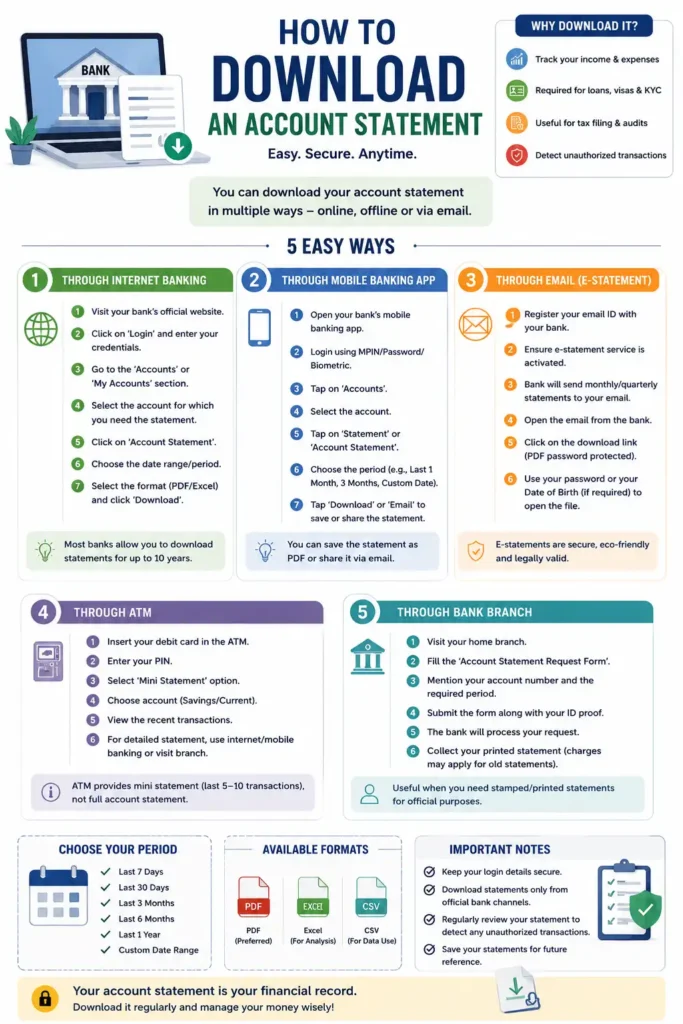
Modern banking has made downloading statements extremely simple.
Through Internet Banking
- Visit your bank’s official website.
- Log in using your credentials.
- Open the “Accounts” section.
- Select the desired account.
- Click on “Account Statement.”
- Choose the required date range.
- Download the statement in PDF or Excel format.
Through Mobile Banking
- Open your bank’s mobile application.
- Sign in securely.
- Select your account.
- Tap “Statement.”
- Choose the period.
- Download or email the statement.
Through Email
Many banks automatically send monthly e-statements to registered email addresses.
Through a Bank Branch
Customers who need a stamped or printed statement can visit their home branch and request one.
Benefits of an Account Statement
Keeping track of your account statement offers several advantages.
Helps Control Spending
Regularly reviewing your transactions helps identify unnecessary expenses.
Simplifies Budgeting
Statements provide a clear picture of monthly income and expenses, making budgeting easier.
Improves Loan Eligibility
Banks assess financial discipline through account statements before approving loans.
Supports Tax Filing
Interest income, salary credits, and business receipts are easy to verify.
Detects Fraud
Unknown transactions can be identified and reported immediately.
Useful for Businesses
Businesses use statements for accounting, audits, and reconciliation.
Financial Planning
Statements help evaluate savings patterns and investment opportunities.
Common Uses of an Account Statement
An account statement is accepted for several official and financial purposes.
- Home loan application
- Personal loan application
- Business loan
- Credit card application
- Visa application
- Immigration documentation
- Income tax filing
- Business accounting
- Audit reports
- Investment verification
- Rental agreements
- Scholarship applications
Account Statement vs Mini Statement
| Feature | Account Statement | Mini Statement |
| Number of Transactions | Complete history | Usually last 5–10 transactions |
| Date Range | Custom | Very limited |
| Available Online | Yes | Yes |
| Available at ATM | Usually No | Yes |
| Suitable for Loans | Yes | No |
| Suitable for Tax Filing | Yes | No |
| Shows Running Balance | Yes | Limited |
Account Statement vs Passbook
| Feature | Account Statement | Passbook |
| Format | PDF, Printed | Physical Book |
| Update | Instant | Requires printing/update |
| Accessibility | Anywhere | Usually branch or kiosk |
| Loan Proof | Accepted | Sometimes accepted |
| Tax Filing | Highly useful | Less detailed |
| Environment Friendly | Yes | No |
E-Statement vs Printed Statement
| Feature | E-Statement | Printed Statement |
| Delivery | Email/Online | Branch |
| Environment Friendly | Yes | No |
| Easy to Store | Yes | No |
| Password Protection | Usually available | Not available |
| Download Anytime | Yes | No |
| Searchable | Yes | No |
Common Mistakes People Make
Avoid these common mistakes while reviewing your bank statement.
- Never ignore small unknown transactions.
- Do not overlook monthly service charges.
- Check whether your salary has been credited correctly.
- Review recurring subscriptions every month.
- Verify EMI deductions.
- Compare your statement with personal expense records.
- Report suspicious transactions immediately.
- Download statements regularly for future reference.
Safety Tips While Sharing Account Statements
Bank statements contain confidential financial information. Follow these precautions.
- Download statements only from official banking websites or apps.
- Never share statements with unknown people.
- Password-protect PDF statements before sending them.
- Avoid using public Wi-Fi while downloading statements.
- Mask account numbers when full details are unnecessary.
- Store digital copies securely.
Did You Know?
- Most banks allow customers to download statements for several years.
- Electronic statements are accepted for many official purposes.
- Banks often require six months of statements before approving loans.
- Reviewing statements monthly helps prevent financial fraud.
- Account statements are among the most requested financial documents during visa applications.
Frequently Asked Questions
AS stands for Account Statement, an official document that records all transactions made in a bank account.
Yes. An account statement provides a detailed transaction history in digital or printed format, while a passbook is a physical record updated by the bank.
Yes. Most banks allow customers to download account statements through internet banking and mobile banking.
Yes. E-statements issued by banks are generally accepted for financial and official purposes.
Yes. You can download it online or receive it through your registered email.
It is recommended to review your statement at least once every month.
Immediately contact your bank’s customer support and report the transaction.
Yes. They help verify income, expenses, interest earnings, and other financial transactions.
It can serve as supporting proof of income, especially for freelancers, consultants, and self-employed individuals.
Conclusion
The AS full form in banking is Account Statement, and it is one of the most important documents every bank customer should understand. Far more than just a list of transactions, an account statement provides a complete financial record that helps manage money, monitor spending, verify income, detect fraud, prepare taxes, and support loan or visa applications.
By learning how to read every section of your account statement and understanding common banking abbreviations like UPI, IMPS, NEFT, RTGS, CR, and DR, you can make better financial decisions and maintain greater control over your finances.
Whether you are a student, salaried employee, entrepreneur, investor, or retiree, reviewing your account statement regularly is a simple habit that can improve your financial awareness and security. Make it a part of your monthly routine to ensure your banking records remain accurate, transparent, and free from unauthorized activity.