The cryptocurrency market has created countless opportunities for investors over the past decade. Bitcoin has grown from a niche digital currency into a globally recognized asset, while thousands of other cryptocurrencies have entered the market with different use cases. At the same time, crypto investing has become more challenging because investors now need to understand market cycles, blockchain technology, regulations, security, and portfolio management.
This is where the term Pedrovazpaulo Crypto Investment has attracted attention. Many investors search for it because they want a structured and disciplined way to invest in cryptocurrencies instead of relying on market hype or social media influencers.
Unlike speculative trading strategies that focus on making quick profits, the Pedrovazpaulo crypto investment approach emphasizes research, diversification, risk management, and long-term wealth creation. However, it is important to understand that publicly available information does not clearly establish Pedrovazpaulo Crypto Investment as a regulated cryptocurrency investment company or licensed financial service. Instead, the term is generally presented online as an educational investment methodology or strategic framework. Investors should always verify any investment service independently before investing money.
This guide explains everything you need to know about Pedrovazpaulo crypto investment. You will learn how the strategy works, why investors are interested in it, how to build a strong crypto portfolio, and how to reduce risks in one of the world’s most volatile financial markets.
Why Is Pedrovazpaulo Crypto Investment Becoming Popular?
Cryptocurrency investing has changed significantly over the last few years. Earlier, many investors simply purchased Bitcoin or Ethereum and waited for prices to rise. Today, the market includes thousands of cryptocurrencies, decentralized finance (DeFi) projects, artificial intelligence (AI) tokens, gaming tokens, Real World Asset (RWA) projects, Layer-2 blockchains, meme coins, and stablecoins.
With so many options available, choosing the right investment has become difficult.
Many investors are looking for a structured investment framework instead of random trading tips. That is one reason why searches for Pedrovazpaulo crypto investment have increased.
People searching this keyword usually want answers to questions like:
- What is Pedrovazpaulo Crypto Investment?
- Is it a real investment platform?
- Is it safe?
- How does the strategy work?
- Can beginners follow it?
- Which cryptocurrencies should investors choose?
- How much risk does crypto investing involve?
- How can investors avoid scams?
This article answers each of these questions in detail.
What Is Pedrovazpaulo Crypto Investment?
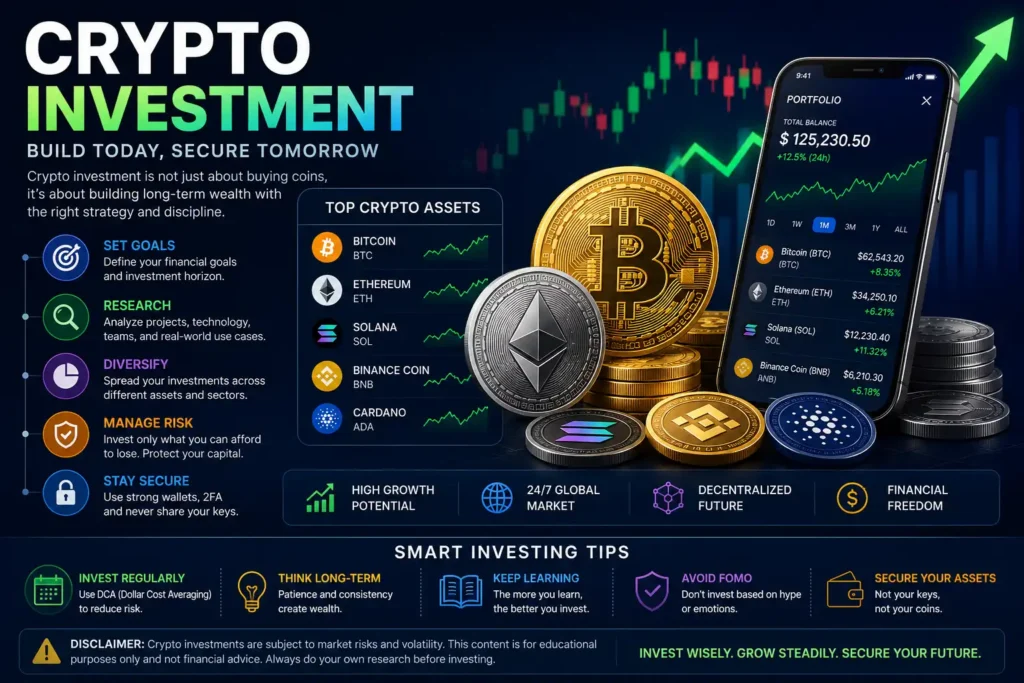
Pedrovazpaulo Crypto Investment refers to a structured approach to cryptocurrency investing that focuses on making informed investment decisions instead of emotional ones.
Rather than encouraging investors to buy every trending coin, the strategy emphasizes careful planning before investing.
The framework generally includes five important principles:
- Thorough research
- Portfolio diversification
- Risk management
- Long-term investing
- Strong security practices
Instead of asking, “Which coin will make me rich next month?”, the strategy asks:
- Does this project solve a real problem?
- Does the blockchain have active users?
- Is the development team experienced?
- Is the token economically sustainable?
- What risks could affect future growth?
This mindset helps investors make better financial decisions.
Is Pedrovazpaulo Crypto Investment a Platform or an Investment Strategy?
One of the biggest questions people ask is whether Pedrovazpaulo Crypto Investment is an actual cryptocurrency investment platform.
Based on publicly available information, there is no widely recognized evidence that it operates as a licensed cryptocurrency exchange, regulated investment company, or registered financial institution.
Instead, the term appears more closely associated with an investment philosophy or educational framework that teaches investors how to build and manage cryptocurrency portfolios responsibly.
This distinction is very important.
A strategy teaches investors how to invest.
A platform provides the tools to invest.
Always verify any company that claims to represent this investment approach before transferring funds or sharing personal information.
Why Investors Need a Structured Crypto Investment Strategy
Many new investors lose money because they make emotional decisions.
They buy coins after prices rise sharply.
They panic when prices fall.
They sell during corrections.
They buy again after another rally.
This cycle repeats continuously.
A structured investment strategy helps eliminate emotional decisions.
Instead of reacting to market headlines, investors follow predefined rules for buying, holding, reviewing, and selling their investments.
Successful investing depends more on discipline than prediction.
Current State of the Cryptocurrency Market in 2026
The cryptocurrency market has matured significantly compared to previous years.
Institutional investors, hedge funds, family offices, publicly listed companies, and asset managers now participate in digital asset investing.
Several important trends continue to shape the market:

Bitcoin Continues to Lead the Market
Bitcoin remains the largest cryptocurrency by market capitalization.
Many institutional investors consider Bitcoin the digital equivalent of gold because of its limited supply and growing acceptance.
It often acts as the benchmark for the entire cryptocurrency market.
Ethereum Continues to Dominate Smart Contracts
Ethereum remains one of the most important blockchain networks.
Developers continue building decentralized applications, decentralized finance platforms, NFTs, tokenized assets, and enterprise blockchain solutions on Ethereum.
Stablecoins Have Become Essential
Stablecoins now play an important role in crypto investing.
Investors use them for:
- Portfolio protection
- Trading liquidity
- International payments
- Yield generation
- Market stability during corrections
Institutional Adoption Is Increasing
Large financial institutions continue expanding their exposure to digital assets through ETFs, custody solutions, tokenized funds, and blockchain infrastructure.
Institutional participation has improved market maturity, although volatility remains high.
Regulation Is Becoming Clearer
Many governments have introduced clearer cryptocurrency regulations.
Although regulatory frameworks differ across countries, increased oversight has improved investor confidence in many regions.
Why Do Investors Choose Cryptocurrency?
Cryptocurrency offers opportunities that traditional investments may not provide.
Some investors seek higher returns.
Others want portfolio diversification.
Many believe blockchain technology will transform finance over the next decade.
Common reasons for investing include:
Potential for Long-Term Growth
Several cryptocurrencies have delivered strong long-term returns since their launch.
Although past performance never guarantees future results, blockchain technology continues expanding into multiple industries.
Portfolio Diversification
Crypto behaves differently from stocks, bonds, and real estate during certain market conditions.
Adding a small crypto allocation may improve portfolio diversification.
Technological Innovation
Blockchain technology powers numerous applications, including:
- Digital payments
- Decentralized finance
- Supply chain management
- Identity verification
- Gaming
- Artificial intelligence
- Tokenization of real-world assets
Many investors believe this innovation could drive future demand.
Global Accessibility
Unlike many traditional financial products, cryptocurrencies allow investors to participate globally with internet access and compatible wallets or exchanges.
The Core Philosophy Behind Pedrovazpaulo Crypto Investment
Although details vary across sources, the underlying philosophy remains consistent.
The strategy encourages investors to think like long-term wealth builders rather than short-term speculators.
Its core principles include:
Research Before Investing
Every investment should begin with research.
Investors should understand:
- The project’s purpose
- The technology
- The development team
- The token supply
- Market demand
- Competition
- Community support
Blind investing rarely succeeds over the long term.
Invest with a Plan
Successful investors define clear objectives before investing.
Examples include:
- Building retirement wealth
- Creating passive income
- Diversifying investments
- Preserving purchasing power
- Long-term capital appreciation
Each objective requires a different investment approach.
Manage Risk Carefully
Every investment carries risk.
Instead of trying to eliminate risk completely, successful investors manage it intelligently.
Good risk management includes:
- Diversification
- Position sizing
- Emergency cash reserves
- Avoiding excessive leverage
- Regular portfolio reviews
Stay Patient
Cryptocurrency markets move in cycles.
Prices rarely rise continuously.
Corrections are normal.
Investors who remain patient often avoid costly emotional decisions.
Key Features of the Pedrovazpaulo Crypto Investment Approach
| Feature | Purpose | Benefit |
|---|---|---|
| Research-Based Investing | Evaluate projects before investing | Better decision-making |
| Diversification | Spread investments across multiple assets | Lower portfolio risk |
| Long-Term Vision | Focus on multi-year growth | Reduced emotional trading |
| Risk Management | Control downside exposure | Better capital preservation |
| Security First | Protect wallets and private keys | Reduced theft risk |
| Regular Portfolio Review | Monitor investments periodically | Improved performance over time |
Who Should Consider This Investment Approach?
The strategy may suit different types of investors.
Beginners
New investors benefit from structured learning instead of emotional trading.
Long-Term Investors
People who plan to hold cryptocurrencies for several years may appreciate a disciplined framework.
Diversified Investors
Individuals who already invest in stocks, mutual funds, ETFs, or real estate may use cryptocurrency as an additional asset class.
Professionals
Busy professionals often prefer systematic investing instead of monitoring markets every hour.
Who Should Avoid This Strategy?
Not every investor has the same financial goals.
This approach may not suit people who:
- Expect guaranteed profits
- Need immediate income
- Cannot tolerate price volatility
- Invest borrowed money
- Trade based only on social media tips
- Ignore risk management
Benefits of Following a Structured Crypto Investment Framework
A disciplined investment strategy offers several advantages.
Better Decision Making
Research reduces emotional investing.
Lower Emotional Stress
Predefined rules reduce panic during market volatility.
Improved Portfolio Quality
Investors focus on stronger projects instead of chasing every trend.
Better Risk Control
Diversification reduces the impact of a single investment failure.
Long-Term Wealth Creation
Patience allows quality projects more time to grow.
Important Limitations
No investment strategy guarantees success.
Even the best investment frameworks cannot eliminate market risk.
Cryptocurrency prices remain highly volatile.
Regulations may change.
Technology evolves rapidly.
Projects can fail.
Security breaches can occur.
Investors should only invest money they can afford to lose and should consult a qualified financial advisor if they are unsure whether crypto investing suits their financial situation.
The Complete Pedrovazpaulo Crypto Investment Framework
A successful crypto investor does not depend on luck. Instead, they follow a repeatable process before investing. The Pedrovazpaulo crypto investment framework is built around disciplined decision-making. Every investment should pass through a series of checks before money enters the market.
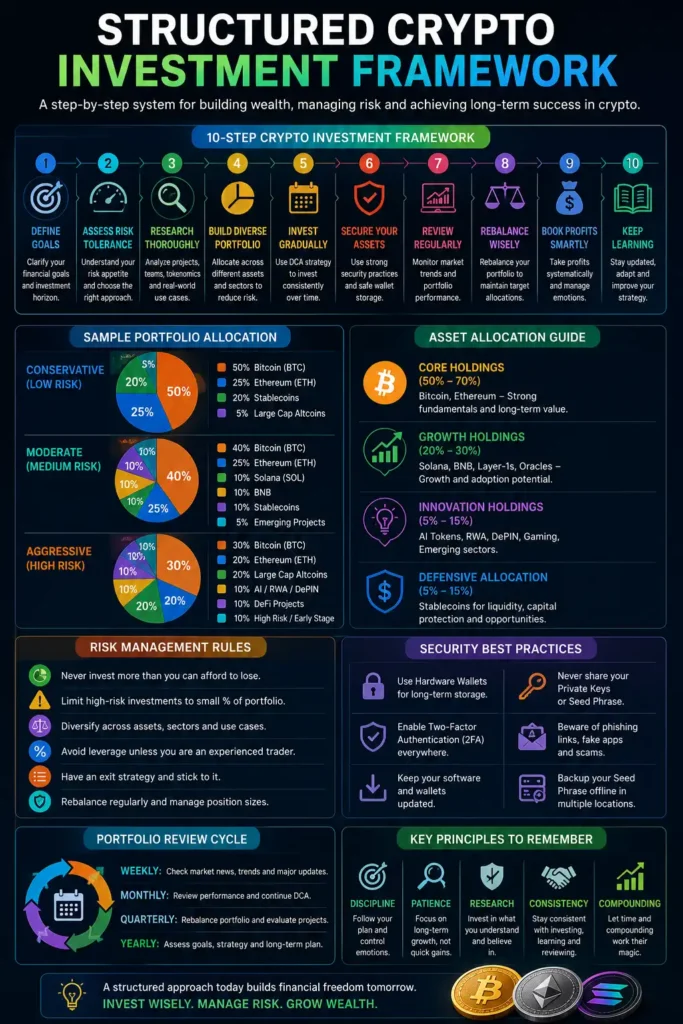
The framework consists of the following steps:
- Define your investment goal.
- Understand your risk tolerance.
- Research the cryptocurrency.
- Build a diversified portfolio.
- Invest gradually instead of all at once.
- Secure your assets.
- Review your portfolio regularly.
- Rebalance when necessary.
- Book profits according to your plan.
- Continue learning as the market evolves.
Following these steps helps investors reduce emotional decisions and improve long-term consistency.
Step 1: Define Your Investment Goal
Before buying any cryptocurrency, decide why you are investing.
Different goals require different strategies.
Common investment goals include:
Long-Term Wealth Creation
This goal focuses on holding high-quality cryptocurrencies for several years.
Suitable assets include:
- Bitcoin
- Ethereum
- Solana
- BNB
Passive Income
Some investors earn rewards through staking or decentralized finance platforms.
Examples include:
- Ethereum staking
- Solana staking
- Cardano staking
- Selected DeFi protocols
Always understand the risks before participating in staking or lending.
Portfolio Diversification
Many investors already own stocks, mutual funds, gold, or real estate. They add cryptocurrencies to diversify their overall portfolio.
Capital Appreciation
Aggressive investors may seek higher returns by investing in emerging blockchain sectors.
Examples include:
- Artificial Intelligence tokens
- Real World Asset (RWA) projects
- Layer-2 networks
- Decentralized Finance (DeFi)
- Blockchain infrastructure projects
Higher potential returns usually come with higher risk.
Step 2: Know Your Risk Profile
Every investor has a different ability to handle market volatility.
Choose your portfolio according to your financial situation rather than following influencers.
Conservative Investor
Characteristics:
- Prefers stability
- Low risk tolerance
- Long investment horizon
- Limited experience
Suggested allocation:
| Asset | Allocation |
|---|---|
| Bitcoin | 50% |
| Ethereum | 25% |
| Stablecoins | 20% |
| Large-cap Altcoins | 5% |
Moderate Investor
Characteristics:
- Comfortable with moderate volatility
- Wants balanced growth
Suggested allocation:
| Asset | Allocation |
| Bitcoin | 40% |
| Ethereum | 25% |
| Solana | 10% |
| BNB | 10% |
| Stablecoins | 10% |
| Emerging Projects | 5% |
Aggressive Investor
Characteristics:
- Accepts high volatility
- Long investment horizon
- Experienced in crypto markets
Suggested allocation:
| Asset | Allocation |
| Bitcoin | 30% |
| Ethereum | 20% |
| Large-cap Altcoins | 20% |
| AI Tokens | 10% |
| RWA Projects | 10% |
| DeFi Projects | 10% |
Remember that aggressive portfolios can experience much larger drawdowns during bear markets.
Step 3: Research Every Cryptocurrency
Never invest simply because someone on social media recommends a coin.
Instead, perform detailed research.
Understand the Problem the Project Solves
Ask yourself:
- What problem does this cryptocurrency solve?
- Does the blockchain provide a real benefit?
- Is there genuine market demand?
Projects without clear utility often struggle during bear markets.
Evaluate the Development Team
Research:
- Team experience
- Public profiles
- Previous projects
- Industry reputation
Anonymous teams are not automatically scams, but transparency increases investor confidence.
Check the Whitepaper
The whitepaper explains:
- Project goals
- Technology
- Token utility
- Economic model
- Roadmap
Avoid projects that publish vague or unrealistic whitepapers.
Examine Tokenomics
Tokenomics directly affects future price performance.
Review:
- Maximum supply
- Circulating supply
- Inflation rate
- Token unlock schedule
- Burn mechanism
- Staking rewards
Poor tokenomics may create excessive selling pressure.
Community Strength
Healthy communities usually show:
- Active discussions
- Developer updates
- Educational content
- Transparent communication
Avoid projects whose communities focus only on price predictions.
Crypto Research Checklist
Use this checklist before investing.
| Question | Yes | No |
| Does the project solve a real problem? | □ | □ |
| Is the team credible? | □ | □ |
| Is the whitepaper available? | □ | □ |
| Are tokenomics sustainable? | □ | □ |
| Is development active? | □ | □ |
| Is liquidity sufficient? | □ | □ |
| Is the project listed on trusted exchanges? | □ | □ |
| Does the roadmap appear realistic? | □ | □ |
| Are security audits available? | □ | □ |
| Do you fully understand the investment? | □ | □ |
If you answer “No” to several questions, reconsider the investment.
Step 4: Build a Diversified Crypto Portfolio
Diversification reduces dependence on one cryptocurrency.
Instead of investing all your money in one coin, spread investments across different sectors.
Core Holdings
Core assets provide long-term stability.
Examples:
- Bitcoin
- Ethereum
These assets generally form the foundation of most portfolios.
Growth Holdings
Growth assets aim for higher returns.
Examples:
- Solana
- BNB
- XRP
- Avalanche
- Chainlink
These projects may outperform during bullish markets but also carry greater volatility.
Defensive Allocation
Stablecoins can provide flexibility during market downturns.
Benefits include:
- Buying opportunities
- Reduced volatility
- Liquidity
- Capital preservation
Innovation Allocation
Allocate only a small percentage to emerging technologies.
Examples:
- AI tokens
- DePIN projects
- Gaming ecosystems
- Real World Assets
- DeFi infrastructure
Because these sectors are still evolving, keep exposure limited.
Sample Portfolio for a ₹5,00,000 Investor
| Asset | Allocation | Investment |
| Bitcoin | 35% | ₹1,75,000 |
| Ethereum | 25% | ₹1,25,000 |
| Solana | 10% | ₹50,000 |
| BNB | 10% | ₹50,000 |
| Stablecoins | 10% | ₹50,000 |
| Emerging Projects | 10% | ₹50,000 |
This example balances stability and growth while leaving cash equivalents available for future opportunities.
Step 5: Invest Gradually Instead of Investing Everything at Once
Many beginners invest their entire budget during market rallies.
Later, when prices decline, they regret entering at the wrong time.
A better approach is gradual investing.
Dollar-Cost Averaging (DCA)
Dollar-Cost Averaging means investing a fixed amount at regular intervals regardless of market price.
Example:
Monthly investment: ₹20,000
| Month | BTC Price | Amount Invested |
| January | ₹50 lakh | ₹20,000 |
| February | ₹47 lakh | ₹20,000 |
| March | ₹44 lakh | ₹20,000 |
| April | ₹49 lakh | ₹20,000 |
| May | ₹46 lakh | ₹20,000 |
This strategy averages the purchase price over time and reduces the impact of short-term volatility.
Lump Sum Investing
Investing the full amount at one time may work during market bottoms, but it increases timing risk.
Unless you have strong conviction and experience, combining an initial investment with regular DCA is often a more balanced approach.
Asset Allocation by Investment Experience
| Experience Level | Bitcoin | Ethereum | Large Caps | Emerging Projects | Stablecoins |
| Beginner | 50% | 25% | 10% | 5% | 10% |
| Intermediate | 40% | 25% | 20% | 10% | 5% |
| Advanced | 30% | 20% | 25% | 20% | 5% |
How Often Should You Review Your Portfolio?
Checking prices every hour often leads to emotional decisions.
Instead, create a review schedule.
Weekly Review
- Check major market news.
- Review portfolio performance.
- Ensure wallets remain secure.
Monthly Review
- Compare asset allocation with your target allocation.
- Continue DCA if appropriate.
- Add funds if they fit your investment plan.
Quarterly Review
- Rebalance the portfolio.
- Review project fundamentals.
- Remove projects whose long-term thesis has weakened.
- Consider taking partial profits if one asset has become disproportionately large.
Common Portfolio Allocation Mistakes
Many investors make the same mistakes repeatedly.
Avoid these common errors:
- Investing 100% in one cryptocurrency.
- Buying only meme coins.
- Ignoring Bitcoin and Ethereum.
- Chasing coins after large price increases.
- Selling during temporary market corrections.
- Ignoring stablecoins for liquidity.
- Over-diversifying into dozens of small projects.
- Investing without an exit strategy.
The Complete Pedrovazpaulo Crypto Investment Framework
Successful crypto investors do not depend on luck. Instead, they follow a proven process before investing. The Pedrovazpaulo crypto investment framework is built around disciplined decision-making rather than emotions. Every investment should pass through a series of checks before you commit your money.
The framework consists of ten simple steps:
- Define your investment goal.
- Understand your risk tolerance.
- Research the cryptocurrency.
- Build a diversified portfolio.
- Invest gradually instead of all at once.
- Secure your assets.
- Review your portfolio regularly.
- Rebalance your portfolio when necessary.
- Book profits according to your investment plan.
- Continue learning as the crypto market evolves.
Following these steps helps you reduce emotional decisions and improve long-term investment performance.
Define Your Investment Goal
Before buying any cryptocurrency, decide why you are investing.
Different financial goals require different investment strategies. Investors who understand their objectives make better decisions during both bull and bear markets.
Some common investment goals include long-term wealth creation, passive income, portfolio diversification, and capital appreciation.
Long-Term Wealth Creation
Many investors buy cryptocurrencies with the intention of holding them for several years. Instead of trying to predict daily price movements, they focus on the long-term growth of blockchain technology and digital assets.
Suitable cryptocurrencies for long-term investors include:
- Bitcoin (BTC)
- Ethereum (ETH)
- Solana (SOL)
- BNB
These cryptocurrencies have established ecosystems, strong developer communities, and significant adoption across the crypto industry.
Passive Income
Some cryptocurrencies allow investors to earn additional income through staking and decentralized finance (DeFi) protocols.
Examples include:
- Ethereum staking
- Solana staking
- Cardano staking
- Selected DeFi lending platforms
While passive income opportunities can be attractive, always understand the associated risks before locking your assets.
Portfolio Diversification
Many investors already own traditional investments such as stocks, mutual funds, bonds, gold, or real estate. They add cryptocurrencies to diversify their overall portfolio and gain exposure to blockchain technology.
Capital Appreciation
Aggressive investors often seek higher returns by investing in emerging blockchain sectors.
Popular sectors include:
- Artificial Intelligence (AI) tokens
- Real World Asset (RWA) projects
- Layer-2 blockchains
- Decentralized Finance (DeFi)
- Blockchain infrastructure
- Gaming and metaverse projects
Higher potential returns usually come with significantly higher risks.
Understand Your Risk Profile

Every investor has a different financial situation and risk tolerance.
Do not copy someone else’s portfolio simply because they made profits. Your investment strategy should match your financial goals, income, experience, and ability to handle market volatility.
Conservative Investor
A conservative investor prefers stability over high returns. This type of investor usually has limited crypto experience and wants to minimize losses during market downturns.
Suggested Portfolio
| Asset | Allocation |
|---|---|
| Bitcoin | 50% |
| Ethereum | 25% |
| Stablecoins | 20% |
| Large-Cap Altcoins | 5% |
This portfolio focuses on preserving capital while still providing exposure to cryptocurrency growth.
Moderate Investor
A moderate investor accepts moderate price fluctuations in exchange for better growth opportunities.
Suggested Portfolio
| Asset | Allocation |
|---|---|
| Bitcoin | 40% |
| Ethereum | 25% |
| Solana | 10% |
| BNB | 10% |
| Stablecoins | 10% |
| Emerging Projects | 5% |
This balanced portfolio combines stability with moderate growth potential.
Aggressive Investor
Aggressive investors seek maximum returns and understand that their portfolio may experience large price swings.
Suggested Portfolio
| Asset | Allocation |
|---|---|
| Bitcoin | 30% |
| Ethereum | 20% |
| Large-Cap Altcoins | 20% |
| AI Tokens | 10% |
| RWA Projects | 10% |
| DeFi Projects | 10% |
Aggressive portfolios can deliver impressive returns during bull markets but may also experience significant losses during market corrections.
Research Every Cryptocurrency Before Investing
Never invest simply because someone on YouTube, X, Telegram, or Instagram recommends a coin.
Instead, research every cryptocurrency carefully before investing.
Successful investors always understand what they own.
Understand the Problem the Project Solves
Every successful cryptocurrency solves a real-world problem.
Ask yourself the following questions:
- What problem does this blockchain solve?
- Does it improve existing technology?
- Will businesses or individuals actually use it?
- Does it have long-term demand?
Projects without real utility often disappear after market hype fades.
Evaluate the Development Team
The team behind a cryptocurrency project plays an important role in its success.
Look for:
- Industry experience
- Previous blockchain projects
- Public profiles
- Transparent communication
- Active leadership
Anonymous founders are not automatically suspicious, but transparency increases investor confidence.
Read the Whitepaper
A whitepaper explains everything about a cryptocurrency project.
It usually covers:
- Project vision
- Technology
- Token utility
- Consensus mechanism
- Roadmap
- Economic model
- Future development plans
Avoid projects that publish vague or unrealistic whitepapers.
Examine Tokenomics
Tokenomics directly affects future price performance.
Before investing, understand:
- Maximum token supply
- Current circulating supply
- Inflation rate
- Vesting schedule
- Token unlock dates
- Burn mechanism
- Staking rewards
Poor tokenomics can create continuous selling pressure, making long-term price appreciation difficult.
Evaluate Community Strength
Healthy crypto communities usually demonstrate:
- Active discussions
- Developer updates
- Educational content
- Transparent communication
- Real product development
Avoid communities that focus only on predicting future prices.
Cryptocurrency Research Checklist
Before investing, answer the following questions.
| Question | Yes | No |
|---|---|---|
| Does the project solve a real problem? | □ | □ |
| Is the development team credible? | □ | □ |
| Is the whitepaper available? | □ | □ |
| Are tokenomics sustainable? | □ | □ |
| Is development active? | □ | □ |
| Is liquidity sufficient? | □ | □ |
| Is the project listed on reputable exchanges? | □ | □ |
| Does the roadmap appear realistic? | □ | □ |
| Has the smart contract been audited? | □ | □ |
| Do you fully understand this investment? | □ | □ |
If you answer “No” to several questions, reconsider the investment before proceeding.
Build a Diversified Crypto Portfolio
Diversification reduces overall investment risk.
Instead of putting all your money into one cryptocurrency, spread your investments across different sectors and asset types.
Core Holdings
Core holdings should form the foundation of your portfolio.
Examples include:
- Bitcoin
- Ethereum
These cryptocurrencies have the largest market capitalizations and the strongest ecosystems.
Growth Holdings
Growth assets aim to generate higher returns over time.
Examples include:
- Solana
- BNB
- XRP
- Avalanche
- Chainlink
Although these cryptocurrencies offer greater growth potential, they are generally more volatile than Bitcoin.
Defensive Holdings
Stablecoins help reduce portfolio volatility.
Benefits include:
- Maintaining liquidity
- Buying during market corrections
- Lower price fluctuations
- Easier portfolio rebalancing
Innovation Holdings
Reserve only a small percentage of your portfolio for emerging sectors.
Examples include:
- Artificial Intelligence tokens
- DePIN projects
- Gaming ecosystems
- Real World Assets
- DeFi infrastructure
These sectors can produce exceptional returns, but they also carry much higher risks.
Sample Portfolio for a ₹5,00,000 Investment
The following example demonstrates a balanced portfolio suitable for many long-term investors.
| Asset | Allocation | Investment Amount |
|---|---|---|
| Bitcoin | 35% | ₹1,75,000 |
| Ethereum | 25% | ₹1,25,000 |
| Solana | 10% | ₹50,000 |
| BNB | 10% | ₹50,000 |
| Stablecoins | 10% | ₹50,000 |
| Emerging Projects | 10% | ₹50,000 |
This allocation balances stability, growth potential, and liquidity while limiting excessive exposure to high-risk assets.
Invest Gradually Instead of Investing Everything at Once
Many beginners invest their entire budget after seeing cryptocurrencies rally.
Unfortunately, prices often correct shortly afterward.
A better strategy is gradual investing.
Dollar-Cost Averaging (DCA)
Dollar-Cost Averaging involves investing a fixed amount at regular intervals regardless of market price.
For example, if you invest ₹20,000 every month into Bitcoin, you automatically buy more units when prices are low and fewer units when prices are high.
Example
| Month | Bitcoin Price | Monthly Investment |
|---|---|---|
| January | ₹50,00,000 | ₹20,000 |
| February | ₹47,00,000 | ₹20,000 |
| March | ₹44,00,000 | ₹20,000 |
| April | ₹49,00,000 | ₹20,000 |
| May | ₹46,00,000 | ₹20,000 |
Over time, Dollar-Cost Averaging helps reduce the impact of short-term market volatility.
Lump Sum Investing
Investing the entire amount at one time may work well if you buy during a market bottom. However, accurately timing the market is extremely difficult.
Many experienced investors combine an initial lump-sum investment with regular monthly DCA to balance opportunity and risk.
Asset Allocation Based on Experience
| Experience Level | Bitcoin | Ethereum | Large Caps | Emerging Projects | Stablecoins |
|---|---|---|---|---|---|
| Beginner | 50% | 25% | 10% | 5% | 10% |
| Intermediate | 40% | 25% | 20% | 10% | 5% |
| Advanced | 30% | 20% | 25% | 20% | 5% |
Choose an allocation that matches your knowledge, financial situation, and investment goals.
How Often Should You Review Your Portfolio?
Checking prices every hour often leads to unnecessary stress and emotional decisions.
Instead, establish a review schedule.
Weekly Review
- Read important crypto news.
- Monitor overall portfolio performance.
- Ensure wallet security remains intact.
Monthly Review
- Compare your actual allocation with your target allocation.
- Continue your Dollar-Cost Averaging plan.
- Add new investments if they align with your strategy.
Quarterly Review
- Rebalance your portfolio.
- Review each project’s fundamentals.
- Remove projects whose long-term outlook has weakened.
- Consider taking partial profits if one asset has grown far beyond your target allocation.
Common Portfolio Allocation Mistakes
Even experienced investors make mistakes.
Avoid these common errors:
- Investing your entire portfolio in one cryptocurrency.
- Buying only meme coins.
- Ignoring Bitcoin and Ethereum.
- Chasing coins after major price rallies.
- Selling during temporary market corrections.
- Holding no stablecoins for future opportunities.
- Investing in too many small-cap cryptocurrencies.
- Buying without an exit strategy.
- Ignoring portfolio rebalancing.
- Making investment decisions based on emotions instead of research.
Mastering Risk Management in Pedrovazpaulo Crypto Investment
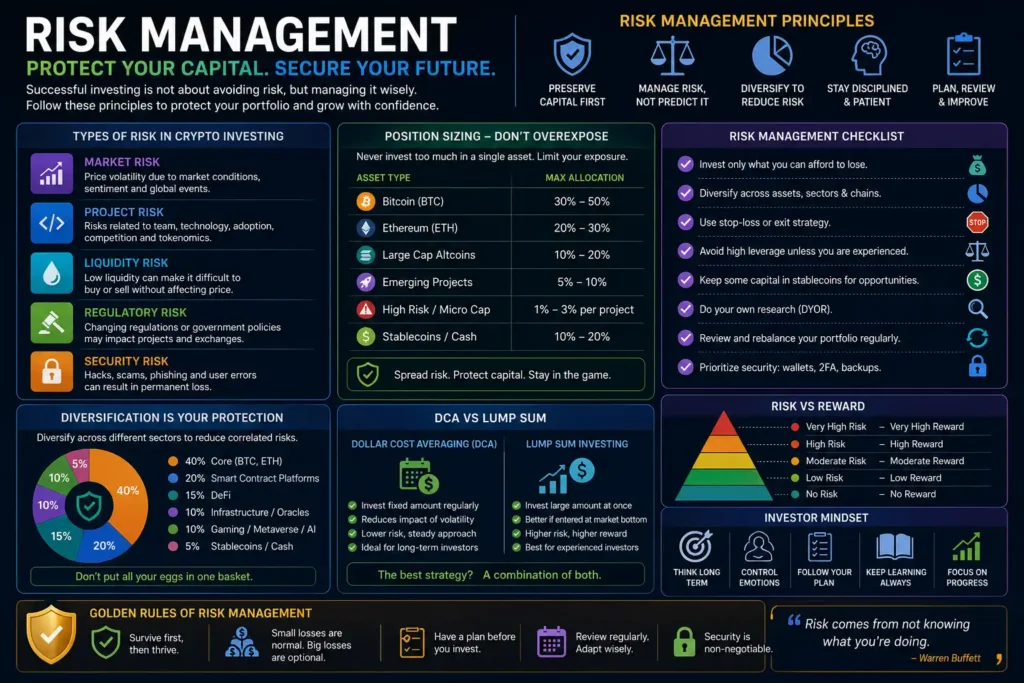
Risk management is the foundation of successful crypto investing. Many people spend hours searching for the next cryptocurrency that could deliver huge returns, but very few focus on protecting their money. In reality, preserving your capital is more important than chasing extraordinary profits.
The cryptocurrency market is highly volatile. It is common to see prices rise by 20% in a single day and fall by 30% within a week. Investors who ignore risk management often lose a significant portion of their portfolio during market corrections.
The Pedrovazpaulo crypto investment approach emphasizes one simple rule:
Protect your capital first. Grow your wealth second.
Following this principle helps investors survive difficult market conditions and remain invested for the long term.
Why Risk Management Is Essential
No investor can predict the market with complete accuracy.
Even experienced traders make mistakes.
Good risk management ensures that one bad investment does not destroy your entire portfolio.
Without a proper risk management strategy, investors often:
- Panic during market crashes.
- Invest too much in one coin.
- Use excessive leverage.
- Buy at market peaks.
- Sell at market bottoms.
- Ignore portfolio diversification.
Successful investors accept that losses are part of investing. Their goal is to keep losses small while allowing winners to grow.
The Five Types of Risk Every Crypto Investor Should Understand
Every cryptocurrency investment carries multiple types of risk.
Market Risk
Market risk refers to overall price movements across the cryptocurrency market.
Even strong projects can lose value during bear markets because investor sentiment becomes negative.
For example:
- Bitcoin declines.
- Ethereum follows.
- Altcoins often decline even more.
No portfolio is completely protected from market-wide corrections.
Project Risk
Every blockchain project has its own risks.
A project may fail because of:
- Poor management
- Lack of adoption
- Security vulnerabilities
- Strong competition
- Weak tokenomics
- Regulatory issues
Research helps reduce project risk but cannot eliminate it completely.
Liquidity Risk
Some cryptocurrencies have low trading volume.
Low liquidity makes it difficult to buy or sell large amounts without affecting the market price.
Always check daily trading volume before investing.
Regulatory Risk
Governments continue developing cryptocurrency regulations.
New rules may affect:
- Exchanges
- Stablecoins
- Privacy coins
- DeFi platforms
- Crypto taxation
Investors should stay informed about regulations in their country.
Security Risk
Crypto investors are responsible for protecting their own assets.
Security threats include:
- Exchange hacks
- Wallet theft
- Phishing attacks
- Fake investment websites
- Malware
- Social engineering scams
Strong security practices reduce these risks significantly.
Build a Risk Management Plan Before Investing
Never buy a cryptocurrency without knowing how much you are willing to lose.
Ask yourself:
- How much money can I comfortably invest?
- What percentage of my portfolio should this investment represent?
- When will I sell?
- What will I do if prices fall by 30%?
- What is my long-term investment thesis?
Having written answers prevents emotional decisions during volatile markets.
Position Sizing: Never Overinvest
One of the biggest mistakes beginners make is investing too much money in a single cryptocurrency.
A balanced portfolio spreads risk across multiple assets.
Example Position Size Guidelines
| Type of Asset | Suggested Maximum Allocation |
|---|---|
| Bitcoin | 30%–50% |
| Ethereum | 20%–30% |
| Large-Cap Altcoins | 10%–20% |
| Emerging Projects | 5%–10% |
| High-Risk Micro-Cap Tokens | 1%–3% per project |
| Meme Coins | Maximum 2%–5% |
Even if a high-risk investment fails completely, it should not significantly damage your portfolio.
Never Invest Money You Cannot Afford to Lose
Cryptocurrency remains a high-risk asset class.
Never invest:
- Emergency savings
- Rent money
- Loan proceeds
- Credit card debt
- Children’s education funds
- Retirement money needed in the short term
Only invest disposable income that will not affect your financial stability if prices decline.
Use Dollar-Cost Averaging During Market Volatility
Trying to predict the perfect buying price rarely works consistently.
Dollar-Cost Averaging (DCA) helps reduce timing risk.
Instead of investing ₹5,00,000 in one transaction, consider investing ₹50,000 every month over ten months.
Benefits include:
- Lower emotional stress
- Better average purchase price
- Reduced market timing risk
- Improved investment discipline
Keep an Emergency Cash Reserve
Many investors remain fully invested during market crashes.
As a result, they cannot buy quality cryptocurrencies when prices become attractive.
Keeping part of your portfolio in stablecoins or cash allows you to take advantage of market opportunities.
Example:
| Portfolio Component | Allocation |
| Long-Term Investments | 80% |
| Stablecoins | 15% |
| Cash Reserve | 5% |
This approach provides flexibility during periods of high volatility.
The Importance of Portfolio Rebalancing
Market prices constantly change.
A portfolio that was originally balanced may become heavily concentrated in one asset after a strong rally.
Example:
Initial Portfolio:
| Asset | Allocation |
| Bitcoin | 40% |
| Ethereum | 30% |
| Solana | 15% |
| Stablecoins | 15% |
Six months later:
| Asset | Allocation |
| Bitcoin | 58% |
| Ethereum | 22% |
| Solana | 12% |
| Stablecoins | 8% |
In this case, rebalancing helps restore your target allocation.
Benefits include:
- Managing portfolio risk
- Locking in partial profits
- Maintaining diversification
- Reducing emotional investing
Many long-term investors rebalance every three to six months.
Should You Use Leverage?
Many exchanges offer leveraged trading.
Leverage allows investors to borrow money to increase position size.
Although leverage can increase profits, it also magnifies losses.
Example:
Without leverage:
Investment: ₹1,00,000
Market falls 10%
Loss = ₹10,000
With 10x leverage:
Investment: ₹1,00,000
Exposure = ₹10,00,000
Market falls 10%
Position may be liquidated completely.
For most investors, avoiding leverage is one of the safest long-term decisions.
Secure Your Cryptocurrency Properly
Buying cryptocurrency is only the first step.
Protecting it is equally important.
Many investors lose money because of poor security rather than poor investment choices.
Hot Wallet vs Cold Wallet
Understanding wallet types helps you choose the right storage method.
| Feature | Hot Wallet | Cold Wallet |
| Internet Connection | Yes | No |
| Security | Medium | Very High |
| Convenience | High | Medium |
| Best For | Small Holdings | Long-Term Holdings |
Many experienced investors keep small amounts in hot wallets and larger investments in hardware wallets.
Essential Wallet Security Practices
Always follow these security rules:
- Enable two-factor authentication (2FA).
- Store your recovery phrase offline.
- Never share your private key.
- Use strong passwords.
- Update wallet software regularly.
- Verify wallet addresses before sending funds.
- Avoid public Wi-Fi when accessing crypto accounts.
- Keep backup copies of your recovery phrase in secure locations.
Following these practices dramatically reduces the risk of theft.
How to Choose a Reliable Cryptocurrency Exchange
Not every exchange offers the same level of security.
Before opening an account, evaluate the exchange carefully.
Consider:
- Security history
- Regulatory compliance
- Trading volume
- Liquidity
- Customer support
- Proof of reserves
- Withdrawal policies
- Supported cryptocurrencies
- Insurance coverage (if available)
Never choose an exchange simply because it lists a trending token first.
Crypto Scam Warning Signs
Scammers constantly target cryptocurrency investors.
Recognizing warning signs can save you from significant losses.
Be cautious if someone promises:
- Guaranteed returns
- Daily fixed income
- Risk-free investments
- Secret trading algorithms
- Double-your-money schemes
- Private investment clubs
- Exclusive insider information
- Unrealistic staking rewards
If something sounds too good to be true, it almost certainly is.
Common Cryptocurrency Scams
Fake Investment Platforms
Scammers create professional-looking websites that imitate legitimate investment companies.
They often show fake profits to encourage larger deposits.
Phishing Websites
Fake websites closely resemble genuine exchanges.
Their goal is to steal your login credentials or recovery phrase.
Always verify website URLs before signing in.
Giveaway Scams
Scammers claim that sending cryptocurrency will result in receiving double the amount back.
Legitimate companies do not operate giveaways that require upfront payments.
Pump-and-Dump Groups
These groups artificially inflate the price of low-quality tokens before selling to unsuspecting investors.
Avoid investment groups that promise guaranteed short-term profits.
Rug Pulls
Developers suddenly abandon a project after attracting investor funds.
Warning signs include:
- Anonymous developers
- No product development
- Unrealistic marketing
- Locked communication channels
- Extremely concentrated token ownership
Crypto Scam Prevention Checklist
Use this checklist before investing.
| Security Check | Status |
| Verified official website | □ |
| Transparent development team | □ |
| Smart contract audit completed | □ |
| Active development | □ |
| Healthy trading volume | □ |
| Listed on trusted exchanges | □ |
| Real community engagement | □ |
| No guaranteed profit claims | □ |
| Realistic roadmap | □ |
| Clear token utility | □ |
Never ignore multiple warning signs.
Emotional Risk Is the Most Dangerous Risk
Most investment mistakes happen because of emotions rather than poor research.
Fear and greed often cause investors to:
- Buy after prices surge.
- Sell after prices crash.
- Ignore their investment plan.
- Chase market hype.
- Hold losing investments indefinitely.
Successful investors remain disciplined regardless of market conditions.
Create Your Personal Investment Rules
Write your investment rules before buying your first cryptocurrency.
Example:
- Invest monthly.
- Never invest borrowed money.
- Hold core assets for at least five years.
- Never allocate more than 10% to a single high-risk project.
- Review the portfolio every quarter.
- Never panic sell during temporary corrections.
- Take partial profits after major rallies.
- Continue learning about blockchain technology.
Written rules reduce emotional decision-making and improve long-term consistency.
Crypto Taxation: What Every Investor Should Know
Understanding cryptocurrency taxation is just as important as selecting the right investment. Many investors focus on buying and selling digital assets but forget that profits from cryptocurrency transactions may be taxable depending on the laws of their country.
Ignoring tax rules can lead to penalties, interest charges, or legal issues.
Before investing, learn how your country’s tax authorities classify cryptocurrencies and maintain proper records of every transaction.
Keep records of:
- Purchase date
- Purchase price
- Selling price
- Trading fees
- Wallet transfers
- Staking rewards
- Airdrops
- Mining income
Good record keeping makes tax filing much easier.
Common Crypto Transactions That May Be Taxable
Depending on local regulations, the following activities may trigger taxation:
- Selling cryptocurrency for fiat currency
- Trading one cryptocurrency for another
- Spending cryptocurrency on goods or services
- Receiving staking rewards
- Mining cryptocurrency
- Earning referral rewards
- Receiving airdrops
- NFT sales
Always consult a qualified tax professional if you are unsure about your tax obligations.
Build an Exit Strategy Before You Invest
One of the biggest mistakes investors make is entering the market without planning how they will exit.
Many people know when they want to buy but have no idea when they should sell.
A successful investor decides both entry and exit before making an investment.
An exit strategy helps you:
- Lock in profits
- Protect capital
- Reduce emotional decisions
- Avoid greed
- Improve long-term consistency
Different Exit Strategies
There is no single exit strategy that works for everyone.
Choose one that matches your investment style.
Percentage Profit Booking
Many long-term investors sell small portions of their holdings as prices increase.
Example:
| Profit Level | Action |
|---|---|
| 30% Gain | Sell 10% |
| 50% Gain | Sell 15% |
| 75% Gain | Sell 20% |
| 100% Gain | Sell 25% |
| Remaining Holdings | Hold Long Term |
This strategy allows investors to secure profits while maintaining exposure to future price appreciation.
Portfolio Rebalancing Exit
If one cryptocurrency grows significantly faster than the rest of the portfolio, rebalance the allocation.
Example:
Original allocation:
Bitcoin – 40%
Ethereum – 30%
Solana – 20%
Stablecoins – 10%
After a strong rally:
Bitcoin – 62%
Ethereum – 20%
Solana – 13%
Stablecoins – 5%
In this situation, selling a small portion of Bitcoin and redistributing the funds helps maintain a balanced portfolio.
Goal-Based Exit Strategy
Some investors invest for a specific financial goal.
Examples include:
- Buying a house
- Children’s education
- Retirement
- Starting a business
- Emergency fund
Once the investment reaches the target amount, gradually reduce exposure instead of waiting indefinitely for higher returns.
Know When to Hold
Selling too early can reduce long-term wealth creation.
Many successful investors hold high-quality cryptocurrencies for years because blockchain adoption continues to grow.
Long-term holding may be appropriate when:
- Project fundamentals remain strong.
- Development continues.
- User adoption increases.
- Revenue grows.
- Institutional interest expands.
Price corrections alone should not determine your investment decisions.
Know When to Sell
Sometimes selling is the smartest decision.
Consider exiting an investment if:
- The development team abandons the project.
- Security vulnerabilities remain unresolved.
- Trading volume declines significantly.
- Regulations permanently affect the project.
- Better investment opportunities emerge.
- The original investment thesis is no longer valid.
Never remain invested only because you hope prices will recover.
Advanced Portfolio Management
Successful investors continuously improve their portfolios.
Portfolio management involves more than buying and holding cryptocurrencies.
Review your investments regularly.
Ask yourself:
- Does each project still solve a real problem?
- Is development progressing?
- Has competition increased?
- Has adoption improved?
- Does the project still fit my investment goals?
Regular evaluation helps remove weak investments before they become major losses.
Diversify Across Crypto Sectors
Owning different cryptocurrencies is helpful, but true diversification also includes different blockchain sectors.
Example:
| Sector | Example Assets |
| Store of Value | Bitcoin |
| Smart Contracts | Ethereum |
| Exchange Ecosystem | BNB |
| High-Speed Blockchain | Solana |
| Oracle Network | Chainlink |
| Artificial Intelligence | AI Tokens |
| Gaming | Gaming Tokens |
| Real World Assets | RWA Projects |
| Decentralized Finance | DeFi Tokens |
| Stablecoins | USDC, USDT |
Sector diversification reduces dependence on one blockchain ecosystem.
Review Your Portfolio Every Quarter
A quarterly review keeps your investments aligned with your goals.
During each review:
- Compare current allocation with target allocation.
- Remove poor-performing projects with deteriorating fundamentals.
- Add new high-quality opportunities after proper research.
- Update your investment thesis.
- Review security practices.
Avoid making frequent changes based only on short-term price movements.
Should You Buy Every Market Dip?
Many investors believe every correction is a buying opportunity.
This is not always true.
Buy market dips only when:
- The project’s fundamentals remain strong.
- Market sentiment is temporarily negative.
- Your investment thesis has not changed.
- You have available cash.
- The decline is not caused by fraud or project failure.
Never average down blindly.
How Institutional Investors Approach Crypto
Institutional investors rarely chase hype.
Instead, they focus on:
- Risk-adjusted returns
- Diversification
- Liquidity
- Custody solutions
- Regulatory compliance
- Long-term adoption
Retail investors can learn from this disciplined approach.
Emerging Trends That May Shape Crypto’s Future
The cryptocurrency industry continues to evolve rapidly.
Several trends may influence future investment opportunities.
Artificial Intelligence and Blockchain
AI-powered blockchain applications continue to expand across multiple industries.
Potential areas include:
- Automated trading
- Fraud detection
- Smart contract optimization
- Data marketplaces
- Decentralized AI infrastructure
Tokenization of Real-World Assets
Real estate, bonds, commodities, and private equity are gradually moving onto blockchain networks.
This trend could significantly increase blockchain adoption over the coming years.
Decentralized Finance
DeFi continues to transform lending, borrowing, trading, and yield generation without traditional financial intermediaries.
Investors should understand both its opportunities and risks.
Central Bank Digital Currencies
Many governments are exploring digital versions of national currencies.
Although these differ from decentralized cryptocurrencies, they may accelerate blockchain adoption.
Increased Institutional Participation
Large financial institutions continue investing in:
- Bitcoin ETFs
- Ethereum products
- Blockchain infrastructure
- Digital asset custody
- Tokenized investment products
Growing institutional participation may improve market maturity over time.
Common Mistakes Investors Should Avoid
Even experienced investors occasionally make mistakes.
Avoid these common errors:
- Investing without research.
- Following social media influencers blindly.
- Ignoring risk management.
- Using excessive leverage.
- Chasing meme coins.
- Investing emotionally.
- Ignoring security.
- Keeping large holdings on exchanges.
- Buying during extreme hype.
- Selling during panic.
- Forgetting tax obligations.
- Ignoring portfolio reviews.
Learning from these mistakes can significantly improve long-term investment performance.
Quick Checklist Before Buying Any Cryptocurrency
Use this checklist before making every investment.
| Question | Completed |
| Do I understand the project? | □ |
| Have I read the whitepaper? | □ |
| Does the project solve a real problem? | □ |
| Is the development team credible? | □ |
| Are tokenomics sustainable? | □ |
| Is liquidity sufficient? | □ |
| Is my portfolio diversified? | □ |
| Am I investing only disposable income? | □ |
| Do I have an exit strategy? | □ |
| Is my wallet secure? | □ |
If several boxes remain unchecked, postpone your investment until you complete your research.
Frequently Asked Questions
What is Pedrovazpaulo Crypto Investment?
Pedrovazpaulo Crypto Investment is generally presented as a disciplined cryptocurrency investment methodology that emphasizes research, diversification, risk management, portfolio construction, and long-term investing rather than short-term speculation.
Is Pedrovazpaulo Crypto Investment a regulated crypto platform?
Publicly available information does not clearly identify it as a licensed cryptocurrency exchange or regulated investment company. Investors should independently verify any service before investing.
Is this strategy suitable for beginners?
Yes. Beginners can benefit from its structured approach because it encourages disciplined investing instead of emotional trading.
Which cryptocurrencies are suitable for beginners?
Bitcoin and Ethereum are often considered suitable starting points because of their larger market capitalization, strong ecosystems, and widespread adoption.
How much of my portfolio should I invest in crypto?
The answer depends on your financial goals, risk tolerance, and overall investment portfolio. Many financial advisors recommend limiting exposure to an amount you can comfortably tolerate during periods of high volatility.
Should I invest all my money at once?
Most long-term investors prefer Dollar-Cost Averaging because it reduces market timing risk and promotes consistent investing.
How often should I review my crypto portfolio?
A monthly review is generally sufficient for monitoring performance, while a detailed portfolio rebalance every three to six months can help maintain your target asset allocation.
Are hardware wallets safer than exchange wallets?
Hardware wallets generally provide stronger security because they store private keys offline, reducing exposure to online attacks.
What is the biggest mistake new investors make?
Many beginners invest based on hype without understanding the project, ignore diversification, and panic during market corrections.
Can cryptocurrency help build long-term wealth?
Cryptocurrencies have delivered substantial long-term returns in the past, but they remain highly volatile. Investors should focus on quality projects, disciplined portfolio management, and proper risk control rather than expecting guaranteed profits.
Final Verdict
The Pedrovazpaulo crypto investment philosophy promotes a disciplined and research-driven approach to cryptocurrency investing. Instead of chasing quick profits, it encourages investors to build diversified portfolios, manage risk carefully, protect their digital assets, and stay focused on long-term financial goals.
Success in cryptocurrency investing rarely comes from finding the next viral token. It comes from following a consistent investment process, controlling emotions, continuously learning about blockchain technology, and making informed decisions based on research rather than speculation.
As the cryptocurrency industry continues to mature with greater institutional participation, improved regulations, artificial intelligence integration, decentralized finance innovations, and tokenized real-world assets, disciplined investors will likely be better positioned to benefit from future opportunities while minimizing unnecessary risks.
Disclaimer: This article is for educational purposes only and should not be considered financial, investment, legal, or tax advice. Cryptocurrency investments involve substantial risk, and prices can be highly volatile. Always conduct your own research and consult a qualified financial advisor before making investment decisions.