Health insurance has become one of the most important financial tools for every individual and family in India. Medical treatment costs are increasing every year, and even a short hospital stay can result in expenses running into lakhs of rupees. Without adequate health insurance, these unexpected medical bills can put significant pressure on your savings and long-term financial goals.
A good health insurance policy not only covers hospitalization expenses but also provides access to quality healthcare through cashless treatment, annual health check-ups, daycare procedures, ambulance services, and several additional benefits. Whether you are a young professional, a growing family, a senior citizen, or someone managing an existing medical condition, choosing the right health insurance plan can protect both your health and finances.
However, selecting the best health insurance plan is not always easy. With dozens of insurance companies offering hundreds of plans, comparing premiums alone is not enough. You also need to consider claim settlement performance, network hospitals, waiting periods, exclusions, room rent limits, restoration benefits, and customer support.
This comprehensive guide will help you compare the best health insurance plans in India for 2026. You’ll learn how to evaluate policies, understand important features, compare leading insurers, and choose a plan that fits your healthcare needs and budget.
Quick Comparison of the Best Health Insurance Plans in India
| Insurance Company | Best For | Cashless Hospital Network | Key Highlights |
|---|---|---|---|
| Star Health | Families | 14,000+ | Comprehensive coverage with restoration benefits |
| HDFC ERGO | Individuals & Families | 13,000+ | High claim experience and digital claim process |
| Niva Bupa | Young Professionals | 10,000+ | Modern wellness benefits and unlimited restoration |
| Care Health Insurance | Families | 11,000+ | High sum insured options and annual health check-ups |
| ICICI Lombard | Working Professionals | 9,500+ | Quick digital policy management |
| Tata AIG | Comprehensive Protection | 10,000+ | Extensive optional add-ons |
| Aditya Birla Health | Wellness Benefits | 11,000+ | Rewards for healthy lifestyle |
| SBI General Health | Budget Buyers | 8,000+ | Affordable premiums with decent coverage |
| Reliance General Health | Value for Money | 9,000+ | Multiple family plans available |
| ManipalCigna Health | Critical Illness Coverage | 8,500+ | Flexible sum insured options |
Note: Network hospitals, premiums, and policy features may change over time. Always verify the latest details before purchasing a policy.
Why Health Insurance Is More Important Than Ever
Healthcare inflation in India has consistently outpaced general inflation. Treatments that cost ₹2 lakh a few years ago may now cost ₹4–5 lakh. Advanced medical procedures, specialist consultations, diagnostic tests, and prolonged hospital stays can quickly exhaust emergency savings.
Health insurance acts as a financial safety net by covering eligible medical expenses according to your policy terms. It also allows you to receive timely treatment without worrying about arranging funds at the last moment.
Some major benefits include:
- Protection against rising medical costs
- Cashless hospitalization at network hospitals
- Financial security during emergencies
- Tax benefits under Section 80D
- Coverage for major illnesses and surgeries
- Peace of mind for your entire family
Instead of treating health insurance as an expense, it should be viewed as a long-term investment in financial security.
What Makes a Health Insurance Plan the Best?
Not every policy offering a low premium provides adequate protection. The best health insurance plans balance affordability with comprehensive coverage, strong claim support, and long-term flexibility.
Here are the key factors you should evaluate before making a decision.
1. Claim Settlement Performance
One of the first things to check is how efficiently an insurer settles claims. A company with a strong claim settlement record generally provides a smoother experience during medical emergencies.
Look for insurers known for:
- Faster claim approvals
- Transparent processes
- Lower claim rejection rates
- Dedicated customer support
A reliable claim process often matters more than choosing the cheapest premium.
2. Large Cashless Hospital Network
Cashless treatment allows policyholders to receive medical care without paying the entire hospital bill upfront. The insurance company settles eligible expenses directly with the hospital.
Before buying a policy:
- Check whether your preferred hospitals are included.
- Look for hospitals near your home and workplace.
- Ensure the insurer has a large nationwide network.
The wider the hospital network, the more convenient your treatment options become.
3. Adequate Sum Insured
Choosing a low coverage amount may save money today but can become expensive during hospitalization.
General recommendations:
| Family Type | Suggested Sum Insured |
| Individual | ₹10–15 lakh |
| Couple | ₹15–20 lakh |
| Family with Children | ₹20–50 lakh |
| Senior Citizens | ₹20 lakh or more |
Your required coverage also depends on your city, age, lifestyle, and family medical history.
4. Affordable Premium
The cheapest plan is rarely the best.
Instead, compare:
- Coverage
- Benefits
- Exclusions
- Waiting periods
- Renewal terms
- Add-on options
Paying a slightly higher premium for significantly better coverage often provides much greater value over time.
5. Waiting Period
Every health insurance policy includes waiting periods before certain illnesses become eligible for claims.
Common waiting periods include:
- Initial waiting period
- Pre-existing disease waiting period
- Specific illness waiting period
- Maternity waiting period
Policies with shorter waiting periods are generally more attractive, especially for families.
6. Room Rent Flexibility
Some plans restrict the room category you can choose during hospitalization.
If your room rent exceeds the policy limit, you may have to pay a proportionate share of several medical expenses.
Choose plans offering:
- No room rent restrictions
- Single private room eligibility
- Higher room category flexibility
7. Restoration Benefit
Restoration benefits automatically refill your sum insured if it gets exhausted during a policy year.
Example:
Suppose your policy provides ₹10 lakh coverage.
If you use the full amount during one hospitalization, restoration benefits may automatically restore another ₹10 lakh for future eligible claims.
This feature is especially valuable for families.
8. No Claim Bonus (NCB)
Many insurers reward policyholders who do not make claims.
Benefits include:
- Increased sum insured
- No increase in premium
- Additional protection every claim-free year
Some insurers increase coverage by up to 100% or even more through accumulated bonuses.
9. Lifetime Renewability
Health risks increase with age.
Always choose policies offering lifetime renewal so you remain insured even during retirement.
10. Value-Added Benefits
Modern health insurance plans include several additional features.
Popular benefits include:
- Annual health check-ups
- Wellness rewards
- Teleconsultation
- Mental health coverage
- Daycare procedures
- Home healthcare
- Organ donor expenses
- AYUSH treatment
- Ambulance services
- Preventive health screening
These benefits improve the overall value of your policy.
Health Insurance Buying Checklist
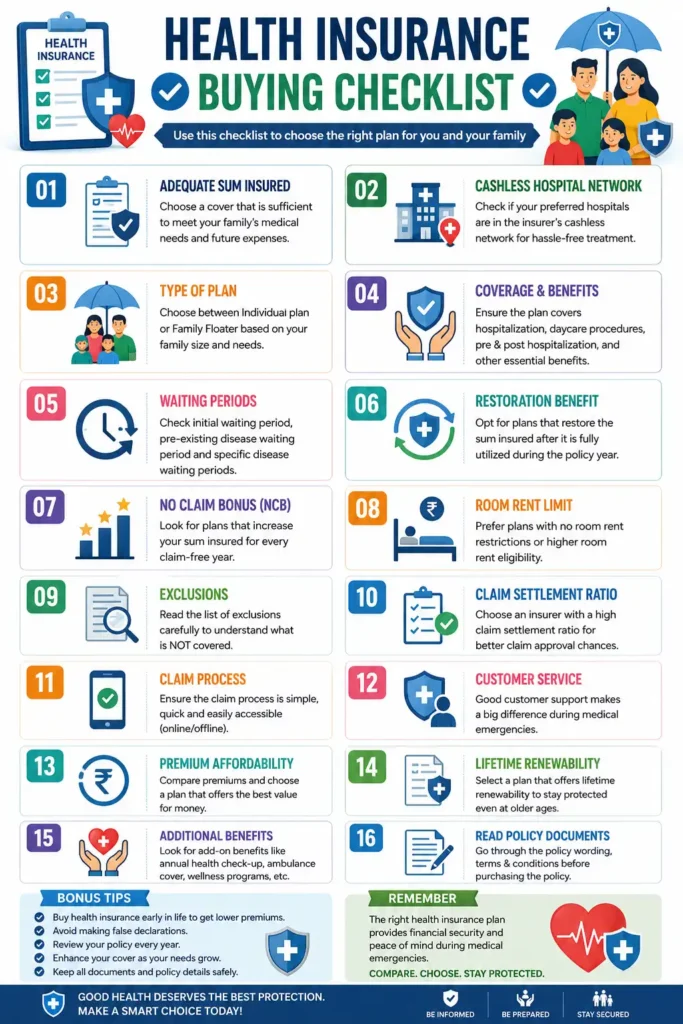
Before purchasing any policy, go through this checklist.
| Checklist | Yes/No |
| Adequate sum insured | |
| Large hospital network | |
| Cashless treatment available | |
| Low waiting period | |
| No room rent restrictions | |
| Lifetime renewability | |
| Restoration benefit included | |
| Annual health check-up | |
| No co-payment (if possible) | |
| High customer satisfaction | |
| Transparent exclusions | |
| Easy online claim process |
Completing this checklist helps you avoid common mistakes while comparing policies.
Top 10 Best Health Insurance Plans in India
1. Star Health Comprehensive Insurance Policy
Best For
Families looking for comprehensive protection with extensive hospital coverage.
Key Features
- Wide range of sum insured options
- Cashless treatment across a large hospital network
- Restoration of sum insured
- Coverage for daycare procedures
- Organ donor expenses
- Annual health check-ups
- Modern treatment coverage
- Lifetime renewability
Pros
- One of India’s largest health-focused insurers
- Strong family coverage
- Multiple optional add-ons
- Comprehensive benefits
Cons
- Premiums may be slightly higher for senior citizens.
- Certain illnesses have waiting periods.
Suitable For
- Families
- Working professionals
- Parents
- Individuals seeking broad medical coverage
2. HDFC ERGO Optima Secure
Best For
Individuals and families seeking higher protection with digital convenience.
Key Features
- Automatic increase in coverage under eligible conditions
- Cashless hospitalization
- Daycare procedures
- Home healthcare support
- Modern treatment coverage
- Lifetime renewability
- Digital claim management
Pros
- Easy online experience
- Strong customer support
- Comprehensive hospitalization coverage
- High overall value
Cons
- Premiums can increase with age.
- Optional riders may cost extra.
Suitable For
- Salaried employees
- Young families
- Urban professionals
3. Niva Bupa ReAssure
Best For
Young professionals and growing families.
Key Features
- Unlimited restoration benefit
- Cashless treatment
- Health coaching
- Digital claim tracking
- Preventive healthcare
- Annual health check-ups
- High sum insured options
Pros
- Excellent wellness features
- Flexible coverage
- Good digital experience
Cons
- Some optional benefits require additional premium.
- Coverage details vary by plan variant.
Suitable For
- Young professionals
- Newly married couples
- Small families
4. Care Supreme Health Insurance
Best For
Families requiring high coverage with value-added benefits.
Key Features
- Large sum insured choices
- Annual health check-ups
- Automatic restoration
- Daycare procedures
- Ambulance cover
- Modern treatments
- Wellness benefits
Pros
- Comprehensive family protection
- Good optional benefits
- Flexible policy options
Cons
- Waiting periods apply to certain illnesses.
- Premiums differ based on age and health profile.
Suitable For
- Families
- Parents
- Self-employed professionals
5. ICICI Lombard Elevate Health Insurance
Best For
Professionals looking for digital-first healthcare protection.
Key Features
- Cashless treatment
- High coverage options
- Quick digital claims
- Health assistance services
- Daycare coverage
- Lifetime renewability
Pros
- User-friendly mobile app
- Efficient customer service
- Strong brand reputation
Cons
- Some advanced benefits depend on selected plan options.
- Premium may vary based on medical history.
Suitable For
- Corporate employees
- Business owners
- Frequent travelers
Comparison of India’s Leading Health Insurance Plans
| Feature | Star Health | HDFC ERGO | Niva Bupa | Care Health | ICICI Lombard |
| Family Floater | ✔ | ✔ | ✔ | ✔ | ✔ |
| Cashless Hospitalization | ✔ | ✔ | ✔ | ✔ | ✔ |
| Annual Health Check-up | ✔ | ✔ | ✔ | ✔ | ✔ |
| Restoration Benefit | ✔ | ✔ | ✔ | ✔ | Available in selected plans |
| Lifetime Renewal | ✔ | ✔ | ✔ | ✔ | ✔ |
| Wellness Benefits | Moderate | Good | Excellent | Good | Good |
| Suitable for Senior Citizens | Good | Good | Good | Very Good | Good |
How to Choose the Right Plan Based on Your Needs
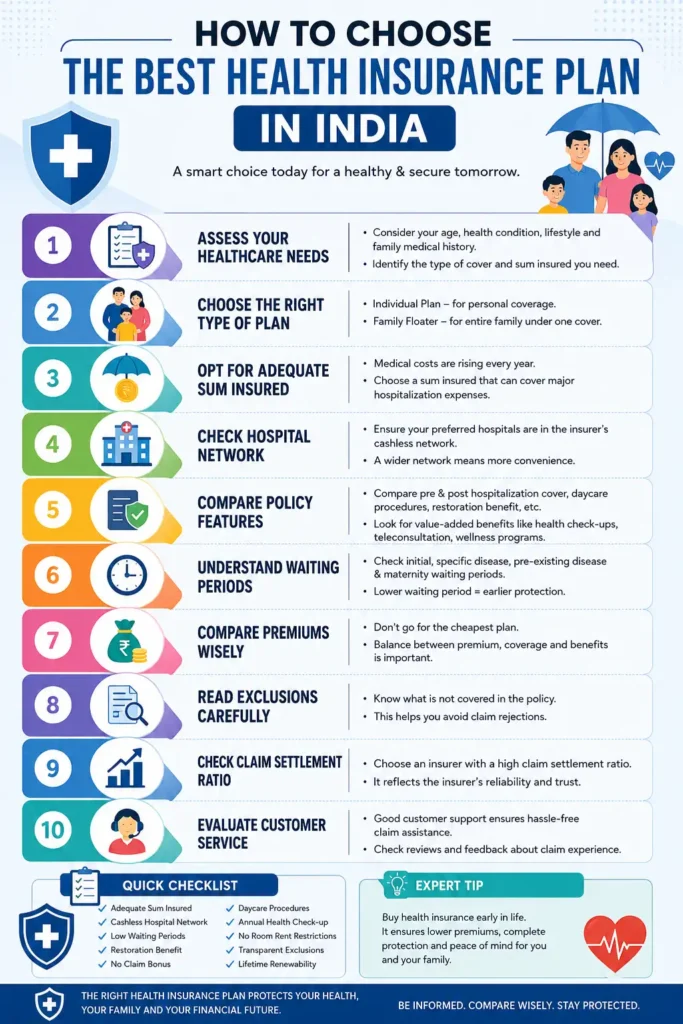
Rather than selecting the most popular insurer, identify your healthcare priorities first.
For example:
- Young professionals should focus on affordable premiums with restoration benefits.
- Families should prioritise higher sum insured and family floater plans.
- Senior citizens should look for lower co-payments and broader hospitalization coverage.
- Individuals with existing medical conditions should compare waiting periods and disease-specific coverage.
- People living in metro cities should opt for higher coverage because treatment costs are significantly higher.
6. Tata AIG Medicare Premier
Best For
Individuals and families looking for flexible coverage with multiple add-on options.
Key Features
- Wide range of sum insured options
- Cashless hospitalization
- Daycare procedures
- Organ donor expenses
- Bariatric surgery cover (as per policy terms)
- Annual health check-ups
- Lifetime renewability
- Wellness benefits
Pros
- Comprehensive coverage
- Flexible policy customization
- Strong customer support
- Good family protection options
Cons
- Premium may be slightly higher for older applicants.
- Certain benefits are available only through optional riders.
Suitable For
- Families
- Working professionals
- Individuals seeking extensive coverage
7. Aditya Birla Activ Health
Best For
People who want insurance combined with wellness rewards.
Key Features
- Wellness reward program
- Health coaching
- Chronic disease management
- Cashless hospitalization
- Annual preventive health check-ups
- Daycare treatments
- Restoration benefit
- Digital claim support
Pros
- Rewards for maintaining a healthy lifestyle
- Good preventive healthcare features
- Easy online policy management
Cons
- Wellness benefits differ by policy variant.
- Premiums may vary depending on age and health condition.
Suitable For
- Fitness-conscious individuals
- Young professionals
- Families
8. SBI General Arogya Supreme
Best For
Budget-conscious buyers seeking reliable protection.
Key Features
- Affordable premium options
- Cashless treatment
- Daycare procedures
- High sum insured choices
- No Claim Bonus
- Annual health check-up
- Lifetime renewability
Pros
- Competitive pricing
- Trusted banking brand
- Suitable for first-time buyers
Cons
- Fewer premium wellness benefits compared to premium plans.
- Optional covers require additional premium.
Suitable For
- Individuals
- Young families
- First-time insurance buyers
9. Reliance Health Gain
Best For
Families looking for value-for-money coverage.
Key Features
- Family floater plans
- Restoration benefits
- Daycare procedures
- Cashless treatment
- Annual health check-ups
- Wellness support
- Lifetime renewability
Pros
- Affordable family coverage
- Multiple sum insured options
- Easy online purchase
Cons
- Policy benefits vary across different plan variants.
- Waiting periods apply to specific illnesses.
Suitable For
- Families
- Self-employed professionals
- Salaried employees
10. ManipalCigna ProHealth Prime
Best For
Customers looking for flexible and customizable coverage.
Key Features
- Multiple plan variants
- High sum insured options
- Restoration benefit
- Cashless hospitalization
- Worldwide emergency coverage (selected plans)
- Annual health check-up
- Wellness rewards
Pros
- Flexible customization
- Comprehensive hospitalization coverage
- Strong wellness features
Cons
- Some advanced benefits are available only in higher variants.
- Premium depends on selected coverage.
Suitable For
- Families
- Professionals
- Frequent travelers
Best Health Insurance Plans Based on Your Needs
Every individual has different healthcare requirements. Instead of choosing the most advertised policy, select one that matches your life stage, family size, and financial goals.
Best Health Insurance for Families
Families should choose plans that provide:
- High sum insured
- Family floater option
- Restoration benefits
- No room rent restrictions
- Annual health check-ups
- Coverage for children
Recommended features:
- ₹20–50 lakh sum insured
- Cashless hospitalization
- Lifetime renewability
- High No Claim Bonus
Best Health Insurance for Parents
Medical expenses generally increase with age. Parents need policies offering broader hospitalization coverage.
Important factors include:
- Lower co-payment
- Shorter waiting period
- Coverage for pre-existing diseases
- Higher claim support
- Large hospital network
Best Health Insurance for Senior Citizens
Senior citizens should prioritize quality over premium.
Look for:
- Higher coverage
- Home healthcare
- Daycare procedures
- Critical illness support
- Lifetime renewal
- Cashless hospitalization
Best Health Insurance for Young Professionals
Young adults generally enjoy lower premiums because of lower health risks.
Ideal features include:
- Affordable premium
- Wellness rewards
- Annual health check-up
- Restoration benefit
- Digital claim management
Buying early also helps complete waiting periods before major health issues arise.
Best Health Insurance for Women
Women should consider policies covering:
- Maternity expenses
- Newborn baby cover
- Pregnancy complications
- Breast cancer screening
- Preventive healthcare
- Annual health check-ups
Best Health Insurance for Children
Children can be covered under family floater plans or individual child policies.
Important features include:
- Vaccination benefits (where available)
- Daycare treatment
- Pediatric care
- Hospitalization
- Emergency ambulance
Best Health Insurance for People with Diabetes
People with diabetes should compare:
- Waiting period
- Coverage for complications
- Cashless hospitals
- Chronic disease management
- Wellness programs
Best Health Insurance for Large Families
Large families benefit from:
- High family floater coverage
- Restoration benefits
- Unlimited claims (where available)
- Annual health screening
- Multiple insured members
Individual vs Family Floater Health Insurance
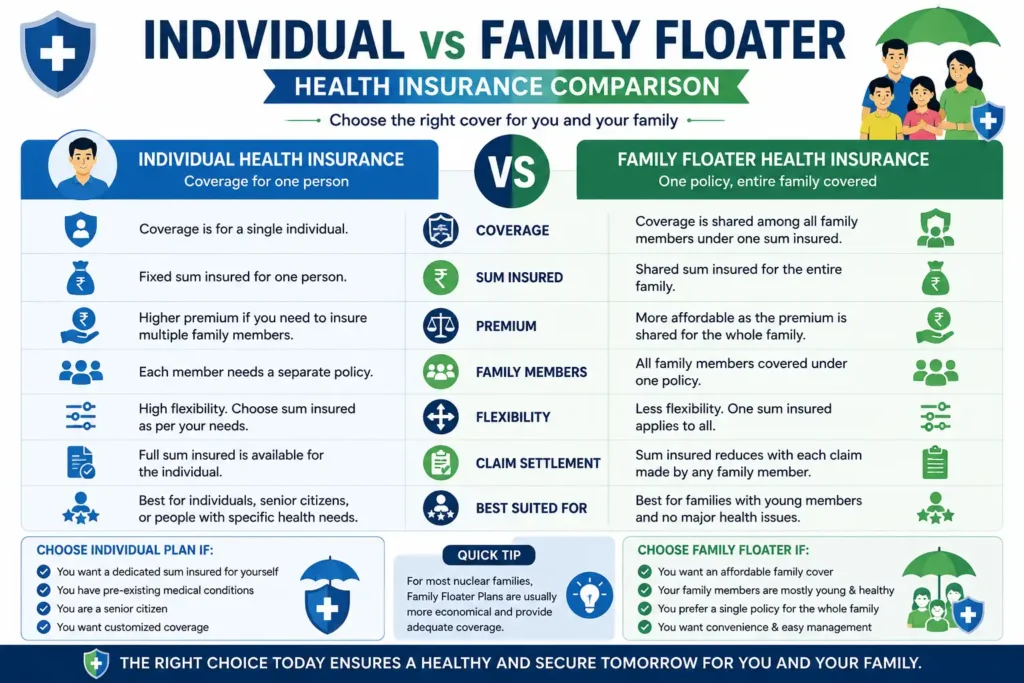
Choosing between an individual policy and a family floater depends on your family’s healthcare needs.
| Feature | Individual Plan | Family Floater |
|---|---|---|
| Coverage | Separate for each person | Shared among all members |
| Premium | Higher for multiple members | More economical |
| Best For | Individuals | Families |
| Sum Insured | Fixed for one person | Shared |
| Cost Effectiveness | Moderate | High |
Individual Health Insurance
Advantages
- Separate sum insured
- Suitable for elderly members
- Better for people with chronic illnesses
Disadvantages
- Higher premium for large families
- Separate policies to manage
Family Floater Insurance
Advantages
- Lower premium
- Single policy
- Covers entire family
- Easier renewal
Disadvantages
- Shared sum insured
- Large claims may reduce coverage for other members
Which One Should You Choose?
Choose an individual policy if:
- You are above 55 years.
- You have existing medical conditions.
- You require dedicated coverage.
Choose a family floater if:
- You have a spouse and children.
- Family members are relatively young and healthy.
- You want lower premiums.
Features You Should Never Ignore
Many buyers compare only premiums. However, these features significantly impact the overall value of your policy.
Cashless Hospitalization
Allows treatment without paying hospital bills upfront at network hospitals.
Restoration Benefit
Automatically restores your sum insured after eligible claims.
No Claim Bonus
Rewards you with increased coverage if no claims are made during the policy year.
Daycare Procedures
Many treatments no longer require 24-hour hospitalization.
A good policy should cover:
- Cataract surgery
- Chemotherapy
- Dialysis
- Minor surgeries
- Endoscopy
- Radiotherapy
Annual Health Check-up
Preventive health check-ups help detect illnesses early.
Many insurers provide this benefit every policy year.
Organ Donor Cover
Covers eligible medical expenses related to organ transplantation.
Ambulance Cover
Includes emergency transportation expenses up to policy limits.
Home Healthcare
Some treatments can now be provided at home under medical supervision.
This benefit is becoming increasingly valuable.
AYUSH Coverage
Many insurers now cover approved treatments under:
- Ayurveda
- Yoga
- Unani
- Siddha
- Homeopathy
Mental Health Coverage
Modern health insurance plans increasingly include hospitalization for mental health conditions according to applicable regulations and policy terms.
Hidden Charges You Should Watch Before Buying
Many buyers discover these charges only during claims.
Co-payment
You agree to pay a fixed percentage of every claim.
Example:
If the claim is ₹5 lakh and the policy has a 20% co-payment:
You pay ₹1 lakh.
Insurance company pays ₹4 lakh.
Deductible
You pay a specified amount before insurance coverage begins.
Common in top-up plans.
Room Rent Limit
Some policies restrict room rent eligibility.
Choosing a room beyond the limit may increase your out-of-pocket expenses due to proportionate deductions.
Disease-specific Limits
Certain treatments may have maximum payout limits.
Examples include:
- Cataract
- Knee replacement
- Hernia surgery
Non-payable Expenses
Policies may not cover certain items such as:
- Personal comfort products
- Administrative charges
- Consumables (depending on policy)
- Cosmetic procedures not medically necessary
Common Exclusions in Health Insurance
Understanding exclusions is just as important as knowing what is covered.
| Usually Covered? | Treatment |
| ❌ | Cosmetic surgery (unless medically necessary) |
| ❌ | Infertility treatment |
| ❌ | Experimental treatment (unless specified) |
| ❌ | Self-inflicted injuries |
| ❌ | Substance abuse-related illnesses (subject to policy terms) |
| ❌ | Dental treatment (except accidental injury or covered procedures) |
| ❌ | Vision correction surgery (unless covered) |
| ❌ | Routine health supplements |
Always read the policy wording carefully before purchasing.
Understanding Waiting Periods
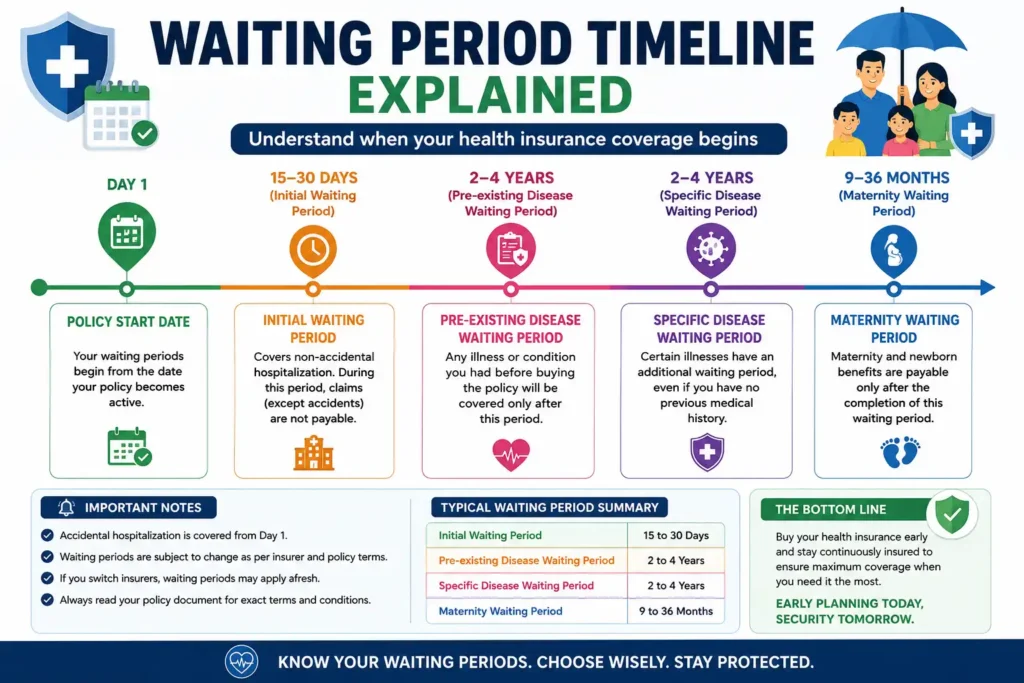
Every health insurance policy includes waiting periods.
Initial Waiting Period
Generally applies for the first few weeks after policy purchase, except for accidental hospitalization.
Pre-existing Disease Waiting Period
Medical conditions already present before buying the policy become eligible only after completing the specified waiting period.
Specific Disease Waiting Period
Certain illnesses have predefined waiting periods regardless of medical history.
Examples may include:
- Hernia
- Cataract
- Joint replacement
- Gallstones
Maternity Waiting Period
Most maternity benefits become available only after completing the required waiting period.
Families planning children should buy health insurance well in advance.
Quick Checklist Before Purchasing
✔ Compare at least five insurers.
✔ Check the network hospitals near your location.
✔ Read exclusions carefully.
✔ Understand waiting periods.
✔ Verify restoration benefits.
✔ Compare No Claim Bonus.
✔ Review customer service ratings.
✔ Check room rent limits.
✔ Choose adequate sum insured.
✔ Buy early instead of waiting for health issues.
Cashless vs Reimbursement Health Insurance Claims
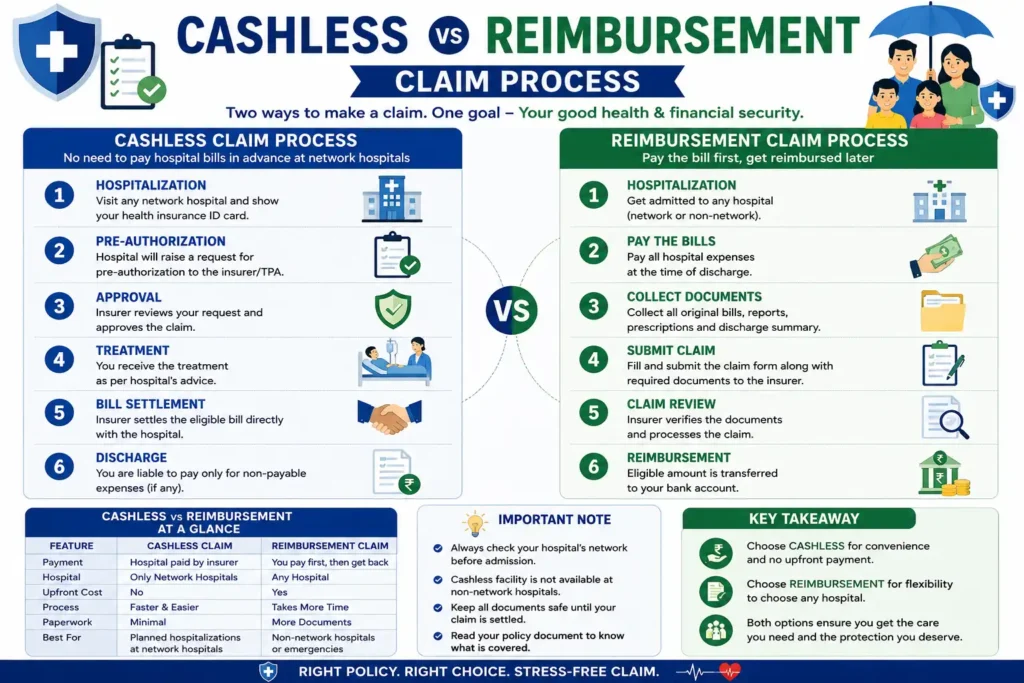
One of the biggest advantages of health insurance is that it reduces the financial burden during medical emergencies. However, many policyholders are confused about the difference between cashless and reimbursement claims. Understanding both claim methods will help you choose the right policy and avoid delays during hospitalization.
What Is a Cashless Claim?
A cashless claim allows you to receive treatment at a network hospital without paying the full hospital bill yourself. The insurance company settles the eligible expenses directly with the hospital.
How Cashless Claims Work
- Visit a network hospital.
- Show your health insurance card or policy details.
- Fill out the pre-authorization form.
- The hospital sends your request to the insurance company or TPA.
- The insurer reviews and approves the claim.
- After treatment, the insurer pays the eligible expenses directly to the hospital.
- You only pay non-covered expenses, if any.
Advantages of Cashless Claims
- No need to arrange a large amount of money immediately
- Faster admission process
- Less paperwork
- Convenient during emergencies
- Direct settlement with the hospital
Limitations
- Available only at network hospitals
- Certain expenses may not be covered
- Approval depends on policy terms
What Is a Reimbursement Claim?
If you receive treatment at a non-network hospital, you usually pay the hospital bill first and then submit the claim to your insurance company for reimbursement.
How Reimbursement Claims Work
- Get admitted to any hospital.
- Pay all medical expenses.
- Collect original bills and medical records.
- Submit the claim form and supporting documents.
- The insurer verifies the claim.
- Eligible expenses are reimbursed according to the policy.
Advantages
- Freedom to choose almost any hospital
- Useful when network hospitals are unavailable
- Can be used during travel
Limitations
- You need sufficient funds to pay the bill initially.
- More paperwork is required.
- Claim settlement may take longer.
Cashless vs Reimbursement Comparison
| Feature | Cashless Claim | Reimbursement Claim |
|---|---|---|
| Payment | Insurance company pays hospital | Customer pays first |
| Hospital | Network hospitals only | Any eligible hospital |
| Paperwork | Minimal | Higher |
| Processing | Faster | May take longer |
| Best For | Planned and emergency hospitalization | Treatment outside network hospitals |
Claim Settlement Ratio Explained
Claim settlement ratio is one of the most important factors while selecting a health insurance company.
It indicates how efficiently an insurer settles claims received from policyholders.
For example, if an insurer receives 1,000 claims and settles 970 of them, its claim settlement ratio is 97%.
A consistently strong claim settlement record generally reflects reliable claims handling and customer service.
Why Claim Settlement Ratio Matters
- Shows insurer reliability
- Indicates claim handling efficiency
- Helps compare insurance companies
- Builds confidence during emergencies
However, never choose an insurer based only on this figure. Also evaluate policy coverage, exclusions, waiting periods, hospital network, and customer experience.
How Much Health Insurance Cover Do You Need?
Choosing the correct sum insured is just as important as choosing the insurer.
Medical inflation in India continues to rise, making higher coverage increasingly important.
Recommended Coverage
| Profile | Suggested Sum Insured |
| Single individual | ₹10–15 lakh |
| Married couple | ₹15–20 lakh |
| Family with children | ₹20–50 lakh |
| Senior citizens | ₹20 lakh or more |
| Metro city residents | ₹25 lakh or more |
Factors That Affect Required Coverage
Age
Older individuals generally require higher coverage due to increased healthcare needs.
City
Treatment costs in metropolitan cities are significantly higher than in smaller towns.
Family Size
Larger families should consider higher coverage because multiple members share the same sum insured under family floater plans.
Medical History
Individuals with existing health risks should opt for higher coverage.
Lifestyle
Smoking, obesity, lack of exercise, and stressful lifestyles increase health risks.
How to Compare Health Insurance Plans
Comparing only premiums can result in buying an inadequate policy.
Instead, evaluate every plan using the following checklist.
Compare Coverage
Check:
- Hospitalization
- Daycare procedures
- Pre and post hospitalization
- Organ donor expenses
- Ambulance charges
- AYUSH treatment
- Home healthcare
Compare Waiting Periods
Shorter waiting periods provide earlier access to benefits.
Compare Network Hospitals
Choose insurers with hospitals located near your home and workplace.
Compare Room Rent Eligibility
Prefer plans without room rent restrictions.
Compare Restoration Benefits
Automatic restoration increases protection during multiple hospitalizations.
Compare No Claim Bonus
Higher bonuses increase your coverage without increasing the premium.
Compare Customer Support
Reliable customer service becomes extremely valuable during medical emergencies.
Common Mistakes to Avoid While Buying Health Insurance
Many policyholders regret their decision because they overlook important details.
Avoid these common mistakes.
Buying the Cheapest Policy
Low premiums often come with limited coverage or higher restrictions.
Choosing Low Coverage
A ₹3–5 lakh policy may not be sufficient for major surgeries in metro cities.
Ignoring Waiting Periods
Always compare waiting periods before purchasing.
Not Reading Exclusions
Know what is not covered to avoid surprises during claims.
Ignoring Room Rent Limits
Room rent restrictions may increase your out-of-pocket expenses.
Hiding Medical Information
Always disclose your medical history honestly.
Incorrect information may lead to claim rejection.
Buying Too Late
Purchasing health insurance while you are young usually results in lower premiums and completion of waiting periods before major health issues arise.
Not Comparing Multiple Policies
Never buy the first policy you see.
Compare benefits carefully.
How to Buy Health Insurance Online
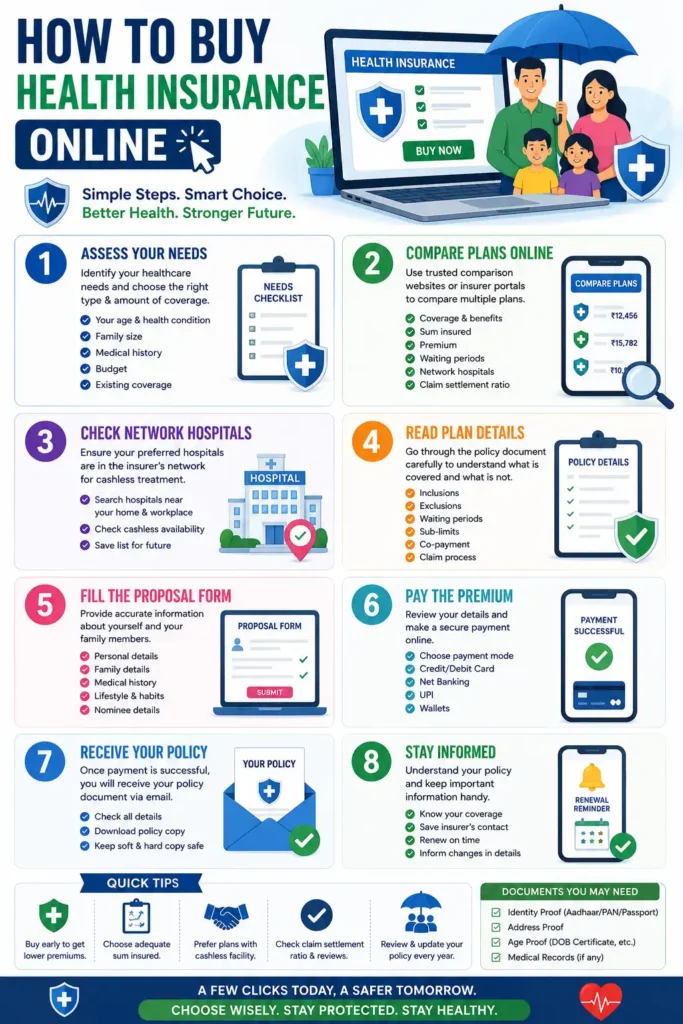
Buying health insurance online is quick and convenient.
Follow these steps.
Step 1: Assess Your Requirements
Determine:
- Number of family members
- Required coverage
- Budget
- Existing medical conditions
Step 2: Compare Plans
Compare:
- Premium
- Coverage
- Waiting periods
- Exclusions
- Hospital network
- Claim process
Step 3: Check Network Hospitals
Ensure your preferred hospitals are included.
Step 4: Read Policy Documents
Never purchase a policy without reading:
- Inclusions
- Exclusions
- Waiting periods
- Claim procedure
Step 5: Fill Accurate Information
Provide correct details regarding:
- Age
- Occupation
- Medical history
- Lifestyle
Step 6: Make Payment
Complete the online payment securely.
Step 7: Download Your Policy
Save both digital and printed copies for future reference.
Tax Benefits of Health Insurance
Health insurance not only protects your health but also helps reduce your tax liability.
Premiums paid for eligible health insurance policies may qualify for deductions under Section 80D of the Income Tax Act, subject to prevailing tax rules and limits.
You may claim deductions for:
- Yourself
- Your spouse
- Dependent children
- Parents
Higher deduction limits are available for eligible senior citizen policies.
Always consult the latest tax provisions or a tax professional for updated limits and eligibility.
Expert Tips for Choosing the Best Health Insurance Plan
- Buy health insurance at a younger age.
- Choose adequate coverage instead of the lowest premium.
- Compare multiple insurers before buying.
- Check the hospital network carefully.
- Read exclusions thoroughly.
- Select plans with restoration benefits.
- Prefer lifetime renewability.
- Review waiting periods.
- Opt for annual health check-up benefits.
- Compare claim support and customer service.
- Review your policy every year.
- Increase your coverage as your income grows.
- Keep all policy documents safely.
- Inform family members about your policy details.
- Never delay policy renewal.
Frequently Asked Questions
The best insurer depends on your healthcare needs, budget, preferred hospital network, policy features, and claim experience rather than a single company name.
It may be adequate for some individuals, but families and people living in metropolitan cities often benefit from higher coverage due to increasing medical costs.
Family floater plans with high sum insured, restoration benefits, cashless hospitalization, and annual health check-ups are generally suitable for families.
Buying health insurance in your 20s or early 30s usually provides lower premiums and helps complete waiting periods before major health issues arise.
Yes. Many people maintain multiple policies for additional financial protection, subject to policy terms and claim coordination rules.
Yes, but coverage generally begins after completing the applicable waiting period specified in the policy.
It is the period during which certain illnesses or conditions are not eligible for claims after purchasing the policy.
This feature automatically restores the sum insured after eligible claims during the policy year.
Many plans offer maternity coverage, but it usually becomes available after completing the required waiting period.
Several modern health insurance plans include annual preventive health check-ups as part of their benefits.
A cashless hospital is a network hospital where eligible medical expenses are settled directly between the insurer and the hospital.
Yes. Many insurers offer dedicated plans designed for senior citizens with age-specific features and coverage.
Final Thoughts
Choosing the best health insurance plan in India is about much more than comparing premiums. The right policy should provide comprehensive medical coverage, a wide cashless hospital network, fair waiting periods, restoration benefits, transparent exclusions, and dependable claim support.
Before making your decision, compare several insurers, evaluate the policy wording carefully, and choose coverage that matches your family’s healthcare needs and long-term financial goals. Purchasing the right policy today can protect your savings, ensure access to quality healthcare, and provide peace of mind during unexpected medical emergencies.