Search for semiconductor stocks India and you will quickly notice a problem.
One stock list may include CG Power and MosChip Technologies. Another may add Tata Elxsi, Dixon Technologies, Vedanta, or even large IT companies.
However, these companies do not have the same semiconductor exposure.
Some companies design chips. Some assemble, package, and test semiconductors. A few are investing in power semiconductor manufacturing. Meanwhile, several others manufacture electronic products that use chips but do not manufacture semiconductors themselves.
That difference matters to an investor.
A company can benefit from India’s electronics growth without becoming a semiconductor manufacturer. Similarly, a company may announce a semiconductor project today, but meaningful revenue from the project may take years to appear.
Therefore, investors should not buy a stock simply because someone has added the “semiconductor” label to it.
In this FundzWise analysis, we separate semiconductor stocks in India according to their actual position in the chip value chain. We also examine direct semiconductor plays, OSAT companies, semiconductor design businesses, power semiconductor companies, and indirect beneficiaries.
More importantly, we look at a question that every investor should ask:
How much semiconductor exposure does the company actually have today, and how much is still an expectation about the future?
Semiconductor Stocks India: Quick Answer
India has only a limited number of listed companies with meaningful direct semiconductor exposure.
Companies such as CG Power and Industrial Solutions, Kaynes Technology, MosChip Technologies, SPEL Semiconductor, and RIR Power Electronics offer different forms of semiconductor exposure.
However, they operate in different parts of the semiconductor value chain.
| Company | Semiconductor Exposure | Main Semiconductor Connection | FundzWise Classification |
|---|---|---|---|
| CG Power and Industrial Solutions | High | OSAT through CG Semi | Strong semiconductor exposure |
| Kaynes Technology | High | OSAT through Kaynes Semicon | Strong semiconductor exposure |
| MosChip Technologies | High | ASIC and semiconductor design | Direct design play |
| SPEL Semiconductor | High | Assembly and testing | Direct semiconductor exposure |
| RIR Power Electronics | High | Power semiconductors and SiC | Emerging direct play |
| ASM Technologies | Medium | Semiconductor engineering exposure | Semiconductor services |
| Tata Elxsi | Medium | Chipset design and semiconductor engineering services | Semiconductor proxy |
| Syrma SGS Technology | Low to Medium | Electronics system design and manufacturing | Ecosystem beneficiary |
| Dixon Technologies | Low | Electronics manufacturing | Indirect beneficiary |
| Vedanta | Project dependent | Semiconductor ambitions | Speculative exposure |
Data classification updated: July 2026
The table does not rank these companies as the best stocks to buy. It only explains the type of semiconductor exposure available to investors.
A direct semiconductor company can still have weak financials or an expensive valuation. On the other hand, an indirect beneficiary may have a stronger existing business.
Investors must study both the semiconductor opportunity and the underlying company.
What Exactly Counts as a Semiconductor Stocks India?
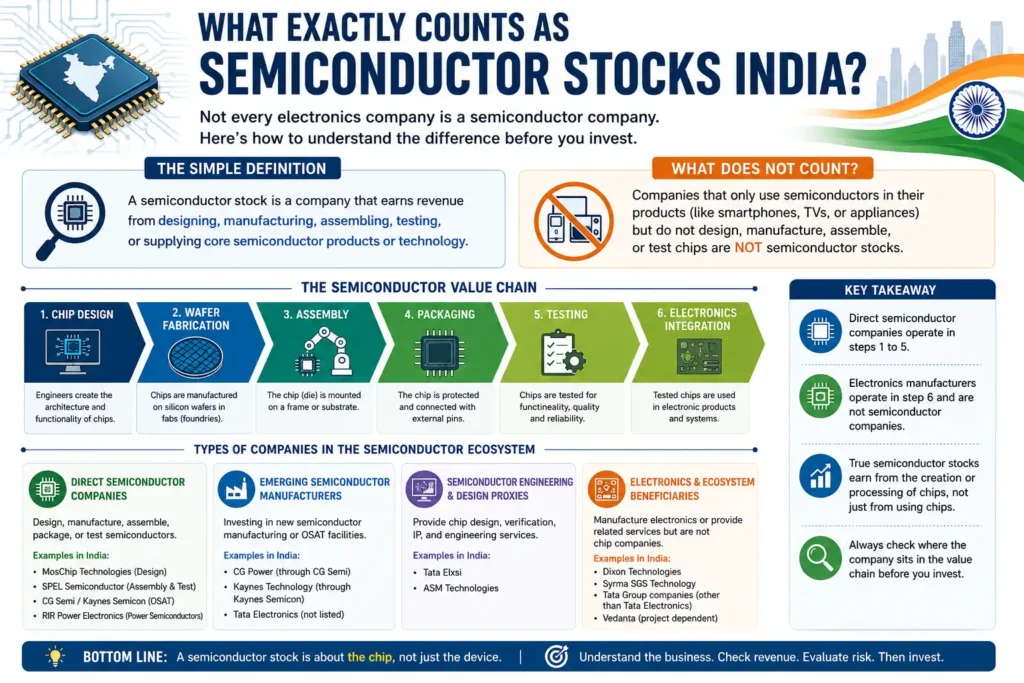
There is no official stock market definition of a “semiconductor stock.”
This creates confusion.
For example, imagine three companies.
Company A designs semiconductor chips.
Company B assembles and tests chips manufactured by another company.
Company C manufactures smartphones that use semiconductor chips.
All three companies participate in the electronics ecosystem. However, only the first two have direct semiconductor operations.
Therefore, FundzWise classifies semiconductor stocks into four broad groups.
Direct Semiconductor Companies
These companies earn revenue from semiconductor products, semiconductor design, chip assembly, packaging, or testing.
Examples may include MosChip Technologies, SPEL Semiconductor, and RIR Power Electronics.
Emerging Semiconductor Manufacturing Companies
These are existing listed companies investing heavily in new semiconductor operations.
CG Power and Kaynes Technology fit more closely into this group because their semiconductor exposure is being developed through dedicated businesses and facilities.
Semiconductor Engineering and Design Proxies
These companies provide engineering, chipset design, embedded systems, validation, or related technology services.
Tata Elxsi and ASM Technologies require analysis in this context.
Electronics Manufacturing Beneficiaries
These companies manufacture electronics that require semiconductor components.
Dixon Technologies and Syrma SGS Technology participate in India’s electronics manufacturing expansion. However, investors should not automatically describe them as pure semiconductor companies.
This classification is important because the growth drivers and risks are different for every group.
Not All Semiconductor Stocks Do the Same Business
A semiconductor passes through several stages before it reaches a smartphone, electric vehicle, industrial machine, or data centre.
The simplified semiconductor value chain looks like this:
Chip Design → Wafer Fabrication → Assembly → Packaging → Testing → Electronics Integration
Each stage requires different technology, capital, skills, and customers.
| Semiconductor Stage | What Happens | Possible Indian Listed Exposure |
|---|---|---|
| Chip design | Engineers design chip architecture | MosChip |
| Semiconductor IP | Reusable technology blocks are developed | Design companies |
| Wafer fabrication | Semiconductor circuits are manufactured on wafers | Very limited direct listed exposure |
| ATMP | Chips are assembled, tested, marked, and packaged | Emerging Indian ecosystem |
| OSAT | Third-party assembly and testing | CG Semi, Kaynes Semicon |
| Power semiconductors | Devices manage electrical power | RIR Power Electronics |
| Engineering services | Companies support semiconductor design and technology development | ASM Technologies, Tata Elxsi |
| Electronics manufacturing | Chips are integrated into electronic products | Dixon, Syrma SGS |
This is why comparing MosChip directly with Dixon Technologies may be misleading.
MosChip describes its semiconductor capabilities around turnkey ASIC, design services, and IP services.
In comparison, Dixon describes itself around electronics manufacturing services and operates a large manufacturing footprint.
Both companies may benefit from technology growth, but investors are buying very different businesses.
Why Semiconductor Stocks in India Are in Focus in 2026
India’s semiconductor investment story is moving from policy announcements towards physical infrastructure, production, and ecosystem development.
This transition is the main reason semiconductor stocks India remains an important investment theme in 2026.
India Semiconductor Mission 2.0 Changes the Scope of the Opportunity
The Union Budget 2026–27 announced India Semiconductor Mission 2.0.
The policy direction goes beyond semiconductor fabrication alone. The government has highlighted equipment, materials, full-stack Indian intellectual property, and stronger semiconductor supply chains as areas of focus.
At the same time, the Budget increased the outlay for the Electronics Components Manufacturing Scheme to ₹40,000 crore.
This is important for investors.
India cannot create a sustainable semiconductor industry by constructing only one or two chip factories.
A complete ecosystem requires:
- Semiconductor materials
- Specialised chemicals
- Equipment
- Chip design
- Intellectual property
- Packaging
- Testing
- Skilled engineers
- Electronics manufacturers
- Reliable power
- Water infrastructure
- Logistics
Therefore, the investment opportunity may gradually expand beyond companies directly manufacturing chips.
India Has Approved 12 Semiconductor Manufacturing Units
According to the Ministry of Electronics and Information Technology’s May 2026 achievements report, 12 semiconductor manufacturing units had been approved under the Semicon India Programme.
The same government report stated that 24 semiconductor design companies had received approval for fiscal support.
This represents an important change in India’s semiconductor story.
Earlier, investors mainly discussed whether India could attract semiconductor manufacturing.
The question is now changing to:
Which projects can reach production, attract customers, improve utilisation, and create sustainable revenue?
Project approval is only the first step.
Commercial success is the real test.
India’s Semiconductor Market Could Reach $100–110 Billion by 2030
Government material published in 2025 cited estimates that India’s semiconductor market could reach $100 billion to $110 billion by 2030.
Several demand drivers support the long-term opportunity.
These include:
- Smartphones
- Electric vehicles
- Automotive electronics
- Renewable energy systems
- Artificial intelligence infrastructure
- Data centres
- Telecom equipment
- Defence electronics
- Industrial automation
- Consumer appliances
- Medical devices
- Internet of Things products
However, investors should understand one important point.
Growth in India’s semiconductor consumption does not guarantee equal growth for every semiconductor stock.
A company must have the right technology, customers, capacity, capital, and execution capability to capture the opportunity.
The Difference Between a Semiconductor Story and Semiconductor Revenue
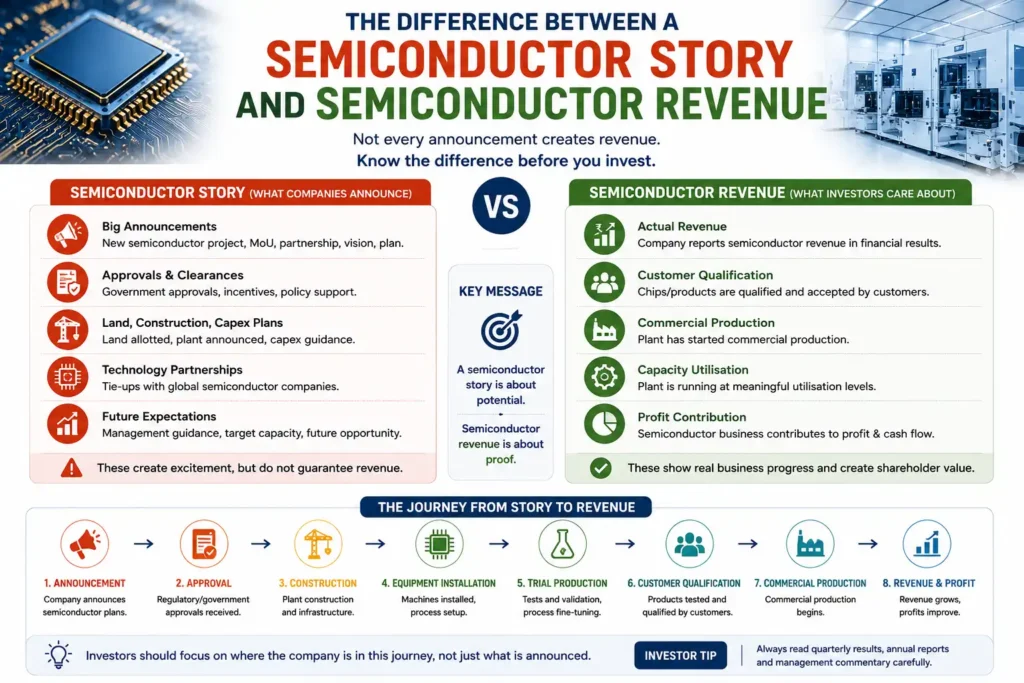
This may be the most important section of this semiconductor stocks India analysis.
Investors often react strongly when a company announces:
“Semiconductor project approved.”
“Company enters chip manufacturing.”
“New semiconductor plant.”
“Semiconductor MoU signed.”
However, an announcement does not immediately create revenue.
The real journey may look like this:
Announcement → Government Approval → Funding → Land → Plant Construction → Equipment Installation → Trial Production → Customer Qualification → Commercial Production → Capacity Ramp-Up → Stable Revenue
Every stage carries risk.
For example, a semiconductor facility may be physically complete but still need customer qualification.
A plant may begin commercial production but initially operate at low capacity utilisation.
A company may report semiconductor revenue, but the business may not yet contribute meaningful profit.
Therefore, FundzWise separates semiconductor exposure into two categories.
Visible Semiconductor Revenue
The company already earns meaningful revenue from semiconductor products or services.
Future Semiconductor Opportunity
The company has announced, approved, or commissioned a project, but investors are still waiting for a significant revenue contribution.
Never value both categories in the same way.
FundzWise Semiconductor Exposure Score
To make semiconductor stocks easier to compare, we use a simple research framework called the FundzWise Semiconductor Exposure Score.
The maximum score is 10.
| Factor | Maximum Score |
|---|---|
| Direct semiconductor revenue exposure | 2 |
| Semiconductor design or manufacturing capability | 2 |
| Approved or operational semiconductor project | 2 |
| Semiconductor-specific capital commitment | 2 |
| Semiconductor revenue visibility | 2 |
| Total | 10 |
We classify companies as follows:
8 to 10 – Direct Semiconductor Play
The semiconductor business is central to the investment case.
5 to 7.5 – Strong Semiconductor Exposure
The company has meaningful semiconductor operations or investments, but other businesses may remain important.
2 to 4.5 – Semiconductor Proxy
The company participates in semiconductor engineering, technology, or a closely connected ecosystem.
0 to 1.5 – Indirect Beneficiary
The company may benefit from electronics and semiconductor demand but does not have meaningful direct semiconductor operations.
The score is not a buy or sell rating.
It only measures the directness of semiconductor exposure.
Semiconductor Stock Exposure Checker
Select a company to check its semiconductor exposure, business type, risk level, and FundzWise classification.
Semiconductor Stocks in India: Company-by-Company Analysis
Instead of ranking companies from number one to number ten, we will examine what investors are actually buying.
CG Power and Industrial Solutions
CG Power has become one of the most closely watched semiconductor stocks India investors follow.
However, investors should understand the structure of the opportunity.
CG Power’s semiconductor exposure comes through CG Semi and the OSAT business.
OSAT stands for Outsourced Semiconductor Assembly and Test.
A semiconductor foundry may manufacture the wafer, but the chip still needs assembly, packaging, and testing before customers can use it.
CG Semi’s Sanand OSAT facility was inaugurated in July 2026. Government broadcaster News on Air described it as a ₹7,500 crore semiconductor OSAT facility.
CG Semi’s ecosystem also involves semiconductor technology relationships with Renesas Electronics and Stars Microelectronics.
Why CG Power Is on the Semiconductor Watchlist
CG Power offers investors exposure to a major Indian company entering semiconductor assembly and testing.
The OSAT opportunity could become important as India develops domestic chip manufacturing and packaging capabilities.
What Investors Must Understand
CG Power is not a pure semiconductor stock.
Its existing electrical engineering businesses remain important.
Therefore, investors must separate:
Existing CG Power earnings
from
Future CG Semi semiconductor earnings
This distinction becomes particularly important when studying valuation.
Key Growth Trigger
Commercial production, customer qualification, and semiconductor capacity utilisation.
Biggest Risk
Investors may price future semiconductor growth into the stock before the new business creates meaningful earnings.
What to Check Every Quarter
Investors should watch:
- Semiconductor revenue contribution
- Customer qualification
- Capacity utilisation
- Semiconductor capex
- Project timelines
- Margin guidance
FundzWise Classification: Strong Semiconductor Exposure
Kaynes Technology India
Kaynes Technology is an integrated electronics manufacturer with capabilities across electronic system design and manufacturing services.
Its semiconductor investment through Kaynes Semicon has changed the company’s investment story.
The company has developed OSAT capabilities in Sanand.
This creates a potential connection between Kaynes’ existing electronics manufacturing ecosystem and semiconductor packaging and testing.
Why Kaynes Technology Is Important
Kaynes already understands electronics manufacturing.
Therefore, its move into the semiconductor ecosystem is different from a completely unrelated company announcing a chip project.
The semiconductor business may create a new growth vertical if Kaynes can successfully:
- Qualify customers
- Ramp production
- Maintain quality
- Improve utilisation
- Generate acceptable margins
The Main Investor Question
The most important question is not:
Will India’s semiconductor industry grow?
The more useful question is:
How much future semiconductor success is already reflected in Kaynes Technology’s valuation?
Semiconductor businesses can receive high market valuations because investors expect years of future growth.
However, high expectations increase risk.
If revenue ramp-up takes longer than expected, the stock may face valuation pressure even when the long-term business opportunity remains intact.
Key Growth Trigger
Successful production ramp-up at Kaynes Semicon.
Biggest Risk
Execution and valuation.
What to Check Every Quarter
Watch:
- OSAT revenue
- Semiconductor customer additions
- Capacity utilisation
- Capex
- Debt
- Cash flow
- Commercial production milestones
FundzWise Classification: Strong Semiconductor Exposure
MosChip Technologies
MosChip Technologies is one of the more direct semiconductor design exposures available in the Indian listed market.
However, MosChip is not a semiconductor fabrication company.
The company operates on the design and engineering side of the value chain.
MosChip describes its silicon engineering services around turnkey ASIC, design services, and IP services. Its broader engineering capabilities also include hardware, device software, digital engineering, and AI engineering.
What Is ASIC Design?
ASIC stands for Application-Specific Integrated Circuit.
Unlike a general-purpose chip, an ASIC is designed for a specific application.
Companies may use ASICs in:
- Automotive systems
- Industrial equipment
- Consumer electronics
- Communications
- Energy systems
- IoT products
Designing an ASIC requires specialised engineering capability.
Is MosChip a Real Semiconductor Stock?
Yes, MosChip has direct semiconductor exposure on the design side.
However, investors should not describe it as a semiconductor manufacturer or wafer fabrication company.
Its investment case depends more on:
- Engineering capability
- Design orders
- Talent
- Customer relationships
- Project execution
- Scalability
Why MosChip Is on the Watchlist
India has a large engineering talent pool.
If India expands its semiconductor design ecosystem, specialised design companies may find new opportunities.
Biggest Risk
Small technology companies can experience customer concentration, project volatility, and high valuation risk.
What to Check Every Quarter
Track:
- Silicon engineering revenue
- Revenue growth
- Customer concentration
- Employee costs
- Operating margins
- New design wins
- Order visibility
FundzWise Classification: Direct Semiconductor Design Play
SPEL Semiconductor
SPEL Semiconductor offers direct exposure to semiconductor assembly and testing.
This makes the company relevant to investors researching semiconductor stocks India.
However, direct industry exposure does not automatically make a company a strong investment.
This is an important lesson.
A company can operate in a high-growth industry and still face:
- Weak revenue growth
- Low profitability
- Poor return ratios
- High debt
- Customer concentration
- Expensive valuation
Therefore, investors should study SPEL’s financial performance before focusing on the semiconductor theme.
Why SPEL Is Relevant
The company participates directly in semiconductor assembly and testing.
Therefore, its semiconductor connection is more direct than an electronics manufacturing proxy.
Biggest Risk
Business quality and financial performance must support the semiconductor narrative.
What to Check Every Quarter
Watch:
- Revenue growth
- Capacity utilisation
- Operating margin
- Return on equity
- Debt
- Cash flow
- Customer additions
FundzWise Classification: Direct Semiconductor Exposure
RIR Power Electronics
RIR Power Electronics offers a different type of semiconductor exposure.
The company focuses on high-power semiconductor solutions and is expanding its silicon carbide opportunity.
RIR has highlighted a ₹618 crore SiC semiconductor facility in Bhubaneswar. The company says the project forms part of a wider silicon carbide power campus.
The company’s project information also discusses high-power SiC MOSFETs, IGBTs, and diodes for applications including electric vehicles, renewable energy, power grids, and industrial automation.
What Is Silicon Carbide?
Silicon carbide, commonly called SiC, is a semiconductor material used in high-power and high-efficiency applications.
It is particularly important where systems must manage:
- High voltage
- High temperatures
- High power
- Energy efficiency
This makes SiC relevant to electric vehicles, renewable energy, industrial systems, and power infrastructure.
Why RIR Power Is Different
RIR Power is not competing in exactly the same segment as an OSAT company.
Its opportunity is linked to power semiconductors and compound semiconductor technology.
Key Growth Trigger
Execution of its SiC expansion and commercial revenue growth.
Biggest Risk
The company is relatively small compared with large global semiconductor players.
Project execution, capital requirements, technology, and customer adoption remain important risks.
What to Check Every Quarter
Track:
- SiC product revenue
- Facility milestones
- Capex
- Government support
- Customer orders
- Export contribution
- Operating margins
FundzWise Classification: Emerging Direct Semiconductor Play
ASM Technologies
ASM Technologies is better analysed as a semiconductor engineering exposure.
Investors should avoid confusing semiconductor engineering services with semiconductor manufacturing.
Engineering companies can participate in areas connected with:
- Semiconductor equipment
- Product development
- Design
- Technology services
- Manufacturing engineering
The investment case may benefit from increasing semiconductor capital expenditure globally and in India.
However, the company’s revenue model and customer exposure must be studied carefully.
Key Growth Trigger
Higher semiconductor engineering demand.
Biggest Risk
Customer concentration and exposure to global semiconductor capital spending cycles.
FundzWise Classification: Semiconductor Services Exposure
Is Tata Elxsi a Semiconductor Stock?
This question deserves a separate answer because many investors confuse different Tata Group businesses.
Tata Elxsi is a design and technology services company.
The company offers semiconductor-related solutions around chipset design and engineering. Its semiconductor practice discusses AI, machine learning, chipset design, product engineering, and functional safety.
Tata Elxsi also has semiconductor ecosystem partnerships. For example, the company describes itself as a Lattice semiconductor design partner.
However:
Tata Elxsi is not Tata Electronics.
This distinction is critical.
Tata Elxsi vs Tata Electronics
| Tata Elxsi | Tata Electronics |
|---|---|
| Listed company | Not separately listed |
| Design and technology services | Electronics and semiconductor manufacturing |
| Semiconductor engineering exposure | Developing semiconductor fabrication |
| Investors can buy Tata Elxsi shares | No separately listed Tata Electronics share |
Buying Tata Elxsi shares does not give an investor direct ownership of Tata Electronics’ semiconductor fab.
FundzWise View
Tata Elxsi has legitimate semiconductor engineering exposure.
However, it should not be described as a direct investment in Tata’s Dholera semiconductor manufacturing project.
FundzWise Classification: Semiconductor Technology Proxy
Can You Buy Tata Semiconductor Stock in India?
At present, investors cannot directly buy a separately listed Tata Electronics stock.
Tata Electronics is developing a semiconductor foundry in Dholera.
According to the company’s semiconductor foundry information, the planned fab is expected to have total monthly capacity of 50,000 wafers.
The facility targets analog and logic integrated circuits based on 28 nm to 110 nm technologies.
This is a major development for India’s semiconductor ecosystem.
However, investors should not assume that buying any Tata Group company gives direct exposure to the fab.
For example:
- Tata Elxsi is a design and technology company.
- Tata Technologies operates in engineering and product development services.
- Tata Motors is an automobile company.
- Tata Consultancy Services is an IT services company.
These businesses may have different technology connections, but none should automatically be called “Tata semiconductor stock.”
Investors should always identify the legal entity that owns the semiconductor business.
Dixon Technologies
Dixon Technologies is one of India’s major electronics manufacturing services companies.
The company reported FY2025–26 revenue of ₹48,873 crore on its corporate website and operates a broad electronics manufacturing footprint.
However, Dixon should not automatically be classified as a pure semiconductor stock.
Why Dixon Appears on Semiconductor Stock Lists
Electronics products require semiconductor components.
As India’s electronics manufacturing industry grows, demand for chips and domestic component ecosystems may also increase.
Therefore, Dixon can benefit from broader electronics localisation.
Direct or Indirect Exposure?
Mostly indirect from a semiconductor investment perspective.
The company’s primary investment story is electronics manufacturing.
FundzWise View
Investors researching semiconductor stocks India should classify Dixon as an ecosystem beneficiary rather than a direct chip manufacturing company.
FundzWise Classification: Indirect Semiconductor Beneficiary
Syrma SGS Technology
Syrma SGS Technology provides electronics manufacturing services across areas including PCB assembly, box build, tester development, repair and rework, and engineering services.
Its business connects with India’s broader electronics system design and manufacturing ecosystem.
However, this does not make Syrma SGS a pure semiconductor company.
Why Investors Watch Syrma SGS
Growth in electronics manufacturing can increase demand for:
- PCB assemblies
- Electronic components
- Testing
- Product engineering
- IoT solutions
Therefore, the company may benefit from the same localisation trend supporting India’s semiconductor ambitions.
FundzWise View
Syrma SGS is better classified as an electronics ecosystem beneficiary.
FundzWise Classification: Semiconductor Ecosystem Proxy
Vedanta
Vedanta has been associated with India’s semiconductor ambitions for several years.
However, investors should handle the semiconductor investment thesis carefully.
A proposed semiconductor project and an operating semiconductor business are not the same.
Before treating Vedanta as a semiconductor stock, investors should check:
- Current project status
- Government approval
- Technology partner
- Funding structure
- Construction progress
- Commercial production timeline
- Ownership structure
Vedanta remains a diversified natural resources company.
Therefore, its existing businesses continue to dominate the investment case unless a semiconductor project reaches meaningful commercial scale.
FundzWise Classification: Speculative Semiconductor Exposure
Direct Semiconductor Stocks vs Semiconductor Proxy Stocks
The following distinction can help investors avoid thematic investing mistakes.
| Company Type | Semiconductor Connection | Example |
|---|---|---|
| Direct design | Designs semiconductor chips | MosChip |
| Direct assembly/testing | Packages and tests chips | SPEL |
| Emerging OSAT | Developing semiconductor assembly and testing | CG Semi, Kaynes Semicon |
| Power semiconductor | Develops specialised power semiconductor products | RIR Power |
| Semiconductor engineering | Supports semiconductor technology development | ASM Technologies |
| Technology proxy | Provides chipset and design services | Tata Elxsi |
| Electronics proxy | Manufactures products that use semiconductors | Dixon |
| Ecosystem beneficiary | Participates in electronics manufacturing | Syrma SGS |
An investor looking for direct semiconductor exposure should not build a portfolio entirely from proxy stocks.
Similarly, an investor seeking lower business concentration may prefer a diversified company rather than a small pure-play stock.
The right choice depends on risk tolerance.
India Semiconductor Project Tracker 2026
India’s semiconductor story should be tracked project by project.
| Project | Location | Segment | 2026 Investor View |
|---|---|---|---|
| Tata Electronics–PSMC | Dholera, Gujarat | Wafer fabrication | Major ecosystem project under development |
| Tata semiconductor assembly project | Assam | Assembly and testing | Important packaging ecosystem project |
| Micron | Sanand, Gujarat | ATMP | Manufacturing ecosystem catalyst |
| CG Semi | Sanand, Gujarat | OSAT | Facility inaugurated in July 2026 |
| Kaynes Semicon | Sanand, Gujarat | OSAT | Production and capacity ramp-up story |
| RIR Power Electronics | Odisha | SiC power semiconductor | Emerging compound semiconductor project |
India’s official semiconductor programme had reached 12 approved manufacturing units by May 2026.
The project tracker should therefore be updated regularly.
A six-month-old semiconductor article can quickly become outdated because project milestones change.
How We Evaluate Semiconductor Stocks at FundzWise

We do not consider a stock attractive simply because the company uses the word “semiconductor” in an investor presentation.
Instead, investors can ask the following six questions.
Where Does the Company Sit in the Semiconductor Value Chain?
First identify the business.
Does the company:
- Design chips?
- Manufacture wafers?
- Assemble chips?
- Package semiconductors?
- Test chips?
- Manufacture semiconductor equipment?
- Produce semiconductor materials?
- Provide engineering services?
- Manufacture electronic products?
This simple question eliminates much confusion.
Is Semiconductor Revenue Already Visible?
Read the company’s annual report and quarterly results.
Search for segment revenue.
If management repeatedly discusses semiconductor opportunity but does not disclose meaningful revenue, investors should treat the business as an emerging opportunity.
Do not treat expected revenue as current revenue.
Has Commercial Production Started?
FundzWise uses a simple project status system.
Operational: Commercial production is established.
Production Ramp-Up: Production has started, but utilisation is increasing.
Under Construction: The facility is being built.
Approved: The project has received relevant approval.
Proposed: Management has discussed or announced the opportunity.
These stages should never receive the same valuation assumption.
Who Are the Technology Partners?
Semiconductor technology is complex.
Investors should check whether the company has:
- Technology licensing agreements
- Joint venture partners
- Equipment partners
- Design partners
- Customer relationships
A strong global partner may reduce some technology risk.
However, a partnership does not remove execution risk.
How Much Capital Does the Project Require?
Semiconductor manufacturing is capital intensive.
Investors should examine:
- Total project cost
- Government fiscal support
- Promoter contribution
- Debt
- Equity dilution
- Cash reserves
- Operating cash flow
A company may have an excellent project but a weak balance sheet.
That combination can create shareholder risk.
Is the Stock Price Already Discounting Future Growth?
This is the most difficult question.
A strong industry can still produce poor stock returns if investors pay an excessive price.
Ask:
If semiconductor revenue takes two additional years to become meaningful, does the current valuation still make sense?
Investors should perform this stress test before buying a semiconductor theme stock.
Eight Numbers Semiconductor Stock Investors Should Track
Quarterly results can provide more useful information than daily share price movements.
Semiconductor Revenue
Check whether the company separately discloses semiconductor revenue.
Order Book
A growing order book may improve future revenue visibility.
However, investors should understand the execution period of orders.
Capacity Utilisation
A large factory operating at low utilisation may struggle to generate attractive returns.
Capital Expenditure
Compare actual capex with management guidance.
Large delays or cost increases require attention.
Net Debt
Semiconductor expansion funded through excessive debt can increase financial risk.
Operating Cash Flow
Profit does not always equal cash.
Compare reported profit with operating cash generation.
EBITDA Margin
Track whether the new business improves or reduces company margins.
Customer Concentration
High dependence on one or two customers increases risk.
Investors should also monitor plant status, government incentive receipts, commercial production timelines, and technology partnership changes.
Semiconductor Stocks India Risk Matrix
| Semiconductor Business | Growth Potential | Execution Risk | Valuation Risk | Cyclical Risk |
|---|---|---|---|---|
| Chip design | High | Medium | High | Medium |
| Wafer fabrication | Very high | Very high | High | High |
| OSAT | High | High | High | High |
| Power semiconductors | High | High | High | Medium |
| Semiconductor engineering | Medium | Medium | Medium | High |
| Electronics proxy | Medium | Low to medium | High | Medium |
The risk matrix explains why investors should not treat the semiconductor theme as one homogeneous sector.
What Could Go Wrong With India’s Semiconductor Investment Story?
India’s semiconductor opportunity is significant.
However, investors should analyse risks with the same seriousness as growth projections.
Semiconductor Projects Can Face Delays
Large semiconductor projects require specialised equipment, construction, technology, and engineering.
Even small delays can change revenue estimates.
Customer Qualification Takes Time
A semiconductor customer cannot always change suppliers overnight.
Automotive and industrial customers may require extensive testing and qualification.
Therefore, a new plant may take time to build a strong customer base.
Capacity Utilisation May Remain Low Initially
Building a plant creates capacity.
Customers create utilisation.
Investors should not value a facility only on its maximum production capacity.
Actual utilisation matters.
Manufacturing Yield Can Affect Profitability
Yield refers to the percentage of usable semiconductor products produced from the manufacturing process.
Poor yield can increase costs.
This is one reason semiconductor manufacturing requires deep technical expertise.
Technology Can Become Obsolete
Semiconductor technology evolves rapidly.
A company must invest in relevant technology rather than simply create manufacturing capacity.
Valuation Can Become Excessive
Semiconductor stocks may attract thematic investors.
As excitement increases, share prices can move faster than earnings.
Eventually, the company must deliver revenue and profit.
Semiconductor Businesses Require Large Capital
Factories, cleanrooms, equipment, and testing infrastructure require significant investment.
This can affect:
- Debt
- Cash flow
- Return on capital
- Share dilution
The Global Semiconductor Industry Is Cyclical
Semiconductor demand can move through expansion and correction cycles.
Inventory changes can affect orders.
Investors should avoid assuming uninterrupted growth every year.
Geopolitical Risk Can Affect Supply Chains
The global semiconductor industry depends on complex international supply chains.
Equipment, materials, technology, and manufacturing capabilities are spread across several countries.
Trade restrictions or geopolitical tensions can affect supply.
Water and Power Infrastructure Matter
Semiconductor facilities require reliable infrastructure.
Power quality, water availability, and logistics can influence manufacturing operations.
Investors often ignore these factors because they focus only on revenue projections.
Small-Cap Semiconductor Stocks in India: Opportunity or Speculation?
Small semiconductor companies can offer high growth potential.
They can also carry high risk.
A small company may grow rapidly if it wins major customers.
However, the same company may face serious problems if:
- One customer leaves
- A project gets delayed
- Capex rises
- Debt increases
- Technology changes
- Margins fall
Therefore, investors should never assume:
Small semiconductor company = future global chip giant
India’s semiconductor ecosystem is developing, but not every company will become a winner.
For small-cap semiconductor stocks, investors should examine balance sheet quality before growth projections.
Semiconductor Penny Stocks: Should You Invest?
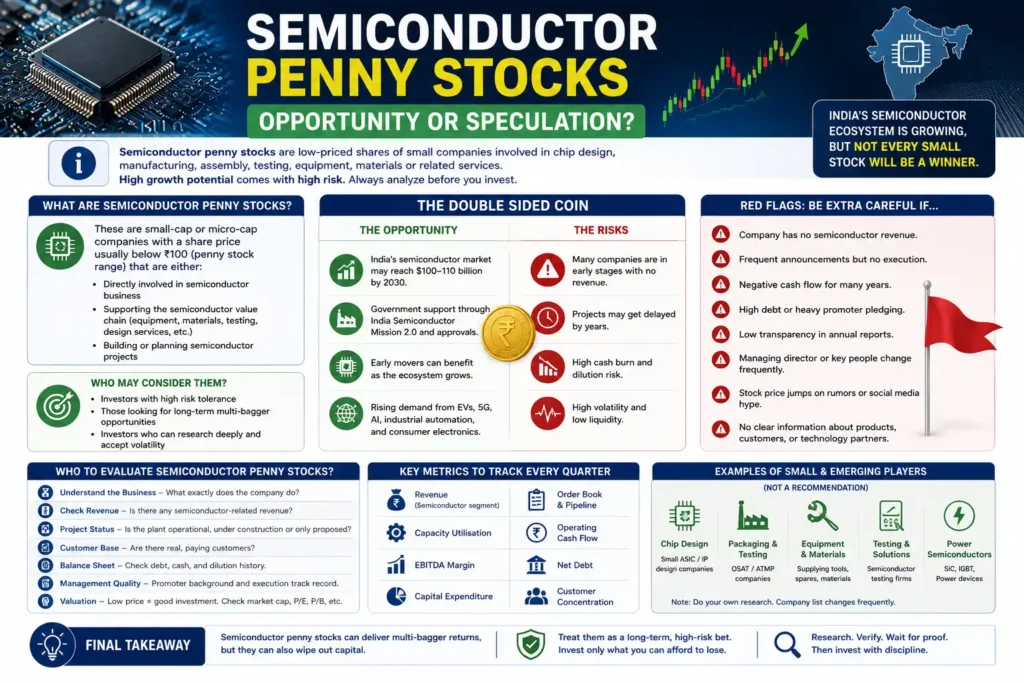
The term “semiconductor penny stocks India” attracts significant investor interest.
However, the word semiconductor can become a marketing narrative for speculative stocks.
Before buying a low-priced stock, check:
- Does the company have semiconductor revenue?
- What semiconductor products does it sell?
- Does it own manufacturing or design capability?
- Who are its customers?
- Is the annual report clear?
- Is operating cash flow positive?
- Has the company repeatedly diluted shareholders?
- Is debt increasing?
- Are promoter pledges high?
- Does the company make frequent announcements without financial results?
A ₹20 stock is not automatically cheaper than a ₹2,000 stock.
Share price alone does not determine valuation.
Market capitalisation, earnings, cash flow, debt, and future growth matter.
Which Type of Semiconductor Stock May Suit Different Investors?
Different semiconductor exposures carry different risks.
| Investor Profile | Semiconductor Exposure to Research |
|---|---|
| Conservative | Diversified profitable companies with technology exposure |
| Moderate | Established companies expanding into semiconductor operations |
| Aggressive | Direct semiconductor design and emerging manufacturing companies |
| Very high risk | Small-cap semiconductor project stories |
Conservative investors should be particularly careful with companies where most of the valuation depends on future semiconductor revenue.
Aggressive investors may accept project execution risk.
However, high risk tolerance does not remove the need for valuation discipline.
Semiconductor Stocks vs Electronics Manufacturing Stocks
These two themes often overlap, but they are not identical.
Semiconductor Company
A semiconductor company may:
- Design chips
- Manufacture semiconductor devices
- Package chips
- Test semiconductors
Electronics Manufacturing Company
An electronics manufacturing company may:
- Assemble smartphones
- Manufacture appliances
- Produce printed circuit board assemblies
- Build electronic products
The electronics manufacturer is a semiconductor customer or ecosystem participant.
This distinction is important when comparing stocks.
For example, a smartphone manufacturing boom may benefit an electronics manufacturer.
However, the semiconductor chips used in those smartphones may still come from global suppliers.
Domestic electronics growth does not automatically mean domestic semiconductor manufacturing growth at the same rate.
Should You Invest in Semiconductor Stocks Through SIP?
A systematic investment approach can reduce the risk of investing a large amount at a single market level.
However, an SIP does not make an expensive stock cheap.
If an investor wants to gradually build semiconductor exposure, a staggered approach may help manage price volatility.
For example, an investor may:
- Create a research watchlist
- Select financially strong companies
- Decide maximum sector allocation
- Invest gradually
- Review quarterly results
- Add only when the investment thesis remains intact
Do not average a semiconductor stock simply because its price has fallen.
First ask why the price has fallen.
If project execution has failed, blind averaging can increase losses.
How Much Portfolio Allocation to Semiconductor Stocks Is Reasonable?
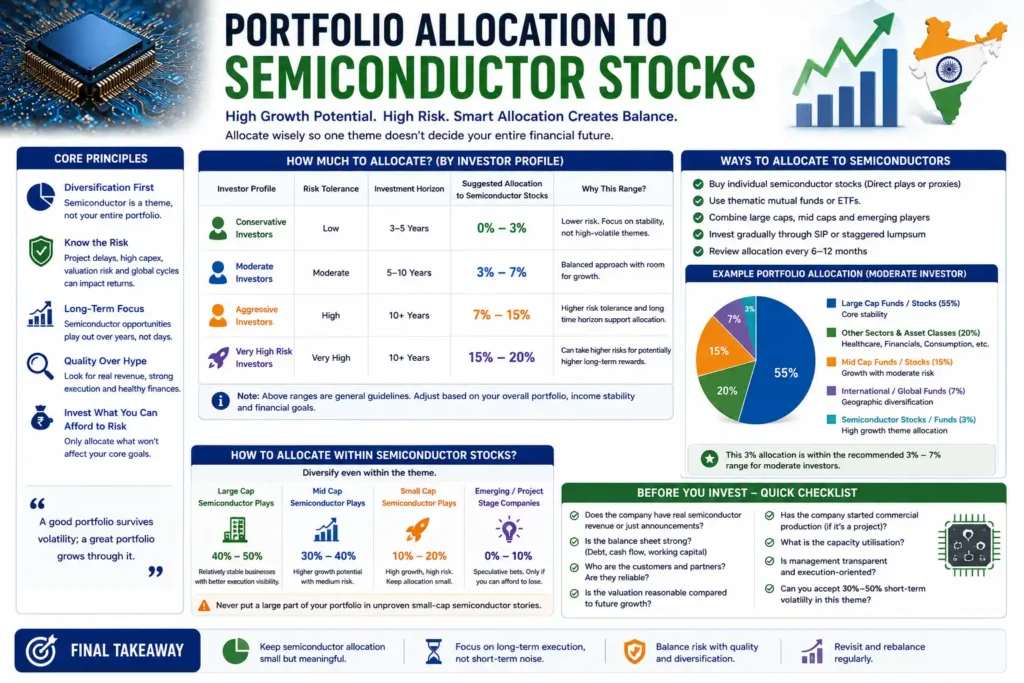
There is no universal allocation suitable for every investor.
Allocation depends on:
- Age
- Risk tolerance
- Existing portfolio
- Investment horizon
- Income stability
- Financial goals
However, thematic exposure should generally remain controlled.
An investor already holding technology, electronics, EV, and defence stocks may have more indirect semiconductor exposure than expected.
Therefore, check portfolio overlap.
Do not create a portfolio where every stock depends on the same semiconductor growth story.
Diversification still matters.
Semiconductor Stocks India Watchlist for 2026 and Beyond
Instead of calling any stock the “best semiconductor stock to buy now,” FundzWise prefers a research watchlist.
CG Power
Why watch: Direct OSAT opportunity through CG Semi.
Growth trigger: Semiconductor production and utilisation ramp-up.
Biggest risk: Future semiconductor expectations may run ahead of earnings.
Next result check: Semiconductor revenue and customer qualification.
Kaynes Technology
Why watch: Semiconductor packaging and testing expansion through Kaynes Semicon.
Growth trigger: OSAT production ramp-up.
Biggest risk: Execution and valuation.
Next result check: Semiconductor revenue visibility and capacity utilisation.
MosChip Technologies
Why watch: Direct semiconductor design exposure.
Growth trigger: ASIC design wins and silicon engineering growth.
Biggest risk: Customer concentration and small-cap volatility.
Next result check: Silicon engineering revenue and margins.
SPEL Semiconductor
Why watch: Direct semiconductor assembly and testing exposure.
Growth trigger: Higher utilisation and customer growth.
Biggest risk: Financial performance.
Next result check: Revenue growth, cash flow, and return ratios.
RIR Power Electronics
Why watch: Silicon carbide and high-power semiconductor opportunity.
Growth trigger: SiC project execution and commercial orders.
Biggest risk: Project and capital execution.
Next result check: Facility milestones and SiC revenue.
ASM Technologies
Why watch: Semiconductor engineering exposure.
Growth trigger: Higher semiconductor engineering demand.
Biggest risk: Global semiconductor cycle.
Tata Elxsi
Why watch: Semiconductor and chipset engineering services.
Growth trigger: Design partnerships and semiconductor engineering demand.
Biggest risk: Investors confusing technology exposure with direct semiconductor manufacturing.
Dixon Technologies
Why watch: India’s electronics manufacturing expansion.
Growth trigger: Electronics localisation.
Biggest risk: Indirect semiconductor exposure.
Syrma SGS Technology
Why watch: Electronics system design and manufacturing ecosystem.
Growth trigger: Domestic electronics manufacturing growth.
Biggest risk: It is not a pure semiconductor play.
The Future of Semiconductor Stocks in India
India’s semiconductor story is entering a more important phase.
The first phase focused on policy.
The second phase focused on project approvals.
The next phase will focus on execution.
Investors should expect the market to ask harder questions.
Which plants have started production?
Which companies have qualified customers?
What is capacity utilisation?
How much semiconductor revenue is visible?
Are margins attractive?
Is the balance sheet strong enough to fund expansion?
These questions will gradually separate serious semiconductor businesses from companies that only benefit from the market narrative.
India’s long-term opportunity remains significant.
The government is expanding the semiconductor policy framework, 12 manufacturing units had received approval by May 2026, and 24 semiconductor design companies had received fiscal support approval.
Meanwhile, Tata Electronics is developing a planned 50,000-wafer-per-month fab for 28 nm to 110 nm analog and logic chips, CG Semi’s OSAT facility has entered the operational phase, and companies such as RIR Power are building specialised SiC semiconductor capabilities.
However, a growing industry does not guarantee that every related stock will deliver strong returns.
Investors must separate:
Industry growth from company growth
Company growth from profit growth
Profit growth from stock returns
The final step depends heavily on the price an investor pays.
Frequently Asked Questions About Semiconductor Stocks India
Which are the semiconductor stocks in India?
Indian listed companies with different forms of semiconductor exposure include CG Power and Industrial Solutions, Kaynes Technology, MosChip Technologies, SPEL Semiconductor, RIR Power Electronics, ASM Technologies, and Tata Elxsi. Dixon Technologies and Syrma SGS are better classified as electronics ecosystem beneficiaries rather than pure semiconductor companies.
Which is the best semiconductor stock in India?
There is no single semiconductor stock suitable for every investor. CG Power and Kaynes offer emerging OSAT exposure, MosChip provides semiconductor design exposure, and RIR Power focuses on power semiconductors and SiC. Investors should compare valuation, financial quality, execution risk, and direct semiconductor revenue before investing.
Is Tata Elxsi a semiconductor stock?
Tata Elxsi has semiconductor engineering and chipset design exposure. However, it is a design and technology services company and should not be confused with Tata Electronics’ semiconductor manufacturing business.
Can I buy Tata Electronics semiconductor shares?
Tata Electronics is not separately listed on the Indian stock exchanges. Therefore, retail investors cannot directly buy a separately traded Tata Electronics share at the time of writing.
Is MosChip a pure semiconductor stock?
MosChip has direct semiconductor exposure through ASIC, silicon engineering, design, and IP services. However, it is a semiconductor design and engineering company rather than a wafer fabrication company.
Is Dixon Technologies a semiconductor stock?
Dixon Technologies is primarily an electronics manufacturing services company. It may benefit from India’s growing electronics and component ecosystem, but investors should classify it as an indirect semiconductor beneficiary rather than a pure semiconductor stock.
What is an OSAT company?
OSAT stands for Outsourced Semiconductor Assembly and Test. These companies provide chip assembly, packaging, and testing services for semiconductor companies.
Are semiconductor stocks risky?
Yes. Semiconductor stocks can face technology risk, project delays, high capital requirements, customer concentration, cyclical demand, and expensive valuations. Emerging semiconductor companies may carry additional execution risk.
Will India’s semiconductor industry grow by 2030?
Government material has cited estimates that India’s semiconductor market could reach $100 billion to $110 billion by 2030. However, individual company performance will depend on execution, customers, technology, and financial strength.
Are small-cap semiconductor stocks good for long-term investment?
Some small semiconductor companies may benefit from industry growth. However, small-cap stocks can carry higher liquidity, customer concentration, balance sheet, and execution risks. Investors should study financial statements and business quality before investing.
Final FundzWise View
The search for semiconductor stocks India should not begin with a list of stock names.
It should begin with the semiconductor value chain.
First, understand whether a company designs chips, manufactures semiconductor devices, packages and tests chips, provides engineering services, or simply manufactures electronic products that use semiconductors.
Then check whether semiconductor revenue exists today.
After that, study project status, customers, capacity utilisation, capex, debt, and valuation.
India’s semiconductor opportunity is moving forward. India Semiconductor Mission 2.0 expands the policy focus, approved manufacturing and design projects are increasing, and new semiconductor facilities are moving towards production.
Still, investors should avoid buying every company attached to the semiconductor theme.
A small semiconductor company is not automatically the next Nvidia.
A semiconductor plant announcement is not revenue.
Commercial production is not full capacity utilisation.
Industry growth is not guaranteed stock market return.
The semiconductor stocks that may create long-term shareholder value will likely be the companies that combine real technology, successful execution, strong customers, disciplined capital allocation, and reasonable valuation.
For investors, the goal should not be to find the stock with the loudest semiconductor story.
The goal should be to identify the company where semiconductor opportunity is gradually becoming measurable business performance.
Disclaimer: This article is for educational and informational purposes only. It does not constitute investment advice or a stock recommendation. Semiconductor stocks can be volatile and may carry high business, technology, execution, and valuation risks. Investors should conduct independent research and consult a SEBI-registered investment adviser where appropriate before making investment decisions.