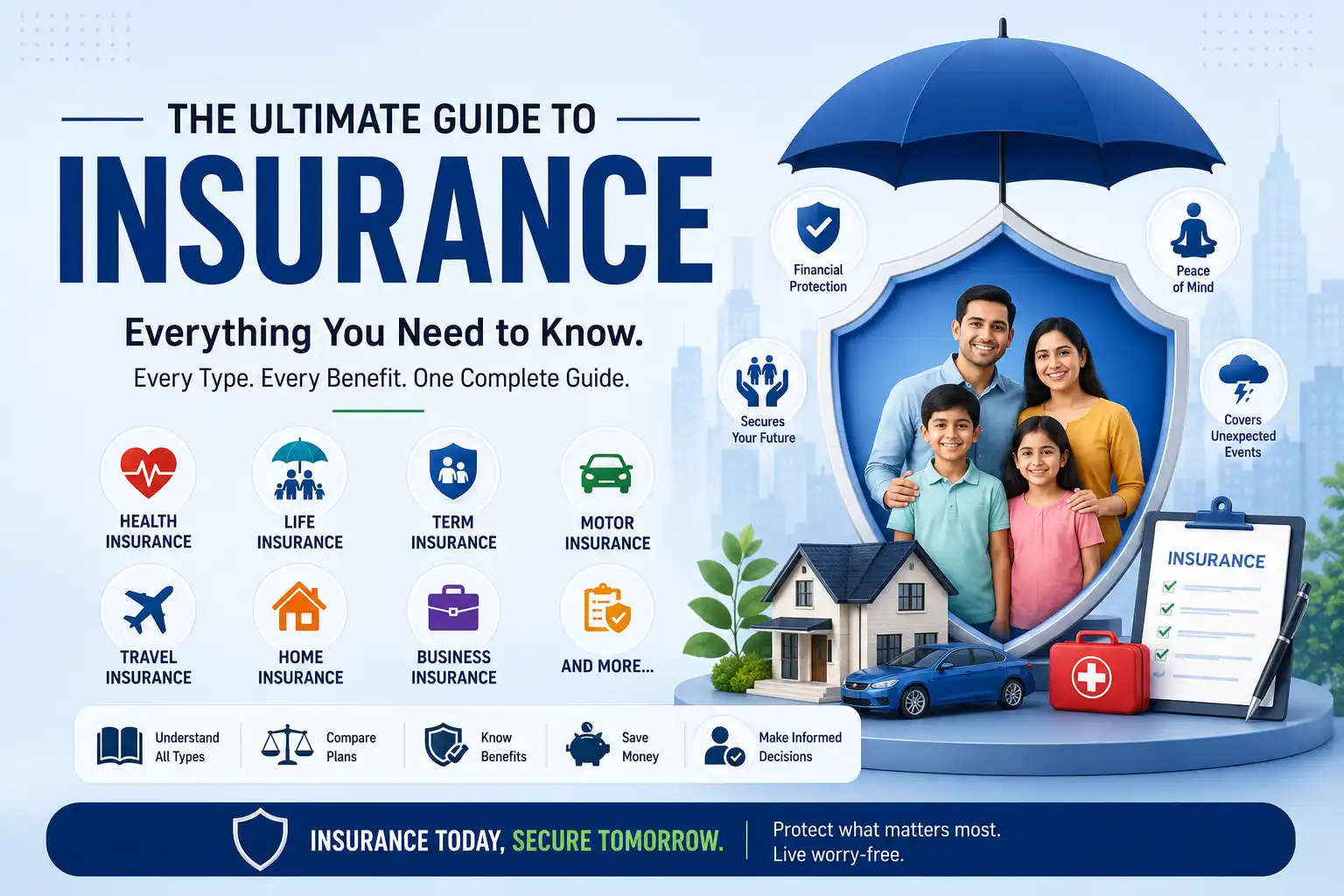
Insurance is one of the most important financial tools you can own. It protects you, your family, and your assets against unexpected financial losses. Whether it’s a medical emergency, a road accident, damage to your home, or the unfortunate loss of a family’s primary earner, insurance provides a financial safety net during life’s most difficult moments.
Unfortunately, many people still consider insurance an unnecessary expense instead of viewing it as financial protection. This misconception often leads individuals to delay buying insurance until it’s too late. A single unexpected event can wipe out years of savings, create debt, or even derail long-term financial goals.
Today’s world is filled with uncertainties. Healthcare costs continue to rise, natural disasters are becoming more frequent, cyber threats are increasing, and road accidents happen every day. Having the right insurance policy helps you prepare for these uncertainties without putting your family’s financial future at risk.
This comprehensive guide explains everything you need to know about insurance in India. You’ll learn how insurance works, the different types of insurance available, essential insurance terminology, the benefits of having adequate coverage, and practical tips to help you choose the right policy for your needs.
Whether you’re buying insurance for the first time or reviewing your existing coverage, this guide will help you make informed decisions with confidence.
What Is Insurance?
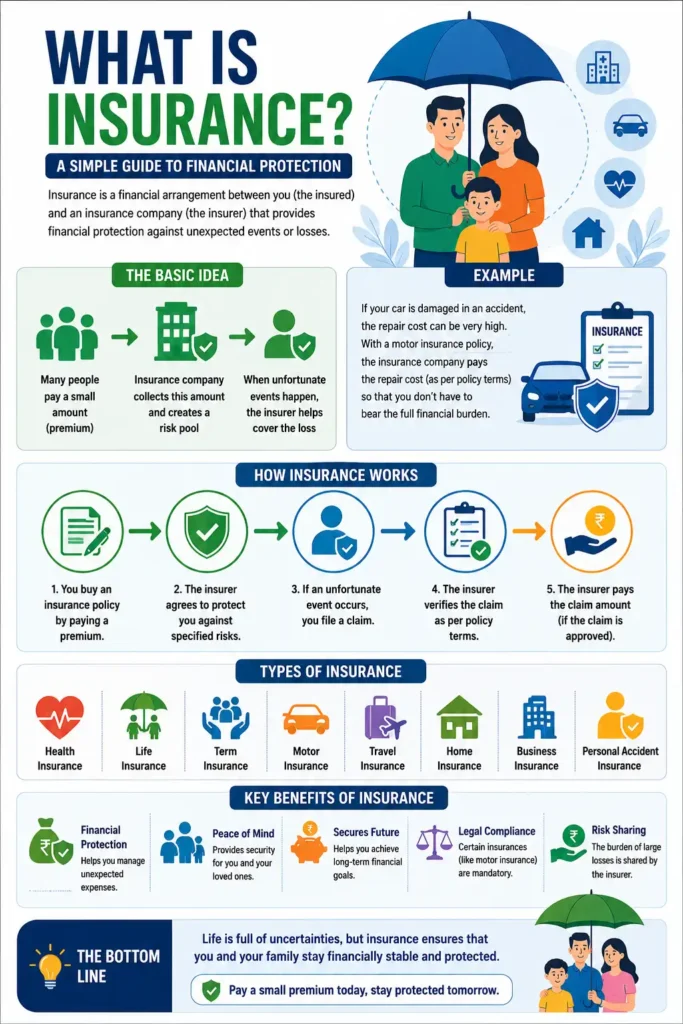
Insurance is a legal agreement between an individual (known as the policyholder) and an insurance company. Under this agreement, the policyholder pays a fixed amount of money, called a premium, and the insurer promises to provide financial compensation if a covered event occurs.
Simply put, insurance transfers financial risk from you to the insurance company.
For example:
Imagine you own a car worth ₹12 lakh. If your car is damaged in an accident, repairing it could cost several lakhs. Without insurance, you would have to bear the entire expense yourself. With a comprehensive motor insurance policy, most of the repair costs may be covered, depending on the policy terms.
Similarly, if you are hospitalized due to an illness or injury, a health insurance policy can significantly reduce your out-of-pocket medical expenses.
Insurance doesn’t prevent unfortunate events from happening, but it helps reduce their financial impact.
Simple Definition
Insurance is a financial protection plan that helps individuals and businesses recover from unexpected losses by sharing risk among a large group of policyholders.
Why Do We Need Insurance?
Life is unpredictable.
You cannot predict:
- Medical emergencies
- Road accidents
- Fire accidents
- Natural disasters
- Theft
- Disability
- Critical illnesses
- Loss of income
- Death of a family member
Although these events cannot always be prevented, their financial consequences can be managed with the right insurance coverage.
Without insurance, even a single unexpected event can force families to:
- Use emergency savings
- Sell investments
- Borrow money
- Take personal loans
- Delay financial goals
- Accumulate debt
Insurance provides peace of mind because it ensures that financial support is available when you need it most.
Real-Life Example
Rahul is a 35-year-old software engineer earning ₹18 lakh annually. He has a wife and two children.
He purchases:
- ₹1 crore term insurance
- ₹20 lakh family health insurance
- Comprehensive car insurance
Two years later, Rahul undergoes emergency surgery costing ₹9 lakh.
Since he has health insurance, the majority of the hospital expenses are covered by his insurer.
Without insurance, Rahul would have had to liquidate investments or take a personal loan.
This simple example highlights why insurance is not merely an expense—it is an essential part of financial planning.
Why Insurance Is Important
Insurance plays a crucial role in protecting your financial well-being.
1. Financial Security
The primary purpose of insurance is to safeguard your finances.
Unexpected expenses can be overwhelming, but insurance helps absorb much of the financial burden.
2. Protects Your Family
Life insurance ensures that your family’s financial needs continue to be met if something happens to the primary earning member.
This financial support can help cover:
- Household expenses
- Children’s education
- Home loan repayments
- Daily living costs
- Future financial goals
3. Covers Rising Medical Costs
Healthcare inflation in India has increased significantly over the past decade.
Hospitalization, surgeries, and specialized treatments can cost several lakhs of rupees.
Health insurance helps protect your savings from these escalating medical expenses.
4. Supports Long-Term Financial Planning
Insurance complements your investment strategy.
Instead of dipping into retirement savings or investment portfolios during emergencies, insurance allows your long-term financial plans to stay on track.
5. Reduces Financial Stress
Knowing that you’re financially protected during difficult situations provides confidence and peace of mind.
This emotional benefit is often overlooked but extremely valuable.
6. Encourages Responsible Financial Planning
People with adequate insurance coverage generally have stronger financial foundations.
Insurance encourages individuals to:
- Assess risks
- Plan for emergencies
- Protect assets
- Think long term
History of Insurance
Insurance is not a modern invention.
Its roots date back thousands of years.
Ancient merchants used early forms of risk-sharing to protect themselves from financial losses during trade.
If one trader’s shipment was lost at sea, losses were shared among all merchants instead of falling entirely on one person.
Over time, this concept evolved into organized insurance systems.
Today’s insurance industry is supported by:
- Advanced actuarial science
- Data analytics
- Regulatory oversight
- Technology-driven underwriting
- Digital claim processing
Modern insurance is one of the pillars of every developed economy.
How Insurance Works
Many people buy insurance without understanding how it actually works.
Let’s break the process into simple steps.
Step 1: You Buy a Policy
You choose an insurance policy based on your needs.
For example:
- Health Insurance
- Term Insurance
- Car Insurance
Step 2: You Pay Premiums
You pay the insurance company a premium.
Premiums may be:
- Monthly
- Quarterly
- Half-yearly
- Annually
Step 3: The Insurance Company Pools Risk
Thousands or even millions of policyholders contribute premiums.
The insurer pools these funds into a common risk pool.
This collective pool is used to compensate policyholders who experience covered losses.
Step 4: A Covered Event Occurs
Suppose you are hospitalized.
You notify your insurance company and submit the required documents.
Step 5: Claim Assessment
The insurer verifies:
- Policy validity
- Coverage terms
- Supporting documents
- Cause of loss
- Exclusions
Step 6: Claim Settlement
If the claim is approved, the insurer pays according to the policy terms.
Depending on the type of insurance, payment may go directly to:
- You
- Hospital
- Repair garage
- Beneficiary
Insurance Process Flow
Choose Policy
↓

Pay Premium

↓

Insurance Company Creates Risk Pool

↓

Unexpected Event Happens

↓

Claim Submitted

↓

Verification

↓

Claim Approved

↓

Compensation Paid
Parties Involved in Insurance
Understanding who is involved in an insurance policy helps you better understand how the system works.
Policyholder
The individual or business purchasing the insurance policy.
Insurer
The insurance company providing financial protection.
Nominee
A person designated to receive policy benefits in case of the policyholder’s death (where applicable).
Beneficiary
The person or entity entitled to receive claim benefits.
Insurance Agent or Advisor
Professionals who help customers understand policies and complete the purchase process.
Surveyor or Loss Assessor
Experts appointed to evaluate the extent of damage or loss in certain types of insurance claims.
Basic Insurance Terms You Must Know
Understanding these terms will make it much easier to compare and choose insurance policies.
| Term | Meaning |
|---|---|
| Policy | The legal contract between you and the insurer |
| Premium | Amount paid to keep the policy active |
| Sum Insured | Maximum amount payable under a general insurance policy |
| Sum Assured | Guaranteed amount payable in many life insurance policies |
| Claim | Request made to receive policy benefits |
| Deductible | Portion of the loss you pay before the insurer contributes |
| Co-payment | Percentage of claim amount shared by the insured |
| Rider | Optional additional benefit added to the base policy |
| Exclusion | Situations or conditions not covered by the policy |
| Waiting Period | Time during which certain claims are not eligible |
| Grace Period | Additional time allowed to pay overdue premiums |
| Free Look Period | Period during which a new policy can be reviewed and canceled under applicable rules |
| Underwriting | Risk evaluation process before issuing a policy |
| Nominee | Person chosen to receive benefits under eligible policies |
| No Claim Bonus | Reward for not making claims during the policy period |
How Insurance Companies Decide Your Premium
Many people wonder why premiums differ from one person to another.
Insurance companies assess the level of risk before determining the premium.
Some common factors include:
Age
Older individuals generally face higher premiums due to increased risk.
Medical History
Existing health conditions can affect health and life insurance premiums.
Lifestyle
Habits such as smoking or excessive alcohol consumption may increase risk and premiums.
Occupation
Jobs involving higher physical risk may attract higher premiums.
Coverage Amount
Higher coverage generally means a higher premium.
Policy Features
Adding optional riders or extra benefits usually increases the premium.
Claim History
A history of frequent claims may influence premiums for certain types of insurance.
Key Principles of Insurance
Insurance operates on several fundamental principles.
Principle of Utmost Good Faith
Both the insurer and the policyholder must disclose all relevant information honestly.
Providing incorrect or incomplete information may affect claim eligibility.
Principle of Insurable Interest
You can only insure something in which you have a legitimate financial interest.
For example:
- Your own house
- Your own car
- Your own life
- Your business
Principle of Indemnity
Most general insurance policies aim to restore the insured to the financial position they were in before the loss, without allowing financial gain from the claim.
Principle of Contribution
If multiple policies cover the same loss, insurers may share the claim payment according to applicable rules.
Principle of Loss Minimization
Policyholders are expected to take reasonable steps to reduce or prevent further damage after an insured event.
Key Takeaways
- Insurance protects you from unexpected financial losses.
- It transfers risk from individuals to insurance companies.
- Premiums are based on factors such as age, health, lifestyle, and coverage.
- Understanding basic insurance terms helps you compare policies effectively.
- Insurance is a critical part of a well-rounded financial plan, not just an optional expense.
What’s Coming Next
Now that you understand the fundamentals of insurance, the next section explores the different types of insurance available in India and helps you identify which policies are most relevant for your personal, family, and financial needs.
In the following part of this guide, we’ll cover Health Insurance, Life Insurance, Term Insurance, Motor Insurance, Travel Insurance, Home Insurance, Business Insurance, and more in detail.
What Is Health Insurance?
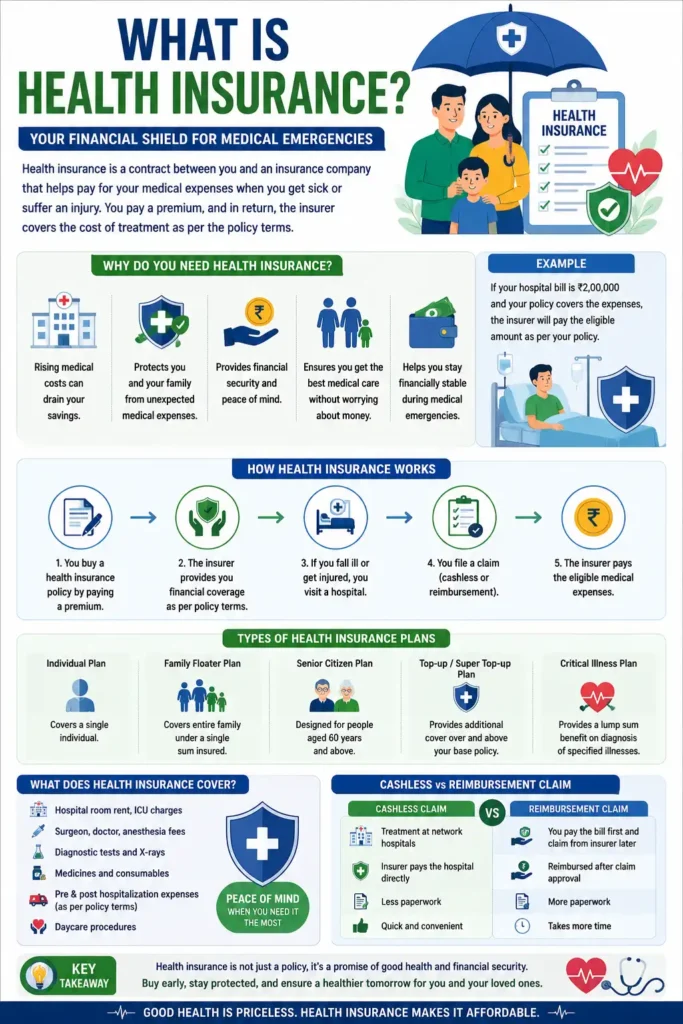
Health insurance is a financial protection plan that helps cover medical expenses arising from illnesses, injuries, surgeries, hospitalization, and certain preventive healthcare services. Instead of paying the full treatment cost from your own pocket, you pay a relatively small premium to an insurance company. In return, the insurer agrees to cover eligible medical expenses according to the policy’s terms and conditions.
Healthcare costs in India have increased significantly over the last decade. A single hospitalization can cost anywhere between ₹50,000 and several lakhs depending on the illness, hospital, and city. Without adequate health insurance, these unexpected expenses can quickly drain your savings or force you to borrow money.
Health insurance acts as a financial safety net. It ensures that medical emergencies do not become financial emergencies.
Whether you are a young professional, a parent, a senior citizen, or a business owner, having adequate health insurance is one of the smartest financial decisions you can make.
Why Health Insurance Is Important
Many people believe they don’t need health insurance because they are young and healthy. However, illnesses and accidents can happen without warning. Buying health insurance early provides several advantages, including lower premiums, shorter waiting periods over time, and continuous financial protection.
Some of the biggest reasons to invest in health insurance include:
Protection Against Rising Medical Costs
Medical inflation in India is growing faster than general inflation. Hospital charges, diagnostic tests, surgeries, medicines, and specialist consultations become more expensive every year.
A health insurance policy helps protect your savings against these increasing healthcare costs.
Financial Security During Medical Emergencies
Medical emergencies often require immediate treatment. Having insurance allows you to focus on recovery rather than arranging funds.
Access to Better Healthcare
Many insurance providers offer access to a large network of hospitals where cashless treatment is available. This means eligible medical bills are settled directly between the insurer and the hospital, reducing the financial burden during emergencies.
Protection for Your Family
Family health insurance plans provide coverage for multiple family members under one policy, making healthcare more affordable and convenient.
Tax Benefits
Premiums paid towards eligible health insurance policies may qualify for tax deductions under applicable Indian tax laws, subject to prevailing rules and limits.
Peace of Mind
Knowing that you have financial support during medical emergencies allows you to focus on your health instead of worrying about treatment costs.
How Health Insurance Works
Understanding how health insurance works makes it easier to choose the right policy.
The process generally follows these steps.
Step 1: Purchase a Policy
You select a health insurance policy based on factors such as age, family size, coverage amount, medical history, and budget.
Step 2: Pay the Premium
The insurer charges a premium, which may be paid monthly, quarterly, half-yearly, or annually depending on the available payment options.
Step 3: Policy Becomes Active
Once the premium is paid and the policy is issued, coverage begins according to the policy terms. Some benefits may have waiting periods before they become available.
Step 4: Medical Emergency Occurs
If you require hospitalization or another covered treatment, you can either use a network hospital for cashless treatment or pay first and request reimbursement if permitted under your policy.
Step 5: Claim Processing
The insurance company reviews the submitted documents, verifies policy coverage, and processes the claim.
Step 6: Claim Settlement
Once approved, eligible medical expenses are settled according to the policy conditions.
Types of Health Insurance Plans
Not every health insurance policy is designed for the same purpose. Understanding the available options helps you choose the right coverage.
Individual Health Insurance
An individual health insurance policy covers one person.
Each insured person has a separate sum insured.
This type of plan is suitable for:
- Young professionals
- Single individuals
- Newly employed people
- Individuals wanting separate coverage
Family Floater Health Insurance
A family floater policy covers multiple family members under one sum insured.
Typically, it can include:
- Husband
- Wife
- Children
- Parents (depending on the insurer)
Since the coverage is shared among all members, family floater plans are often more economical than buying separate individual policies for every family member.
Senior Citizen Health Insurance
These policies are specially designed for individuals generally aged 60 years and above.
They may include:
- Coverage for age-related illnesses
- Higher hospitalization limits
- Specialized healthcare benefits
Premiums are usually higher due to increased medical risks.
Critical Illness Insurance
Critical illness insurance provides a lump sum payout if the insured is diagnosed with specified serious illnesses covered under the policy.
Examples include:
- Cancer
- Heart attack
- Kidney failure
- Stroke
- Major organ transplant
Unlike regular health insurance, the payout is usually made as a fixed benefit after diagnosis, subject to policy conditions.
Top-Up Health Insurance
A top-up policy provides additional coverage after your existing deductible or base health insurance limit is exhausted.
It is useful for people who already have basic coverage but want extra financial protection at a relatively lower premium.
Super Top-Up Plans
Super top-up plans work similarly to top-up plans but generally consider multiple claims made during a policy year instead of only a single hospitalization.
These plans are increasingly popular for enhancing overall medical coverage.
Group Health Insurance
Many employers provide group health insurance to employees as part of their benefits package.
Although useful, employer-provided coverage may not always be sufficient for long-term healthcare needs. Having an individual health insurance policy can provide additional financial security.
Individual vs Family Floater Health Insurance
Choosing between an individual policy and a family floater depends on your family size, age, and healthcare needs.
| Feature | Individual Plan | Family Floater Plan |
|---|---|---|
| Coverage | Separate for each person | Shared among all members |
| Premium | Higher for multiple individuals | Generally more economical |
| Best For | Single individuals | Young families |
| Sum Insured | Individual limit | Common family limit |
| Flexibility | High | Moderate |
Which One Should You Choose?
An individual plan is usually suitable if:
- You live alone.
- You have different healthcare needs than your family members.
- Senior citizens require separate coverage.
A family floater plan may be better if:
- You have a young family.
- Family members are generally healthy.
- You want affordable comprehensive coverage.
What Does Health Insurance Cover?
Coverage varies by insurer and policy. Always read the policy document carefully.
Most comprehensive health insurance plans commonly include eligible expenses related to:
- Hospitalization
- Room charges (subject to policy limits)
- ICU expenses
- Doctor consultation fees during hospitalization
- Surgery expenses
- Nursing charges
- Diagnostic tests
- Medicines used during hospitalization
- Ambulance charges (subject to policy conditions)
- Day-care procedures specified in the policy
- Pre-hospitalization expenses for the period mentioned in the policy
- Post-hospitalization expenses for the period mentioned in the policy
- Organ donor expenses where covered
- Domiciliary treatment under specified conditions
- AYUSH treatment where included by the insurer
Some insurers also provide wellness benefits such as annual health check-ups and preventive healthcare programs.
What Is Usually Not Covered?
Every policy has exclusions. Understanding them is just as important as understanding the benefits.
Common exclusions may include:
- Cosmetic surgery without medical necessity
- Experimental treatments not covered by the policy
- Self-inflicted injuries
- Substance abuse-related treatments where excluded
- Certain pre-existing diseases during the waiting period
- Treatment during the initial waiting period (except accidental hospitalization, where applicable)
- Non-prescribed supplements
- Hospitalization primarily for diagnostic purposes if not covered
- Administrative charges not payable under the policy
Coverage differs between insurers, so always review the policy wording before purchasing.
Important Health Insurance Terms
Cashless Treatment
Cashless treatment allows eligible medical expenses to be settled directly between the insurance company (or TPA) and a network hospital.
The insured generally pays only non-covered expenses, if any.
Reimbursement Claim
In a reimbursement claim, you first pay the hospital expenses and later submit the required documents to the insurer for eligible reimbursement.
Waiting Period
A waiting period is the duration during which certain illnesses or conditions are not covered.
Different waiting periods may apply for:
- Initial waiting period
- Specific diseases
- Pre-existing medical conditions
- Maternity benefits
Co-payment
Co-payment means you agree to pay a fixed percentage of the medical expenses while the insurer pays the remaining eligible amount.
Example:
If your policy has a 10% co-payment and the approved claim is ₹2 lakh, you may need to pay ₹20,000 while the insurer pays the balance, subject to policy terms.
Deductible
A deductible is the amount you pay before the insurer starts covering eligible expenses.
Top-up plans commonly include deductibles.
Network Hospital
A network hospital has an agreement with the insurer to provide cashless treatment facilities.
Choosing a policy with a large network of hospitals can improve convenience during emergencies.
Key Benefits of Health Insurance
Health insurance offers much more than reimbursement of medical expenses.
Some important benefits include:
- Financial protection during emergencies
- Access to quality healthcare
- Cashless hospitalization
- Protection against medical inflation
- Coverage for major surgeries
- Family financial security
- Better financial planning
- Tax-saving opportunities
- Reduced stress during hospitalization
- Long-term healthcare support
Expert Tip
Buy health insurance while you are young and healthy.
Premiums are generally lower at younger ages, and purchasing early also helps you complete waiting periods before major healthcare needs arise.
Common Mistakes to Avoid
Many buyers make avoidable mistakes when selecting health insurance.
Avoid these common errors:
- Choosing the cheapest policy without comparing benefits.
- Ignoring policy exclusions.
- Buying insufficient coverage.
- Depending only on employer-provided insurance.
- Not disclosing existing medical conditions honestly.
- Failing to review waiting periods.
- Forgetting to renew the policy on time.
- Not checking the insurer’s hospital network.
Key Takeaways
- Health insurance protects your savings from unexpected medical expenses.
- Buy coverage early to enjoy lower premiums and complete waiting periods sooner.
- Understand what is covered and what is excluded before purchasing a policy.
- Compare policies based on coverage, hospital network, claim service, and overall value—not just premium.
- A well-chosen health insurance policy is an essential part of a comprehensive financial plan.
How to Choose the Right Health Insurance Policy
Choosing the right health insurance policy is just as important as deciding to buy one. A policy with a low premium may not always provide sufficient coverage, while an expensive plan may include features you don’t actually need.
Instead of focusing only on the premium, evaluate the policy based on your healthcare needs, family size, lifestyle, age, and financial goals.
Here are the most important factors to consider before purchasing health insurance.
Choose an Adequate Sum Insured
The sum insured is the maximum amount your insurer will pay for eligible medical expenses during the policy period.
Medical costs have increased significantly in recent years. A coverage amount that seemed sufficient a few years ago may not be enough today.
As a general guideline:
| Family Size | Suggested Coverage* |
|---|---|
| Individual (Age 25–35) | ₹10–15 lakh |
| Married Couple | ₹15–20 lakh |
| Family with Children | ₹20–30 lakh |
| Senior Citizens | Based on healthcare needs and affordability |
*These are general examples and not personalized financial advice.
If your budget allows, consider adding a Super Top-Up plan to increase your overall protection at a relatively lower cost.
Compare Network Hospitals
Cashless hospitalization is one of the biggest advantages of health insurance.
Before buying a policy, check:
- Number of network hospitals
- Availability in your city
- Nearby multi-specialty hospitals
- Availability of reputed healthcare providers
A larger network usually provides greater convenience during emergencies.
Understand Waiting Periods
Most health insurance policies include waiting periods for certain illnesses and treatments.
Common waiting periods include:
- Initial waiting period
- Pre-existing diseases
- Specific illnesses
- Maternity benefits
Choosing a policy with reasonable waiting periods can provide better long-term value.
Check Claim Settlement Performance
A smooth claim experience is often more valuable than saving a small amount on premiums.
While comparing insurers, review:
- Claim settlement efficiency
- Customer service quality
- Digital claim support
- Cashless claim process
- Customer reviews
Don’t choose a policy based only on advertising or price.
Read the Exclusions Carefully
Every policy contains exclusions.
Common exclusions may include:
- Cosmetic procedures
- Experimental treatments
- Certain pre-existing illnesses during waiting periods
- Non-medically necessary hospitalization
- Self-inflicted injuries
Reading exclusions before buying helps prevent surprises during claims.
Review Room Rent Limits
Some policies specify limits on room rent.
Choosing a room above the permitted category may affect reimbursement for other hospitalization expenses as well, depending on policy terms.
Always understand room rent conditions before purchasing.
Look for Restoration Benefits
Many modern health insurance policies automatically restore the sum insured after it has been exhausted by an eligible claim.
This feature can be particularly valuable if multiple hospitalizations occur during the same policy year.
Consider Lifetime Renewability
Health insurance becomes more important as you age.
Selecting a policy that offers lifetime renewability can provide continuous protection in later years.
Evaluate Optional Riders
Several insurers offer optional add-ons that enhance coverage.
Popular riders include:
- Critical illness benefit
- Hospital cash benefit
- Personal accident cover
- OPD cover
- Maternity cover
Only choose riders that genuinely match your healthcare needs.
How to Compare Two Health Insurance Policies
When comparing policies, don’t focus on just one feature.
Use the following checklist.
| Comparison Factor | Policy A | Policy B |
| Sum Insured | ||
| Premium | ||
| Cashless Hospitals | ||
| Waiting Period | ||
| Room Rent Limit | ||
| Restoration Benefit | ||
| No Claim Bonus | ||
| Co-payment | ||
| Pre-existing Disease Coverage | ||
| Optional Riders |
This simple comparison table makes choosing between policies much easier.
Health Insurance Claim Process
Understanding the claim process helps avoid unnecessary delays during medical emergencies.
Cashless Claim Process
Step 1
Visit a network hospital.
Step 2
Show your health insurance card or policy details.
Step 3
The hospital submits a pre-authorization request to the insurer.
Step 4
The insurance company reviews the request.
Step 5
Once approved, eligible hospital bills are settled directly between the insurer and the hospital.
The insured usually pays only expenses not covered by the policy.
Reimbursement Claim Process
If treatment takes place at a non-network hospital:
- Pay the hospital bill.
- Collect all original documents.
- Inform the insurance company.
- Submit the claim form and required documents.
- The insurer reviews the claim.
- Eligible expenses are reimbursed according to policy terms.
Documents Commonly Required
Although requirements vary, insurers commonly ask for:
- Claim form
- Hospital discharge summary
- Medical reports
- Doctor’s prescriptions
- Original hospital bills
- Pharmacy bills
- Diagnostic reports
- Identity proof
- Policy details
Always preserve original documents until the claim is settled.
Why Health Insurance Claims Get Rejected
Claim rejection can be stressful, but many cases are avoidable.
Some common reasons include:
Non-disclosure of Medical History
Providing incorrect or incomplete health information while purchasing the policy may affect claim eligibility.
Always disclose existing illnesses honestly.
Waiting Period Not Completed
Certain diseases may not be covered until the specified waiting period has ended.
Policy Lapse
If premiums are not paid within the allowed period, coverage may stop.
Timely renewal is essential.
Treatment Not Covered
Some treatments are excluded under policy conditions.
Review the policy wording carefully before purchasing.
Incorrect Documentation
Missing documents or incomplete claim forms can delay or affect claim processing.
Health Insurance Tax Benefits
Health insurance also offers tax advantages under applicable Indian tax laws.
Eligible premiums paid for yourself and qualifying family members may be deductible subject to prevailing limits and conditions.
Tax laws may change over time, so always verify the latest provisions or consult a qualified tax professional before making decisions based on tax benefits.
Expert Tips for Buying Health Insurance
Buying the right policy requires planning rather than impulse.
Here are some expert recommendations.
Buy Early
The younger you are, the lower your premium is likely to be.
Early purchase also helps complete waiting periods before major healthcare needs arise.
Don’t Depend Only on Employer Insurance
Employer-provided health insurance may end when you change jobs or retire.
Having your own policy provides continuous protection.
Increase Coverage Gradually
As your income grows and your family expands, review and increase your coverage when appropriate.
Renew Without Fail
Continuous renewal helps preserve accumulated benefits and avoids losing coverage.
Review Your Policy Every Year
Healthcare needs change over time.
Review your policy annually to ensure it still meets your family’s requirements.
Common Health Insurance Myths
Many people avoid buying insurance because of misconceptions.
| Myth | Reality |
| I’m young, so I don’t need health insurance. | Medical emergencies can occur at any age. |
| Employer insurance is enough. | It may not provide adequate long-term protection. |
| Healthy people never need insurance. | Accidents and unexpected illnesses affect healthy individuals too. |
| Cheap policies are always better. | Coverage quality matters more than premium alone. |
| Insurance covers every expense. | Every policy has exclusions and limits. |
Health Insurance Buying Checklist
Before purchasing a policy, make sure you can answer “Yes” to these questions.
✅ Is the coverage amount sufficient?
✅ Have you compared multiple insurers?
✅ Did you check waiting periods?
✅ Did you review exclusions?
✅ Are nearby hospitals included in the network?
✅ Did you understand room rent limits?
✅ Have you reviewed optional riders?
✅ Did you disclose all medical conditions honestly?
✅ Have you compared claim support services?
✅ Have you read the policy wording?
Health Insurance Comparison
| Feature | Individual Plan | Family Floater | Senior Citizen Plan | Critical Illness Plan |
|---|---|---|---|---|
| Covers | One Person | Entire Family | Senior Citizens | Specified Critical Diseases |
| Premium | Moderate | Cost-effective | Higher | Moderate |
| Best For | Singles | Families | People aged 60+ | Income Earners |
| Sum Insured | Individual | Shared | Individual | Lump Sum Benefit |
| Cashless Hospitalization | Yes | Yes | Yes | No (Lump Sum) |
| Tax Benefits | Yes | Yes | Yes | Yes |
Key Takeaways
- Health insurance protects your savings from rising healthcare costs.
- Compare policies based on coverage, claim experience, hospital network, exclusions, and long-term value—not just premium.
- Buy insurance early to benefit from lower premiums and waiting period completion.
- Always read the policy wording before making a purchase.
- Review your coverage regularly as your family and healthcare needs change.
What Is Life Insurance?
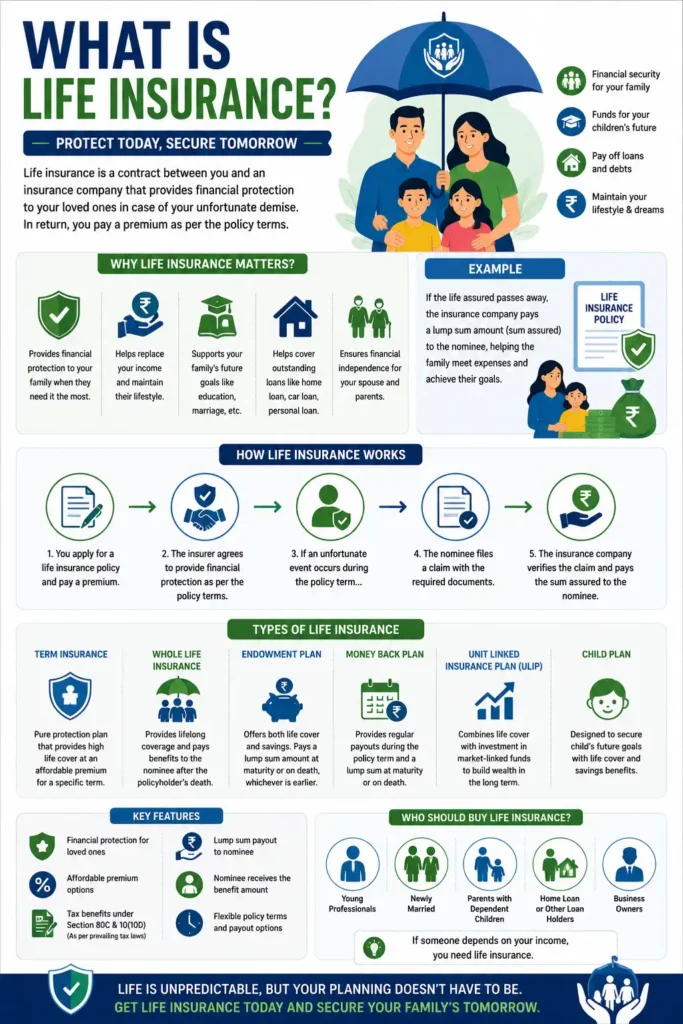
Life insurance is a financial contract between an individual and an insurance company. In this agreement, the policyholder pays regular premiums, and in return, the insurer provides a financial benefit to the nominee or beneficiary if the insured person passes away during the policy term. Depending on the type of policy, some life insurance plans may also provide maturity benefits if the insured survives the policy term.
The primary objective of life insurance is to provide financial security to your loved ones. It helps ensure that your family’s lifestyle, education expenses, loan repayments, and future financial goals are not affected by the loss of the family’s primary income earner.
Life insurance is not only about preparing for unexpected events—it is also an important component of long-term financial planning.
Why Is Life Insurance Important?
Life is unpredictable, but your family’s financial future should never depend on uncertainty.
Life insurance helps provide stability during one of life’s most difficult situations. If the family’s primary earning member is no longer there, a life insurance payout can help the family continue meeting its financial obligations.
Some of the biggest benefits include:
- Financial protection for dependents
- Income replacement
- Loan repayment support
- Children’s education funding
- Retirement support for a spouse
- Estate planning
- Peace of mind
Without adequate life insurance, families may struggle to maintain their standard of living after losing a primary source of income.
How Does Life Insurance Work?
Life insurance follows a simple process.
Step 1: Purchase a Policy
You select a life insurance plan based on your age, financial goals, family responsibilities, and coverage requirements.
Step 2: Pay Regular Premiums
Premiums may be paid monthly, quarterly, half-yearly, annually, or through limited payment options depending on the policy.
Step 3: Policy Remains Active
As long as premiums are paid according to policy terms, the insurance coverage continues.
Step 4: Claim Is Made
If the insured person passes away during the policy period, the nominee submits a claim with the required documents.
Step 5: Claim Verification
The insurance company verifies the claim, policy status, and supporting documents.
Step 6: Claim Settlement
Once approved, the insurer pays the policy benefit to the nominee according to the policy conditions.
Certain life insurance plans also provide maturity benefits if the policyholder survives the policy term.
Who Should Buy Life Insurance?
Life insurance is suitable for anyone whose family depends on their income.
It is especially important for:
- Salaried employees
- Business owners
- Self-employed professionals
- Parents
- Home loan borrowers
- Individuals supporting elderly parents
- Newly married couples
- Young professionals planning a family
Even individuals without dependents may consider life insurance as part of long-term financial planning, depending on their goals.
Types of Life Insurance
Life insurance is available in different forms. Each type serves a different financial objective.
Term Life Insurance
Term insurance provides pure life cover for a fixed period.
If the insured dies during the policy term, the nominee receives the death benefit.
Most standard term plans do not offer a maturity benefit if the insured survives the policy period.
Term insurance is usually the most affordable way to obtain a high life cover.
Read Next: Complete Guide to Term Insurance
Whole Life Insurance
Whole life insurance provides coverage for the insured’s entire lifetime, subject to policy terms.
Some policies also accumulate cash value over time.
These plans are generally chosen for:
- Estate planning
- Long-term wealth transfer
- Lifelong protection
Endowment Plans
Endowment plans combine insurance with savings.
If the insured survives the policy term, a maturity benefit is paid.
If the insured passes away during the policy term, the nominee receives the policy benefit according to the policy conditions.
These plans are often selected by individuals who prefer disciplined long-term savings alongside insurance.
Money Back Plans
Money back plans periodically return a portion of the policy benefits during the policy term while continuing life insurance coverage.
They are suitable for individuals who prefer periodic payouts instead of receiving the entire amount at maturity.
Child Insurance Plans
Child insurance plans are designed to help fund future financial goals such as:
- Higher education
- Professional courses
- Marriage expenses
Many plans continue to provide benefits even if the parent passes away during the policy term, subject to policy conditions.
Pension and Retirement Plans
These policies help individuals build a retirement corpus through regular contributions.
After retirement, the accumulated amount may provide regular income depending on the policy structure.
ULIPs (Unit Linked Insurance Plans)
ULIPs combine life insurance with market-linked investments.
Part of the premium provides life cover, while the remaining amount is invested in funds selected by the policyholder.
Returns depend on market performance and are not guaranteed.
Life Insurance vs Health Insurance
Many people confuse these two products.
Although both provide financial protection, they serve different purposes.
| Feature | Life Insurance | Health Insurance |
|---|---|---|
| Purpose | Financial support after death | Medical expense coverage |
| Benefit | Death or maturity benefit (depending on policy) | Hospitalization and healthcare expenses |
| Primary Goal | Family financial security | Healthcare protection |
| Covers Medical Bills | No | Yes |
| Covers Family Income Loss | Yes | No |
Ideally, every financial plan should include both life insurance and health insurance because they protect against different types of financial risks.
Key Benefits of Life Insurance
Income Replacement
Life insurance helps replace lost income so that your family’s lifestyle is less affected by the loss of the primary earning member.
Financial Security
The policy payout can help your family manage household expenses and long-term financial commitments.
Loan Protection
Outstanding loans such as:
- Home loans
- Personal loans
- Business loans
can often be managed using life insurance proceeds, reducing the financial burden on surviving family members.
Children’s Future
Life insurance helps ensure that important goals such as education and marriage planning can continue even if the unexpected occurs.
Retirement Planning
Certain life insurance products also support retirement planning by combining insurance with long-term savings.
Wealth Transfer
Life insurance can play an important role in transferring wealth efficiently to future generations.
How Much Life Insurance Do You Need?
There is no one-size-fits-all answer.
The ideal coverage depends on factors such as:
- Annual income
- Family expenses
- Existing savings
- Outstanding loans
- Children’s education goals
- Retirement planning
- Number of dependents
Instead of choosing coverage based solely on affordability, evaluate your family’s long-term financial needs.
Important Factors Before Buying Life Insurance
Before purchasing a policy, consider the following.
Financial Goals
Ask yourself why you need life insurance.
Common goals include:
- Family protection
- Wealth creation
- Retirement planning
- Child education
- Estate planning
Coverage Amount
Choose a coverage amount that realistically supports your family’s future financial needs.
Policy Term
The policy duration should ideally cover your major earning years and financial responsibilities.
Premium Affordability
Select a premium that comfortably fits your long-term budget.
Missing premium payments may affect policy benefits.
Claim Settlement Record
A smooth claim experience is important for your family.
Compare insurers based on overall service quality, claim support, and customer satisfaction—not only on promotional claims.
Optional Riders
Many life insurance policies allow additional benefits through riders such as:
- Accidental death benefit
- Critical illness rider
- Disability benefit
- Waiver of premium
- Income benefit rider
Choose only those riders that match your personal financial needs.
Common Mistakes to Avoid
Avoid these common errors when buying life insurance.
- Buying insufficient coverage
- Delaying the purchase
- Hiding medical information
- Choosing only the cheapest plan
- Ignoring policy conditions
- Forgetting to update nominee details
- Not reviewing insurance needs after major life events
Life Insurance Myths
Many myths prevent people from purchasing adequate coverage.
| Myth | Reality |
| Life insurance is only for older people. | Buying early often means lower premiums. |
| Single people don’t need insurance. | Future financial responsibilities may change. |
| Employer insurance is enough. | Employer coverage may not continue after changing jobs. |
| Life insurance is an investment. | Many policies focus primarily on financial protection. |
| Rich people don’t need insurance. | Insurance protects wealth as well as income. |
Expert Tips
- Purchase life insurance early.
- Review coverage after marriage or the birth of a child.
- Increase coverage as income grows.
- Keep nominee information updated.
- Inform your family about your policy details.
- Review policies every few years to ensure they continue meeting your financial needs.
Life Insurance Comparison
| Plan Type | Life Cover | Maturity Benefit | Investment Component | Best For |
|---|---|---|---|---|
| Term Insurance | ✅ High | ❌ Usually No | ❌ No | Family Protection |
| Whole Life | ✅ Lifetime | Limited/Policy Specific | Limited | Estate Planning |
| Endowment Plan | ✅ Yes | ✅ Yes | ✅ Yes | Savings + Insurance |
| Money Back Plan | ✅ Yes | ✅ Periodic Payout | ✅ Yes | Regular Income |
| ULIP | ✅ Yes | Market Linked | ✅ Yes | Long-term Investors |
| Child Plan | ✅ Yes | ✅ Yes | ✅ Yes | Child Education |
Key Takeaways
- Life insurance protects your family’s financial future.
- Choose coverage based on long-term financial responsibilities rather than premium alone.
- Different life insurance products serve different financial goals.
- Buying early often provides lower premiums and longer protection.
- Review your life insurance regularly as your family and financial situation evolve.
What Is Term Insurance?
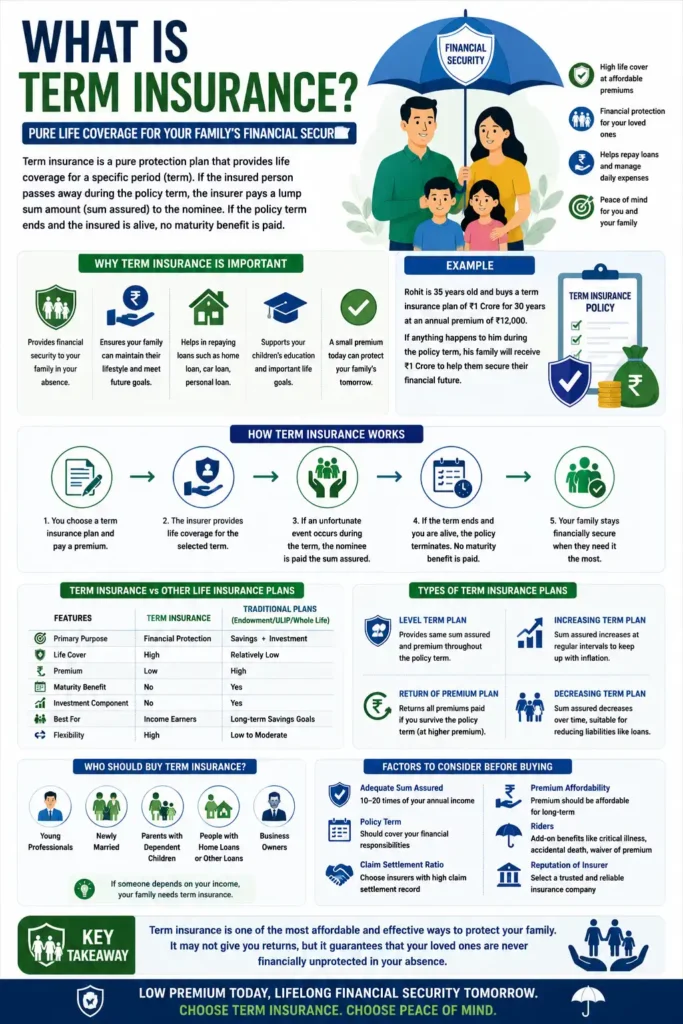
Term insurance is the simplest and most affordable form of life insurance. It is designed to provide pure financial protection to your family if something happens to you during the policy term. Unlike many traditional life insurance plans, a standard term insurance policy focuses entirely on life cover and generally does not provide a maturity benefit if the insured survives the policy period.
In simple words, you pay a regular premium, and the insurance company promises to pay a predetermined amount, known as the sum assured, to your nominee if you pass away while the policy is active and subject to its terms and conditions.
Because term insurance does not combine insurance with savings or investment features, it usually offers a much higher coverage amount at a comparatively lower premium.
For example, a 30-year-old healthy individual may be able to obtain a term insurance policy with a high sum assured for a relatively affordable annual premium, depending on factors such as age, health, occupation, and insurer underwriting.
Term insurance is often considered one of the most important financial products for anyone who has dependents or financial responsibilities.
Why Is Term Insurance Important?
Your income supports your family’s daily expenses, future goals, and financial stability. If that income suddenly stops due to an unfortunate event, your family may struggle to meet essential financial commitments.
Term insurance helps reduce this financial burden by providing a lump sum payout to your nominee.
The money can be used for:
- Household expenses
- Children’s education
- Home loan repayment
- Business liabilities
- Daily living expenses
- Retirement planning for your spouse
- Emergency financial needs
It allows your family to maintain financial stability even in your absence.
How Does Term Insurance Work?
The process is straightforward.
Step 1: Choose Your Coverage
Decide how much financial protection your family needs.
Step 2: Select the Policy Term
Choose the number of years you want the coverage to remain active.
Many people select a term that extends until their planned retirement age or until major financial responsibilities are expected to end.
Step 3: Pay Premiums
Premiums may be paid:
- Monthly
- Quarterly
- Half-yearly
- Annually
- Limited pay (available with some plans)
- Single premium (available in selected products)
Step 4: Coverage Begins
Once the policy is issued, your family remains financially protected according to the policy terms.
Step 5: Claim Settlement
If the insured passes away during the policy term, the nominee submits a claim.
After verification, the insurer settles the eligible claim according to the policy conditions.
Why Financial Experts Recommend Term Insurance
Many financial planners recommend term insurance because it provides maximum life cover at an affordable cost.
Unlike investment-oriented insurance products, term insurance focuses entirely on protecting your family’s financial future.
It allows you to:
- Buy higher coverage
- Keep premiums affordable
- Invest remaining money separately according to your financial goals
This approach is often preferred by individuals who want flexibility in their investment decisions.
Who Should Buy Term Insurance?
Term insurance is suitable for almost every earning individual.
It is especially recommended for:
- Salaried employees
- Business owners
- Self-employed professionals
- Parents
- Newly married couples
- Home loan borrowers
- Individuals supporting elderly parents
- People with financial dependents
If your family depends on your income, term insurance deserves serious consideration.
Who May Need Higher Coverage?
Certain individuals may require higher life cover because of greater financial responsibilities.
Examples include:
- Sole earning members
- Individuals with large home loans
- Parents with young children
- Business owners
- Professionals with long-term financial commitments
Key Benefits of Term Insurance
Affordable Premiums
One of the biggest advantages of term insurance is affordability.
Since it focuses purely on life protection, premiums are generally much lower than many other life insurance products offering similar coverage.
High Sum Assured
Term insurance allows policyholders to obtain substantial financial protection for their families.
Financial Security
The policy payout helps your family continue meeting important financial obligations.
Flexible Policy Terms
Most insurers offer multiple policy durations to match different life stages.
Rider Options
Optional riders can enhance your coverage according to your needs.
Peace of Mind
Knowing your family’s financial future is protected provides confidence and security.
Types of Term Insurance Plans
Different insurers offer different variations of term insurance.
Level Term Insurance
The sum assured remains the same throughout the policy period.
This is the most common type of term insurance.
Increasing Term Insurance
The coverage amount increases periodically according to policy conditions.
This helps offset the impact of inflation over time.
Decreasing Term Insurance
The sum assured gradually decreases over the policy term.
These policies are sometimes considered alongside loans where outstanding liabilities reduce over time.
Return of Premium Plans
Some term insurance plans refund eligible premiums at maturity if the insured survives the policy term, subject to policy conditions.
Because of this additional feature, premiums are generally higher than standard term insurance plans.
How Much Term Insurance Do You Need?
There is no universal formula.
The ideal coverage depends on several factors.
Consider:
- Annual income
- Outstanding loans
- Children’s future education
- Household expenses
- Existing investments
- Retirement goals
- Number of dependents
Instead of choosing a random amount, calculate your family’s future financial requirements.
Factors That Affect Your Premium
Insurance companies assess multiple risk factors before determining premiums.
These commonly include:
Age
Younger applicants usually pay lower premiums.
Medical History
Health conditions may influence premium calculations.
Smoking Status
Smoking often increases health risks and may result in higher premiums.
Occupation
High-risk professions may attract higher premiums.
Lifestyle
General health and lifestyle habits can affect underwriting.
Coverage Amount
Higher life cover generally results in higher premiums.
Policy Duration
Longer policy terms may influence premium calculations.
Important Riders You Can Add
Riders provide additional protection beyond the base policy.
Popular options include:
Critical Illness Rider
Provides an additional benefit upon diagnosis of specified serious illnesses, subject to policy conditions.
Accidental Death Benefit Rider
Provides additional financial support if death occurs due to a covered accident.
Permanent Disability Rider
Offers benefits in case of permanent disability as defined in the policy.
Waiver of Premium Rider
Future premiums may be waived if specified conditions are met, allowing coverage to continue.
Income Benefit Rider
Provides regular income to beneficiaries instead of only a lump sum payout, where available.
Only choose riders that genuinely suit your family’s needs.
Term Insurance vs Life Insurance
Many people believe these products are identical.
In reality, term insurance is a type of life insurance focused exclusively on financial protection.
| Feature | Term Insurance | Traditional Life Insurance |
|---|---|---|
| Primary Purpose | Pure life protection | Protection with savings or investment elements (depending on policy) |
| Premium | Generally lower | Usually higher |
| Maturity Benefit | Usually not available | May be available depending on the policy |
| Coverage Amount | Generally higher for the same premium | Often lower for the same premium |
| Investment Component | No | Available in certain products |
Term Insurance vs Endowment Plan
| Feature | Term Insurance | Endowment Plan |
| Life Cover | High | Moderate |
| Savings Component | No | Yes |
| Maturity Benefit | Usually No | Yes |
| Premium | Lower | Higher |
| Best For | Family protection | Protection with long-term savings |
Common Mistakes While Buying Term Insurance
Avoid these common errors.
Buying Too Little Coverage
Choosing inadequate life cover can leave your family financially vulnerable.
Delaying the Purchase
Premiums generally increase with age.
Buying early often provides better long-term value.
Hiding Medical Information
Always provide complete and accurate information during the application process.
Incorrect disclosure may affect future claims.
Choosing Based Only on Premium
The cheapest policy isn’t always the most suitable.
Compare features, service quality, and policy conditions.
Ignoring Riders
Appropriate riders can significantly strengthen your financial protection.
Not Updating Nominee Details
Review nominee information after major life events such as marriage or the birth of children.
How to Choose the Best Term Insurance Policy
Before making a decision, compare policies carefully.
Consider:
- Coverage amount
- Policy duration
- Premium affordability
- Rider availability
- Claim support
- Customer service
- Digital claim process
- Policy conditions
- Flexibility of premium payment
Don’t rush your decision.
Term insurance is a long-term financial commitment.
Expert Tips
- Buy term insurance as early as possible.
- Choose coverage based on future financial responsibilities.
- Review your policy every few years.
- Increase coverage after major life events.
- Keep your nominee details updated.
- Inform your family about your policy documents.
Common Myths About Term Insurance
| Myth | Reality |
| Term insurance is a waste if I survive. | Its primary purpose is financial protection, not investment returns. |
| Young people don’t need term insurance. | Buying early generally provides lower premiums. |
| My employer’s insurance is enough. | Employer coverage may end when you change jobs or retire. |
| Only married people need insurance. | Anyone with financial responsibilities may benefit from coverage. |
| Buying more than one policy isn’t allowed. | Many individuals hold multiple policies based on different financial goals. |
Term Insurance Buying Checklist
Before purchasing a policy, ask yourself:
✅ Is the coverage sufficient?
✅ Have I disclosed all medical information honestly?
✅ Did I compare multiple insurers?
✅ Did I review available riders?
✅ Is the premium affordable for the long term?
✅ Have I selected the right nominee?
✅ Did I understand the policy conditions?
✅ Have I informed my family about the policy?
Term Insurance Comparison
| Feature | Standard Term Plan | Return of Premium Plan |
|---|---|---|
| Premium | Lower | Higher |
| Life Cover | High | High |
| Maturity Benefit | Usually No | Premium Returned (subject to policy terms) |
| Investment Component | No | Limited |
| Best For | Maximum Protection | People wanting premium return |
Key Takeaways
- Term insurance is one of the most affordable ways to protect your family’s financial future.
- Higher life cover is usually available at lower premiums compared to many traditional life insurance products.
- Buy coverage early for better affordability.
- Select coverage based on your family’s future financial needs rather than your current income alone.
- Review your policy regularly as your responsibilities change.
Motor Insurance
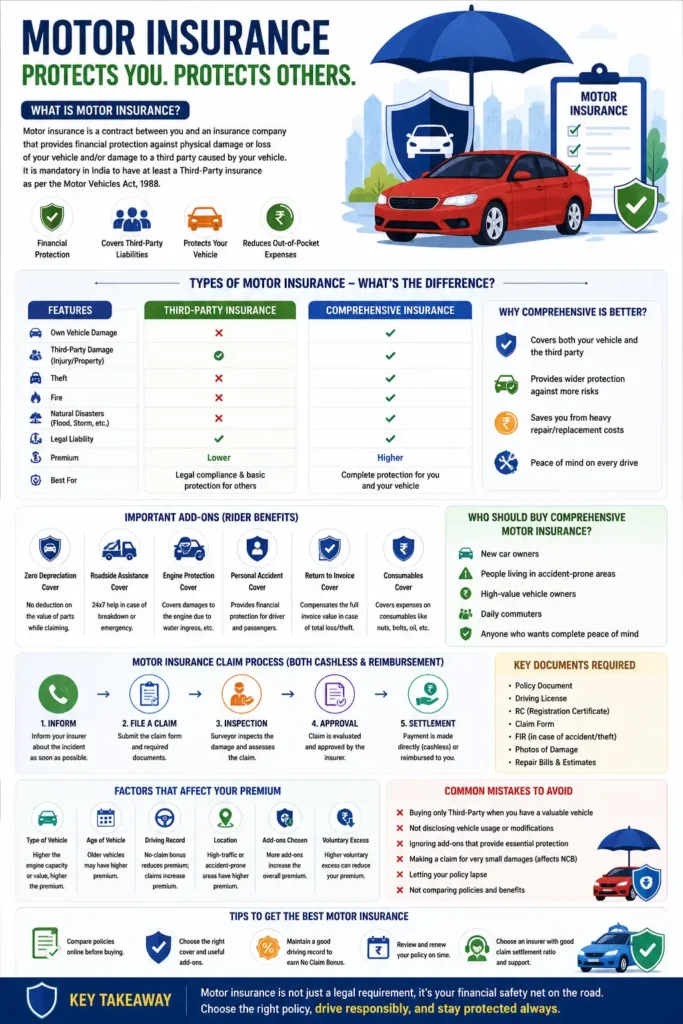
Motor insurance is a type of general insurance that provides financial protection against losses arising from accidents, theft, natural disasters, fire, and third-party liabilities involving your vehicle. Whether you own a car, bike, or commercial vehicle, motor insurance helps reduce the financial burden of unexpected incidents.
In India, third-party motor insurance is mandatory for vehicles driven on public roads under the applicable laws. However, many vehicle owners also choose comprehensive insurance because it provides broader protection.
Motor insurance not only safeguards your vehicle but also protects you from significant legal and financial liabilities.
Why Motor Insurance Is Important
Owning a vehicle comes with responsibilities. Even a minor accident can result in repair costs running into thousands or lakhs of rupees.
Motor insurance helps by:
- Covering accidental damage
- Protecting against theft
- Providing third-party liability coverage
- Covering damage caused by floods, storms, earthquakes, and fire (depending on policy)
- Reducing unexpected financial losses
- Helping comply with legal requirements
Without insurance, the owner must bear all repair or compensation costs personally.
Types of Motor Insurance
Third-Party Motor Insurance
Third-party insurance covers legal liabilities arising from injuries, death, or property damage caused to another person due to your insured vehicle.
This is the minimum legally required motor insurance in India.
It generally does not cover damage to your own vehicle.
Comprehensive Motor Insurance
Comprehensive insurance offers wider protection.
It usually includes:
- Third-party liability
- Damage to your own vehicle
- Theft
- Fire
- Natural disasters
- Man-made disasters
Many vehicle owners prefer comprehensive insurance because it provides more complete financial protection.
Standalone Own Damage Insurance
This policy covers damage to your own vehicle only.
It is generally purchased along with a valid third-party insurance policy where applicable.
Add-On Covers
Motor insurance policies often allow additional protection through optional add-ons.
Popular add-ons include:
- Zero Depreciation Cover
- Engine Protection
- Roadside Assistance
- Return to Invoice Cover
- Consumables Cover
- Key Replacement Cover
- NCB Protection
- Passenger Cover
Choose add-ons based on your driving habits, vehicle age, and location.
What Is Covered?
Coverage varies by insurer and policy, but comprehensive policies commonly include:
- Road accidents
- Fire damage
- Theft
- Flood damage
- Cyclone damage
- Earthquake damage
- Riot damage
- Vandalism
- Third-party liability
What Is Usually Not Covered?
Common exclusions include:
- Driving without a valid licence
- Driving under the influence of alcohol or prohibited substances
- Normal wear and tear
- Mechanical breakdown
- Electrical failure unrelated to insured events
- Consequential damage
- Racing activities
- Illegal use of the vehicle
Always review the policy wording carefully.
No Claim Bonus (NCB)
If you do not make a claim during the policy year, many insurers reward you with a No Claim Bonus.
Benefits include:
- Renewal premium discounts
- Reward for safe driving
- Savings over multiple years
Maintaining your NCB can significantly reduce long-term insurance costs.
Motor Insurance Buying Checklist
Before purchasing motor insurance, check:
- Coverage amount
- Insured Declared Value (IDV)
- Cashless garage network
- Claim process
- Add-on options
- Premium
- Customer reviews
- Claim support
Motor Insurance Comparison
| Feature | Third Party | Comprehensive |
|---|---|---|
| Own Vehicle Damage | ❌ | ✅ |
| Third-Party Damage | ✅ | ✅ |
| Theft Cover | ❌ | ✅ |
| Fire Damage | ❌ | ✅ |
| Natural Disaster | ❌ | ✅ |
| Add-ons Available | Limited | Yes |
| Premium | Lower | Higher |
| Recommended For | Legal Compliance | Complete Protection |
Travel Insurance
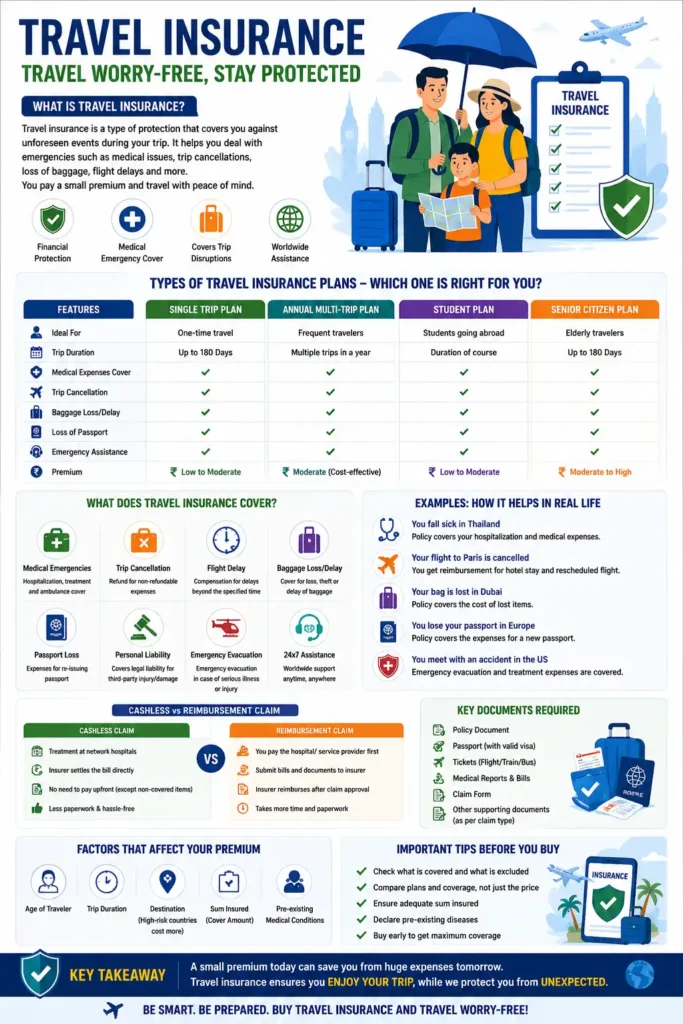
Travel insurance provides financial protection against unexpected events that may occur before or during a trip.
Whether travelling within India or abroad, travel insurance can help reduce financial losses arising from medical emergencies, trip cancellations, baggage loss, passport loss, or travel delays.
While many people consider travel insurance optional, it can become extremely valuable during unforeseen situations.
Why Travel Insurance Matters
Travel plans do not always go as expected.
Unexpected situations may include:
- Medical emergencies
- Flight cancellations
- Lost baggage
- Passport theft
- Natural disasters
- Political disturbances
- Personal emergencies
Travel insurance helps reduce the financial impact of such events according to the policy terms.
Types of Travel Insurance
Domestic Travel Insurance
Designed for travel within India.
It may include:
- Personal accident cover
- Trip cancellation benefits
- Medical emergency assistance
- Baggage protection
International Travel Insurance
Suitable for overseas travel.
Coverage often includes:
- Emergency hospitalization
- Medical evacuation
- Passport loss
- Baggage delay
- Flight cancellation
- Personal liability
Many countries require valid travel insurance before issuing visas.
Student Travel Insurance
Designed for students studying abroad.
It may include:
- Medical expenses
- Study interruption
- Laptop protection
- Personal liability
- Emergency evacuation
Senior Citizen Travel Insurance
Provides travel-related protection for older travellers.
Coverage varies according to the insurer’s policy.
What Travel Insurance Usually Covers
Depending on the policy, coverage may include:
- Medical emergencies
- Hospitalization
- Emergency evacuation
- Flight delays
- Trip cancellation
- Trip interruption
- Lost passport
- Lost baggage
- Personal liability
- Emergency assistance
Travel Insurance Exclusions
Common exclusions may include:
- Pre-existing conditions (subject to policy terms)
- Adventure sports (unless covered)
- Alcohol-related incidents
- Illegal activities
- Cosmetic treatment
- War-related situations (unless specified)
Tips Before Buying Travel Insurance
- Buy before starting your journey.
- Compare medical coverage limits.
- Understand exclusions.
- Save emergency contact numbers.
- Keep policy documents accessible.
Travel Insurance Comparison
| Feature | Domestic | International | Student | Senior Citizen |
|---|---|---|---|---|
| Medical Cover | Limited | Extensive | Extensive | Specialized |
| Passport Loss | Usually No | Yes | Yes | Yes |
| Baggage Cover | Yes | Yes | Yes | Yes |
| Trip Cancellation | Yes | Yes | Yes | Yes |
| Best For | India Travel | Overseas Trips | Study Abroad | Older Travelers |
Home Insurance
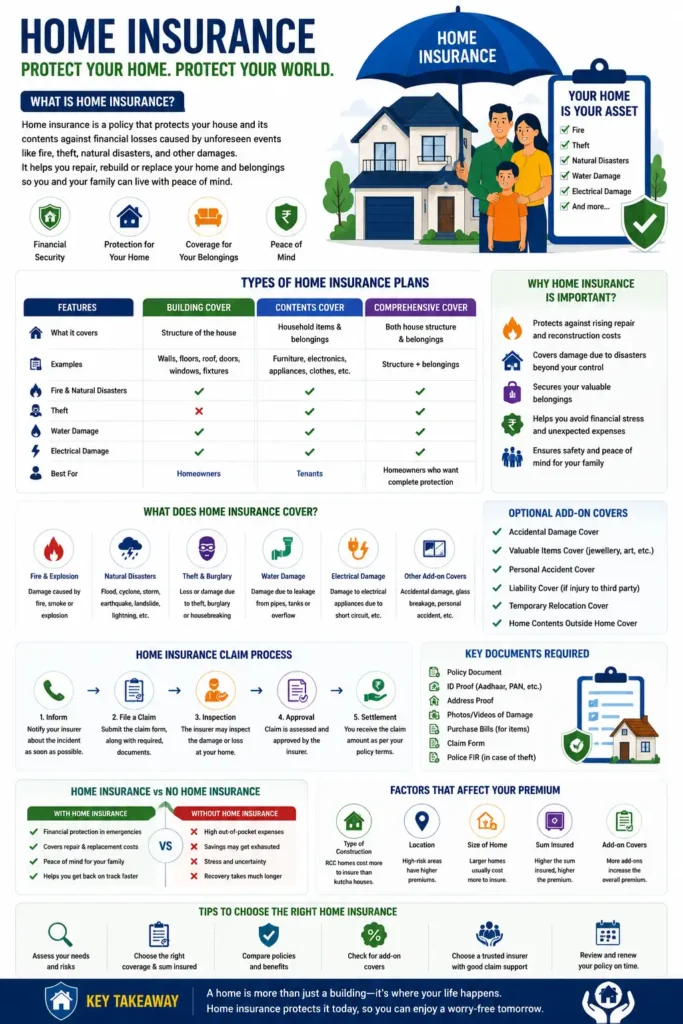
Your home is one of your most valuable assets. Home insurance helps protect your house and belongings from unexpected financial losses caused by covered events. Many homeowners focus only on buying a property but overlook the importance of protecting it. Home insurance provides financial support for repairing or rebuilding your home after insured events.
Why Home Insurance Is Important
Unexpected incidents such as:
- Fire
- Flood
- Storm
- Earthquake
- Theft
- Burglary
can cause substantial financial losses.
Home insurance helps reduce these risks.
Types of Home Insurance
Building Insurance
Protects the physical structure of your home.
This generally includes:
- Walls
- Roof
- Flooring
- Permanent fixtures
Contents Insurance
Protects belongings inside the home.
Examples include:
- Furniture
- Electronics
- Appliances
- Clothing
- Jewellery (subject to policy conditions)
Comprehensive Home Insurance
Provides protection for both:
- Building
- Household contents
This is one of the most comprehensive options available for homeowners.
What Home Insurance May Cover
Coverage depends on the policy.
It commonly includes:
- Fire
- Explosion
- Lightning
- Storm
- Cyclone
- Flood
- Earthquake
- Theft
- Burglary
- Riot damage
Common Exclusions
Examples include:
- Normal ageing
- Wear and tear
- Intentional damage
- Construction defects
- War-related damage
- Nuclear risks
Always review exclusions before purchasing.
Home Insurance Comparison
| Feature | Building Cover | Contents Cover | Comprehensive |
|---|---|---|---|
| Structure Protection | ✅ | ❌ | ✅ |
| Furniture | ❌ | ✅ | ✅ |
| Electronics | ❌ | ✅ | ✅ |
| Theft Cover | Limited | ✅ | ✅ |
| Fire Cover | ✅ | ✅ | ✅ |
| Best For | Homeowners | Tenants | Homeowners with Valuable Contents |
Business Insurance
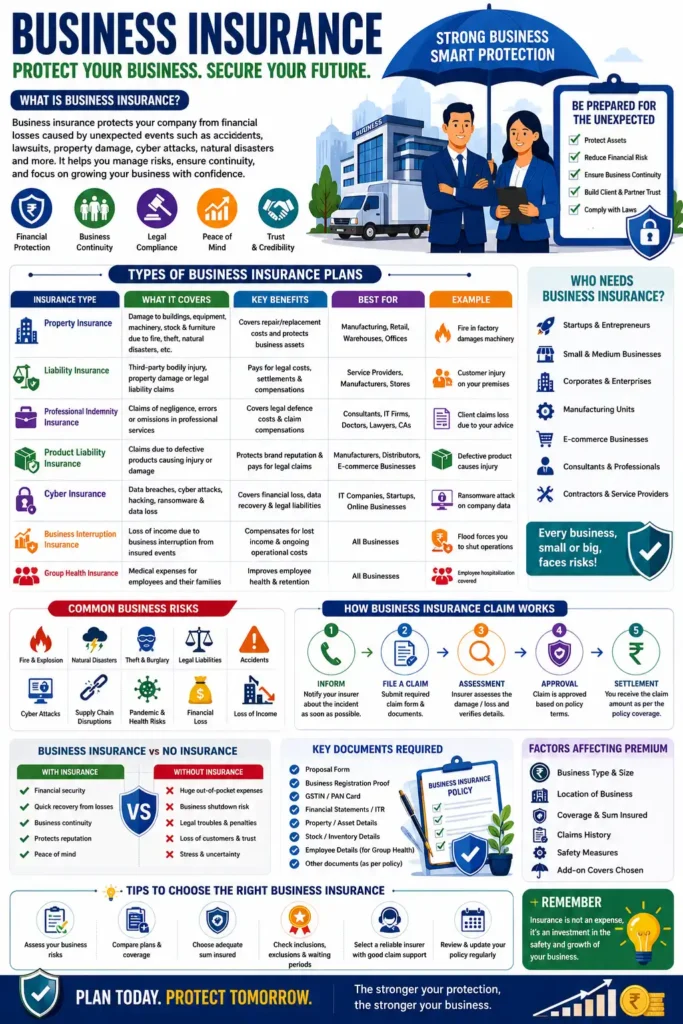
Businesses face a wide range of financial risks every day.
Business insurance helps protect companies against unexpected losses that could interrupt operations or create major financial liabilities.
Whether you operate a small retail shop or a large company, business insurance plays an important role in risk management.
Why Business Insurance Is Important
Businesses may face risks such as:
- Fire
- Theft
- Employee injuries
- Cyber attacks
- Property damage
- Lawsuits
- Equipment breakdown
Insurance helps businesses recover more quickly from these events.
Types of Business Insurance
Property Insurance
Protects office buildings, warehouses, equipment, inventory, and other business assets.
Fire Insurance
Provides financial protection against losses resulting from fire and related risks according to policy conditions.
Liability Insurance
Helps cover legal liabilities arising from injuries or property damage involving third parties.
Professional Indemnity Insurance
Suitable for professionals who provide advice or specialised services.
It helps protect against claims of professional negligence where covered.
Cyber Insurance
As businesses become increasingly digital, cyber insurance has become more important.
It may provide protection against:
- Data breaches
- Cyber attacks
- Ransomware
- Business interruption
- Digital fraud
Coverage depends on the insurer and policy terms.
Employee Insurance
Many businesses provide employee benefits such as:
- Group Health Insurance
- Group Term Insurance
- Personal Accident Insurance
These benefits help improve employee welfare and retention.
How to Choose the Right Insurance Policy
No matter which type of insurance you buy, the selection process should follow the same principles.
Understand Your Needs
Identify the financial risks you want to protect against.
Compare Multiple Policies
Don’t buy the first policy you see.
Compare:
- Coverage
- Premium
- Exclusions
- Claim process
- Customer support
Read Policy Documents
Understand:
- Waiting periods
- Deductibles
- Co-payment
- Exclusions
- Claim procedure
Choose Adequate Coverage
Buying insufficient coverage may leave you financially exposed.
Balance affordability with adequate protection.
Review Regularly
Your insurance needs change over time.
Review your policies after:
- Marriage
- Birth of children
- Buying a home
- Starting a business
- Retirement
Expert Tips
- Never buy insurance based only on premium.
- Read the complete policy wording.
- Keep digital and physical copies of policy documents.
- Inform nominees and family members about important policies.
- Review insurance annually.
- Increase coverage as your assets and responsibilities grow.
Business Insurance Comparison
| Policy | Covers | Best For |
|---|---|---|
| Property Insurance | Buildings & Assets | All Businesses |
| Fire Insurance | Fire Damage | Manufacturing & Retail |
| Cyber Insurance | Data Breaches | IT Companies |
| Liability Insurance | Third-Party Claims | Service Businesses |
| Professional Indemnity | Professional Negligence | Doctors, CAs, Lawyers, Consultants |
| Group Health Insurance | Employee Healthcare | Employers |
Key Takeaways
- Motor insurance protects your vehicle and third-party liabilities.
- Travel insurance helps manage unexpected travel-related financial losses.
- Home insurance safeguards your property and belongings.
- Business insurance protects companies against operational and financial risks.
- The right insurance strategy includes multiple policies that address different risks rather than relying on a single product.
What Are Insurance Riders?
Insurance riders are optional add-on benefits that enhance your base insurance policy by providing additional coverage for specific risks. Instead of purchasing a separate insurance policy, you can customize your existing policy with riders that suit your personal needs.
Although riders increase your premium, they often provide valuable financial protection at a lower cost than buying separate standalone insurance products.
Not every rider is necessary. The right choice depends on your age, lifestyle, occupation, health condition, financial responsibilities, and long-term goals.
Why Should You Consider Insurance Riders?
A standard insurance policy provides basic coverage, but life is full of uncertainties that may require additional protection.
Insurance riders help you:
- Increase financial security
- Customize your policy
- Cover specific risks
- Protect your family’s future
- Avoid purchasing multiple separate policies
Think of riders as upgrades that make your insurance policy more comprehensive.
Types of Insurance Riders
Critical Illness Rider
A Critical Illness Rider provides a lump sum benefit if the insured is diagnosed with one of the specified serious illnesses covered under the policy.
Common illnesses may include:
- Cancer
- Heart attack
- Stroke
- Kidney failure
- Major organ transplant
The payout can be used for:
- Medical treatment
- Household expenses
- Loan repayments
- Income replacement
Coverage depends on the illnesses listed in the policy.
Accidental Death Benefit Rider
This rider provides an additional payout if the insured dies due to an accident covered under the policy.
It offers extra financial support for the nominee in addition to the base policy benefit.
Permanent Disability Rider
If the insured becomes permanently disabled because of an accident, this rider may provide financial assistance according to the policy conditions.
Some policies may offer:
- Lump sum payment
- Monthly income
- Waiver of future premiums
Benefits differ between insurers.
Waiver of Premium Rider
If the insured experiences a covered disability or critical illness, this rider may waive future premium payments while allowing the policy to continue.
This ensures continuous insurance protection even during difficult financial situations.
Hospital Cash Rider
Hospitalization often leads to additional expenses beyond medical bills.
A Hospital Cash Rider provides a fixed daily amount during hospitalization, subject to policy limits.
The money may help cover:
- Food expenses
- Transportation
- Caregiver costs
- Other incidental expenses
Income Benefit Rider
Instead of paying only a lump sum, this rider provides regular monthly income to beneficiaries after the insured’s death.
This helps families manage recurring household expenses.
Which Riders Are Worth Buying?
Not every rider is suitable for everyone.
The following table provides general guidance.
| Rider | Suitable For |
|---|---|
| Critical Illness | Working professionals |
| Accidental Death | Individuals who travel frequently |
| Disability Rider | Sole earning members |
| Waiver of Premium | Families with long-term financial responsibilities |
| Hospital Cash | Families seeking additional medical support |
| Income Benefit | Parents with young children |
Choose riders based on your actual financial needs rather than purchasing every available option.
Understanding the Insurance Claim Process
The real value of insurance becomes evident when a claim is made.
Understanding the claim process before purchasing a policy helps reduce stress during emergencies.
Although claim procedures vary across insurance companies, the overall process remains similar.
Step 1: Inform the Insurance Company
Notify your insurer as soon as possible after the insured event occurs.
Examples include:
- Hospitalization
- Vehicle accident
- Fire
- Theft
- Death of the insured
Many insurers provide multiple reporting options:
- Mobile app
- Customer care
- Website
- Branch office
Prompt notification can help avoid unnecessary delays.
Step 2: Submit Required Documents
The insurer requests documents depending on the type of claim.
Examples include:
Health Insurance
- Hospital bills
- Discharge summary
- Medical reports
- Prescriptions
Life Insurance
- Death certificate
- Policy documents
- Identity proof
- Nominee details
Motor Insurance
- FIR (where applicable)
- Driving licence
- Registration certificate
- Repair estimate
- Photographs
Home Insurance
- Property damage photographs
- Police report (if applicable)
- Repair estimates
Step 3: Verification
The insurer reviews:
- Policy status
- Coverage
- Documents
- Cause of loss
- Policy exclusions
Additional information may be requested if required.
Step 4: Survey or Inspection
For certain claims, particularly property and motor insurance, a surveyor may inspect the damage before approving the claim.
Step 5: Claim Decision
The insurer either:
- Approves the claim
- Requests additional documents
- Partially approves the claim
- Rejects the claim with reasons
Step 6: Claim Settlement
After approval, payment is made according to the policy terms.
Depending on the insurance type, settlement may be made to:
- Hospital
- Policyholder
- Nominee
- Repair garage
- Business
Insurance Claims Comparison
| Feature | Cashless Claim | Reimbursement Claim |
|---|---|---|
| Pay Hospital First | No | Yes |
| Network Hospital Required | Yes | No |
| Paperwork | Less | More |
| Settlement Speed | Faster | Usually Longer |
| Convenience | High | Moderate |
Types of Insurance Claims
Cashless Claims
Available mainly in health and motor insurance.
The insurer settles eligible expenses directly with the network hospital or authorized garage.
Reimbursement Claims
The insured pays the expenses first and later submits documents for reimbursement of eligible costs.
How Long Does Claim Settlement Take?
The time required depends on:
- Insurance type
- Document completeness
- Nature of claim
- Investigation requirements
- Policy conditions
Submitting complete and accurate documents generally speeds up the process.
Common Reasons Insurance Claims Are Rejected
Many claim rejections are avoidable.
Understanding the reasons helps policyholders avoid mistakes.
Incorrect Information
Providing false or incomplete information during policy purchase can affect claim eligibility.
Always disclose:
- Medical history
- Existing illnesses
- Smoking habits
- Occupation
- Previous insurance history
Policy Lapse
If premiums are not paid on time and the policy lapses, claims may not be payable.
Renew policies before their due dates.
Exclusions
Insurance policies clearly mention situations that are not covered.
Claims arising from excluded events may be rejected.
Waiting Period
Some health insurance benefits become available only after the waiting period has ended.
Fraudulent Claims
Submitting fake bills or incorrect information may lead to claim rejection and legal consequences.
Delayed Intimation
Reporting an incident very late without a valid reason may complicate the claim process.
Always inform the insurer promptly.
Missing Documents
Incomplete documentation remains one of the most common reasons for delayed or rejected claims.
Tips for Faster Claim Settlement
- Read policy conditions carefully.
- Keep policy documents safe.
- Inform the insurer immediately.
- Submit complete documents.
- Maintain copies of all records.
- Answer insurer queries honestly.
- Follow claim timelines.

Insurance Tax Benefits
Insurance not only provides financial protection but may also offer tax advantages under applicable laws.
The available benefits depend on:
- Type of insurance
- Applicable tax provisions
- Individual circumstances
- Prevailing tax regulations
Because tax laws may change, consult a qualified tax professional for personalized guidance.
Health Insurance Tax Benefits
Eligible premiums paid for health insurance may qualify for deductions under applicable tax provisions, subject to specified limits and conditions.
Life Insurance Tax Benefits
Eligible life insurance premiums and policy proceeds may receive tax treatment according to prevailing tax laws and policy conditions.
Why Tax Benefits Should Not Be the Primary Reason for Buying Insurance
Many people purchase insurance solely to save tax.
This is not the ideal approach.
Insurance should primarily provide financial protection.
Tax benefits should be viewed as an additional advantage rather than the main objective.
How to Choose the Right Insurance Policy
Choosing insurance is easier when you follow a structured approach.
Step 1: Identify Your Needs
Ask yourself:
- What financial risks am I trying to protect against?
- Who depends on my income?
- What assets do I own?
- What liabilities do I have?
Your answers help determine the type of insurance you need.
Step 2: Determine the Required Coverage
Avoid both underinsurance and excessive coverage.
Choose an amount that matches your financial responsibilities.
Step 3: Compare Multiple Policies
Don’t buy the first policy you find.
Compare:
- Coverage
- Premium
- Claim process
- Exclusions
- Customer service
- Additional benefits
Step 4: Read the Policy Document
Never skip the policy wording.
Understand:
- Coverage
- Exclusions
- Waiting periods
- Deductibles
- Co-payment
- Claim procedure
Step 5: Check Claim Support
Good customer service becomes extremely valuable during emergencies.
Choose insurers known for responsive claim assistance.
Step 6: Consider Digital Services
Modern insurers often provide:
- Mobile apps
- Online claims
- Policy downloads
- Renewal reminders
- Digital health cards
Digital convenience can improve your overall experience.
Insurance Buying Checklist
Before purchasing any insurance policy, confirm the following:
✅ Have I identified my financial risks?
✅ Is the coverage amount sufficient?
✅ Have I compared multiple insurers?
✅ Did I review policy exclusions?
✅ Did I understand waiting periods?
✅ Have I checked claim support?
✅ Did I compare premium affordability?
✅ Have I reviewed available riders?
✅ Did I read the complete policy wording?
✅ Have I informed my nominee or family members?
Expert Tips
- Review insurance annually.
- Update nominees whenever necessary.
- Increase coverage after major life events.
- Store policy documents securely.
- Keep digital copies accessible.
- Never hide medical or financial information during application.
Key Takeaways
- Insurance riders allow you to customize your coverage.
- Understanding the claim process improves your chances of smooth claim settlement.
- Most claim rejections occur because of avoidable mistakes.
- Tax benefits should be considered an additional advantage, not the primary reason to buy insurance.
- Comparing policies carefully helps you choose better long-term financial protection.
Insurance Myths You Should Stop Believing

Insurance is one of the most misunderstood financial products. Many people delay buying insurance because of common myths that can leave them financially vulnerable.
Let’s separate facts from fiction.
Myth 1: I’m Young, So I Don’t Need Insurance
One of the biggest misconceptions is that insurance is only for older people.
Reality
Medical emergencies and accidents can happen at any age.
Buying insurance while you’re young offers several advantages:
- Lower premiums
- Easier policy approval
- Better health-related underwriting
- Completion of waiting periods before you may need coverage
- Long-term financial security
The best time to buy insurance is before you actually need it.
Myth 2: Health Insurance Is Only for Sick People
Many healthy individuals believe they don’t require health insurance.
Reality
Health insurance is designed for unexpected situations.
No one plans for:
- Accidents
- Emergency surgeries
- Sudden illnesses
- Hospitalization
Buying insurance after becoming seriously ill may result in limited options or higher premiums.
Myth 3: Employer Insurance Is Enough
Many salaried employees depend completely on company-provided insurance.
Reality
Employer insurance usually has limitations.
For example:
- Coverage may be insufficient.
- Benefits may stop after changing jobs.
- Coverage usually ends after retirement.
- Parents may not always be covered.
Having your own health insurance provides long-term protection.
Myth 4: Insurance Is a Waste If I Never Make a Claim
People sometimes feel they lose money if they never claim insurance.
Reality
Insurance is a financial safety net.
You don’t buy insurance expecting to use it every year.
Just like you don’t expect your house to catch fire, you still protect it.
The value of insurance lies in being financially protected when the unexpected happens.
Myth 5: Cheapest Insurance Is Always the Best
Lower premiums often attract buyers.
Reality
The cheapest policy may also provide:
- Lower coverage
- More exclusions
- Higher deductibles
- Limited claim support
Always compare overall value rather than price alone.
Myth 6: Insurance Covers Everything
Some people assume every expense will be reimbursed.
Reality
Every insurance policy has:
- Exclusions
- Waiting periods
- Coverage limits
- Conditions
Reading the policy wording before purchase helps avoid misunderstandings.
Myth 7: Buying Insurance Online Is Unsafe
Digital insurance purchases have become increasingly common.
Reality
Buying directly through authorized insurer websites or licensed intermediaries can be safe when proper precautions are followed.
Always verify:
- Website authenticity
- Policy details
- Customer support
- Payment security
Myth 8: I Don’t Need Life Insurance Because I Have Savings
Savings alone may not provide long-term financial security for your family.
Reality
Insurance and investments serve different purposes.
Savings help build wealth.
Insurance protects wealth.
A balanced financial plan usually includes both.
Common Insurance Mistakes to Avoid
Choosing the right insurance is important, but avoiding mistakes is equally critical.
Below are the most common mistakes people make.
Buying Insurance Too Late
Waiting until later in life often results in:
- Higher premiums
- More medical checks
- Waiting periods
- Limited options
Early planning usually provides greater flexibility.
Choosing Inadequate Coverage
Many people buy insurance based only on affordability.
Unfortunately, insufficient coverage may not provide adequate financial protection during emergencies.
Review your insurance needs regularly.
Ignoring Policy Exclusions
Many disputes occur because policyholders don’t understand what isn’t covered.
Always read:
- Exclusions
- Waiting periods
- Deductibles
- Co-payment
- Claim conditions
Not Comparing Policies
Buying the first available policy may cause you to miss better options.
Compare:
- Coverage
- Premium
- Claim process
- Customer support
- Additional benefits
Hiding Medical Information
Some applicants fail to disclose existing medical conditions.
Providing incorrect information may affect future claims.
Always answer proposal forms honestly.
Forgetting Policy Renewal
Missing renewal dates can interrupt coverage.
Set reminders for:
- Renewal dates
- Premium due dates
- Policy reviews
Depending on One Insurance Policy
No single policy covers every financial risk.
A comprehensive financial plan may include:
- Health Insurance
- Term Insurance
- Motor Insurance
- Home Insurance
- Personal Accident Insurance
Each policy serves a different purpose.
Failing to Update Nominee Details
After important life events such as marriage or childbirth, review and update nominee information if necessary.
Not Informing Family Members
Many nominees don’t know:
- Which insurer issued the policy
- Policy number
- Claim procedure
- Where documents are stored
Keep your family informed.
Insurance Comparison Guide
Every insurance type serves a unique purpose.
The following comparison makes it easier to understand which policy protects which risk.
| Insurance Type | Purpose | Best For |
|---|---|---|
| Health Insurance | Medical expenses | Everyone |
| Term Insurance | Family income protection | Income earners |
| Life Insurance | Long-term financial security | Families |
| Motor Insurance | Vehicle protection | Vehicle owners |
| Travel Insurance | Travel-related risks | Frequent travelers |
| Home Insurance | Property protection | Homeowners |
| Business Insurance | Business risk management | Business owners |
Which Insurance Should You Buy First?
The answer depends on your life stage.
If You’re a Young Professional
Priority:
- Health Insurance
- Term Insurance (if you have dependents)
- Personal Accident Cover
If You’re Married
Priority:
- Family Health Insurance
- Term Insurance
- Home Insurance
- Motor Insurance
If You Have Children
Priority:
- Higher Term Insurance
- Family Floater Health Insurance
- Child Education Planning
- Home Insurance
If You’re a Senior Citizen
Priority:
- Senior Citizen Health Insurance
- Personal Accident Insurance
- Estate Planning
- Long-term Care Planning
If You Own a Business
Priority:
- Business Insurance
- Property Insurance
- Cyber Insurance
- Professional Indemnity Insurance
- Group Health Insurance
Insurance Buying Checklist
Before purchasing any insurance policy, complete this checklist.
Personal Assessment
✅ Have I identified my financial responsibilities?
✅ Do I understand the risks I want to cover?
✅ Have I calculated the required coverage?
Policy Comparison
✅ Have I compared at least three policies?
✅ Have I reviewed policy exclusions?
✅ Did I understand waiting periods?
✅ Have I compared claim support?
Financial Review
✅ Is the premium affordable?
✅ Can I continue paying premiums long term?
✅ Does the policy provide value for money?
Documentation
✅ Have I filled the proposal form honestly?
✅ Did I disclose my medical history?
✅ Have I selected the correct nominee?
After Purchase
✅ Have I downloaded the policy document?
✅ Have I informed my family?
✅ Did I save customer care details?
✅ Have I set renewal reminders?
Insurance Review Checklist
Insurance should not be purchased once and forgotten.
Review your policies after:
- Marriage
- Childbirth
- Buying a home
- Starting a business
- Salary increase
- Major loan
- Retirement
Updating coverage ensures your insurance keeps pace with your changing financial responsibilities.
Expert Tips
Diversify Your Insurance Portfolio
Different risks require different insurance products.
Instead of relying on one policy, build comprehensive protection over time.
Review Every Year
Healthcare costs, family responsibilities, and assets change.
An annual insurance review helps ensure your coverage remains adequate.
Maintain an Emergency Fund
Insurance complements an emergency fund—it does not replace it.
Ideally, maintain both.
Keep Digital Copies
Store policy documents securely in cloud storage and on your mobile device.
Digital access can save valuable time during emergencies.
Did You Know?
- Medical inflation in India has been rising steadily over the years, making adequate health insurance increasingly important.
- Buying insurance at a younger age generally results in lower premiums.
- Many policyholders only read policy documents after filing a claim—reviewing them beforehand can help prevent misunderstandings.
- Insurance is designed to protect your financial future, not to generate investment returns.
Key Takeaways
- Don’t let common myths delay important financial decisions.
- Buy insurance before you need it.
- Compare policies carefully instead of focusing only on premium.
- Review your insurance portfolio every year.
- Inform your family about your insurance policies and nominees.
- Read the complete policy document before making a purchase.
Frequently Asked Questions (FAQs)
1. What is insurance?
Insurance is a financial agreement between an individual and an insurance company. In exchange for paying a premium, the insurer provides financial protection against covered risks such as medical emergencies, accidents, property damage, or loss of life, according to the policy terms.
2. Why is insurance important?
Insurance protects you and your family from unexpected financial losses. It helps safeguard your savings, supports long-term financial planning, and provides peace of mind during emergencies.
3. What are the different types of insurance?
The major types of insurance include:
- Health Insurance
- Life Insurance
- Term Insurance
- Motor Insurance
- Travel Insurance
- Home Insurance
- Business Insurance
- Personal Accident Insurance
- Critical Illness Insurance
- Cyber Insurance
- Marine Insurance
- Crop Insurance
Each type is designed to protect against different financial risks.
4. What is the difference between life insurance and term insurance?
Term insurance is a type of life insurance that provides pure financial protection for a specific period. Most standard term insurance plans do not provide maturity benefits.
Life insurance is a broader category that includes term insurance as well as products such as whole life insurance, endowment plans, ULIPs, and money-back plans.
5. How much life insurance should I buy?
The ideal amount depends on your:
- Annual income
- Number of dependents
- Existing loans
- Children’s education goals
- Household expenses
- Retirement planning
Your coverage should be sufficient to support your family’s long-term financial needs.
6. Can I have multiple insurance policies?
Yes.
Many people own multiple insurance policies for different purposes.
For example:
- Health Insurance
- Term Insurance
- Car Insurance
- Home Insurance
- Travel Insurance
Some individuals also maintain multiple life insurance policies as their financial responsibilities increase.
7. What is a premium?
A premium is the amount you pay to keep your insurance policy active.
Premiums may be paid:
- Monthly
- Quarterly
- Half-yearly
- Annually
8. What is a deductible?
A deductible is the amount the policyholder pays before the insurance company starts covering eligible expenses.
Deductibles are common in health insurance and top-up plans.
9. What is co-payment?
Co-payment means the insured shares a fixed percentage of eligible claim expenses with the insurer.
For example, if your policy has a 10% co-payment, you pay 10% of eligible expenses while the insurer pays the remaining amount according to the policy conditions.
10. What is a waiting period?
A waiting period is the period during which certain illnesses or benefits are not covered after purchasing the policy.
Waiting periods vary across insurers and products.
11. What is cashless hospitalization?
Cashless hospitalization allows eligible medical expenses to be settled directly between the insurer (or TPA) and a network hospital.
The policyholder generally pays only non-covered expenses, if applicable.
12. Can health insurance be purchased after retirement?
Yes.
Many insurers offer health insurance plans specifically designed for senior citizens.
Premiums and policy conditions vary depending on age, medical history, and the insurer.
13. Does insurance cover every loss?
No.
Every insurance policy contains:
- Exclusions
- Waiting periods
- Coverage limits
- Conditions
Always review the policy wording before purchasing.
14. What should I do if my claim is rejected?
Read the rejection letter carefully to understand the reason. If you believe the decision is incorrect, contact your insurer for clarification and follow the insurer’s grievance process. You may also explore available dispute resolution mechanisms if appropriate.
15. Is buying insurance online safe?
Buying insurance online can be safe when you purchase from an authorized insurer or licensed intermediary. Verify the website, read policy details carefully, and use secure payment methods.
16. Can I change my nominee later?
Yes.
Most insurers allow policyholders to update nominee details according to their procedures.
Review nominee information after major life events such as marriage or childbirth.
17. What happens if I miss a premium payment?
Many policies include a grace period for premium payment. If premiums are not paid within the permitted period, policy benefits may be affected. Refer to your policy document for specific terms.
18. Can I cancel an insurance policy?
Some policies provide a free-look period during which you can review the policy and request cancellation subject to applicable conditions.
Always check the policy document for cancellation rules.
19. What documents should I keep safely?
Maintain copies of:
- Insurance policies
- Premium receipts
- Identity proof
- Nominee details
- Claim forms
- Medical records (where applicable)
- Renewal notices
Keeping digital copies is also recommended.
20. How often should I review my insurance?
Review your insurance portfolio at least once every year or after significant life events such as marriage, childbirth, purchasing a home, starting a business, or retirement.
Insurance Glossary
Understanding insurance terminology makes it easier to compare policies and make informed decisions.
| Term | Meaning |
|---|---|
| Premium | Amount paid to keep the policy active |
| Policy | Legal contract between insurer and policyholder |
| Policyholder | Person purchasing the insurance policy |
| Insurer | Insurance company providing coverage |
| Sum Assured | Guaranteed amount payable under eligible life insurance policies |
| Sum Insured | Maximum coverage amount under general insurance policies |
| Claim | Request for insurance benefits |
| Nominee | Person designated to receive policy benefits where applicable |
| Beneficiary | Individual entitled to receive claim proceeds |
| Rider | Optional add-on benefit that enhances coverage |
| Deductible | Amount paid by the insured before coverage applies |
| Co-payment | Percentage of eligible expenses shared by the insured |
| Waiting Period | Time before certain benefits become available |
| Exclusion | Events or situations not covered under the policy |
| Underwriting | Risk assessment conducted before issuing a policy |
| Grace Period | Additional time allowed for premium payment |
| Free Look Period | Time during which a new policy can be reviewed and cancelled under applicable conditions |
| No Claim Bonus | Reward offered for not making eligible claims during the policy period |
| Network Hospital | Hospital providing cashless treatment under participating insurers |
| Cashless Claim | Eligible expenses settled directly between insurer and service provider |
| Reimbursement Claim | Claim where the insured pays first and later seeks reimbursement for eligible expenses |
| IDV | Insured Declared Value used in motor insurance |
| Restoration Benefit | Automatic restoration of the sum insured after an eligible claim, subject to policy terms |
Quick Summary
Before purchasing insurance, remember these key principles:
- Protect your income before growing your wealth.
- Buy insurance before you actually need it.
- Compare coverage instead of only comparing premiums.
- Read the policy wording carefully.
- Review your insurance every year.
- Keep nominees updated.
- Inform your family about your insurance policies.
- Store policy documents securely.
- Build an emergency fund alongside insurance.
- Choose policies that match your financial goals.
Building a Complete Insurance Portfolio
As your financial responsibilities grow, your insurance portfolio should also evolve.
A well-balanced insurance portfolio may include:
Essential Protection
- Health Insurance
- Term Insurance
Asset Protection
- Motor Insurance
- Home Insurance
Lifestyle Protection
- Travel Insurance
- Personal Accident Insurance
Business Protection
- Property Insurance
- Liability Insurance
- Cyber Insurance
- Professional Indemnity Insurance
Not everyone needs every type of insurance immediately. Build your portfolio gradually based on your needs, budget, and stage of life.
Final Thoughts
Insurance is one of the strongest foundations of a healthy financial plan. While investments help you grow your wealth, insurance helps protect everything you have worked hard to build.
Whether you are starting your career, raising a family, buying your first home, running a business, or planning retirement, the right insurance strategy can provide financial stability during life’s unexpected events.
Instead of viewing insurance as an expense, think of it as an investment in financial security. A carefully chosen insurance portfolio protects your loved ones, safeguards your assets, and gives you the confidence to pursue your long-term goals without fear of financial setbacks.
The key is to buy the right insurance, understand your coverage, review your policies regularly, and make informed decisions based on your personal financial situation.
Final Key Takeaways
✔ Insurance protects your financial future.
✔ Every earning individual should consider Health Insurance and Term Insurance as foundational coverage.
✔ Compare policies based on coverage, claim support, and long-term value—not just premium.
✔ Review your insurance regularly as your life changes.
✔ Build your insurance portfolio gradually according to your financial goals.
Thank you for reading the Complete Guide to Insurance in India. We hope this guide has helped you understand insurance better and empowered you to make informed financial decisions that protect you and your loved ones.